Awarded for 3D Views of Life’s Biological Machinery
..."The technique is already driving some scientific advances. Last year, scientists were able to use cryo-electron microscopy to analyze the structure of the Zika virus, the mosquito-borne virus that causes birth defects.
“We could never have done that with crystallography on its own,” said Michael Rossmann, a professor of biological sciences at Purdue University in Indiana who led the research that produced the Zika structure.
He said that he and his colleagues have identified sites on the virus where antibodies can attach and disable Zika. That could lead to the development of antiviral drugs.
The same technique was used to figure out the structure of proteins involved with circadian rhythms, advances that were recognized with this year’s Nobel Prize in Medicine.
Only a small number of institutions can perform cryo-electron microscopy. The microscope apparatus costs millions of dollars. Dr. Henderson likened the technique to DNA sequencing — once laborious and costly, now commonplace and affordable.
He imagined that the same will happen for biologists wanting to know the structure of a protein. “You send it off, teatime, and the next morning, you get the structure back by email,” he said...."
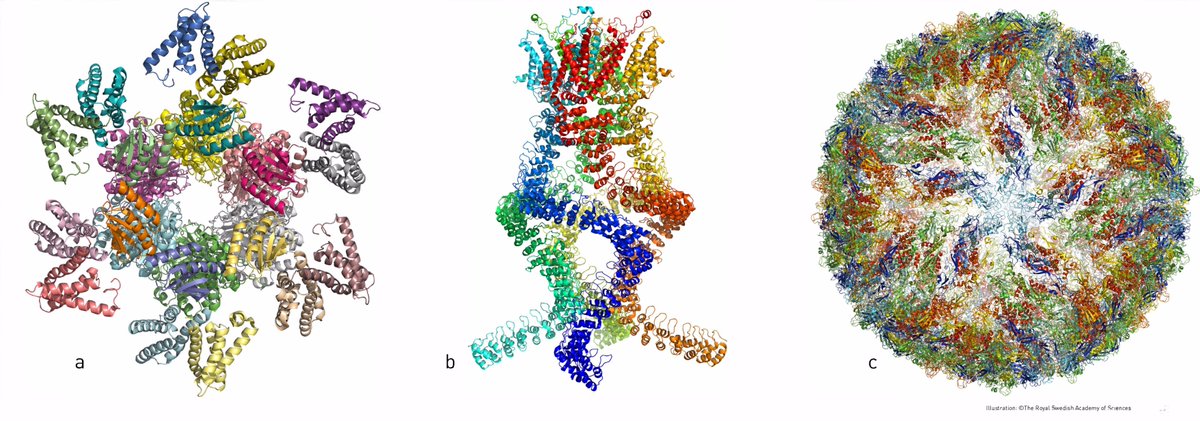
Atomic structures of a) protein complex that governs circadian rhythm b) pressure sensor of the type that allows us to hear c) Zika virus
https://www.nytimes.com/2017/10/04/science/nobel-prize-chemistry.html


 Nobel Prize in Chemistry
 Re: Nobel Prize in Chemistry


