Previous in Forum: Small Synchronous Motors   Next in Forum: Multimeter Question
Close
Close
Close
33 comments
Rate Comments: Nested
Anonymous Poster #1

How Does This Transformer Work?

04/05/2018 1:35 PM

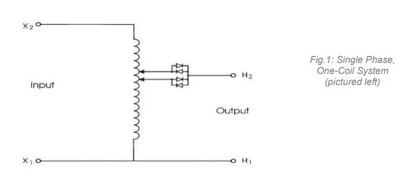
We currently have this variable transformer at our work. It is a 480V to 600 Volts autotransformer. My main question is why they have the X2 lead connected to the highlighted section. We used a Transformer Turns Ratio Test set and the ratio was correct (1.25).

Reply
Interested in this topic? By joining CR4 you can "subscribe" to
this discussion and receive notification when new comments are added.

Good Answers:

These comments received enough positive votes to make them "good answers".

"Almost" Good Answers:

Check out these comments that don't yet have enough votes to be "official" good answers and, if you agree with them, vote them!
Guru
Engineering Fields - Electrical Engineering - Been there, done that. Engineering Fields - Control Engineering - New Member

Join Date: Dec 2008
Location: Long Island NY
Posts: 15602
Good Answers: 982
#1

Re: How does this trasnformer work?

04/05/2018 2:16 PM

Usually a transformer only works when it is connected to an AC voltage source. You don't indicate any voltage source or load connection at all.

Now for how an autotransformer can step up voltage without there being a secondary winding you have to understand Faraday's Law of Induction.

__________________
"Don't disturb my circles." translation of Archimedes last words
Reply Score 1 for Off Topic
Participant

Join Date: Apr 2018
Posts: 4
#2
In reply to #1

Re: How does this trasnformer work?

04/05/2018 2:41 PM

The source side is the 480 volts on X2 and X1. The output is on H2 and H1 with a max voltage of 600 volts. H1 is the movable contact.

Reply
Guru

Join Date: May 2006
Location: Placerville, CA (38° 45N, 120° 47'W)
Posts: 6215
Good Answers: 248
#20
In reply to #2

Re: How does this trasnformer work?

04/08/2018 2:04 PM

NO! X1 and H1 are connected together. It is H2 that can move. Since an autotransformer provides no isolation, X1 and H1 must be the zero voltage reference point for both input and output.

__________________
Teaching is a great experience, but there is no better teacher than experience.
Reply
Guru

Join Date: Apr 2017
Location: Southern Illinois
Posts: 627
Good Answers: 13
#21
In reply to #2

Re: How does this trasnformer work?
04/08/2018 3:26 PM

First, I think I need to correct what I said in an earlier post about any ratio requiring two windings. But, it is true that the only way to get either a step-up 0r down is to use a different number of windings between input and output. The highlighted section shorts out a portion of the windings. That makes X2 and H2 the same electrical point with an internal loop current around that shorted section of windings. That in itself is a problem. Other than that, with that highlighted section there, no matter where the slider is, X1,H1 and X2,H2 will be at the same voltage relative to each other with neither a step up or down. The only way to get a step-up output from this schematic, is if that highlighted section is removed and X1,X2 is the input, and H1,H2 is the output. X2 would be the slider. X1,H1 and H2 would be fixed points. If you switched the input to H1,H2 and the output to X1,X2, then it would be a step-down. If X1,X2 were the inputs (to provide step-up), the closer the X2 slider is moved to X1, the less windings are left to provide inductance, which would eventually be a short. But, if H1,H2 were the inputs for a step-down, the closer the X2 slider is moved to X1, the less windings are left to provide a voltage output. But, as long as that highlighted section is there, any step up or down function is null and void. And that's why this looks more like a potentiometer than anything else.

__________________
Science is the "cookbook" for making things.
Reply
Guru
New Zealand - Member - Kiwi Popular Science - Weaponology - New Member Engineering Fields - Power Engineering - New Member Engineering Fields - Electrical Engineering - New Member

Join Date: Sep 2006
Location: Auckland, New Zealand
Posts: 8777
Good Answers: 376
#3

Re: How Does This Transformer Work?

04/05/2018 3:55 PM

So if H2 is movable across the secondary does the link across the part of the winding X2 to H2 just prevent the transformer from stepping the output voltage above 600V?

One would assume from the drawing this is a voltage limiter feature to prevent the output from being set accidently to a voltage higher than 600V.

__________________
jack of all trades
Reply
Guru

Join Date: Apr 2010
Location: About 4000 miles from the center of the earth (+/-100 mi)
Posts: 9913
Good Answers: 1141
#4

Re: How Does This Transformer Work?

04/05/2018 5:42 PM

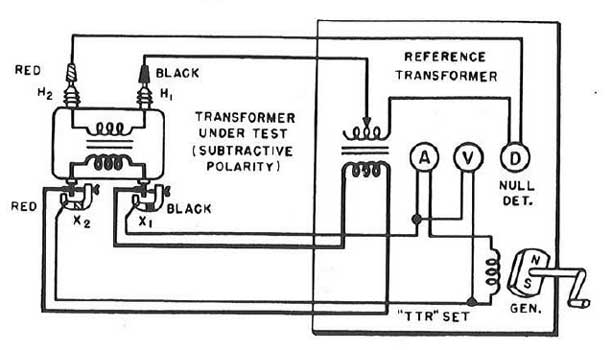
We don't have a schematic of your test set, but usually, a transformer turns ratio test involves energizing one pair of terminals with a low AC voltage and measuring the voltage between other pairs. One way this can be done is shown below, using an adjustable reference transformer in parallel with the transformer under test and adjusting it for a null.

https://testguy.net/content/253-Introduction-to-Transformer-Turns-Ratio-Testing

Back to your question... I don't see how it would be possible to measure a ratio of 1.25 if H2 and X2 are truly connected. When something doesn't add up, you should check again.

If H2 and X2 are connected with an external connection, when you are running the test, there should be current flowing through this connection. You might try to measure it with a clamp-on meter.

We're just guessing here since we don't have a picture of what you are looking at.

Reply
Guru

Join Date: Apr 2010
Location: About 4000 miles from the center of the earth (+/-100 mi)
Posts: 9913
Good Answers: 1141
#5

Re: How Does This Transformer Work?

04/05/2018 7:22 PM

Maybe it's not an autotransformer. If you remove the strap between X2 and H2, do you measure continuity between X2 and H2? If there's no continuity, it's a standard transformer, not an autotransformer. While you have the strap off, also measure for continuity between X1 and H1.

It doesn't seem likely that you would have a short circuit across the windings between X2 and H2, which would normally have 120 VAC across it if it is an autotransformer.

Reply
2
Guru

Join Date: Oct 2006
Location: Surrey BC Canada
Posts: 1571
Good Answers: 42
#6

Re: How Does This Transformer Work?

04/06/2018 12:16 AM

That strap creates a shorted windings - probably drawing error.

Reply Good Answer (Score 2)
Guru
Engineering Fields - Electrical Engineering - Hmmm...

Join Date: Jul 2010
Location: Maryland
Posts: 567
Good Answers: 29
#7
In reply to #6

Re: How Does This Transformer Work?

04/06/2018 8:06 AM

I agree. There should not be a connection shown by the yellow highlighting.

OP, did you actually see a wire connecting those two points or did you measure it with an ohmmeter? If you measured it, it's likely that you measured the winding resistance and not an actual external connection.

Reply
Participant

Join Date: Apr 2018
Posts: 4
#8
In reply to #7

Re: How Does This Transformer Work?

04/06/2018 8:40 AM

We disconnected the lead at both sides and performed a continuity test to ensure this connection existed.

Reply
Guru

Join Date: Apr 2010
Location: About 4000 miles from the center of the earth (+/-100 mi)
Posts: 9913
Good Answers: 1141
#9
In reply to #8

Re: How Does This Transformer Work?

04/06/2018 9:29 AM

Did you check for continuity between X2 and H2 on the transformer with the strap removed to see if there is one winding (autotransformer) or two windings (standard transformer)?

Reply
Participant

Join Date: Apr 2018
Posts: 4
#10
In reply to #9

Re: How Does This Transformer Work?

04/06/2018 9:58 AM

Yes we checked it and its a one winding transformer.

Reply
2
Guru

Join Date: Mar 2011
Location: Sebastopol, California
Posts: 1205
Good Answers: 54
#11
In reply to #7

Re: How Does This Transformer Work?

04/06/2018 10:28 AM

It may not be sensible from an electronics standpoint, but it is sensible from a mechanical one. That "extra" connection sets the maximum output area that the wiper moves over at the end of it's travel, and is the area that will see the greatest wear and the most heat and arcing. The extra lead causes a slight dip and rise across the whole length of that section of the winding and allows the wiper a large area to come to rest on without unduly stressing just one final turn.

It helps increase the lifetime of the setup AND it sets the upper limit of the coil.

Electrically, the upper limit is centered between X2 and H2 and so gives an area of fine adjustment as well. Once the wiper passes X2, the voltage starts to flatten out until the center is reached and then it should dip back to the voltage of X2 again as it reaches H2.

Think of it as a fine adjustment point at the top of the sweep that soft limits to 480V. Take it away and you have a hard limit at 600v.

__________________
Most people are mostly good most of the time.
Reply Good Answer (Score 2)
Participant

Join Date: Apr 2018
Posts: 4
#13
In reply to #6

Re: How Does This Transformer Work?

04/06/2018 10:53 AM

Here is the nameplate of the transformer

here is an image of the transformer itself

Reply
Guru
Engineering Fields - Electrical Engineering - Been there, done that. Engineering Fields - Control Engineering - New Member

Join Date: Dec 2008
Location: Long Island NY
Posts: 15602
Good Answers: 982
#15
In reply to #13

Re: How Does This Transformer Work?

04/06/2018 11:44 AM

There are far too many inconsistencies in this. Your sketch does not include any diodes. The manufacturer's schematic does include diodes and I see them in the picture. The manufacturer's schematic seems to me to be a stepping down auto-transformer with some funky diode tapping of the output circuitry. On second thought I now see that each pair of diodes goes to adjacent sliding taps to assure continuous connection to a winding while sliding the tap. It still looks like a step down instead of a step up. One can certainly feed power in the other direction to step things up but that's not what the diagram states.

__________________
"Don't disturb my circles." translation of Archimedes last words
Reply
Guru

Join Date: Oct 2006
Location: Surrey BC Canada
Posts: 1571
Good Answers: 42
#16
In reply to #13

Re: How Does This Transformer Work?

04/06/2018 12:57 PM

I believe the NP and the connections are not matching up.

There is no way it can work as either you drew it or the NP shows.

NP suggests X1 X2 are the HV taps, and H1 H2 are the low voltage.

The diodes only allow a smooth transition on the sliding taps so internal windings are not shorted as it moves.

Reply
Guru

Join Date: Oct 2006
Location: Surrey BC Canada
Posts: 1571
Good Answers: 42
#17
In reply to #16

Re: How Does This Transformer Work?

04/06/2018 1:14 PM

Google Hypotronics Peschel Transformer:

https://www.hubbell.com/haefelyhipotronics/en/Products/Electrical-Electronic/Test-Equipment/OEM-Equipment-Supplies/Peschel-Variable-Transformers-PVT/p/2133879

Their web site makes the point that NO TURNS ARE SHORTED. They also use copper sliders, not carbon, and explain the use of the diodes to some extent.

NP, terminal markings, and how it is connected are not 100% correct. Do a careful connection check and it should prove this out.

Reply Score 1 for Good Answer
Guru

Join Date: May 2006
Location: Placerville, CA (38° 45N, 120° 47'W)
Posts: 6215
Good Answers: 248
#19
In reply to #17

Re: How Does This Transformer Work?

04/08/2018 1:59 PM

I have to both agree and disagree... I assume that by NP, you mean NamePlate. From your prior post: "NP suggests X1 X2 are the HV taps, and H1 H2 are the low voltage." The drawing would indeed suggest that, but the labels clearly show that the low voltage taps are the X taps, as is standard on all the similar sized transformers I've ever worked on. To be sure, I enhanced that nameplate photo a bit:

That nameplate drawing is definitely misleading! The left side of the drawing is clearly labeled Input and 480 Volts, while the right side of the drawing is clearly labeled Output and 600 Volts. The drawing also shows X1 connected to the very top of the winding. If it were actually connected that way, the maximum output would be 480V minus one diode forward bias.

I believe a more appropriate drawing would be:

In this drawing, the slider (arrows, diodes to H2) can move the full range from bottom to top, so zero to ≈600V. The drawing agrees with

I can't tell whether the X2 in this photo is printed on the transformer, or was added to the photo, as other markings and letters were added, but it is correctly labelled. There are 48 turns of wire above this X2, corresponding to a voltage of 2.5 Volts per turn for 120 Volts above X2.

To bgarrett:

Your added text in this photo:

is clearly wrong! H1 can't move; the label on the right should say "H2's max position", and that loop of wire/buss must connect to H2, not X2. I strongly suspect that that point connects to the top of the slider.

The resistance of the windings of any transformer of this size are always WAY below the capabilities of any standard multimeter, so it will indicate a short between any two terminals, except when one of those terminals is H2, in which case the diodes introduce an error. If this measurement is made while H1 and H2 are connected to their load, you will probably measure a short between them as well.

__________________
Teaching is a great experience, but there is no better teacher than experience.
Reply Score 1 for Good Answer
Guru

Join Date: May 2016
Posts: 1746
Good Answers: 87
#12

Re: How Does This Transformer Work?

04/06/2018 10:43 AM

I believe that the connection is what is referred to as "a magic smoke generator". It is used to let the magic smoke out of the transformer without the delay and inconvenience of waiting for the transformer to fail due to natural causes.

If the jumper from X2 to H2 is a high temperature, high resistance wire, it could alternately be an emergency light source, incandescent fire lighter or a radiant heater.

Reply
Guru

Join Date: Apr 2017
Location: Southern Illinois
Posts: 627
Good Answers: 13
#14

Re: How Does This Transformer Work?

04/06/2018 10:57 AM

This schematic shows only one winding. Therefore, there would be no "ratio" in existence. If there is in fact any ratio at all, that would require two windings. A fault somewhere could make it appear to be one winding when it's not supposed to be. You need to verify that X1,X2 and H1,H2 are in fact on the same winding, or if they are separated on different windings. With all leads/connections disconnected, you could use a "growler on it to check for shorted windings. But, if the primary and secondary are shorted together at only one point, a growler won't detect it. Other than that, this schematic is how a potentiometer is hooked up. But, it's hooked up in series in a single line. That way, either X1 or H1 (or both) would be the input, and either X2 or H2 (or both) would be the output. In other words, this is either the wrong schematic, or this is not an autotransformer.

__________________
Science is the "cookbook" for making things.
Reply
Guru

Join Date: Apr 2010
Location: About 4000 miles from the center of the earth (+/-100 mi)
Posts: 9913
Good Answers: 1141
#18

Re: How Does This Transformer Work?

04/06/2018 3:20 PM

Here is a schematic of a similar transformer:

https://hubbellcdn.com/specsheet/HAEFELY_PVT_DS_SPEC.pdf

H2 connects to adjacent windings (odd & even) through the diodes. Are you sure that the "jumper" is not the connection to the diode assembly, and when you are measuring continuity, you are reading through the windings of the transformer and the diodes, not across a jumper from X2 to H2?

Reply
Guru
Engineering Fields - Power Engineering - New Member

Join Date: May 2007
Location: NYC metropolitan area.
Posts: 3230
Good Answers: 444
#22

Re: How Does This Transformer Work?

04/09/2018 2:22 PM

Unfortunately, the diagrams do not show the intricacies of how the sliding contacts interact with the windings. You'll have to read the patent for the Peschel transformer to understand how it works.

Here's the "secret sauce" that enables 480VAC on the input, become 600VAC on the ouput:

"...said first circuit means including a first plurality of unidirectional conduction members connected in first and second parallel lines between said first brush and said output connection means,

said unidirectional conduction members being reversed in polarity in said first and second lines,

said second circuit means including a second plurality of unidirectional conduction members connected in third and fourth parallel lines between said second brush and said output connection means,

said unidirectional conduction members being reversed in polarity in said third and fourth lines..."(emphasis mine)

The sliding contacts are cleverly arranged to interact with the specialized windings, that's how you get a boost winding that adds to the input voltage.

__________________
“Tell me and I forget. Teach me and I remember. Involve me and I learn.” Ben Franklin.
Reply
Guru
Engineering Fields - Electrical Engineering - Been there, done that. Engineering Fields - Control Engineering - New Member

Join Date: Dec 2008
Location: Long Island NY
Posts: 15602
Good Answers: 982
#23
In reply to #22

Re: How Does This Transformer Work?

04/09/2018 2:33 PM

In fewer words, the diagram does not reflect how the magnetics achieve a step up voltage but it does.

__________________
"Don't disturb my circles." translation of Archimedes last words
Reply
Guru

Join Date: Oct 2006
Location: Surrey BC Canada
Posts: 1571
Good Answers: 42
#24
In reply to #23

Re: How Does This Transformer Work?

04/09/2018 3:20 PM

LOL,

We can keep this thread going forever!

The simpler the problem the more opinions and interpretations.

The amazing thing is the apparent misconceptions of so many over basic physics.

Reply Off Topic (Score 5)
Guru
Engineering Fields - Power Engineering - New Member

Join Date: May 2007
Location: NYC metropolitan area.
Posts: 3230
Good Answers: 444
#25
In reply to #23

Re: How Does This Transformer Work?

04/09/2018 11:02 PM

Agreed, I couldn't figure out how it could output 600V on the highest tap, which the diagram would suggest would connect directly to the 480V input side. That's when I went digging for how it really works.

It's what you learn after you know it all, that really counts!

__________________
“Tell me and I forget. Teach me and I remember. Involve me and I learn.” Ben Franklin.
Reply
Guru

Join Date: Mar 2011
Location: Sebastopol, California
Posts: 1205
Good Answers: 54
#26
In reply to #25

Re: How Does This Transformer Work?

04/10/2018 10:34 AM

If you want to learn more about transformer action, look up magamps.

Old school method of amplified control that is still used today in nuclear power plant cores and fighter jet wings.

https://en.wikipedia.org/wiki/Magnetic_amplifier

__________________
Most people are mostly good most of the time.
Reply
Guru
Engineering Fields - Power Engineering - New Member

Join Date: May 2007
Location: NYC metropolitan area.
Posts: 3230
Good Answers: 444
#27
In reply to #26

Re: How Does This Transformer Work?

04/10/2018 11:09 AM

Except this is not a magamp, there are no DC control windings involved. This clever design was patented in 1998, magamps have been around at least 50 years longer.

__________________
“Tell me and I forget. Teach me and I remember. Involve me and I learn.” Ben Franklin.
Reply
Guru

Join Date: Mar 2011
Location: Sebastopol, California
Posts: 1205
Good Answers: 54
#28
In reply to #27

Re: How Does This Transformer Work?

04/10/2018 11:26 AM

I know that this is not a magamp. I was just suggesting another interesting transformer tech beyond the also very old school autotransformer that this "new' (1998) device is.

__________________
Most people are mostly good most of the time.
Reply
Guru

Join Date: Oct 2006
Location: Surrey BC Canada
Posts: 1571
Good Answers: 42
#29
In reply to #28

Re: How Does This Transformer Work?

04/11/2018 2:18 PM

It is just a variac or variable transformer with some diodes on the contacts so no shorted turns occur. I am amazed it was able to be patented!

Reply Score 1 for Good Answer
Guru

Join Date: Mar 2011
Location: Sebastopol, California
Posts: 1205
Good Answers: 54
#30
In reply to #29

Re: How Does This Transformer Work?

04/11/2018 9:49 PM

Me too. I don't see anything unique really, unless it is the shorted upper turns this whole discussion has been about.

__________________
Most people are mostly good most of the time.
Reply
Guru

Join Date: May 2006
Location: Placerville, CA (38° 45N, 120° 47'W)
Posts: 6215
Good Answers: 248
#32
In reply to #22

Re: How Does This Transformer Work?

04/12/2018 12:21 PM

Thanks for linking the patent. I didn't read every word, but I did study the diagrams sufficiently to pretty fully understand how the brushes work, at least in one configuration. The patent does show several totally different possible configurations; the one that I believe most closely fits the OPs unit is shown in Fig. 19 of the patent:

In this configuration, the special brush arrangement has nothing to do with enabling voltages above the input voltage, but rather enables the elimination of shorting adjacent windings, thereby reducing arcing at the contacts and allowing the use of higher conductivity brushes than the standard carbon brushes. Such brushes allow higher currents and reduce contact heat.

__________________
Teaching is a great experience, but there is no better teacher than experience.
Reply
Guru

Join Date: Oct 2006
Location: Surrey BC Canada
Posts: 1571
Good Answers: 42
#33
In reply to #32

Re: How Does This Transformer Work?

04/12/2018 2:47 PM

That is my take on it also.

Reply
Power-User

Join Date: Dec 2007
Posts: 177
Good Answers: 6
#31

Re: How Does This Transformer Work?

04/12/2018 7:22 AM

bad drawing--you would not want a short from XX2 to H2. X1 & X2 are input, H1 & H2 are output.

Reply Score 1 for Good Answer
Reply to Forum Thread 33 comments

Good Answers:

These comments received enough positive votes to make them "good answers".

"Almost" Good Answers:

Check out these comments that don't yet have enough votes to be "official" good answers and, if you agree with them, vote them!
Copy to Clipboard

Users who posted comments:

bgarrett (4); Deefburger (4); Dennis R. Levesque (2); dkwarner (3); GW (6); jack of all trades (1); Jpfalt (1); Lo_Volt (1); lrsheldon (1); RAMConsult (3); redfred (3); Rixter (4)

Previous in Forum: Small Synchronous Motors   Next in Forum: Multimeter Question

Advertisement