Previous in Forum: Too Many Bells and Whistles   Next in Forum: When Should You Fill Your Gas Tank in the Summertime?
Close
Close
Close
55 comments
Rate Comments: Nested
Power-User
United States - Member - Western Wisconsin

Join Date: Mar 2007
Location: Wisconsin USA
Posts: 305
Good Answers: 25

Internal Combustion vs. Electric Vehicles

04/23/2018 1:40 PM

When reading Autobroker's Post on global warming, I noticed a lot of conversation about electric vehicles and Internal combustion vehicles. I was going to post there but then decided I think the topic deserves it's own thread.

I see a lot of literature and marketing about electric vehicles claiming to be "green", and I hear and read a lot of discussion about them reducing CO2 emissions and pollution.

When everything is taken into account, I don't think EVs (electric vehicles) are any more efficient or produce less emissions than similar ICE (internal combustion engine) vehicles. They just move the emissions to a different location.

With our current infrastructure, we don't have any extra solar or wind capacity, so any extra load would have to be taken up by increasing base load generation. That means coal in this part of the country.

When the losses incurred at all the steps between generation to charging are added up, do EVs really take less fuel or just different fuel at a different location?

I'm not sold on EVs but I am trying to keep an open mind. Does anyone here have a good argument for or against?

__________________
Troy
Register to Reply
Pathfinder Tags: electric vehicles
Interested in this topic? By joining CR4 you can "subscribe" to
this discussion and receive notification when new comments are added.

Good Answers:

These comments received enough positive votes to make them "good answers".

"Almost" Good Answers:

Check out these comments that don't yet have enough votes to be "official" good answers and, if you agree with them, vote them!
Guru
Engineering Fields - Mechanical Engineering - New Member Fans of Old Computers - TRS-80 - New Member Popular Science - Weaponology - New Member Safety - Hazmat - New Member Hobbies - Fishing - Fish On! United States - Member - New Member

Join Date: Apr 2012
Location: Detroit MI, USA
Posts: 2496
Good Answers: 271
#1

Re: Internal Combustion vs. Electric Vehicles

04/23/2018 2:03 PM

I have never given it much thought but after a quick search it seems E.V.'s still emit less green house gases (factoring in the upstream emissions) then an I.C.E. vehicle.

http://www.hybridcars.com/heres-why-electric-cars-are-always-greener-than-gas/

https://content.sierraclub.org/evguide/myths-vs-reality

I am having a hard time finding anything that carries the opposite view.

__________________
How we deal with death is at least as important as how we deal with life. --CAPTAIN KIRK, Star Trek II: The Wrath of Khan
Register to Reply
2
Guru

Join Date: Apr 2010
Location: About 4000 miles from the center of the earth (+/-100 mi)
Posts: 9911
Good Answers: 1141
#2

Re: Internal Combustion vs. Electric Vehicles

04/23/2018 2:06 PM

True, EVs may create pollution, just in someone else's backyard. Your EV is only as green as your electricity supply. In sections of the country where electricity is generated by coal, the EV actually contributes more to CO2 production than a hybrid vehicle.

"... in the Midwest and South, where coal fuels the bulk of electricity generation, a hybrid produces less CO2 than an electric car. In fossil fuel–dependent Minnesota an electric car would actually emit 300 grams per mile of greenhouse gases. As a result, some researchers suggest that a regional approach to clean vehicle standards makes more sense than national standards that effectively require electric cars across the board. Minnesota could go for hybrids and California could go for electric vehicles."

https://www.scientificamerican.com/article/electric-cars-are-not-necessarily-clean/

Register to Reply Good Answer (Score 2)
Guru

Join Date: Oct 2008
Posts: 42355
Good Answers: 1693
#3

Re: Internal Combustion vs. Electric Vehicles

04/23/2018 2:13 PM

"The study found that while the environmental impact of making electric vehicles is greater than for making gas and diesel vehicles, this is more than made up for by the greater impact of gas and diesel vehicles while they’re being used. This is true in terms of total energy consumption, use of resources, greenhouse gases, and ozone pollution. The electric vehicles were assumed to be charged from a grid that includes significant amounts of fossil fuels. (Other studies show that electric vehicles beat gas-powered ones in terms of greenhouse gas emissions even if they’re charged in regions that depend heavily on coal. Here’s one such study. In some areas, hybrids are a better choice than electric cars.)"

Are Electric Vehicles Better for the Environment than Gas-Powered ...

"On average, battery electric vehicles (BEVs) representative of those sold today produce less than half the global warming emissions of comparable gasoline-powered vehicles, even when the higher emissions associated with BEV manufacturing are taken into consideration. Based on modeling of the two most popular BEVs available today and the regions where they are currently being sold, excess manufacturing emissions are offset within 6 to 16 months of driving."

Gasoline vs Electric—Who Wins on Lifetime Global Warming ...

Draw your own conclusions, or completely ignore this.

Battery Electric Vehicles vs. Internal Combustion Engine Vehicles ...

Register to Reply
Power-User
United States - Member - Western Wisconsin

Join Date: Mar 2007
Location: Wisconsin USA
Posts: 305
Good Answers: 25
#5
In reply to #3

Re: Internal Combustion vs. Electric Vehicles

04/23/2018 4:22 PM

Thanks for the links everyone.

The consensus seems to be that EVs are ok on emissions even in the areas that are heavy on coal fired power. They have a long ways to go to be economically viable and have the range needed by someone like me but, it doesn't appear to be as bad as I was imagining.

If EVs are to be the way of the future I think we will need some major upgrades to our electric power infrastructure.

I doubt we will see the demise of the ICE for several generations though. As EVs become more popular and the number of ICE vehicles decline, the demand for gasoline / diesel should decline along with it, thus lowering the price.

__________________
Troy
Register to Reply
Guru

Join Date: Oct 2008
Posts: 42355
Good Answers: 1693
#6
In reply to #5

Re: Internal Combustion vs. Electric Vehicles

04/23/2018 4:38 PM

Yep. Price and range are big hang-ups for lots of people.

Should You Worry About Battery Replacement Costs for Electric Cars ...

Last week, our ever-so-curious friends at GreenCarReports reached out to General Motors to find out just how expensive it would be to replace the lithium-ion battery pack found inside the Chevrolet Bolt EV.

The answer, a total price of $15,734.29, is a fair hunk of cash for anyone, and may lead some to argue that electric car battery packs are just too expensive for electric cars to be consideredas mainstream vehicles.

But, as overwhelming data suggests, battery replacements are still very rare and even when they happen, they’re usually under warranty.

Register to Reply
Guru

Join Date: Jul 2005
Location: Stoke-on-Trent, UK
Posts: 4496
Good Answers: 137
#14
In reply to #5

Re: Internal Combustion vs. Electric Vehicles

04/24/2018 3:54 AM

Nobody has mentioned yet the vehicle emissions other than tailpipe. There's dust from brakes, tyres and road wear, likely to be higher from EVs due to higher weight (OK maybe not brake dust IF the EV has effective regenerative braking).

__________________
Give masochists a fair crack of the whip
Register to Reply
Commentator

Join Date: Dec 2013
Posts: 84
Good Answers: 3
#4

Re: Internal Combustion vs. Electric Vehicles

04/23/2018 3:24 PM

Note as well, that continuous improvements are constantly being made. Battery technology is improving, hybrid drives have made quantum leaps over the past 20 years. As any engineer knows, products improve with incremental development over time.

In 5 years it may take half of the carbon needed today to produce an electric vehicle.

Register to Reply
Guru
Engineering Fields - Instrumentation Engineering - New Member Hobbies - Automotive Performance - New Member Technical Fields - Education - New Member Fans of Old Computers - TRS-80 - New Member Hobbies - Musician - New Member

Join Date: Jan 2008
Location: Tucson, AZ
Posts: 1331
Good Answers: 30
#7

Re: Internal Combustion vs. Electric Vehicles

04/23/2018 7:25 PM

Just 'imagine' the battery-replacement co$t as being a lump-sum payment equivalent of saved gasoline purchases.

__________________
...and the Devil said: "...yes, but it's a DRY heat..!"
Register to Reply
Guru

Join Date: Mar 2012
Location: Out of your mind! Not in sight!
Posts: 4424
Good Answers: 108
#8

Re: Internal Combustion vs. Electric Vehicles

04/23/2018 10:37 PM

I am using a car only for shopping or long distance hauls. Would not mind an electric car for the short distance runs, but long hauls in long distance country, I cannot see this working with an EV.

BTW my daily commuting is already electrical in a train. So maybe you should include in your discussion public transport options.

And while we talk about transport, long hauls over land to move supplies where they are needed and electric on the road do not get along very well.

Trains maybe, not road trucks for long distance.

So you also need to define the use of the vehicle if you want to come up with a proper comparison.

__________________
Common Sense Dictates
Register to Reply
Guru
Engineering Fields - Nuclear Engineering - New Member

Join Date: Sep 2009
Location: Louisville, OH
Posts: 1926
Good Answers: 36
#9

Re: Internal Combustion vs. Electric Vehicles

04/23/2018 11:09 PM

I like that you mentioned that EVs just transfer the pollution to the electric power generating plant. The generating plant is probably better able to handle the pollution, but there are transformer and transmission line losses to move the electricity to the location of the EV.

I don't think the manufacturers of EVs should brag about the large miles per gallon they achieve;after all, that is not the only cost of running the car--ignoring all the other costs like insurance, licensing, etc, etc. they should give the cost per mile driven, since the electric component of the mileage certainly does have a cost.

__________________
Lehman57
Register to Reply
Guru
United Kingdom - Member - Indeterminate Engineering Fields - Control Engineering - New Member

Join Date: Jan 2007
Location: In the bothy, 7 chains down the line from Dodman's Lane level crossing, in the nation formerly known as Great Britain. Kettle's on.
Posts: 32175
Good Answers: 839
#12
In reply to #9

Re: Internal Combustion vs. Electric Vehicles

04/24/2018 2:05 AM

Has the true environmental impact cost ever been taken into account or does the interest in it end at the tailpipe?

__________________
"Did you get my e-mail?" - "The biggest problem in communication is the illusion that it has taken place" - George Bernard Shaw, 1856
Register to Reply
Guru

Join Date: Mar 2007
Location: by the beach in Florida
Posts: 33392
Good Answers: 1817
#10

Re: Internal Combustion vs. Electric Vehicles

04/24/2018 12:00 AM

..."The direct answer to your question is that electric engines can be more than 90% efficient and even up to 98% efficient while combustion engines are 30 to 45% efficient. ... The biggest issue with electrical power vs combustion power or even hydrogen power is the medium that is used to hold energy in the vehicle."...

https://www.quora.com/How-energy-efficient-are-electric-motors-compared-to-combustion-engines

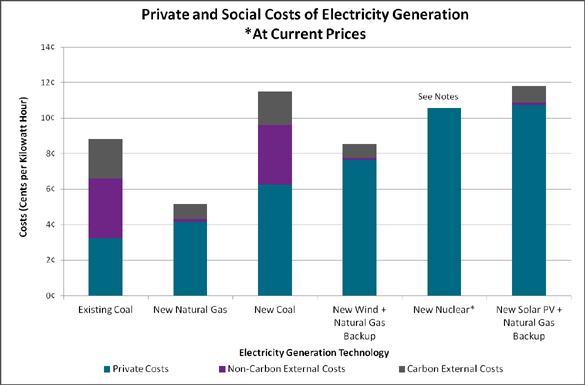
https://www.brookings.edu/testimonies/the-true-costs-of-alternative-energy-sources-are-we-unfairly-penalizing-natural-gas/

1 million btu's = 293 kWh

..."For a 2012 Nissan Leaf, its average rated efficiency of 99 MPGe translates to 34 kilowatt-hours per 100 miles. Just multiply that by your electric cost. So if you pay the U.S. average of 12 cents/kWh, the Leaf will cost you $4.08 to go 100 miles (versus $16 in a 25-mpg car with gas at $4/gallon).Mar 6, 2013"..

https://www.greencarreports.com/news/1082737_electric-car-efficiency-forget-mpge-it-should-be-miles-kwh

__________________
All living things seek to control their own destiny....this is the purpose of life
Register to Reply
Guru

Join Date: Dec 2010
Location: North West England
Posts: 1170
Good Answers: 153
#15
In reply to #10

Re: Internal Combustion vs. Electric Vehicles

04/24/2018 5:00 AM

The manufacturers are a little coy about giving you a battery lifespan and fall back on the "how you drive it, how you charge it" defence. A clearer picture might be seen looking at the warranties offered. The maximum I found after a brief search was 100,000 miles so figuring that the companies never want to fork out for a warranty replacement let us assume that 150,000 miles is a reasonable life expectancy. From an earlier post the replacement cost would appear to be $15,000 or with our assumed lifespan $10/100 mile to add to the $4.08/100 mile. This makes the comparison with the $16/100 mile ICEs much less attractive. When taking into account the additional time required for frequent recharging stops, depending on "how you organise you life around charging your car" and how much you cost your own time at it could be that EVs are more expensive to run.

Register to Reply
Guru

Join Date: Mar 2007
Location: by the beach in Florida
Posts: 33392
Good Answers: 1817
#17
In reply to #15

Re: Internal Combustion vs. Electric Vehicles

04/24/2018 10:13 AM

Well I would say that’s about the same as an engine replacement, so this seems a wash... I would add that people rarely drive more than the distance a full charge would take them, so having the car charge in the garage overnight when a gasoline powered car would just be sitting, seems not to be an issue either...

__________________
All living things seek to control their own destiny....this is the purpose of life
Register to Reply
Power-User

Join Date: Mar 2017
Posts: 191
Good Answers: 9
#47
In reply to #15

Re: Internal Combustion vs. Electric Vehicles

05/01/2018 4:02 PM

Well, here in New Zealand a group of EV owners formed and documented their battery degradation etc (with the odd name flipthefleet.org ). They found that Nissan Leaf annual battery degradation was 2-3% for the 24kWh battery but that the newer 30 kWh batteries were closer to 10%. As I understand it the replacement battery is aroun NZ$6,000. New Zealand does not have any allocation for new Nissan Leafs, they are alll second hand imports from Japan - like us, they drive on the correct side of the road :-).

Register to Reply
Guru

Join Date: May 2016
Posts: 1746
Good Answers: 87
#48
In reply to #47

Re: Internal Combustion vs. Electric Vehicles

05/01/2018 4:08 PM

Don't you mean the other correct side of the road. But then we all drive on the correct side of the road....the top that is.

Register to Reply
Guru

Join Date: Jul 2005
Location: Stoke-on-Trent, UK
Posts: 4496
Good Answers: 137
#16
In reply to #10

Re: Internal Combustion vs. Electric Vehicles

04/24/2018 5:51 AM

Sounds like whoever wrote ..."The direct answer to your question is that electric engines can be more than 90% efficient and even up to 98% efficient while combustion engines are 30 to 45% efficient. ... The biggest issue with electrical power vs combustion power or even hydrogen power is the medium that is used to hold energy in the vehicle."... hasn't heard of the 2nd law of thermodynamics.

The thermal efficiency of a power station is on a par with ICEs.

__________________
Give masochists a fair crack of the whip
Register to Reply
Guru

Join Date: Mar 2007
Location: by the beach in Florida
Posts: 33392
Good Answers: 1817
#28
In reply to #16

Re: Internal Combustion vs. Electric Vehicles

04/24/2018 1:08 PM

The difference is the scale...and the cost of the fuel... 8.3 gallons of gasoline = 1 million btu's

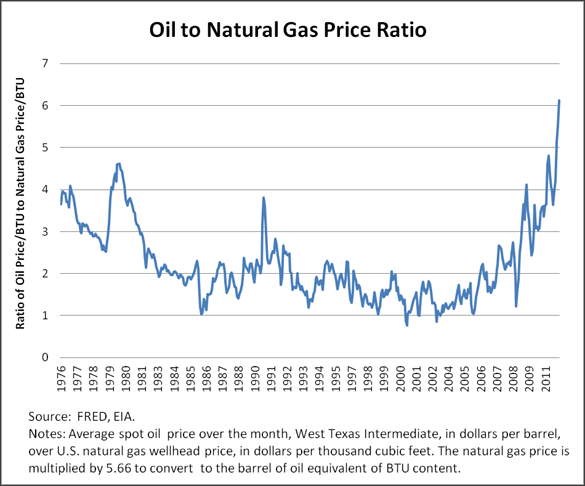
Natural gas is less than $3 per million btu's...If you're paying $3.75 per gallon of gasoline that = $31.13....

__________________
All living things seek to control their own destiny....this is the purpose of life
Register to Reply
Guru

Join Date: Jul 2005
Location: Stoke-on-Trent, UK
Posts: 4496
Good Answers: 137
#34
In reply to #28

Re: Internal Combustion vs. Electric Vehicles

04/25/2018 5:30 AM

Not sure what point you're making. Is $3 per million btu for natural gas the price to power companies or domestic consumers? We pay a lot more in UK, but that doesn't surprise me.

Anyway, all I was saying is you get about the same shaft work per heat input, whether it's an ICE or a power station and electric motor. And that's a mains motor, further losses in a battery-powered vehicle.

__________________
Give masochists a fair crack of the whip
Register to Reply
3
Power-User

Join Date: Mar 2017
Posts: 191
Good Answers: 9
#11

Re: Internal Combustion vs. Electric Vehicles

04/24/2018 12:34 AM

Just imagine your gasoline powered car idling at the lights, the coolant fan cuts in and out as it dumps the waste heat. What is the equivalent electric car doing? Nothing!

(I'm ignoring parasitics here).

Now you drive of down the road, 50kph (30mph). The throttle of your car prevents the engine developing full power so that you maintain your speed. How does it do this?

It creats a blockage in the inlet manifold which reduces the amount of fuel and air ingested. The efficiency of an Otto cycle engine (gas engine) is highly dependent on compression ratio, but the throttle first reduces the pressure before the piston can compress it, making the overall compression ratio low. Thus efficiency of combustion is poor at slow speed. The reason mileage is better at slow speed is that air drag is related to the square of the speed.

At high speed, efficiency of combustion is much better but air drag is a lot higher, so overall mileage reduces.

This is why electric cars are very sensitive to speed, since the eengine efficiency is much less affected by power level.

Now we come to braking, your gas engined vehicle wastes its kinetic energy through the brakes, turning it into heat. Whereas your electric vehicle recovers a large portion of its kinetic ennergy back into the battery. There are recovery losses, but it is much better than throwing that money (kinetic energy costs money) away as heat.

In a sensibly designed power plant (coal) the waste heat would be used for heating houses, hot water or industrial processes. It should be considered criminal to not utilise the waste heat of a power station, or any thermal power station for that matter.

Register to Reply Good Answer (Score 3)
Power-User
United States - Member - Western Wisconsin

Join Date: Mar 2007
Location: Wisconsin USA
Posts: 305
Good Answers: 25
#20
In reply to #11

Re: Internal Combustion vs. Electric Vehicles
04/24/2018 10:34 AM

"In a sensibly designed power plant (coal) the waste heat would be used for heating houses, hot water or industrial processes. It should be considered criminal to not utilize the waste heat of a power station, or any thermal power station for that matter."

From what I have seen around here, most of the power plants are built quite a distance from houses or other industries. They are almost always around a river or large body of water for a cooling source or have massive cooling towers.

Does anyone here know of any coal fired plants that utilize waste heat? A quick search of the internet turns up a lot of theoretical stuff but I don't find much on any waste heat recovery methods that have actually been implemented.

Edit: I meant to mark this off topic as it doesn't really relate to the original topic but, I don't think there is an option to do that after it has been posted.

__________________
Troy
Register to Reply
Power-User

Join Date: May 2017
Location: Houston the Emerald City that would be Oz, TX serving art collectors and patrons worldwide
Posts: 224
Good Answers: 8
#22
In reply to #20

Re: Internal Combustion vs. Electric Vehicles
04/24/2018 11:54 AM

The term is co-generation. It is quite common in the Houston Ship Channel Refinery and Petrochemical Complex (of +/-50 of said businesses). The key thing is the fuel which is natural gas augmented by tailend "squeak-of-the-pig" process leftovers.

About coal co-generation: There are two sites in Texas where there might be potential, One is a electrolytic aluminum smelter and the other is an electrolytic scrap steel remelt smelter. Coal power plants next to them provide the E-power, BUT both plants are in the rural middle-of-nowhere.

__________________
To get anywhere fast the first thing you do is go off in the wrong direction.
Register to Reply
Guru
Engineering Fields - Power Engineering - New Member

Join Date: May 2007
Location: NYC metropolitan area.
Posts: 3230
Good Answers: 444
#37
In reply to #20

Re: Internal Combustion vs. Electric Vehicles

04/25/2018 2:14 PM

In addition to cogeneration which is usually used for industrial purposes, there's also district heating that has been around for nearly a century. It is found in high density urban areas where generating stations located closed to the city's load centers, provide steam and/or hot water for building heating and cooling (via absorption refrigeration). The customers pay for it on a metered BTU basis, and it saves them from installing, maintaining, and fueling their own boiler systems.

The latest spin is called CHP (Combined Heat & Power) and which utilizes the waste heat from local generation/processes to increase the overall cycle efficiency.

__________________
“Tell me and I forget. Teach me and I remember. Involve me and I learn.” Ben Franklin.
Register to Reply
Guru

Join Date: Jul 2005
Location: Stoke-on-Trent, UK
Posts: 4496
Good Answers: 137
#35
In reply to #11

Re: Internal Combustion vs. Electric Vehicles

04/25/2018 5:42 AM

I've never heard of the idea that gasoline engine efficiency is reduced at part load, due to inlet throttling (not that that disproves it!). Power output, yes, that's the intention. In any case, compression ratio, final volume/initial volume, doesn't change, only final pressure.

Diesels don't throttle the air intake, just vary the fuel injected. I know diesels are more efficient than gasoline (though I believe gasoline efficiency is improving) but I thought that was due to higher compression ratio, not the absence of throttling.

__________________
Give masochists a fair crack of the whip
Register to Reply
Power-User

Join Date: Mar 2017
Posts: 191
Good Answers: 9
#40
In reply to #35

Re: Internal Combustion vs. Electric Vehicles

04/25/2018 9:11 PM

Diesels are more efficient than Otto cycle engines for the simple reason that they operate at high compression all the time. In fact, the diesel cycle itself is less efficient than the Otto cycle in theory but the real world soon sorts that out.

Adding a turbocharger boosts the diesel efficiency by improving the effective expansion ratio of the gases passing through the engine and the same works for the Otto cycle engine, but as soon as you get away from full power the problems start for the Otto cycle engine and this is why turbo gas engines have miserable around town fuel economy. This is for the same reason as for the non-turbo engines, but made much worse because the compression ratio for a turbo gas engine has to be reduced to ensure the maximum power compression pressure is not exceeded, which would give pre-ignition. This is not a problem for diesel engines since their fuel is not mixed with the air, pre-ignition does not happen.

Register to Reply
Guru
United Kingdom - Member - Indeterminate Engineering Fields - Control Engineering - New Member

Join Date: Jan 2007
Location: In the bothy, 7 chains down the line from Dodman's Lane level crossing, in the nation formerly known as Great Britain. Kettle's on.
Posts: 32175
Good Answers: 839
#13

Re: Internal Combustion vs. Electric Vehicles

04/24/2018 2:08 AM

<...don't have any extra solar or wind capacity...> There's the opportunity - income-based activities rather than spending [<...coal...>] from the savings account.

__________________
"Did you get my e-mail?" - "The biggest problem in communication is the illusion that it has taken place" - George Bernard Shaw, 1856
Register to Reply
Guru

Join Date: Apr 2017
Location: Southern Illinois
Posts: 627
Good Answers: 13
#18

Re: Internal Combustion vs. Electric Vehicles

04/24/2018 10:15 AM

How a vehicle is used varies widely among so many people. Not everyone uses them every day or for long trips. Gasoline does not have a very long shelf-life. Gas can go bad and carbs can get gummed up. EVs don't have that problem. Other than that, I do wonder how an EV will heat the cabin in winter. You might have to have a separate internal combustion heater just for that. And while you're at it, you might want to include an emergency generator just for when you're stuck out in the boondocks somewhere. Stuff happens. The main thing I want to say, is that neither EVs nor ICVs will be ideal for every situation. Some kind of hybrid would be better. But, it could lean more to either the EV side Or the ICV side, depending on the situation. I don't think anyone would like to settle for a poor fit/function.

__________________
Science is the "cookbook" for making things.
Register to Reply
Power-User

Join Date: May 2017
Location: Houston the Emerald City that would be Oz, TX serving art collectors and patrons worldwide
Posts: 224
Good Answers: 8
#19

Re: Internal Combustion vs. Electric Vehicles

04/24/2018 10:18 AM

After following the ICE v EV discussion / debate / contention over economic and environmental price for at least five years I have come to the conclusion it's a zero sum answer. I also see with the increase of solar and wind generation replacing coal a future probability of a slight edge to EV. But like everything else there is a time and place for EV. Dense population centers and short regional travel highly favors EV; yes this includes heavy transport. Here in Texas not so much. The City State of Metropolitan Houston easily covers 10,000 square miles, The Dallas-Fort Worth MetroPlex 15,000, and upwards to 50,000 people regularly commute on a daily basis the 250mi x 250mi x 200mi Dallas-Houston-San Antonio triangle (for all yu'al geographically challenged Austin is on the SA-DFW leg).

__________________
To get anywhere fast the first thing you do is go off in the wrong direction.
Register to Reply
Guru

Join Date: May 2016
Posts: 1746
Good Answers: 87
#21

Re: Internal Combustion vs. Electric Vehicles

04/24/2018 11:51 AM

I haven't seen mention of disposal costs. This would end up being much higher for an EV as an EV contains a lot of hazardous material and a green recycling/recovery system isn't in place. With China rejecting recycle materials, this is unlikely to become more readily available.

From an energy density standpoint, we will need one or two more iterations of battery design as the gasoline or diesel ICE still has a huge energy density advantage.

I suspect in the end, another technology will step in. Hydrogen storage fueling ICE or fuel cell is a strong possible. Biofuel is also a contender as it eliminates the fossil carbon footprint and maintains the energy density advantage and the vehicle is readily recyclable.

Register to Reply
Guru

Join Date: May 2016
Posts: 1746
Good Answers: 87
#24
In reply to #23

Re: Internal Combustion vs. Electric Vehicles

04/24/2018 12:30 PM

Unfortunately, the references refer to future opportunities for recycling (not actually in place yet), perform questionable rebuilding/repurposing or offer to provide a quotation for you to pay to get your battery recycled (hazardous waste disposal). I don't see these as high volume solutions yet if other alternatives exist. Until recently, the answer was to send it to China and let them handle the environmental carnage. That option is closing. It will be interesting to see where these devices eventually go.

Like the poop train or spent nuclear fuel, I expect the problem doesn't have a destination yet.

Register to Reply
Guru

Join Date: Oct 2008
Posts: 42355
Good Answers: 1693
#25
In reply to #24

Re: Internal Combustion vs. Electric Vehicles

04/24/2018 12:42 PM

I give up!

First this comment #3 was voted OT for only reasons the anonymous voter may know, and now I'm chided because recycling facilities, not presently needed, but planned for the time the need arises are not on-line and sitting idle, waiting for the time they will be needed?

Register to Reply
Guru

Join Date: May 2016
Posts: 1746
Good Answers: 87
#26
In reply to #25

Re: Internal Combustion vs. Electric Vehicles

04/24/2018 12:47 PM

Don't give up, build a recycling facility.

The hitch will be getting permission to do it.

Register to Reply
Guru

Join Date: Apr 2017
Location: Southern Illinois
Posts: 627
Good Answers: 13
#27
In reply to #25

Re: Internal Combustion vs. Electric Vehicles

04/24/2018 12:54 PM

The old Catch-22. Nobody does it because nobody is using it, and nobody is using it because nobody does it.

__________________
Science is the "cookbook" for making things.
Register to Reply Score 1 for Good Answer
Guru

Join Date: May 2016
Posts: 1746
Good Answers: 87
#29
In reply to #25

Re: Internal Combustion vs. Electric Vehicles

04/24/2018 2:09 PM

I was going to bring #3 back to neutral, but saw someone beat me to it.

You make good points, but the question is where you draw in the boundary conditions. By second law, you always lose as entropy always increases. Victory is in defining the limits of the model.

Register to Reply
Guru
Engineering Fields - Nuclear Engineering - New Member

Join Date: Sep 2009
Location: Louisville, OH
Posts: 1926
Good Answers: 36
#30
In reply to #24

Re: Internal Combustion vs. Electric Vehicles

04/24/2018 6:53 PM

Please don't include spent nuclear fuel. This would be true of the presently used thermal reactors (water cooled, pressurized water, etc), but it is not true of the fast neutron reactors which are forthcoming. They can utilize as fuel what is considered waste from a thermal reactor. The fast reactor is much much more efficient, using about 99% of the fuel instead of 1% or so. There is waste left of course but perhaps 100 times less in volume and radioactivity that decays in hundreds of years instead of several hundred thousand.

__________________
Lehman57
Register to Reply
Guru

Join Date: May 2016
Posts: 1746
Good Answers: 87
#31
In reply to #30

Re: Internal Combustion vs. Electric Vehicles

04/24/2018 7:36 PM

I've always maintained that there was no greater waste than the failure to reprocess and reuse spent nuclear fuel. Carter imposed the recycling ban to support a fast breeder reactor program that never materialized and Regan reversed the ban in 1989, but no reprocessing of commercial fuel initiated (not in my back yard). Every bit of it should have been reprocessed for reactor fuel and the waste products of commercial value should have been put to use. They still could be except that no one has seriously set out to do it. Then the waste repository issue goes away and the volume of spent fuel in the country also goes away.

In 1994, I worked at a reactor plant that produced 1100MW at a cost of 2.8 to 3.2 cents per KWH depending on the quarter and the refueling schedule. We closed because the plant had Westinghouse type F steam generators that were prone to crevice corrosion on the steam side. Enough steam generator tubes had been plugged that the plant needed derating or steam generator replacement. Management knew about it and failed to plan for steam generator replacement. When the time came, the ready cash had been pocketed and the golden parachutes deployed. Half a billion dollars had been diverted into "other investments" and lost. Had management planned properly, the plant would still be running on it's first license renewal. They still have a building full of dry casks that aren't going anywhere.

I question whether fast fission spent fuel is any less radioactive or long lived than thermal reactor spent fuel. It wasn't in 1981 and was remarkably similar in isotopic analysis. However, if it is reprocessed and reburned, it is still not the issue we have at present with inventories of spent fuel in dry casks and spent fuel pools.

Register to Reply
Guru
Engineering Fields - Nuclear Engineering - New Member

Join Date: Sep 2009
Location: Louisville, OH
Posts: 1926
Good Answers: 36
#32
In reply to #31

Re: Internal Combustion vs. Electric Vehicles

04/24/2018 9:31 PM

We would have to reprocess the inventories of spent thermal fuel to make it into fuel usable in whatever fast reactor design would be in use. It becomes less radioactive because the long-lived and highly radioactive transuranic actinides are consumed in producing energy. Fast reactors can also utilize depleted uranium and thorium. You probably know that President Clinton shut down the research in 1994 or we might have fast reactors by now. Argonne National Lab was about ready for a demonstration Plant I believe, when research was stopped for political reasons.

__________________
Lehman57
Register to Reply
Guru

Join Date: May 2016
Posts: 1746
Good Answers: 87
#41
In reply to #32

Re: Internal Combustion vs. Electric Vehicles

04/26/2018 12:32 PM

Regardless of the intended use, the fuel requires reprocessing. Typically thermal spent fuel began life enriched to about 5% U235 and 95% U238. Typical burn is to 2% U235, 94% U238 and 4% waste product of which a significant bit is Pu239.

Of the waste products Sr90 is the largest long lived product of commercial value.

The 94% U238, 2% U235 and the Pu239 can go directly back into new fuel with added U235 to bring it back up to an initial fuel load for a thermal reactor.

The Sr90 makes a very nice thermal pile battery with about a 90 year useful life and can be handled the same way we use Co60 radiation sources for industrial radiography.

All we need to do is to do it. The added benefit is that the inventory of spent fuel is large enough that we don't have to do any mining to gather the raw material.

Register to Reply Score 1 for Good Answer
Guru

Join Date: Apr 2008
Location: Chicago
Posts: 3990
Good Answers: 144
#33

Re: Internal Combustion vs. Electric Vehicles

04/24/2018 11:14 PM

Years ago I asked a question to this forum about a suggestion for a low cost reliable cars for a friend.

Based on the response a '96 toyota tercel was purchased.

My "friend" still owns the little green 2 door.. not much to look at and not particularly fun to drive, but to this day it runs like a top.

I've replaced a few feet of rusted brake line and a couple sets of brakes over the years, but those are sub $50 repairs. It runs on the fumes of the car in front of it and can go a month between fill ups.

Not bad for a car that was purchased for under $2500

I kind of doubt any EV can match the value of a used mid 90's toyota.

As a person who has purchased new cars and trucks from US manufacturers (and paid the price in post warranty/ extended warranty repairs) ..it's kind of an eye opener. .. it's ruined my appreciation for the latest and "greatest" model.

Thanks to the forum for the great advice!

__________________
High Tolerance is Beautiful
Register to Reply
Participant

Join Date: Apr 2018
Posts: 1
#36

Re: Internal Combustion vs. Electric Vehicles

04/25/2018 10:31 AM

Actually EV's use more fuel on a per energy basis. The well to wheel efficiency for ICE vehicles varies around 10%, whereas for EV's is around 5%. The "GHG reduction" appeal comes from multiple things. Based on many government mandates around the world, a significant portion of energy is to be renewable by 2050 (in select countries of course). This would mean there would be 0 emissions coming from EV's. In that sense the EV's "green" factor is calculated completely based on the grid emission factor of the energy supply.

Additionally, with the increasing availability of CO2 capture technologies, much of the CO2 emissions which come from coal/natural gas plants can be/or is expected to be processed and thus this would make EV's much more green overall than ICE's.

You are correct though; currently in many states EV's will not be more green than ICE's. It will not be until politicians start investing in renewable/carbon capture technologies that EV's will become a green vehicle.

Register to Reply
Guru

Join Date: Oct 2008
Posts: 42355
Good Answers: 1693
#39
In reply to #36

Re: Internal Combustion vs. Electric Vehicles

04/25/2018 4:43 PM

Hi, and welcome.

Do you have any studies, data, empirical evidence to support your claims?

Register to Reply
Guru

Join Date: Jul 2012
Location: Madison, WI.
Posts: 2074
Good Answers: 77
#38

Re: Internal Combustion vs. Electric Vehicles

04/25/2018 4:39 PM

Study after study shows that BEV is the better, less polluting option. The question though, is moot. Once the EU and China set dates for the end of ICE vehicles, that pretty much was the nail that sealed the coffin. Everyone in the world except Elon Musk is now playing catch up. Now granted, America is owned by oil companies and so we will fail to lead yet again. Embarrassing as it might be, we will be the last bastion of fossil fuel power even as one of our own shows the world that EV’s are the future.

__________________
Knowing is the end result of learning, not believing.
Register to Reply
The Engineer
Engineering Fields - Engineering Physics - Physics... United States - Member - NY Popular Science - Genetics - Organic Chemistry... Popular Science - Cosmology - New Member Ingeniería en Español - Nuevo Miembro - New Member

Join Date: Feb 2005
Location: Albany, New York
Posts: 5060
Good Answers: 129
#42

Re: Internal Combustion vs. Electric Vehicles

04/26/2018 1:49 PM

When I think about the carbon impact of cars, I think about conditions in the future, not necessarily as they are today. There seems to be a trend towards renewable energy around the world. Solar growth has been very strong as has wind energy. If these trends continue, then electric cars will become increasingly smaller carbon dioxide polluters as compared to internal combustion engines.

That said, if electric cars truly do start to replace internal combustion engines in any meaningful way, we will have to consider the pollution produced by all of those batteries. This is a significant issue that probably will need to be addressed through recycling efforts.

Register to Reply
Guru

Join Date: Apr 2008
Location: Chicago
Posts: 3990
Good Answers: 144
#43
In reply to #42

Re: Internal Combustion vs. Electric Vehicles

04/26/2018 4:31 PM

not that there's a solution here, but .. it's all very fascinating.

I'm secretly impressed that this works at all with such a small surface area.

The best thing here is the kitchen countertop assembly and so on..

...What I'm hoping is that the batteries also green up.. There's so much development, but little commercial success.

(I skipped through)

__________________
High Tolerance is Beautiful
Register to Reply
Guru

Join Date: Jul 2012
Location: Madison, WI.
Posts: 2074
Good Answers: 77
#44
In reply to #42

Re: Internal Combustion vs. Electric Vehicles

04/26/2018 6:06 PM

Well the idea was good. We'll give these big corporations tax breaks and subsidies so they can invest in R&D. What we didn't realize (but we should have really) was they would spend it on personal wealth increases and not on R&D and things like green energy or batteries or new technology, etc.etc.

Could GM or Toyota have done a better job than Tesla?

Probably since they had already made the move back in the last century.

But then something happened and suddenly the EV1 and the ERAV both disappeared.

So I am betting on Tesla since it seems they are not as easily swayed as GM and Toyo were.

__________________
Knowing is the end result of learning, not believing.
Register to Reply
Guru

Join Date: Mar 2007
Location: by the beach in Florida
Posts: 33392
Good Answers: 1817
#45

Re: Internal Combustion vs. Electric Vehicles

04/30/2018 3:59 PM

Well there is another aspect here that hasn't been addressed at all, and that's energy security, and energy independence....as long as the US is dependent on foreign sources for oil, we are vulnerable to disruption due to political pressures that would use oil as a weapon, an economic weapon...anybody remember the gas shortages?...well I do, and is was and is still a threat...EV's help to reduce the demand for oil thus bringing us closer to energy independence....Another issue we have not addressed here is the cost of pollution in cities which is responsible for respiratory diseases, this drives up medical costs and contributes to lower quality of life issues....You can't have this discussion and ignore the associated problems ....

__________________
All living things seek to control their own destiny....this is the purpose of life
Register to Reply Score 1 for Good Answer
Guru
Engineering Fields - Nuclear Engineering - New Member

Join Date: Sep 2009
Location: Louisville, OH
Posts: 1926
Good Answers: 36
#46
In reply to #45

Re: Internal Combustion vs. Electric Vehicles

05/01/2018 10:36 AM

These are all reasons for transitioning to nuclear power. And if that is fast nuclear, there is enough uranium and thorium on hand that we won't even have to mine any more for a long time. Plus they can utilize, with reprocessing, all that waste from the currently used thermal reactors thus tremendously reducing the storage problems.

__________________
Lehman57
Register to Reply Score 1 for Good Answer
Guru

Join Date: Sep 2007
Location: East Texas
Posts: 1439
Good Answers: 31
#50
In reply to #46

Re: Internal Combustion vs. Electric Vehicles

12/08/2018 7:51 PM

Is the volume of "waste" reduced during reprocessing? Doesn't the chemical reduction and seperation of the spent fuel generate more "waste?"
Can you share with us what the numbers might look like in terms of volume and mass of the waste generated during reprocessing?

__________________
"The greater danger for most of us lies not in setting our aim too high and falling short; but in setting our aim too low, and achieving our mark." -- Michelangelo
Register to Reply
Active Contributor

Join Date: Mar 2011
Location: England
Posts: 19
Good Answers: 3
#49

Re: Internal Combustion vs. Electric Vehicles

05/14/2018 4:32 AM

Don't get me wrong, I am all for reducing the worlds emmisions to make for a greener, less toxic planet, but, the current EV technology is, in my opinion, flawed.

I agree with some previous comments, the power has to come from somewhere and if it's from a coal fired power station, is that really and better for the environment?

Please also consider the pollution and toxic waste generated from the production and mining of materials to produce the batteries.

This article supports my view https://www.theguardian.com/sustainable-business/2017/aug/24/nickel-mining-hidden-environmental-cost-electric-cars-batteries

So all in all are EV's any more environmentally friendly than the newer range of lower emission more fuel efficient combustion engined cars?

Steve

Register to Reply
Guru

Join Date: Sep 2007
Location: East Texas
Posts: 1439
Good Answers: 31
#51

Re: Internal Combustion vs. Electric Vehicles

12/08/2018 8:11 PM

If the ICE of a hybrid vehicle could be made to operate at a near constant output during the entire transportation cycle how would this affect the overall efficiency of the process? Would it favor some types of ICEs over others?

When we look at regenerative braking isn't the ROI a function of prime mover efficiency? Where energy saved in primary energy source production approximates the energy regenerated / efficiency fraction of the prime mover?

Looking at a throughput efficiency of 25% (efficiency fraction .25) and excluding regenerated energy does it not take 4 units of input energy to perform one unit of work? Does it not follow that regenerating one unit of kinetic or gravitational energy would save the expense of 4 units of input energy? I do not believe this to be over unity; but simply the relationship of prime mover efficiency to regenerative braking.

__________________
"The greater danger for most of us lies not in setting our aim too high and falling short; but in setting our aim too low, and achieving our mark." -- Michelangelo
Register to Reply
Guru

Join Date: Jul 2012
Location: Madison, WI.
Posts: 2074
Good Answers: 77
#52

Re: Internal Combustion vs. Electric Vehicles

12/10/2018 12:46 PM

I think a good way to go is with straight comparison. You have to compare like to like. So start with things that cancel out.

Tires, since all cars have them tires and their associated costs, financial and environmental are a non issue.

Brakes, If you use the regen braking feature you will not be changing your brakes very often. There are several 2012 model S owners still running original pads. So obviously brakes are more of a cost for an ICE vehicle. So that one lines up as a plus for EV since the fewer changes the less impact, financially, environmentally and health.

Now lets talk about the drive system. When you consider the cost of all that goes into the modern powerplant of an ICE vehicle you see a huge loss for that mode of transport. Everything from belts and bolts to how many different kinds of oils and fluids. All the pieces that have to be made all the hoses of all sizes and shapes, and an electrical system from hell. The cost of ICE goes up really fast. Especially the environmental since most of these items are dirty processes in manufacture and of course all use energy in production. Hybrids are even worse having two separate drive trains to build and maintain. Then there's the maintenance and upkeep. Lots.

The properly built EV has an electric motor. A reduction gear box. (no transmission like the Bolt has) the drive shafts are the same for either so again, cancels out. The production of electric motors is far less energy intensive or chemically damaging environmentally. Not saying there isn't waste produced, but far less of it per unit just in the drive train production alone. Then there's the maintenance and upkeep. None.

Production of the actual car. Now this one is going to be interesting. We can draw a possible conclusion from the legacy ICE manufacturers since other than Jag, all other legacy manufacturers have pulled back from releasing their EV's for at least another year or two. Given the ramp issues Tesla had I am going to assume that building an electric car is a far different proposition than building an ICE vehicle.

Is the cost of production of the chassis cheaper or more expensive? Less parts tends to mean less cost. But that I would love to see the numbers crunched on chassis and body costs. AS for environmental impact, all cars are built out of the same stuff so that one is a wash as well for the time being unless a substantial reduction in materials used is realized by EV's.

Fuel. Now there is a lot of arguing over this one. Mostly from people not fully aware of what they are talking about. Production of both battery and Gasoline are dangerous processes. Both generate pollution. The extraction of raw materials for either is likewise damaging to the environment. The only thing that puts battery ahead of Oil is its recyclable and sustainable and lets face it, we have yet to take recycling seriously as a planet so this one will get better in favor of battery obviously.

So lets Hypothetically assume that the cost to make batteries is equal to the cost to make gasoline.

I can't recycle gasoline. Once used it pollutes the environment again, over and above the pollution created in its manufacture.

However, electricity produces no point of use pollution. The battery is recycled. Recycling uses less energy and resources than gross production. Electricity can be produced without burning fossil fuels. (FYI, I have the option to use wind power in my Tesla and I do, my coworker who also has a Model 3 uses solar and a powerwall) All Madison Gas and Electric charging stations through the ChargePoint network are fed from Wind farms. As are all Tesla Superchargers in Madison.

I think you can see the general tack I'm taking here. A vinyl seat is a vinyl seat. a carpet is a carpet, Glass is glass. Paint is paint. The question of which is better is not really a question at all when looked at from the worlds future perspective. The problem is, we are looking at things presented to us by those with a vested interest in maintaining the status quo. Much like all the non stop Tesla this, Tesla that, which magically disappeared after the third quarter earnings call. Why? because all of that noise was being produced by shortsellers trying to not lose their shirts.

Most of the resistance comes from those who do not wish to change which is why the arguments become irrational very quickly. Fear. Unleashed, the dogs of wars!

__________________
Knowing is the end result of learning, not believing.
Register to Reply
Guru
Hobbies - DIY Welding - New Member

Join Date: Apr 2008
Location: Bristol, Tennessee
Posts: 1177
Good Answers: 58
#53

Re: Internal Combustion vs. Electric Vehicles

12/17/2018 7:14 PM

Hoping for guidance, I'm posting here. I want to build a home-made hybrid pickup. I plan to purchase an older small pickup and hybridize it.

I think drive-shaft motors are available, and am hoping solar cells will get cheaper.

Flexible solar film on hood, cab, and a 'topper' would charge golf cart batteries mounted to the chassis and out of the way places.

The alternator would be as large as possible, and a second one in place of the air conditioner compressor all help to charge batteries.

The motor serves as backup, and is also charging the batteries.

I hope to keep costs down to acceptable levels, to make the project attractive to other hybrid fans. A do-it-yourself plan and kit for others, maybe even a hybrid club, might turn this idea into a fad.

I think the average mechanic with welding skills can do this project.

__________________
mike k
Register to Reply
Guru

Join Date: Sep 2007
Location: East Texas
Posts: 1439
Good Answers: 31
#54
In reply to #53

Re: Internal Combustion vs. Electric Vehicles

12/20/2018 7:48 PM

There is not enough collecting area on a small pickup to power it with solar panels unless you would charge it for days for a few minutes of operation.
Do a quick conversion from HP to Watts and you will find 25 hp is approx equal to 18,642 watts. The collecting area required is far in excess of what is available on a small pickup.
Perhaps look at a Harley Davidson engine coupled to a power and rpm matched alternator feeding a Maxwell Super-cap package. By averaging the power input over the entire transportation cycle the prime mover can operate at near constant output. Required storage for super high performance would require an energy capacity of about 4 times the kinetic energy at maximum sustained speed. A super high efficiency model would require a storage capacity slightly greater than the kinetic energy at maximum sustained speed. The energy storage requirements for such a hybrid system would be some small fraction of that required for an all-electric vehicle.
A quick freshman physics review of the relationships between Energy, Time, Power, and Gravitational Potential may also be helpful. A quick study of aerodynamic drag may also be helpful.
Solar power rocks; but the energy density is very low. It requires a large collecting area to support energy intensive processes.

Here is a link that MAY help you to understand some fundamental principles regarding hybrid vehicles.

http://www.bestsyndication.com/Articles/2006/c/carter_mark/031206_hybrid_cars.htm

__________________
"The greater danger for most of us lies not in setting our aim too high and falling short; but in setting our aim too low, and achieving our mark." -- Michelangelo
Register to Reply Score 1 for Good Answer
Guru
Hobbies - DIY Welding - New Member

Join Date: Apr 2008
Location: Bristol, Tennessee
Posts: 1177
Good Answers: 58
#55
In reply to #54

Re: Internal Combustion vs. Electric Vehicles

12/21/2018 2:49 PM

Thanks, Gavilan, for the good post. I was involved with Villanova's solar racer and solar commuter car, a VW, I believe. It's been a long time since that job. Both cars had solar panels everywhere, and very good battery systems. That is what has inspired me to try to build another solar commuter.

I didn't mention plug-in charging, or regenerative braking, which I find is not all that efficient, but I'm willing to try anything for a few more miles of range.

I'm not looking for a long-distance car. I only drive a little. For folks like me who don't need long distance travel, a car sitting all day can gather a lot of sunshine. Having a vehicle like this would be something to be proud of.

If I could find a small diesel pickup I could by-pass the gas station all-together! For sure I would paint the vehicle green.

__________________
mike k
Register to Reply
Register to Reply 55 comments

Good Answers:

These comments received enough positive votes to make them "good answers".

"Almost" Good Answers:

Check out these comments that don't yet have enough votes to be "official" good answers and, if you agree with them, vote them!
Copy to Clipboard

Users who posted comments:

70AARCuda (1); Bayes (1); Codemaster (4); Dennis R. Levesque (2); Gavilan (3); GJM (3); IdeaSmith (1); JE in Chicago (2); jhhassociates (1); Jpfalt (7); JPool (1); Lehman57 (4); lyn (5); mike k (2); NEL (1); PWSlack (2); RAMConsult (1); rashavarek (3); Rixter (1); SolarEagle (4); Stephen Archer (2); stevewicks (1); Troy36 (2); willieb3 (1)

Previous in Forum: Too Many Bells and Whistles   Next in Forum: When Should You Fill Your Gas Tank in the Summertime?

Advertisement