Previous in Forum: Software Useful for PCB Design   Next in Forum: Two Different Transformers (Step Down and Step Up) in Series!
Close
Close
Close
36 comments
Rate Comments: Nested
Guru

Join Date: Oct 2006
Location: 44.56024"N 15.307971E
Posts: 8277
Good Answers: 270

Charging in Parallel Discharging in Series

05/04/2018 8:51 AM

Does anyone have a method of charging 6 (or more) lead acid batteries in parallel,and discharging them in series?

The problem comes to mind with golf cart batteries,which are charged and discharged in series.

It is difficult to charge all batteries equally in series,and would be much easier in parallel,but the higher voltage is required for the motor.

I am thinking something along the lines of a voltage multiplier circuit,as in a TV flyback circuit,except substituting batteries for capacitors in the circuit.

The problem is in the high current and voltage drop through the dodoes when in series under load(150+ amps)

Anyone have a workable solution to this?

__________________
"A man never stands so tall as when he stoops to help a child." "Never argue with a stupid person.They will drag you down to their level and beat you with experience" "To create an apple pie from scratch, first you must create a universe"
Register to Reply
Interested in this topic? By joining CR4 you can "subscribe" to
this discussion and receive notification when new comments are added.

Good Answers:

These comments received enough positive votes to make them "good answers".

"Almost" Good Answers:

Check out these comments that don't yet have enough votes to be "official" good answers and, if you agree with them, vote them!
Guru

Join Date: Mar 2007
Location: by the beach in Florida
Posts: 33392
Good Answers: 1817
#1

Re: Charging in Parallel Discharging in Series

05/04/2018 9:03 AM
__________________
All living things seek to control their own destiny....this is the purpose of life
Register to Reply Score 1 for Good Answer
Guru

Join Date: Oct 2006
Location: 44.56024"N 15.307971E
Posts: 8277
Good Answers: 270
#4
In reply to #1

Re: Charging in Parallel Discharging in Series

05/04/2018 10:43 AM

Thanks for the feedback and link,but nothing there that I could use for my situation.

__________________
"A man never stands so tall as when he stoops to help a child." "Never argue with a stupid person.They will drag you down to their level and beat you with experience" "To create an apple pie from scratch, first you must create a universe"
Register to Reply
Guru

Join Date: Apr 2010
Location: About 4000 miles from the center of the earth (+/-100 mi)
Posts: 9910
Good Answers: 1141
#9
In reply to #4

Re: Charging in Parallel Discharging in Series

05/04/2018 4:02 PM

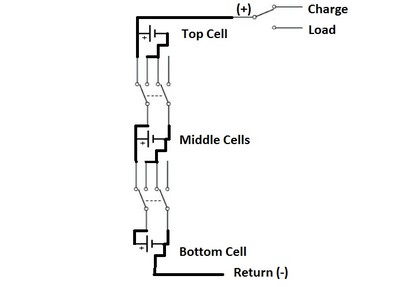
You can do it with dpdt relays. Here is a sample circuit diagram. It shows 3 cells but more cells can be added in the middle.

Register to Reply
Guru

Join Date: Oct 2006
Location: 44.56024"N 15.307971E
Posts: 8277
Good Answers: 270
#10
In reply to #9

Re: Charging in Parallel Discharging in Series
05/04/2018 4:17 PM

That would work,but the problem is the high cost of the relays that can handle the high current of over 100 amps under load.

Thanks for the feedback.

__________________
"A man never stands so tall as when he stoops to help a child." "Never argue with a stupid person.They will drag you down to their level and beat you with experience" "To create an apple pie from scratch, first you must create a universe"
Register to Reply
Guru

Join Date: Apr 2010
Location: About 4000 miles from the center of the earth (+/-100 mi)
Posts: 9910
Good Answers: 1141
#11
In reply to #10

Re: Charging in Parallel Discharging in Series

05/04/2018 7:36 PM

If you wire it properly, you only have to handle 1 battery worth of amps through the relay contacts. You might find cheaper relays that would work...

Register to Reply
3
Guru
Engineering Fields - Power Engineering - New Member

Join Date: May 2007
Location: NYC metropolitan area.
Posts: 3230
Good Answers: 444
#12
In reply to #10

Re: Charging in Parallel Discharging in Series

05/04/2018 7:37 PM

The problem with charging multiple cells, regardless of their configuration, is that you can't detect a weak cell that won't accept a charge without some form of monitoring for each cell. Aside from the cost of the relays, that's the major fail of the above method.

Under most circumstances, brute force is the most reliable method. Just break all the interconnections, charge each cell individually, and reconnect. The task isn't that onerous for a few cells, with the bonus of knowing which cell(s) is failing to take a charge.

__________________
“Tell me and I forget. Teach me and I remember. Involve me and I learn.” Ben Franklin.
Register to Reply Good Answer (Score 3)
Guru
Engineering Fields - Electrical Engineering - Been there, done that. Engineering Fields - Control Engineering - New Member

Join Date: Dec 2008
Location: Long Island NY
Posts: 15600
Good Answers: 981
#18
In reply to #12

Re: Charging in Parallel Discharging in Series

05/05/2018 7:43 AM

Excellent point. We should also remember that the typical vehicle lead acid battery is six cells connected in series in a molded, sealed container. Unless one disassembles the battery container one will always be charging cells in series.

__________________
"Don't disturb my circles." translation of Archimedes last words
Register to Reply
Guru

Join Date: Apr 2010
Location: About 4000 miles from the center of the earth (+/-100 mi)
Posts: 9910
Good Answers: 1141
#2

Re: Charging in Parallel Discharging in Series

05/04/2018 9:19 AM

Well, if each had an individual charger connected with transformer isolation, you could energize the transformers. The other method would be a set of switches that remove the series connections and make parallel connections.

Register to Reply
Guru

Join Date: Oct 2006
Location: 44.56024"N 15.307971E
Posts: 8277
Good Answers: 270
#3
In reply to #2

Re: Charging in Parallel Discharging in Series

05/04/2018 10:41 AM

I considered those options,but the cost of relays or switches to handle that much current makes it impractical for me,and the cost of individual chargers is also prohibitive.

The diodes are not so much for a 300 amp diode, (about $18ea)but it would require a very large heat sink and create a lot of losses.

A 6 pole relay or switch would have less losses,but very expensive.

Thanks for your feedback.

__________________
"A man never stands so tall as when he stoops to help a child." "Never argue with a stupid person.They will drag you down to their level and beat you with experience" "To create an apple pie from scratch, first you must create a universe"
Register to Reply
5
Guru
Hobbies - DIY Welding - Wannabeabettawelda

Join Date: May 2007
Location: Annapolis, Maryland
Posts: 7940
Good Answers: 458
#5

Re: Charging in Parallel Discharging in Series

05/04/2018 11:28 AM

If these are flooded lead-acid batteries, there is no problem with charging them in series. Imbalances will occur but on some regular interval, you condition the cells at a lower current. That will bring up the state of charge on the low cells, and you end up 'boiling off' water on the high cells. You just have to keep an eye on your electrolyte levels.

Register to Reply Good Answer (Score 5)
Guru
Engineering Fields - Power Engineering - New Member

Join Date: May 2007
Location: NYC metropolitan area.
Posts: 3230
Good Answers: 444
#6

Re: Charging in Parallel Discharging in Series

05/04/2018 12:06 PM

You could also do what utilities do with their 125 Vdc station batteries which are comprised of series/parallel strings. Periodically put an equalizing charge on the string until the current starts decreasing, then switch to a float charge to maintain the voltage. It's not perfect, but measuring the voltage across each cell during the equalizing charge points out the cell(s) that are nearing their EOL (End Of Life).

__________________
“Tell me and I forget. Teach me and I remember. Involve me and I learn.” Ben Franklin.
Register to Reply
Guru
Engineering Fields - Electrical Engineering - Been there, done that. Engineering Fields - Control Engineering - New Member

Join Date: Dec 2008
Location: Long Island NY
Posts: 15600
Good Answers: 981
#7

Re: Charging in Parallel Discharging in Series

05/04/2018 12:11 PM

If those golf cart batteries are lithium based you can get get a very big problem overcharging a cell.

__________________
"Don't disturb my circles." translation of Archimedes last words
Register to Reply
Guru

Join Date: Apr 2010
Location: About 4000 miles from the center of the earth (+/-100 mi)
Posts: 9910
Good Answers: 1141
#8

Re: Charging in Parallel Discharging in Series

05/04/2018 12:19 PM
Register to Reply
Power-User

Join Date: Jun 2007
Location: Center of the Known Industrial Universe - TUGGERAH 2259 - Australia
Posts: 259
Good Answers: 52
#13

Re: Charging in Parallel Discharging in Series

05/04/2018 11:04 PM

An idea using no relays, no diodes:

https://www.electricalcarservices.com/quick-release-battery-terminals/superior-quality-quick-connect/release-terminals-/p-162-4208

Make up two rectangular plates that each carry enough of these, or similar, quick on/off battery connectors, in a layout that you can drop onto the array of cells.

Wire one plate to place the cells in parallel and connect that first plate permanently to your charger.

Wire the second plate to place the cells in series and connect this second plate permanently to your motor/controller.

You would need to investigate what force would be required to connect, then release, so many quick-release connectors in a single plunge ... but there are no relays, no diodes ... and as a bonus, when neither of the plates is in play, each cell may be inspected and managed separately.

Register to Reply
Guru

Join Date: Dec 2010
Location: North West England
Posts: 1170
Good Answers: 153
#14

Re: Charging in Parallel Discharging in Series

05/05/2018 5:42 AM

What is your budget? A 4 pole N/O 25A motor contactor will cost about £16.50. A 63A version will cost only £19.50. One contactor will isolate both sides of 2 batteries from the parallel charging circuit so you need 3 to isolate 6 batteries. You need a further 2 contactors to isolate between each battery plus one pole fore and aft in the series circuit. A single £5, 3 position switch "parrallel/off/series" will control the contactors. The center off interlocks the contactors so both sets cannot be energised together. You will need 6mm (25A) or 10mm (63A) wire for connections. So about £100 ($135) to charge/discharge at 25 amps and £120 ($165) to charge/discharge at 63 amps. Note your club may take a dim view of running your golf buggy at 63 amps, Buggy drag racing is not normally allowed.

Register to Reply
Guru

Join Date: Oct 2006
Location: 44.56024"N 15.307971E
Posts: 8277
Good Answers: 270
#16
In reply to #14

Re: Charging in Parallel Discharging in Series

05/05/2018 6:53 AM

The golf cart controllers are rated at 125 amps,36VDC,which is very high current and high cost for relays.

Some controllers are rated above 400 amps at 36-48VDC,but usually only demand round 125 amps under load.

I could use a group of starter solenoids,like the ones used for the main contactor of the golf cart,but then again,the cost is the problem..around $30 each and they are single pole contactors.

Thanks again for your input and feedback.

__________________
"A man never stands so tall as when he stoops to help a child." "Never argue with a stupid person.They will drag you down to their level and beat you with experience" "To create an apple pie from scratch, first you must create a universe"
Register to Reply
Guru

Join Date: Oct 2006
Location: 44.56024"N 15.307971E
Posts: 8277
Good Answers: 270
#15

Re: Charging in Parallel Discharging in Series

05/05/2018 6:41 AM

I vaguely recall from many years ago,a circuit that balanced all batteries in series,using zener diodes to bypass individual batteries when they reached a designated full charge,passing the current on to other batteries in the series.

It had temperature compensation,and the differential voltage between two different zener diodes to compensate for individual variation of the zeners.

However,I cannot recall the details of the circuit.

Is anyone familiar with a similar circuit?

This would solve the imbalance problem without having to charge them in parallel.

__________________
"A man never stands so tall as when he stoops to help a child." "Never argue with a stupid person.They will drag you down to their level and beat you with experience" "To create an apple pie from scratch, first you must create a universe"
Register to Reply
Guru

Join Date: Oct 2006
Location: 44.56024"N 15.307971E
Posts: 8277
Good Answers: 270
#17

Re: Charging in Parallel Discharging in Series

05/05/2018 7:25 AM

I think I have found the solution to the balancing problem: The LTC3305 (Linear Technology) Lead Acid Battery Balancer.

It will require 2 of these chips and a few external components for 6 batteries,but I think I can make them work.

I will have to study the specs a little more,but it looks like a simple way to achieve balancing of the batteries.

Thanks everyone for all of the thoughtful and helpful feedback!

__________________
"A man never stands so tall as when he stoops to help a child." "Never argue with a stupid person.They will drag you down to their level and beat you with experience" "To create an apple pie from scratch, first you must create a universe"
Register to Reply
Guru

Join Date: Oct 2006
Location: 44.56024"N 15.307971E
Posts: 8277
Good Answers: 270
#22
In reply to #17

Re: Charging in Parallel Discharging in Series

05/05/2018 1:05 PM

Here is a link to the battery balancing IC LTC3305

Good video explanation:

http://www.analog.com/en/education/education-library/videos/5579254337001.html

__________________
"A man never stands so tall as when he stoops to help a child." "Never argue with a stupid person.They will drag you down to their level and beat you with experience" "To create an apple pie from scratch, first you must create a universe"
Register to Reply
Guru

Join Date: Apr 2017
Location: Southern Illinois
Posts: 627
Good Answers: 13
#24
In reply to #22

Re: Charging in Parallel Discharging in Series

05/05/2018 9:28 PM

That was interesting. I noticed he said that 6V and 12V batteries were supported. I wonder why individual cells are not. A long time ago, I came across a 2V sealed lead-acid D-cell battery. I have no idea where it came from, and never saw another one. Until then, submarines were the only place I knew of that used discrete single-cell lead-acid batteries. But, that battery balancing IC LTC3305 was interesting. Thanks for the post.

__________________
Science is the "cookbook" for making things.
Register to Reply
Guru

Join Date: Aug 2014
Location: Port Macquarie N.S.W. Australia
Posts: 1071
Good Answers: 225
#25
In reply to #24

Re: Charging in Parallel Discharging in Series

05/05/2018 10:10 PM

Batteries consist of individual cells either in series, parallel or series/parallel, so by inference that article also supports single cells in series.

Most large lead acid battery installations such as those used in UPSs, data banks, telephone exchanges, power stations (for getting the system back up and running after a breakdown) etc. use batteries consisting of individual cells rather than multi cell batteries. 2000+Ah 2.2V LA cells are not uncommon.

Lead acid D cells are still available, Cyclon are one manufacturer that comes to mind.

Register to Reply
Guru

Join Date: Oct 2006
Location: 44.56024"N 15.307971E
Posts: 8277
Good Answers: 270
#27
In reply to #25

Re: Charging in Parallel Discharging in Series

05/05/2018 10:30 PM

I have seen some industrial fork lifts that use the 2.2 LA volt single cells connected in series.Weight is a plus for these forklifts,and when a single cell fails,it is relatively cheap to replace,compared to a complete battery.

I would like to see a 6 or 12volt LA battery with individual taps for each cell to allow individual cell monitoring and balancing.

__________________
"A man never stands so tall as when he stoops to help a child." "Never argue with a stupid person.They will drag you down to their level and beat you with experience" "To create an apple pie from scratch, first you must create a universe"
Register to Reply
3
Guru

Join Date: Aug 2014
Location: Port Macquarie N.S.W. Australia
Posts: 1071
Good Answers: 225
#23
In reply to #17

Re: Charging in Parallel Discharging in Series

05/05/2018 9:18 PM

I'm not sure what you're trying to achieve here.

If it is balancing of the individual batteries in series, then consider that every battery consists of separate cells - 3 in series for a 6v unit and 6 in series for a 12v unit - how do you intend to also balance those?

Lead acid batteries don't require active balancing as such.

As each cell reaches full charge, it begins to release energy in the form of gas and heat and takes less charge in the process, other cells that are not as advanced in the charge process will then catch up.

Depending on the cell temperature, gassing will occur somewhere between 2.3v and 3v. For say 25°C cell temperature, then gassing will begin at 2.39v (for a cell with correct proportions of H2O to H2SO4 of 56:1). At this point roughly half of the electrical energy received by the cell is released.

Provided you don't apply a voltage that is too high for too long, then over charging of cells will not occur.

If the cells are a recombinant type, then voltage should be kept lower than for a vented cell to prevent gassing and pressure build up in the cell which will pop the seal, but vented types are very forgiving of excess voltages provided you keep them watered.

Regular equalisation of vented cells assists in preventing stratification and sulphation but should not be performed on sealed cells. Most good chargers have an equalisation setting.

Any voltage above 2.15v per cell will charge the cell, but for a fork lift type vented battery going to 2.45v/cell will achieve the best rate of charge. Equalisation would be performed at 2.5v/cell. Equalisation is complete when specific gravity of all cells is within 0.03 of each other, most decent chargers will have a time limited equalisation process so manual SG checking is largely redundant. The charger must then revert to float mode to allow the cells to settle.

Be aware also that every 1 Amphour received at full charge voltage will produce about 0.4 litres of Hydrogen and 0.2 litres of Oxygen per cell (for average sized cells). A typical 100Ah 6V battery will release around 30 litres of gas at 2.35V/cell to reach full charge, so allow adequate ventilation when charging.

The upshot of the above is to simply charge your lead acid batteries in series to a suitable voltage equal to the sum of the total number of series cells times the cell voltage required, and they will self equalise to a satisfactory level.

Register to Reply Good Answer (Score 3)
Guru

Join Date: Oct 2006
Location: 44.56024"N 15.307971E
Posts: 8277
Good Answers: 270
#26
In reply to #23

Re: Charging in Parallel Discharging in Series

05/05/2018 10:16 PM

The link above has good information about balancing of series batteries.

I learned a lot from this video.

I recommend it for some good information on lead acid batteries in general.

__________________
"A man never stands so tall as when he stoops to help a child." "Never argue with a stupid person.They will drag you down to their level and beat you with experience" "To create an apple pie from scratch, first you must create a universe"
Register to Reply
3
Guru

Join Date: Aug 2014
Location: Port Macquarie N.S.W. Australia
Posts: 1071
Good Answers: 225
#28
In reply to #26

Re: Charging in Parallel Discharging in Series

05/06/2018 12:03 AM

The first 60 seconds of that video is sufficient indication of its value.

He tells you that a battery consists of individual cells in series but then tells you that he is only interested in balancing entire batteries and not individual cells.

A 12V battery consists of 6 individual cells in series, two 12V batteries in series is simply 12 cells in series, so why would you differentiate between 12 cells in separate packages or 2 packages containing 6 cells each. The electrical relationships between the cells are identical in each case.

So... he's quite happy to balance each battery separately, but does nothing about the individual cells in those batteries which have exactly the same propensity to go out of balance as the entire package...Why doesn't he balance the separate cells? - because it is impossible to do so without being able to monitor each cell, and battery manufacturers don't provide that ability because it is not needed.

His statements fly in the face of all respected battery and charger manufacturers.

Whilst cells may drift out of balance over time, correct charge procedures which include periodic voltages which verge on the gas off levels will ensure that balancing is maintained.

You mention in your post #27 that you would like to see individual cell monitoring taps on multi cell batteries - manufacturers no longer provide this facility because they know it is not necessary.

It's pretty easy to determine if an individual cell fails, and if that's in a multi-cell package, then you have to replace the entire package regardless.

Register to Reply Good Answer (Score 3)
Guru

Join Date: Apr 2017
Location: Southern Illinois
Posts: 627
Good Answers: 13
#29
In reply to #28

Re: Charging in Parallel Discharging in Series

05/06/2018 10:09 AM

I suppose it really depends on the specific installation. I was a qualified Battery Charging Electrician sailor on subs. To replace the battery, you need to make a hull-cut; it's not easy. We carefully monitored and charted each cell. You can definitely see that individual cells have different life-times. Also, you can extend the service-life (by a significant amount) of a "stacked set" of cells by jumpering-out/bypassing the failing cells, thereby saving a hull-cut or two. It would be shame to waste a whole sub, because of a bad battery. Maybe not all installations are this demanding, but individual cell maintenance does make a big difference. I guess it's a judgement-call on whether it's worth it or not. But one of my pet peeves about a lot of "modern" devices these days, is that they don't provide an easy way for battery replacement, when it really doesn't have to be that way, nor should it be.

__________________
Science is the "cookbook" for making things.
Register to Reply Score 1 for Good Answer
Guru

Join Date: Oct 2006
Location: 44.56024"N 15.307971E
Posts: 8277
Good Answers: 270
#30
In reply to #28

Re: Charging in Parallel Discharging in Series

05/06/2018 7:58 PM

So you are saying the guy in the video is selling"snake oil" and that there is absolutely no value in balancing all batteries in a group of series connected batteries?

__________________
"A man never stands so tall as when he stoops to help a child." "Never argue with a stupid person.They will drag you down to their level and beat you with experience" "To create an apple pie from scratch, first you must create a universe"
Register to Reply
Guru

Join Date: Aug 2014
Location: Port Macquarie N.S.W. Australia
Posts: 1071
Good Answers: 225
#32
In reply to #30

Re: Charging in Parallel Discharging in Series

05/06/2018 10:39 PM

There is real value in keeping series cells reasonably balanced and this must be done regularly, but can that be done by simply monitoring and moving charge voltages across packages of cells as in a group of 12v batteries significantly more efficiently than by applying the same control across the entire string?

A 12v battery has 6 cells in series, two 12v batteries in series is 12 cells in series - that guy is suggesting that by controlling the charge across each of the packs, he can balance the separate cells in each pack - how can he do that without also monitoring each of those cells individually? All he can do is control the charge to each of the packs and leave the internal cells to their own devices which is what regular equalisation does.

Considering that the voltage range of a cell from 0% to 100% SOC is just 0.2V or 2mV per 1% change in SOC, any voltage measuring device would require extreme accuracy to be able to keep tabs on the balance of sets of 6 cells in series but still could not do so for the separate cells. To get those cells in balance will still require controlled overcharge.

While this may be a slight improvement on just charging a whole string of series packaged batteries and will gain following in some quarters, it still won't manage the internal cell balancing other than by regular equalisation, but that can also be done on a total string basis..

.

In reply to post #29 :- I agree that separate cell monitoring and control is advantageous where it can be done and where each cell is a separate entity, in those circumstances a single cell can be replaced (some of them could even be dismantled and repaired).

This is not the case with a packaged/monoblock unit....Cognisant of correct maintenance, whether or not you can monitor the internal cells is going to make no difference to failure and when that occurs the whole package needs replacement, you can't fix one cell. It is a simple matter to monitor the voltage across each package and to know when one is not performing correctly without resorting to individual cell monitoring.

Best longevity practice involves correct watering of flooded cells, timely full recharging (nothing kills a LA battery faster than leaving it in an undercharged state), regular equalising of flooded/vented cells by controlled overcharging, not overcharging VRLA type cells, charging at correct temperatures, slow charging where possible, avoidance of regular discharge below 50%, correct formatting of deep cycle batteries, keeping full charge SG lower (around 1.200 will increase life but reduce energy density), preventing stratification by charging fully and regular use, do not add acid, etc.

It is common practice with large storage installations to designate a pilot cell in each battery or bank of cells for specific gravity checks rather than test every cell - this should give you an indication that monitoring of every cell is superfluous. The pilot cell is generally randomly re-allocated on a monthly basis to ensure uniformity.

I really have no problem with you using any system that you are comfortable with, I'm just offering my perspective on the matter.

Register to Reply
Guru

Join Date: Oct 2006
Location: 44.56024"N 15.307971E
Posts: 8277
Good Answers: 270
#33
In reply to #32

Re: Charging in Parallel Discharging in Series

05/07/2018 5:59 AM

It was never my intention to balance all cells in a battery,which,as everyone knows,is in itself a series of cells,but merely to balance as much as possible,all batteries in a string of series connected batteries.A balancing charge requires a slight amount of overcharging,which if not carefully controlled can result in excessive heat and electrolyte loss.

When a bad battery is replaced,even if it is balanced with all of the other cells initially,it will still deviate from the rest of the bank as discharge occurs.

The purpose of the IC mentioned above is to maintain a constant state of balance for all of the batteries in the string,on an individual battery basis,not at a cell level.

An auxiliary capacitor or battery is required to store and provide the required balancing current when required.This prevents overcharging and reduces electrolyte loss and extends the string life as a whole.

My personal preference is to prevent an unbalanced state from occurring on all batteries and to insure that they all contribute equally to the load demands.

I think this IC will accomplish this goal,but I am waiting for more info from the battery manufacturer.

I respect your valuable input on this matter,and agree with the facts that you have stated regarding individual cells.

I certainly appreciate all of your valuable time and effort in addressing this matter.

__________________
"A man never stands so tall as when he stoops to help a child." "Never argue with a stupid person.They will drag you down to their level and beat you with experience" "To create an apple pie from scratch, first you must create a universe"
Register to Reply
Guru
Engineering Fields - Power Engineering - New Member

Join Date: May 2007
Location: NYC metropolitan area.
Posts: 3230
Good Answers: 444
#35
In reply to #33

Re: Charging in Parallel Discharging in Series

05/07/2018 10:19 AM

There's really not much to do, the controller chip is available for under $3.50 in quantity, the MOSFET switches are $0.75 each in manufacturing quantities, and if you want to save a lot of time and effort you can buy a completely populated demo board for $153.00 and play with it yourself.

A thorough read of the manufacturer's literature indicates that this is an elegant solution to an age old problem that is being solved by modern techniques; and based on the fact that the parts are available in quantities so low in cost, they're probably embedded in many high performance battery packs that are readily available. You just have to be willing to pay for the solution. TANSTAAFL

__________________
“Tell me and I forget. Teach me and I remember. Involve me and I learn.” Ben Franklin.
Register to Reply
Guru

Join Date: Apr 2017
Location: Southern Illinois
Posts: 627
Good Answers: 13
#34
In reply to #32

Re: Charging in Parallel Discharging in Series

05/07/2018 8:44 AM

"...how can he do that without also monitoring each of those cells individually?"? Every little bit helps. You might say, "It's a small step for battery-charging, but it's a giant leap in the right direction.".

__________________
Science is the "cookbook" for making things.
Register to Reply
Guru

Join Date: Oct 2006
Location: 44.56024"N 15.307971E
Posts: 8277
Good Answers: 270
#31
In reply to #28

Re: Charging in Parallel Discharging in Series

05/06/2018 8:03 PM

I have contacted Trojan Battery Company and requested their feedback on the subject of battery balancing,and this particular chip in particular.(LTC3305) .

I will post results when I receive their reply.

__________________
"A man never stands so tall as when he stoops to help a child." "Never argue with a stupid person.They will drag you down to their level and beat you with experience" "To create an apple pie from scratch, first you must create a universe"
Register to Reply
Guru

Join Date: Apr 2017
Location: Southern Illinois
Posts: 627
Good Answers: 13
#19

Re: Charging in Parallel Discharging in Series

05/05/2018 10:08 AM

I was wanting the same thing. But, since you can't have cells in both series and parallel at the same time, the only way to avoid a reconfiguration of the connections, would be to have a separate charger for each cell (calibrated equally) to avoid damage to either the cells or the charger. What I was wanting, was a way to test/maintain each cell without disturbance to the system. There are more automatic chargers these days that can even prevent/fix sulfation. Even tho that would require a separate charger/line to each cell, it seems to me the easiest way to do it.

__________________
Science is the "cookbook" for making things.
Register to Reply
Guru
Popular Science - Cosmology - Let's keep knowledge expanding Engineering Fields - Retired Engineers / Mentors - Hobbies - HAM Radio - New Member

Join Date: Dec 2006
Location: North America, Earth
Posts: 4528
Good Answers: 106
#20

Re: Charging in Parallel Discharging in Series

05/05/2018 10:36 AM

Just get several float chargers and put one on each battery. The isolated secondaries should eliminate any need to disconnect the batteries which are in series.

__________________
“I would rather have questions that can't be answered than answers that can't be questioned.” - Richard Feynman
Register to Reply
Guru

Join Date: Sep 2016
Posts: 973
Good Answers: 9
#21

Re: Charging in Parallel Discharging in Series

05/05/2018 11:27 AM

Looks like a voltage stepper circuit.

Register to Reply
Guru

Join Date: Dec 2010
Posts: 1686
Good Answers: 116
#36

Re: Charging in Parallel Discharging in Series

05/07/2018 2:32 PM

I think you have "the wrong end of the stick".

Look at any manufacturers data and it will require a current of e.g. 10 amps for 14 hours to ensure full charge from flat. That is far easier to ensure with cells in series, in parallel there is no easy way to know how much charge [current] each cell got - unless you have vented lead acid cells and can measure specific gravity. As pointed-out in one post, the procedure for ensuring all cells of a string are "Equalised" [fully charged] by an overcharge is well proven by 70 - 120 years of experience of long life batteries for telephone exchanges, power stations & emergency lighting [roughly 24 - 240V strings] which have lives of 25 - 40 years.

In parallel you have all the problems & inefficiency of a lower voltage e.g. for the same percent volt drop at 12V as at 48V you need 42 = 16 times the cable cross-section (per block also!). The higher current really hits any switching devices on cost, size & volt drop.

When it comes to "age" of a cell, it is more practical to compare cell/block voltages at the same current series than to measure current to individual cells in parallel. While cell voltage on-charge is an indicator, the only way to really know the battery capacity is to discharge it & see when each cell/block voltage collapses. In blocks, modern opaque cells do not let one see the rush of gas when a cell reverses, only dodges like microphones or IR thermometers showing hot cells could help.

Register to Reply
Register to Reply 36 comments

Good Answers:

These comments received enough positive votes to make them "good answers".

"Almost" Good Answers:

Check out these comments that don't yet have enough votes to be "official" good answers and, if you agree with them, vote them!
Copy to Clipboard

Users who posted comments:

67model (1); Brave Sir Robin (1); Dennis R. Levesque (4); gutmonarch (1); HiTekRedNek (12); jhhassociates (1); RAMConsult (3); redfred (2); Relativity PL (1); Rixter (4); SolarEagle (1); spades (4); StandardsGuy (1)

Previous in Forum: Software Useful for PCB Design   Next in Forum: Two Different Transformers (Step Down and Step Up) in Series!

Advertisement