Previous in Forum: Engineered for More Consumption   Next in Forum: Neutron Detectors in Mining?
Close
Close
Close
42 comments
Rate Comments: Nested
Guru

Join Date: Mar 2007
Location: by the beach in Florida
Posts: 33392
Good Answers: 1817

Space Elevator Model to Be Tested

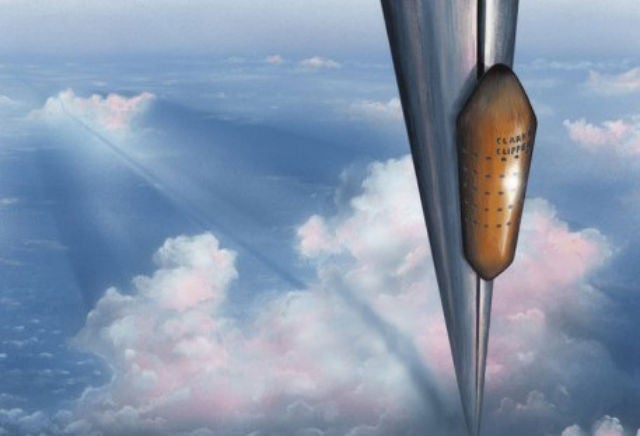
09/08/2018 12:32 PM

"Japanese Space-Elevator Experiment Launching to Space Station Next Week (Really!)"

Look I'm no scientist but this seems like one of those Hindu rope tricks to me, I mean what holds it up?

...and is 33' really a plausible test to begin with?

https://en.wikipedia.org/wiki/Space_elevator

Can you really make a cable that long, and get it into space, and stretch it out properly? Having said all that, it sure would be cool to hop an elevator to space...but realistically how long would it take to transverse this elevator....I mean I've been in some tall buildings, but this seems unrealistically tall...a 3 month journey on an elevator would make a great horror story though....haha

https://www.space.com/41278-japan-space-elevator-cubesats-experiment.html

__________________
All living things seek to control their own destiny....this is the purpose of life
Register to Reply
Interested in this topic? By joining CR4 you can "subscribe" to
this discussion and receive notification when new comments are added.

"Almost" Good Answers:

Check out these comments that don't yet have enough votes to be "official" good answers and, if you agree with them, vote them!
Guru

Join Date: Apr 2010
Location: About 4000 miles from the center of the earth (+/-100 mi)
Posts: 9910
Good Answers: 1141
#1

Re: Space elevator model to be tested

09/08/2018 1:20 PM

All we need is a material stronger than any we have now (AFAIK), a way to manufacture a piece about 30000-40000 miles long, and a way to get it up into space and anchor one end firmly in the earth. It might be a little tricky...

Register to Reply
Guru

Join Date: Mar 2007
Location: by the beach in Florida
Posts: 33392
Good Answers: 1817
#2
In reply to #1

Re: Space elevator model to be tested

09/08/2018 1:54 PM

We could attach it to Mount Chimborazo...

__________________
All living things seek to control their own destiny....this is the purpose of life
Register to Reply
Guru
Engineering Fields - Instrumentation Engineering - New Member Hobbies - Automotive Performance - New Member Technical Fields - Education - New Member Fans of Old Computers - TRS-80 - New Member Hobbies - Musician - New Member

Join Date: Jan 2008
Location: Tucson, AZ
Posts: 1331
Good Answers: 30
#3

Re: Space elevator model to be tested

09/08/2018 3:36 PM

Instructions on sign at base of rope, "Hand over hand, for next 22K miles."

__________________
...and the Devil said: "...yes, but it's a DRY heat..!"
Register to Reply
Guru

Join Date: Apr 2008
Location: Chicago
Posts: 3990
Good Answers: 144
#4

Re: Space elevator model to be tested

09/08/2018 3:54 PM

Calling this toy a mockup of a space elevator is like vacuuming up a marshmallow and saying you're working on a hyperloop prototype.

...of course if you do this in outer space then it must be a serious advancement!

I expected more from Japan?.. More than a 90 billion dollar estimate.

I'll offer my estimate to build one for half of that.

Just a small downpayment to get things started.

__________________
High Tolerance is Beautiful
Register to Reply
Guru

Join Date: Mar 2007
Location: by the beach in Florida
Posts: 33392
Good Answers: 1817
#5
In reply to #4

Re: Space elevator model to be tested

09/08/2018 5:17 PM
__________________
All living things seek to control their own destiny....this is the purpose of life
Register to Reply
Guru

Join Date: Apr 2008
Location: Chicago
Posts: 3990
Good Answers: 144
#7
In reply to #5

Re: Space elevator model to be tested

09/08/2018 8:43 PM

Looks as relaxing as any coffin.

__________________
High Tolerance is Beautiful
Register to Reply
Guru

Join Date: Jul 2008
Posts: 1688
Good Answers: 145
#6

Re: Space elevator model to be tested

09/08/2018 8:12 PM

You shoot a three foot tall plastic rocket into a charged atmosphere sky with a small wire trailing behind it and the sky discharges in an event called a lightning strike. You run a 30,000 plus mile cable from the earth into space and ??????

Running a earth ground through thunderstorms, ionosphere, troposphere, the E-layer and the various spheres and layers I have forgotten about sounds to me like we risk unexpected changes to earth weather, space weather, communications and possibly our protection from the various nasties that the sun spews out.

I'm not saying it will be bad and I'm not saying it will be good. I do think the news stories will cover a lot more than just the cost of buying an elevator ticket.

__________________
Few things limit our potential as much as knowing answers and setting aside questions.
Register to Reply Score 1 for Good Answer
Guru

Join Date: May 2006
Location: Placerville, CA (38° 45N, 120° 47'W)
Posts: 6215
Good Answers: 248
#10
In reply to #6

Re: Space elevator model to be tested

09/08/2018 11:09 PM

GA! You beat me to it...

I've thought the same for many years. Any "cable" they pass through those layers above the Earth had better have an extremely high dielectric constant.

__________________
Teaching is a great experience, but there is no better teacher than experience.
Register to Reply
Guru

Join Date: Mar 2007
Location: by the beach in Florida
Posts: 33392
Good Answers: 1817
#8

Re: Space elevator model to be tested

09/08/2018 8:45 PM
__________________
All living things seek to control their own destiny....this is the purpose of life
Register to Reply
Guru

Join Date: Apr 2017
Location: Southern Illinois
Posts: 627
Good Answers: 13
#9

Re: Space elevator model to be tested

09/08/2018 10:51 PM

It seems to me, that something in geosynchronous orbit would have to maintain it's equilibrium to stay in orbit. If that's what's keeping the rope tight, then once you put a load on it, that would disturb the equilibrium, then that something would no longer be able to stay in orbit. To get anything into space, you must increase it's potential energy. That energy, if taken from the thing in orbit, must cause that thing to change orbit, until it reaches a new equilibrium, which means it will no longer be geosynchronous.

The only way I see this working, is to have a pulley on that thing in orbit to allow lowering a mass the same weight as what's going to space, to maintain the combined potential energy. And, even then I doubt it.

You'd also have to have all kinds of navigation lights on it so airplanes won't run into it.

__________________
Science is the "cookbook" for making things.
Register to Reply
Guru

Join Date: Apr 2017
Location: Southern Illinois
Posts: 627
Good Answers: 13
#11
In reply to #9

Re: Space elevator model to be tested

09/09/2018 8:49 AM

Just in case anyone thinks I'm barking up the wrong tree/cable, if it doesn't take that energy from that thing in orbit, then what's the purpose of the cable? You might as well not use it in the first place.

__________________
Science is the "cookbook" for making things.
Register to Reply
Guru

Join Date: May 2006
Location: Placerville, CA (38° 45N, 120° 47'W)
Posts: 6215
Good Answers: 248
#12
In reply to #11

Re: Space elevator model to be tested

09/09/2018 9:16 PM

Go back and look again at the illustration in SE's original post. The counterweight is located way beyond the geosynchronous orbit. That means the cable has to be more than 30,000 miles long. "Centrifugal force" will put the cable under considerable tension, and the cable will act just like a cable going from a floor to the ceiling.

A person or device wanting to climb that cable will have to have its own source of energy to do the climbing. It takes no energy from the cable. A person climbing a rope must use his/her own energy to make his/her muscles do the climb. A robot/car/whatever capable of climbing the rope/cable would require a significant source of energy (batteries, solar, nuclear, etc.) to do the climb. Although I listed batteries, they would have to be supplemented. No battery I can conceive of could power a climb of around 22,000 miles.

__________________
Teaching is a great experience, but there is no better teacher than experience.
Register to Reply
Guru

Join Date: Apr 2017
Location: Southern Illinois
Posts: 627
Good Answers: 13
#13
In reply to #12

Re: Space elevator model to be tested

09/10/2018 12:00 AM

You forgot that "for every action, there is an equal and opposite reaction.". For every unit of distance climbed up, there will be an equal and opposite force pulling that counterweight down. To keep that counterweight in position, there needs to be more than just the energy supplied by the climber. I've never heard of an elevator built without a building around it to "hold it up". The only way this will work, is to build a genuine skyscraper anchored/supported to/by the ground to provide that "equal and opposite reaction", regardless of the energy required to do the climb. And, regardless of where the geosynchronous "orbit" is, that counterweight must also be geosynchronous, even if it's not in that proper/official "orbit". Otherwise, that cable will get wrapped around the Earth.

__________________
Science is the "cookbook" for making things.
Register to Reply Score 1 for Off Topic
Guru

Join Date: May 2006
Location: Placerville, CA (38° 45N, 120° 47'W)
Posts: 6215
Good Answers: 248
#14
In reply to #13

Re: Space elevator model to be tested

09/10/2018 1:19 AM

NO!

Yes, there will be a force pulling down on the counterweight, but that force MUST be smaller than the tension in the cable, or it would pull the counterweight down (and that would be a MAJOR disaster - 30 or 40 thousand miles of very strong cable plus a massive counterweight falling to one spot on Earth).

Elevators use counterweights that go down as the elevator goes up, while the motor is fixed in one position, in order to save energy. It would be perfectly possible to build an elevator that climbed a fixed cable, but the motor would have to be in the elevator car, adding significantly to the weight that has to be lifted, and there would have to be flexible electric cables (or sliding contacts, etc.) to supply energy to that motor. It would be significantly less efficient that common elevators.

On the other hand, rockets are EXTREMELY inefficient, so even the low efficiency of a climbing car would be significantly more efficient than rockets.

Your last statement is true. The counterweight indeed must be geosynchronous, but at geosynchronous orbit it would be weightless, and incapable of lifting anything. Beyond geosynchronous orbit, the natural period of a satellite (counterweight) would normally be longer than 24 hours. This means that the counterweight would tend to lag behind. This means in turn that the cable would have to pull the counterweight forward, and in order to do that, the cable could not be vertical; it would have to slant away from vertical (with respect to the Earth's surface at the point of attachment. It is the reaction to that pull that enables the counterweight to produce tension in the cable, so it can withstand the weight of something climbing up the cable. There will definitely be a limit to the weight that can be lifted...

__________________
Teaching is a great experience, but there is no better teacher than experience.
Register to Reply
Guru

Join Date: Apr 2017
Location: Southern Illinois
Posts: 627
Good Answers: 13
#15
In reply to #14

Re: Space elevator model to be tested

09/10/2018 8:40 AM

I see what you're saying. But, the energy to keep the cable tight still has to come from somewhere. If it's coming from the Earth, then the Earth will eventually slow down. That might take a long time, but it's not insignificant. And, the more mass, and the longer it stays there, the more the Earth will slow down. Once that counterweight is in place, you know someone will want to develop it into a city or something.

You might also need to build an identical one on the opposite side of the Earth to equalize the counterweight's pull on the Earth so the Earth doesn't gradually change orbit (which might in turn change the moon's orbit).

__________________
Science is the "cookbook" for making things.
Register to Reply
Guru

Join Date: May 2006
Location: Placerville, CA (38° 45N, 120° 47'W)
Posts: 6215
Good Answers: 248
#16
In reply to #15

Re: Space elevator model to be tested

09/10/2018 11:20 AM

Energy (quite a lot of it) is required to lift the counterweight up there, but no energy is required to keep it there. If you put a wire/cord/rope/cable between the floor and ceiling, and then tighten it, energy is required to place and tighten it, but once placed and tightened, it requires no further energy to remain tight. You or a robot could then climb that cable as many times as you like. The ceiling is NOT a source of energy unless you burn it (ignoring tiny amounts of energy due to expansion and contraction due to temperature and humidity changes).

Since the Earth must pull on the cable and counterweight, the cable and counterweight must pull on the Earth with an equal and opposite force. The end effect would be the same as that of the growth of a new large volcano: the center of mass of the Earth will shift slightly. (The counterweight is still effectively part of the earth.)

Any mass that mankind could cause to be lifted to that distance from earth would be a negligibly small fraction of the mass of the Earth, so the wobble caused by it will also be negligibly small.

In a similar manner, any slowing of the Earth's rotation would be negligible compared to the current slowing caused by the Moon/tides.

__________________
Teaching is a great experience, but there is no better teacher than experience.
Register to Reply
Guru

Join Date: Apr 2017
Location: Southern Illinois
Posts: 627
Good Answers: 13
#17
In reply to #16

Re: Space elevator model to be tested

09/10/2018 2:17 PM

"... it requires no further energy to remain tight." Wrong. Kinetic energy is required by all satellites to stay in orbit, and kinetic energy is required by all masses to maintain a centrifugal force. Without that energy, all masses will gravitate toward each other (and a cable won't be able to keep them separated).

"If you put a wire/cord/rope/cable between the floor and ceiling,...." The ceiling is a means of physical support to counteract gravity. Without building a genuine skyscraper to support the space-elevator, you'll need to supply energy to provide that centrifugal force. It will NOT stay there by itself.

"Since the Earth must pull on the cable and counterweight, the cable and counterweight must pull on the Earth with an equal and opposite force." The only way for the cable and counterweight to pull on the Earth with an equal and opposite force. is with centrifugal force, which requires energy 24/7. Add a load to that, and the amount of centrifugal force required changes. But, if you build a genuine skyscraper to support all that, then no further energy would be be needed. Remember that experiment to exemplify centrifugal force, the one of swinging a bucket full of water around in circle? If you remove the energy required to swing it in a circle, the water and the bucket and the rope will fall to Earth. Therefore, the Earth must supply the energy to the cable and counterweight to maintain that centrifugal force (after all, there's nothing else to support it).

Wow, I can't believe this is even a discussion. Is this the Twilight Zone?

__________________
Science is the "cookbook" for making things.
Register to Reply Score 1 for Off Topic
Guru

Join Date: May 2006
Location: Placerville, CA (38° 45N, 120° 47'W)
Posts: 6215
Good Answers: 248
#18
In reply to #17

Re: Space elevator model to be tested

09/10/2018 2:49 PM

I'm about ready to give up on you!

Did you note the word "further" in that first statement? Yes, the counterweight will require energy both to be lifted and to have the appropriate velocity to reach its position. BUT, once in position, no further energy is required.

A flywheel requires energy to get it spinning at the desired speed, and there are definitely centripetal and centrifugal forces acting while it is spinning, but in the absence of friction, no energy is required to keep it spinning.

Cables can't exert any significant pushing (compression) forces (as would be required to "...keep them separated"). Cables CAN exert pulling (tension) forces, as would be required once the counterweight is beyond the geosynchronous distance from Earth.

"Without building a genuine skyscraper to support the space-elevator, you'll need to supply energy to provide that centrifugal force. It will NOT stay there by itself." NOT true. Once the counterweight is beyond the natural geosynchronous distance, but has the required velocity to remain above a single point on the equator, it will require a downward (centripetal) force to avoid flying away into space. Assuming the cable is able to exert that force, it can stay in that position indefinitely, with NO further energy required.

You apparently have misconceptions on the relationships between force and energy. The chair I'm sitting on has been exerting well over a hundred pounds of force on me nearly all morning long, but it has expended zero energy.

If you think this is the Twilight Zone, then you need to go back and study standard High School Physics!

__________________
Teaching is a great experience, but there is no better teacher than experience.
Register to Reply
Guru

Join Date: Apr 2017
Location: Southern Illinois
Posts: 627
Good Answers: 13
#20
In reply to #18

Re: Space elevator model to be tested

09/10/2018 3:00 PM

Okay. Let me think about that for awhile before I shoot my mouth off again.

__________________
Science is the "cookbook" for making things.
Register to Reply
Guru

Join Date: Jul 2008
Posts: 1688
Good Answers: 145
#26
In reply to #14

Re: Space elevator model to be tested

09/11/2018 4:47 PM

I wonder how far off vertical the cable would be.

__________________
Few things limit our potential as much as knowing answers and setting aside questions.
Register to Reply
Guru

Join Date: May 2006
Location: Placerville, CA (38° 45N, 120° 47'W)
Posts: 6215
Good Answers: 248
#28
In reply to #26

Re: Space elevator model to be tested

09/11/2018 6:31 PM

I've wondered that too, but have done nothing but mental calculations, and I'm incapable of doing any but the simplest calculations without seeing them on paper or some kind of display.

On the other hand, since it is around 22,000 miles to Geosynchronous orbit, and apparently 30,000 miles or more to the counterweight, a tiny angle would cause a significant displacement of the counterweight from vertical.

I haven't given it a whole lot of thought, but I'm also not at all sure whether the cable would follow a straight line (once above atmospheric influences), a catenary, or something else.

__________________
Teaching is a great experience, but there is no better teacher than experience.
Register to Reply
Power-User

Join Date: Oct 2011
Posts: 138
Good Answers: 21
#36
In reply to #28

Re: Space elevator model to be tested

09/17/2018 4:23 AM

Actually, there will be no displacement from vertical and the reason is simple: the centrifugal force will cause the counterweight to be as far away as possible from Earth and this is achieved when the position is vertical - any other position will cause a lower orbit (due to the cable) and the tendency to fly away (to the highest possible orbit, limited by the cable length).

As for the atmosphere influence, I think it will cause only some small variations in the cable tension - just think that it will have an influence only on the first few tens of km on a 56000 km cable.

On the other hand, a real threat to the cable will be the countless number of low orbit objects that fly at high speed as space junk. I wonder how could this problem be solved. I'm afraid that this concept will remain just a theoretical one.

Register to Reply
Guru

Join Date: May 2006
Location: Placerville, CA (38° 45N, 120° 47'W)
Posts: 6215
Good Answers: 248
#37
In reply to #36

Re: Space elevator model to be tested

09/17/2018 11:49 AM

"Centrifugal" force is not the only force acting on the cable, especially when the elevator is lifting a load. The tangential velocity of the load must be gradually increased, from roughly 1000 mph at the Earth's surface to roughly 6,900 mph at Geosynchronous altitude. A vertical cable is incapable of exerting tangential forces.

I too suspect that this will remain nothing beyond a concept for the foreseeable future.

__________________
Teaching is a great experience, but there is no better teacher than experience.
Register to Reply
Power-User

Join Date: Oct 2011
Posts: 138
Good Answers: 21
#38
In reply to #37

Re: Space elevator model to be tested

09/18/2018 9:48 AM

Sorry, but you are wrong.

The most intuitive way in this case is to use a rotating frame of reference (in which we have the fictitious centrifugal force) at least because it's easy to understand that the centrifugal force works in opposite direction than gravity and at the Geosynchronous altitude they compensate each other, while at higher altitudes the dominant force that will cause the counterweight to keep the cable in vertical position is the centrifugal one.

Considering the above frame of reference, the only forces that act on the lifting load are the gravity (acting vertically downwards) and the centrifugal force (acting vertically upwards) so, there is no reason for the lifting load to apply a tangential force to the cable. Note that both the tangential velocity and the centrifugal force are proportional to the altitude from the load to the Earth's center and lifting the load leads to a greater centrifugal force which (like any force) will change the load's velocity (and, since the angular velocity is constant, it will change the tangential velocity). I admit that this seems strange for our common sense but it's because we use here a rotating frame of reference (while we are accustomed to inertial ones). After all, it's also strange that a force applied in a certain direction causes a velocity change in a perpendicular direction (but that's because there aren't in fact constant directions but rotating ones).

The only way to create a tangential force would be to change the angular velocity (which is not the case).

Register to Reply
Guru

Join Date: May 2006
Location: Placerville, CA (38° 45N, 120° 47'W)
Posts: 6215
Good Answers: 248
#39
In reply to #38

Re: Space elevator model to be tested

09/18/2018 12:05 PM

"...it's also strange that a force applied in a certain direction causes a velocity change in a perpendicular direction"

It's not just strange, it's impossible!

You may be using a rotating frame of reference, but the only frame of reference I can use for this concept is one looking at the Earth from a pole, where the Earth, the cable, and the counterweight all make one revolution per day.

The only way for the cable to create a tangential force is for it to have an angle different from normal to the Earth's surface at the point of attachment to the Earth (non-vertical). There is nothing other than the cable that can exert the force necessary to accelerate the load from Earth-surface velocity to orbital velocity. Thus the cable must in turn be pulled by the point of attachment, and that force must have a vertical component to prevent the counterweight from flying off into space, and a horizontal component to accelerate the load as it climbs.

__________________
Teaching is a great experience, but there is no better teacher than experience.
Register to Reply
Power-User

Join Date: Oct 2011
Posts: 138
Good Answers: 21
#41
In reply to #39

Re: Space elevator model to be tested

09/19/2018 4:57 AM

Well, you are partially right and partially wrong. You are wrong because what you are missing is that in this case, although the instant velocity is always tangential, the acceleration is always vertical (in the same direction as the force), which means that inertia (which is always opposed in direction to the acceleration) will also act along the cable. Apparently, while the load is lifted, the force applied to lift it will act against the centrifugal force of the counterweight but, as long as it is smaller, nothing will be moved but the load.

But you are right considering the fact that the load must gain energy while lifted. As the load is lifted to a higher altitude, its centrifugal force will be increased in magnitude, which means that its acceleration will be increased in magnitude but the inertia will also be increased as well, so its tangential velocity will have the tendency to not change - this is related to the conservation of angular momentum. The final effect will be that the angular velocity of the whole system will be lowered - so, it will not be just a simple vertical displacement of the counterweight but a gradually increasing one, leading to a catastrophic destruction. There are two ways to prevent that (and keep the angular velocity stable):

1) To provide the needed energy to the system (by using a propulsion system applied to the counterweight) - but this will be equivalent to the energy needed to provide in the same way to the load, making the whole concept absurd.

2) To cancel the effect by lowering an equal mass to compensate the angular velocity change - this seems more rational but, since the idea is to lift loads that will be released either to orbit around Earth or to fly to other planets (from altitudes exceeding the second cosmic velocity), this will be possible only by slowly consuming the counterweight.

So, again, the whole concept seems very unlikely to be ever used.

Register to Reply
Guru

Join Date: May 2006
Location: Placerville, CA (38° 45N, 120° 47'W)
Posts: 6215
Good Answers: 248
#42
In reply to #41

Re: Space elevator model to be tested

09/19/2018 10:58 AM

What makes you think the acceleration is always vertical?

Why do launch rockets always begin to turn away from vertical shortly after liftoff? The answer is that the energy required to overcome gravity and lift the object to a given altitude (the final gravitational potential energy of the object), is a small fraction of the energy required to bring the the object up to orbital speed (the final kinetic energy of the object).

__________________
Teaching is a great experience, but there is no better teacher than experience.
Register to Reply
Guru

Join Date: Feb 2013
Posts: 716
Good Answers: 33
#40
In reply to #38

Re: Space elevator model to be tested

09/18/2018 7:42 PM

DK is right. Angular velocity is not the important concept here. Orbital velocity is the problem. Any mass that is raised from the Earth to orbit has to be accelerated tangentially to match the orbital velocity of the station in geosynchronous orbit, and that can't be done by a cable hanging perfectly vertically. You would need rockets or something to prevent the cable from bending as the cargo was raised.

On the other hand, you can solve the problem by lowering an equal mass down the cable to cancel out the change in velocity as the cargo is is being raised. If the goal is to make it easy to get mass off the Earth, that doesn't help much.

__________________
canary
Register to Reply
Guru

Join Date: Apr 2008
Location: Chicago
Posts: 3990
Good Answers: 144
#19

Re: Space Elevator Model to Be Tested

09/10/2018 2:52 PM

In practical terms I was wondering if there were a material that could withstand being stretched with enough Force to remain taught while being able to suspend its own weight inside Earth's atmosphere?

I don't think we have any high-speed nanotube shoelace splitting robots just yet?

Do that imo

__________________
High Tolerance is Beautiful
Register to Reply
Guru

Join Date: Mar 2007
Location: by the beach in Florida
Posts: 33392
Good Answers: 1817
#21

Re: Space Elevator Model to Be Tested

09/10/2018 11:12 PM

..."There is a direct relationship between gravitational acceleration and the downwards force (weight) experienced by objects on Earth, given by the equation F = ma (force = mass × acceleration). However, other factors such as the rotation of the Earth also contribute to the net acceleration."...

https://www.fxsolver.com/browse/formulas/Variation+in+gravity+with+altitude

__________________
All living things seek to control their own destiny....this is the purpose of life
Register to Reply
Guru

Join Date: May 2006
Location: Placerville, CA (38° 45N, 120° 47'W)
Posts: 6215
Good Answers: 248
#22
In reply to #21

Re: Space Elevator Model to Be Tested

09/11/2018 12:08 AM

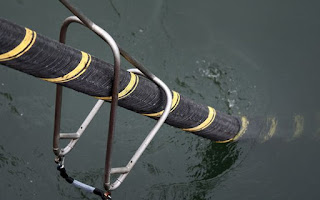
Wow! That's quite a cable. I assume that is an under-sea high voltage cable being loaded on a ship prior to laying...

__________________
Teaching is a great experience, but there is no better teacher than experience.
Register to Reply
Guru

Join Date: Mar 2007
Location: by the beach in Florida
Posts: 33392
Good Answers: 1817
#23
In reply to #22

Re: Space Elevator Model to Be Tested

09/11/2018 9:26 AM
__________________
All living things seek to control their own destiny....this is the purpose of life
Register to Reply
Guru

Join Date: May 2006
Location: Placerville, CA (38° 45N, 120° 47'W)
Posts: 6215
Good Answers: 248
#24
In reply to #23

Re: Space Elevator Model to Be Tested

09/11/2018 11:21 AM

Wow again! I had no idea that an undersea data cable would be that large! I also can't imagine how they can manufacture that much cable. And finally, 10 TB/sec on each fiber is astonishing. I presume that means something like 1 TB/sec in each of 10 different colors (wavelengths).

Thanks.

__________________
Teaching is a great experience, but there is no better teacher than experience.
Register to Reply
Guru

Join Date: Apr 2008
Location: Chicago
Posts: 3990
Good Answers: 144
#25
In reply to #24

Re: Space Elevator Model to Be Tested

09/11/2018 11:42 AM

Back in the day, I was taught that single mode could be faster than multimode fiberoptic cable (the number of light bits going through at the same time).

Lasers vs LED, optics, circuits, and $$$$ single mode cable, were the difference. (some)

I've been misinformed before.

__________________
High Tolerance is Beautiful
Register to Reply
Guru

Join Date: May 2006
Location: Placerville, CA (38° 45N, 120° 47'W)
Posts: 6215
Good Answers: 248
#27
In reply to #25

Re: Space Elevator Model to Be Tested

09/11/2018 6:15 PM

I'm sure that would depend on a lot of factors, including such things as the method of creating the different wavelengths (I presume it would require a separate laser for each wavelength), the method of modulating those wavelengths, the original polarization, how the travel through the fiber affects the polarization, what method is used to separate the wavelengths at the destination (prism, grating, or...), and of course the properties of the various detectors.

__________________
Teaching is a great experience, but there is no better teacher than experience.
Register to Reply
Guru

Join Date: Mar 2007
Location: by the beach in Florida
Posts: 33392
Good Answers: 1817
#29
In reply to #24

Re: Space Elevator Model to Be Tested

09/12/2018 3:53 PM

Yes over 4000 km this one...There's another one 16,000 km long...pretty awesome

https://vocusgroup.com.au/news-media/news/vocus-group-and-alcatel-submarine-networks-to-build-the-coral-sea-cable/

..."The announcement followed NEC last year demonstrating speeds of 50.9Tbps across subsea cables of up to 11,000km on a single optical fibre through the use of C+L-band erbium-doped optical fibre amplifiers, amounting to speeds of 570 petabits per second-kilometre."...

https://www.zdnet.com/article/nec-announces-indian-subsea-cable/

__________________
All living things seek to control their own destiny....this is the purpose of life
Register to Reply
Guru

Join Date: May 2006
Location: Placerville, CA (38° 45N, 120° 47'W)
Posts: 6215
Good Answers: 248
#30
In reply to #29

Re: Space Elevator Model to Be Tested

09/12/2018 4:34 PM

Thanks.

Any idea how long a single section of cable is? I presume there is an amplifier at each joint between sections, and those joints must be REALLY strong!

__________________
Teaching is a great experience, but there is no better teacher than experience.
Register to Reply
Guru

Join Date: Mar 2007
Location: by the beach in Florida
Posts: 33392
Good Answers: 1817
#31
In reply to #30

Re: Space Elevator Model to Be Tested

09/12/2018 9:31 PM

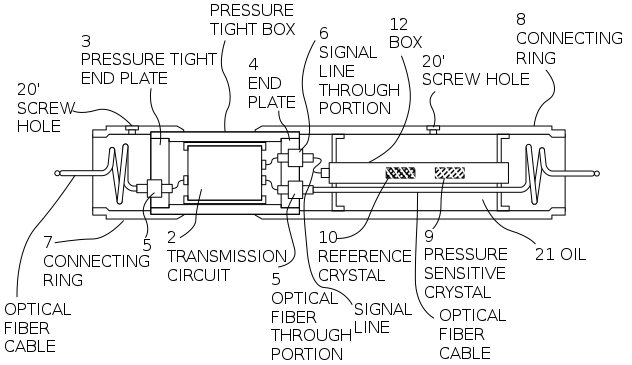
Diagram of an optical submarine cable repeater

..."An indirect contributor to fiber optic cable loss is the fact that all transparent materials transmit energy at slightly different speeds, depending on the wavelength. This is the same effect that causes a prism to split white visible light into its constituent colors, and takes place because the index of refraction is dependent on the wavelength. This is observed as a "smearing-out-over-time" effect in long fiber optic cable runs, unless the energy for each signal can be kept within a narrow range of wavelengths. Engineers have developed schemes such as wave-division multiplexing (WDM) and dense wave-division multiplexing (DWDM) in an attempt to minimize this problem."...

..."

  1. An intermediate line repeater is placed approximately every 80–100 km to compensate for the loss of optical power as the signal travels along the fiber. The 'multi-wavelength optical signal' is amplified by an EDFA(Erbium-doped fiber amplifier), which usually consists of several amplifier stages.
  2. An intermediate optical terminal, or optical add-drop multiplexer. This is a remote amplification site that amplifies the multi-wavelength signal that may have traversed up to 140 km or more before reaching the remote site. Optical diagnostics and telemetry are often extracted or inserted at such a site, to allow for localization of any fiber breaks or signal impairments. In more sophisticated systems (which are no longer point-to-point), several signals out of the multi-wavelength optical signal may be removed and dropped locally."...

https://en.wikipedia.org/wiki/Wavelength-division_multiplexing

https://en.wikipedia.org/wiki/Submarine_communications_cable

__________________
All living things seek to control their own destiny....this is the purpose of life
Register to Reply
Guru

Join Date: Mar 2007
Location: by the beach in Florida
Posts: 33392
Good Answers: 1817
#32
In reply to #31

Re: Space Elevator Model to Be Tested

09/12/2018 9:47 PM

..."Basic principle of EDFA

A relatively high-powered beam of light is mixed with the input signal using a wavelength selective coupler (WSC). The input signal and the excitation light must be at significantly different wavelengths.

The mixed light is guided into a section of fiber with erbium ions included in the core. This high-powered light beam excites the erbium ions to their higher-energy state. When the photons belonging to the signal at a different wavelength from the pump light meet the excited erbium atoms, the erbium atoms give up some of their energy to the signal and return to their lower-energy state.

A significant point is that the erbium gives up its energy in the form of additional photons which are exactly in the same phase and direction as the signal being amplified. So the signal is amplified along its direction of travel only.

This is not unusual – when an atom “lases” it always gives up its energy in the same direction and phase as the incoming light. Thus all of the additional signal power is guided in the same fiber mode as the incoming signal.

There is usually an isolator placed at the output to prevent reflections returning from the attached fiber. Such reflections disrupt amplifier operation and in the extreme case can cause the amplifier to become a laser. The erbium doped amplifier is a high gain amplifier."...

__________________
All living things seek to control their own destiny....this is the purpose of life
Register to Reply
Guru

Join Date: Mar 2007
Location: by the beach in Florida
Posts: 33392
Good Answers: 1817
#33
In reply to #32

Re: Space Elevator Model to Be Tested

09/13/2018 1:29 PM
__________________
All living things seek to control their own destiny....this is the purpose of life
Register to Reply
Guru

Join Date: Feb 2013
Posts: 716
Good Answers: 33
#34

Re: Space Elevator Model to Be Tested

09/14/2018 10:49 PM

When I first heard about the space elevator idea I thought it was cool, but then I started looking at the actual practical details. It is great for science fiction, but I have some difficulties with the plan in real life:

1. The amount of mass needed to create it is mind-boggling, even if the strength of materials used is far above what is currently possible.

2. The amount of energy needed to create it is mind-boggling.

3. It has that unfortunate liability that if it breaks, like if a moderately sized meteor hits it, then the bottom part falls to Earth/Mars and the rest shoots out of orbit.

4. The time it takes for a container or passenger compartment to climb to the geostationary height of 25,000 miles is pretty large, like a car trip around the Earth.

5. You have to include food and air for all the passengers for the trip.

6. The cargo being raised doesn't have to be accelerated vertically as it rises, but it has to be accelerated horizontally to orbital velocity somehow, and in this situation it takes that energy from the orbital velocity of the elevator itself (unless the mass being raised is matched by the mass of the cargo being lowered simultaneously). So after raising a cargo, the elevator has to be accelerated horizontally again, all along its height, to avoid its orbit being degraded. So it has to include rockets or something all along its height, plus fuel.

7. Maybe by the time it might be feasible to build, terrorism will no longer be a problem, but until then this would be the greatest bullseye ever created for people wanting to get attention.

8. Very difficult to move with that enormous mass, in case it is in the way of a known meteorite on a collision course. (Maybe you could intercept the meteorite, if you had time.)

9. Its location is limited in that you have to put the bottom end on the equator somewhere.

10. Weather. (Maybe you could put the bottom end far above the planetary surface, so you don't have to worry about weather or tethering.)

So what would I do instead?

For the Earth, rather than Mars, I would suggest a much, much easier solution, based loosely on Jules Verne's novel "From the Earth to the Moon." He used a very large cannon pointing straight up. That's not really possible. But if all you want to do is get things into orbit you could use a very long, very powerful railgun that extended up from the Earth's surface as close as we can get it to the top of the atmosphere, which is about 100 miles.

One hundred miles of structure resting on the Earth would be difficult, but woud be far easier than some 25,000 to 50,000 miles of cable suspended from orbit. In fact, it doesn't even have to rest on the Earth, but could be suspended by large balloons up above the troposphere where there is no weather to speak of.

The railgun would be sealed off from the atmosphere and kept evacuated, and during a shot the top end would be opened briefly to let the cargo pod escape. There would only be atmospheric resistance from the top of the railgun up to the top of the atmosphere. That way we could have rapid acceleration of payloads and therefore very quick trips to orbit and beyond. We could also use technology that is available today. The cargo pods would have rockets to push through the last layer of atmosphere, and then navigate to the destination.

One destination could be another railgun in Earth orbit, to send things on longer trips. That railgun would be able to launch things in either direction, so that a launch in one direction that changed its orbit would be countered by a launch in the opposite direction.

This would be difficult, but it uses nothing but conventional technology. There is nothing that has to be invented to do this. It can be done almost anywhere on Earth, not just at the equator. You could point it in any direction. It would be a much more efficient use of energy and mass. Much faster trips. No need for fuel, just electricity from solar panels that never have clouds shading them.

Coming back down? There is always the old fashioned way. Atmospheric braking. But you could also use that orbital railgun to slow down, and then just gracefully parachute down.

__________________
canary
Register to Reply
Guru

Join Date: Feb 2013
Posts: 716
Good Answers: 33
#35
In reply to #34

Re: Space Elevator Model to Be Tested

09/14/2018 11:42 PM

TLDR?

Too long, didn't read, even if I do say so myself. Sorry. I got carried away. And then I read the links to the Japanese companies. Still not persuaded.

__________________
canary
Register to Reply
Register to Reply 42 comments

"Almost" Good Answers:

Check out these comments that don't yet have enough votes to be "official" good answers and, if you agree with them, vote them!
Copy to Clipboard

Users who posted comments:

70AARCuda (1); Alex. Roman (3); BruceFlorida (2); Canary (3); Dennis R. Levesque (6); dkwarner (13); JE in Chicago (4); Rixter (1); SolarEagle (9)

Previous in Forum: Engineered for More Consumption   Next in Forum: Neutron Detectors in Mining?

Advertisement