Previous in Forum: Dust Remove/Settle Down from Water   Next in Forum: Flow in Concentric Pipes
Close
Close
Close
39 comments
Rating: Comments: Nested
Guru
Hobbies - RC Aircraft - New Member

Join Date: Aug 2007
Posts: 901
Good Answers: 9

Mixing of Gases

10/04/2018 4:44 PM

Ok say you have a sealed volume of H2 (Hydrogen)

And you introduce into this H2, say 25% of the H2 volume of NH3.

Does anything happen to either gas?

Register to Reply
Interested in this topic? By joining CR4 you can "subscribe" to
this discussion and receive notification when new comments are added.

Good Answers:

These comments received enough positive votes to make them "good answers".
Guru
Engineering Fields - Instrumentation Engineering - New Member Hobbies - Automotive Performance - New Member Technical Fields - Education - New Member Fans of Old Computers - TRS-80 - New Member Hobbies - Musician - New Member

Join Date: Jan 2008
Location: Tucson, AZ
Posts: 1331
Good Answers: 30
#1

Re: Mixing of Gases

10/04/2018 4:48 PM

Depends upon whether you add energy or not.

__________________
...and the Devil said: "...yes, but it's a DRY heat..!"
Register to Reply
Guru
Hobbies - RC Aircraft - New Member

Join Date: Aug 2007
Posts: 901
Good Answers: 9
#4
In reply to #1

Re: Mixing of Gases

10/04/2018 5:35 PM

When the NH3 is introduced to the H2

energy is neutral.

Later on energy will be removed, ( it will get colder)

Register to Reply
Guru

Join Date: Jul 2005
Location: Stoke-on-Trent, UK
Posts: 4496
Good Answers: 137
#13
In reply to #4

Re: Mixing of Gases

10/05/2018 7:04 AM

Nothing will happen chemically. As others have said, if the volume expands in proportion, the pressure is practically unchanged. Depending on the pressure of the NH3 source, there might be a drop in temperature, but it will be small. If the volume stays fixed, the pressure rises. Whether the temperature rises due to adiabatic compression of the H2 I'm not sure, but again the effect will be small.

__________________
Give masochists a fair crack of the whip
Register to Reply
Guru
Engineering Fields - Electrical Engineering - Been there, done that. Engineering Fields - Control Engineering - New Member

Join Date: Dec 2008
Location: Long Island NY
Posts: 15600
Good Answers: 981
#2

Re: Mixing of Gases

10/04/2018 5:00 PM

Yes, the first thing that happens is the seal on the hydrogen gas volume is broken. Then unless the vessel containing ammonia has a higher pressure than the hydrogen gas then ammonia is not transferred into the hydrogen vessel with the exception of whatever Brownian motion transfers happen. That is unless the ammonia was magically transported into the hydrogen vessel.

In short, more information is needed.

__________________
"Don't disturb my circles." translation of Archimedes last words
Register to Reply
Guru
Hobbies - RC Aircraft - New Member

Join Date: Aug 2007
Posts: 901
Good Answers: 9
#5
In reply to #2

Re: Mixing of Gases

10/04/2018 5:37 PM

Sorry, the vessel can expand to accommodate the extra volume of the NH3,

So the pressure remains neutral atmospheric pressure.

Register to Reply
Guru

Join Date: Mar 2007
Location: by the beach in Florida
Posts: 33392
Good Answers: 1817
#3

Re: Mixing of Gases

10/04/2018 5:35 PM

I don't think anything happens, if you add N2 this is called the Haber process and how you make liquid ammonia...

https://www.enotes.com/homework-help/haber-process-gases-n2-h2-nh3-condense-525995

__________________
All living things seek to control their own destiny....this is the purpose of life
Register to Reply Score 1 for Off Topic
Guru
Hobbies - RC Aircraft - New Member

Join Date: Aug 2007
Posts: 901
Good Answers: 9
#6
In reply to #3

Re: Mixing of Gases

10/04/2018 5:39 PM

This is interesting....

Register to Reply
Guru

Join Date: Mar 2007
Location: by the beach in Florida
Posts: 33392
Good Answers: 1817
#7
In reply to #3

Re: Mixing of Gases

10/04/2018 6:00 PM

..."Due to its dramatic impact on the human ability to grow food, the Haber process served as the "detonator of the population explosion", enabling the global population to increase from 1.6 billion in 1900 to today's 7 billion.[19] Nearly 50% of the nitrogen found in human tissues originated from the Haber-Bosch process.[20] Since nitrogen use efficiency is typically less than 50%,[21] farm runoff from heavy use of fixed industrial nitrogen disrupts biological habitats.[3][22] "...

https://en.wikipedia.org/wiki/Haber_process

__________________
All living things seek to control their own destiny....this is the purpose of life
Register to Reply Score 1 for Off Topic
Guru

Join Date: Apr 2011
Posts: 8006
Good Answers: 286
#8

Re: Mixing of Gases

10/04/2018 6:00 PM

There will be some exchange of hydrogen atoms between the hydrogen molecules and the ammonia molecules. Rate of exchange will increase with temperature. The exchange will be difficult to notice/measure unless there is some difference in intial isotope concentrations and you have some way to measure changes in such.

__________________
Eternal vigilance is the price of knowledge. - George Santayana
Register to Reply
Guru
Hobbies - RC Aircraft - New Member

Join Date: Aug 2007
Posts: 901
Good Answers: 9
#9
In reply to #8

Re: Mixing of Gases

10/04/2018 6:10 PM

Woah,

But the overall more or less ratios will remain the same true?

Like if it was 75%H2 and 25% NH3, even with the exchanges happening, it shou,ld remain the same yes?

Why would they swap atoms?

Joe

Register to Reply
Guru

Join Date: Apr 2011
Posts: 8006
Good Answers: 286
#10
In reply to #9

Re: Mixing of Gases

10/04/2018 6:32 PM

Yes, the concentration of h2 and nh3 should remain the same as long as the temperature doesn't get too high. Those are the most energetically favorable around stp.

Why would like atoms exchange between molecules? Why wouldn't like atoms exchange between molecules regularly interacting each other at a typical mutual speed of several thousand miles per hour?

__________________
Eternal vigilance is the price of knowledge. - George Santayana
Register to Reply
4
Guru

Join Date: Apr 2010
Location: About 4000 miles from the center of the earth (+/-100 mi)
Posts: 9910
Good Answers: 1141
#11

Re: Mixing of Gases

10/04/2018 6:48 PM

AFAIK, there is no reaction between H2 and NH3.

Gases that are nowhere near the liquification point all behave the same, as ideal gases. Ideal gases have the same number of moles per liter at standard temperature and pressure, 1/22.4 moles per liter.

So if you have 1 liter of H2 and combine it with 1/4 liter of NH3 and this then occupies the 1 liter volume, providing there is no change in temperature, the pressure will increase by a factor of 5/4.

PV = nRT,

where P is pressure,

V is volume,

n is the number of moles,

R is the gas constant, and

T is temperature in Kelvin degrees.

In this example, Volume and temperature remain the same. n is replaced by 1.25 n so pressure, P, increases by 25 percent.

https://en.wikipedia.org/wiki/Ideal_gas_law

Register to Reply Good Answer (Score 4)
Guru
United Kingdom - Member - Indeterminate Engineering Fields - Control Engineering - New Member

Join Date: Jan 2007
Location: In the bothy, 7 chains down the line from Dodman's Lane level crossing, in the nation formerly known as Great Britain. Kettle's on.
Posts: 32175
Good Answers: 839
#12

Re: Mixing of Gases

10/05/2018 3:58 AM

Chemically: nothing, though note that the mixture, as well as the components, is combustible so care is needed in handling and containment.

Physically: they will mix completely, eventually, due to Brownian Motion, and the temperature/pressure/volume relationship of the mixture will follow, very nearly, the relationship for an Ideal Gas.

__________________
"Did you get my e-mail?" - "The biggest problem in communication is the illusion that it has taken place" - George Bernard Shaw, 1856
Register to Reply
Power-User

Join Date: Jan 2010
Location: Dayton Ohio
Posts: 265
Good Answers: 10
#14

Re: Mixing of Gases

10/05/2018 8:58 AM

If you have NH4 in a skillet, it's panned-ammonium

__________________
MikeMack747
Register to Reply Score 2 for Off Topic
Guru
Hobbies - RC Aircraft - New Member

Join Date: Aug 2007
Posts: 901
Good Answers: 9
#15

Re: Mixing of Gases

10/05/2018 10:32 AM

Ok some details of what I am doing. Many may remember me and my High Altitude Balloon flights. Like this,

https://youtu.be/HJ0IT4ZwtSo

and the view from 118,000 feet.

https://youtu.be/EdAuHr-bZ1M

All the flights last about 90 minutes to burst. The Balloon keeps rising and expanding till it can not expand any more and bursts and comes down via a parachute.

Now there are only a few lighter than air gases. H2, and NH3 are two of them.

All my previous flights (76 of them) has used only H2

My Goal is to do this,

Fill the balloon with H2 with enough H2 to give like 80% of the needed lift.

Then use the NH3 to give it the remainder needed amount of lift for it to fly.

WHY?

Well of all the "Lighter Than AIR" lifting gases NH3 has a unique property it's boiling point. ~28 below zero F.

These Flights reach often 70 below zero F.

So the thought here is, the balloon is launched and as it rises it gets colder and colder, and eventually it gets to the temp where the NH3 starts to condense back to a liquid.

In doing so the volume it is displacing gets 850 times smaller, and the balloon looses it's buoyancy lifting capacity. And it starts to come down, But in doing so it gets to warmer air and the NH3 changes back to a Gas and again provides lift.

Eventually hopefully it will reach a somewhat smaller window and just float there.

at least that the Idea.

Thoughts?

Register to Reply
Guru

Join Date: Apr 2011
Posts: 8006
Good Answers: 286
#17
In reply to #15

Re: Mixing of Gases

10/05/2018 12:20 PM

Oh. That's a little different.

At high altitude, due to radiation, the answer needs to be revised...

"... But overall more or less ratios will remain the same true?..."

Nope. They will change.

"...Does anything happen to either gas..."

Yes.

initially as the warm balloon rises, overall result will be less NH3, more H2 and some N2 will be produced. increase in ionizing radiation will tend to increase the rate of this shift toward equilibrium. Temperature will largely control the equilibtrium concentration being moved toward.

By thr time the balloon is cold enough where NH3 begins to condense to liquid, the change will have reversed and N2 will overall be mostly eliminated over time by reacting with H2 to form NH3 and condense. There will still be NH3 disrupted by ionizing radiation resulting in some othet combinations but this should combine reasonably quickly to once again form ammonia and condense.

Upon warming back up with NH3 boiling to a gas, ionizing radiation will yield some N2 present again. The concentration will heavily depend on temperature. Ionizing radiation will tend to hasten the move to equilibrium concentration.

__________________
Eternal vigilance is the price of knowledge. - George Santayana
Register to Reply
Guru
Hobbies - RC Aircraft - New Member

Join Date: Aug 2007
Posts: 901
Good Answers: 9
#18
In reply to #17

Re: Mixing of Gases

10/05/2018 1:28 PM

Wow,

That's a lot to wrap my head around.

Looks like multiple changes happening.

But in the big scene thing it might work as hoped?

Joe

Register to Reply
Guru

Join Date: Mar 2007
Location: by the beach in Florida
Posts: 33392
Good Answers: 1817
#19
In reply to #15

Re: Mixing of Gases

10/05/2018 2:52 PM

What about a small lightweight pressure relief valve?

https://straval.com/products/plastic-valves/rvi20-p/

__________________
All living things seek to control their own destiny....this is the purpose of life
Register to Reply
Guru
Hobbies - RC Aircraft - New Member

Join Date: Aug 2007
Posts: 901
Good Answers: 9
#21
In reply to #19

Re: Mixing of Gases

10/05/2018 3:32 PM

In the balloon the pressure differential is sooo incredibly low, it took literally decades to get a measurement. and it is very very small.

Joe

Register to Reply
Guru

Join Date: Mar 2007
Location: by the beach in Florida
Posts: 33392
Good Answers: 1817
#23
In reply to #21

Re: Mixing of Gases

10/05/2018 4:11 PM

What about monitoring the stress/strain on the balloon fabric as a trigger for the valve?

https://www.omega.com/literature/omegadyne/omegadyneNH_sg.pdf

__________________
All living things seek to control their own destiny....this is the purpose of life
Register to Reply
Guru
Hobbies - RC Aircraft - New Member

Join Date: Aug 2007
Posts: 901
Good Answers: 9
#24
In reply to #23

Re: Mixing of Gases

10/05/2018 4:16 PM

Interesting thought, but how would you?

Register to Reply
Guru

Join Date: Mar 2007
Location: by the beach in Florida
Posts: 33392
Good Answers: 1817
#25
In reply to #24

Re: Mixing of Gases

10/05/2018 4:29 PM

Well just shooting from the hip, I would make an enclosure for the balloon out of silk, the silk enclosure reaching full size before the balloon reaches burst size, the strain on the silk enclosure could be used to activate a relief valve keeping the balloon inflated just below burst size....maybe

__________________
All living things seek to control their own destiny....this is the purpose of life
Register to Reply
Guru
Hobbies - RC Aircraft - New Member

Join Date: Aug 2007
Posts: 901
Good Answers: 9
#28
In reply to #25

Re: Mixing of Gases

10/05/2018 5:04 PM

If I could make a silk outer skin, then I'd just go for the method of a super pressure balloon system.

Register to Reply
Guru

Join Date: Mar 2007
Location: by the beach in Florida
Posts: 33392
Good Answers: 1817
#29
In reply to #28

Re: Mixing of Gases

10/05/2018 5:50 PM
__________________
All living things seek to control their own destiny....this is the purpose of life
Register to Reply
Guru

Join Date: Jul 2005
Location: Stoke-on-Trent, UK
Posts: 4496
Good Answers: 137
#20
In reply to #15

Re: Mixing of Gases

10/05/2018 3:07 PM

The BP of NH3 is -28°F at 1atm absolute, But I suspect your pressure will be lower, so the BP is lower also.

__________________
Give masochists a fair crack of the whip
Register to Reply
Guru
Hobbies - RC Aircraft - New Member

Join Date: Aug 2007
Posts: 901
Good Answers: 9
#22
In reply to #20

Re: Mixing of Gases

10/05/2018 3:33 PM

Yup, by the paperwork I have found it looks like it will work, but barely.

Register to Reply
Guru

Join Date: May 2016
Posts: 1746
Good Answers: 87
#16

Re: Mixing of Gases

10/05/2018 10:49 AM

A few things happen.

1. they mix.

2. They react with each other. Reactivity as I was taught depends on two terms, both statistical, k-reaction and k-concentration. The overall reactivity is k-reaction times k-concentration. There is k-reaction can be broken down further into types of reactions.

In a nutshell, the gasses will have a certain spontaneous level of dissociation that produce charged radicals that are capable of reacting. The percentage of dissociation will depend a lot on temperature. In gasses, the reaction rate tends to be limited by available radicals capable of reacting, so the overall reaction rate tends to be proportional to the concentration of gasses.

If the reaction generates heat, then the spontaneous dissociation percentage increases, the velocity of particles increases and the pressure increases, accelerating the reaction rate.

Register to Reply
Guru

Join Date: Mar 2007
Location: by the beach in Florida
Posts: 33392
Good Answers: 1817
#26

Re: Mixing of Gases

10/05/2018 4:42 PM

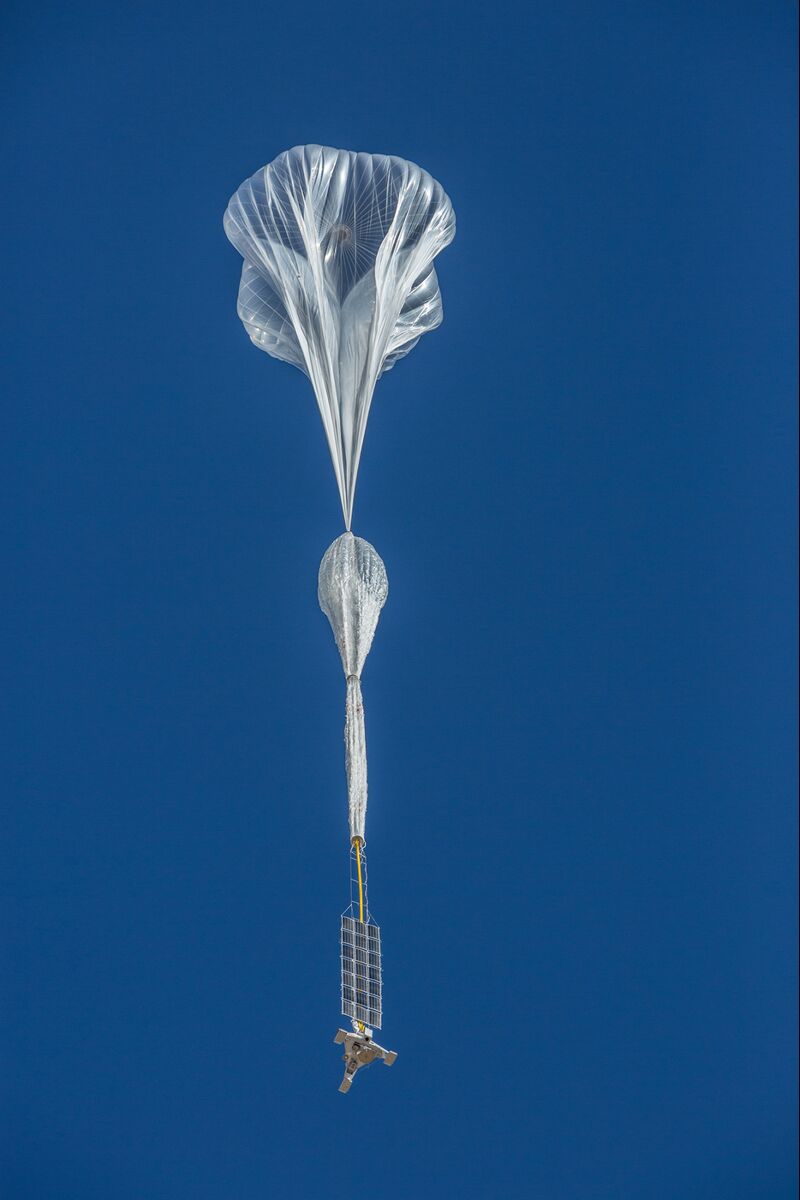
What about this as a launch vehicle?

A Stratollite rises above Spaceport Tucson in October 2017. From top to bottom: the primary lift balloon, a secondary balloon for altitude control, a solar panel, and the payload.

PHOTOGRAPHER: STEVEN MECKLER

https://www.bloomberg.com/news/features/2018-07-26/world-view-wants-to-send-you-to-the-stratosphere-in-a-balloon

__________________
All living things seek to control their own destiny....this is the purpose of life
Register to Reply
Associate

Join Date: May 2017
Posts: 27
Good Answers: 3
#27

Re: Mixing of Gases

10/05/2018 4:42 PM

I think this is actually a meteorology problem, an analog of a rising parcel of air with H2O dissolved in it.

Your parcel rises and cools at the "dry" rate until the NH3 reaches its dewpoint, at which time the NH3 condenses and releases its heat of condensation. If the surrounding air is less dense, the parcel will continue upwards, but at its harder-to-cool "wet" rate.

If the air nearby and above is unstable with respect to your H2/NH3 blend, your parcel will continue ascending until it cools to the density of the surrounding air, or bursts.

I just checked this for a parcel of ambient air here in Austin. Heating a parcel on the ground to 92degF (expected high for today), the parcel will slowly rise, condensing out the water at 4500ft, and continuing to ascend to about 42,000ft, at which point it finds a particularly warm layer of surrounding air (inversion).

Register to Reply
Guru

Join Date: May 2006
Location: Placerville, CA (38° 45N, 120° 47'W)
Posts: 6215
Good Answers: 248
#31
In reply to #27

Re: Mixing of Gases

10/06/2018 11:57 PM

One major difference: Once a parcel of rising air reaches the dew point altitude, the water will condense or freeze, and the droplets or snowflakes thus formed will begin to precipitate out of the parcel, leaving drier (and thus heavier[more dense]) air. Since the parcel is now more dense, it will either rise more slowly or begin to fall, although not as rapidly as the condensed/frozen water. The fallen water is no longer available to that parcel of air.

In the H2/NH3 mixture in a balloon, the precipitate will fall to the bottom of the balloon, and remain available for vaporization if/when the balloon reaches a location where the surrounding air combined with radiation absorption are able to vaporize some of the liquid NH3.

This H2/NH3 mixture in a balloon sounds to me like an excellent idea, where condensation of NH3 will prevent over-expansion of the balloon, and re-vaporization will provide additional lift if it falls too low. It sounds like this should make it possible for the balloon to stay aloft until it has lost too much H2 through the balloon membrane. On the other hand, That -28°C occurs at a significantly lower altitude, so it depends whether time aloft or altitude attainable is more important... The FAA might also have something to say, since the -28°C occurs well within commercial flight altitudes.

__________________
Teaching is a great experience, but there is no better teacher than experience.
Register to Reply
Guru
Engineering Fields - Electrical Engineering - Been there, done that. Engineering Fields - Control Engineering - New Member

Join Date: Dec 2008
Location: Long Island NY
Posts: 15600
Good Answers: 981
#33
In reply to #31

Re: Mixing of Gases

10/07/2018 10:07 AM

I agree that this sounds like a good idea. In fact this seems like such a good idea that it makes me wonder why this is not done more often in ballooning? You mention one possibility of commercial air traffic at phase transition altitudes. However, a slowly leaking H2 or HE balloon can still create traffic interference problems, albeit for a shorter interval of time. Therefore this should still be mitigated by another design aspect, possibly a large radar profile.

I think the problem lies in an assumption, but what assumption?

When NH3 reacts with the O2 in air there are less gases on the right hand side of the stoichiometric equation. At the same time, the reaction of H2 and O2 leads to only a liquid on the right side and H2 is used successfully to float balloons. Therefore reacting to residual air molecules in the balloon is not the likely assumption.

Possibly the assumption is NH3 being inert with the balloon material itself, causing a containment problem.

Maybe the critical assumption is an aspect in the phase changes itself. What if this phase change is not always the assumed gradual transition that makes a sustained elevation. The payload might then violently oscillate above and below the phase transition temperature altitude. Isn't this mechanism with the phase transition of H2O how microbursts and other downdrafts occur in storm clouds?

__________________
"Don't disturb my circles." translation of Archimedes last words
Register to Reply
Guru
Hobbies - RC Aircraft - New Member

Join Date: Aug 2007
Posts: 901
Good Answers: 9
#36
In reply to #31

Re: Mixing of Gases

10/07/2018 11:45 AM

I agree 100% with your thinkings.

The only issue of this working as planned, is the drop of boiling point temp because of the lowering of the pressure.

It will be very close if this will work or not if I take the basic idea.

So charts I have found for the bioling point vs pressure or mkore accurately vacuum, shows that it will NOT work, while other show it will but with a very small window.

I guess the ukltimate test will be do it and see what happens.

As far as the FAA goes, not an issue, fully compliant with part 101.

Register to Reply
Guru

Join Date: May 2006
Location: Placerville, CA (38° 45N, 120° 47'W)
Posts: 6215
Good Answers: 248
#37
In reply to #36

Re: Mixing of Gases

10/07/2018 1:01 PM

Thanks.

Upon further thinking, it might even be possible to use some other gas, even conceivably one a bit heavier than air (acetylene, CO2, Propane,...) to achieve the stability at a desired temperature/altitude.

Clearly you would require more H2 to compensate for the additional weight, but I don't think that is a fatal limitation.

You obviously already must have anti-explosion facilities/procedures in place if you are using H2, so the flammabilities of some of these other gasses should not be a problem.

I know almost nothing about possible reactions between H2 and any of these other gasses; that would require further investigation/research, but I really think your basic concept is an excellent one!

__________________
Teaching is a great experience, but there is no better teacher than experience.
Register to Reply
Guru
Hobbies - RC Aircraft - New Member

Join Date: Aug 2007
Posts: 901
Good Answers: 9
#38
In reply to #37

Re: Mixing of Gases

10/07/2018 1:06 PM

I'll have to think about the other gasses. that have a boiling point in the areas we are dealing with. and then what happens to the overall buoyancy when they change state.

Register to Reply
Guru

Join Date: May 2006
Location: Placerville, CA (38° 45N, 120° 47'W)
Posts: 6215
Good Answers: 248
#39
In reply to #38

Re: Mixing of Gases

10/07/2018 1:31 PM

Correct. I don't believe this will produce a sudden drop in pressure, since the first bit of gas that condenses or freezes will reduce the volume of the balloon and thus reduce the rate of rise into colder air. ...and of course the heat of vaporization of that first bit will be released and warm the rest of the gas slightly.

Since you've already made it public, I believe that puts the concept into the public domain. Otherwise, I think this would have been a patentable concept.

Good luck!

__________________
Teaching is a great experience, but there is no better teacher than experience.
Register to Reply
Power-User

Join Date: Nov 2011
Posts: 249
Good Answers: 4
#30

Re: Mixing of Gases

10/06/2018 11:35 PM

Nothing would happen, except that pressure would increase suitably.

Hydrogen per se, is colourless, odourless, tasteless and USELESS, as far as chemical action is concerned. Even if you mix oxygen and Hydrogen, nothing will happen unless a spark is introduced.

On the other hand, nascent hydrogen which is but a proton, is the most reactive particle in the universe, being with a charge and mass too, but its shelf life is nil.

Register to Reply
Guru

Join Date: Jul 2005
Location: Stoke-on-Trent, UK
Posts: 4496
Good Answers: 137
#32
In reply to #30

Re: Mixing of Gases

10/07/2018 7:18 AM

What has any of that got to do with the question? And he said in #5 that the container expands as the NH3 goes in.

__________________
Give masochists a fair crack of the whip
Register to Reply
Guru

Join Date: May 2006
Location: Placerville, CA (38° 45N, 120° 47'W)
Posts: 6215
Good Answers: 248
#34
In reply to #30

Re: Mixing of Gases

10/07/2018 10:40 AM

How can you say Hydrogen is "USELESS"? Ever hear of Fuel Cells, Rockets, Hydrogenation, Hydrogen Atmosphere Brazing, etc.?

__________________
Teaching is a great experience, but there is no better teacher than experience.
Register to Reply
Power-User

Join Date: Nov 2011
Posts: 249
Good Answers: 4
#35
In reply to #34

Re: Mixing of Gases

10/07/2018 11:26 AM

Uselessness pertains to direct chemical action- not when used with catalysts as in Hydrogenation, and adsorption in other reaction.

Register to Reply
Register to Reply 39 comments

Good Answers:

These comments received enough positive votes to make them "good answers".
Copy to Clipboard

Users who posted comments:

70AARCuda (1); Bo1000 (1); Codemaster (3); dkwarner (4); Gadepalli Subrahmanyam (2); Jpfalt (1); MikeMack747 (1); NSS (12); PWSlack (1); redfred (2); Rixter (1); SolarEagle (7); truth is not a compromise (3)

Previous in Forum: Dust Remove/Settle Down from Water   Next in Forum: Flow in Concentric Pipes

Advertisement