This is kind of neat, but the efficiency is so low that I can't see it being practical. Efficiency is very important in a flying vehicle where you have to carry your source of energy and efficiency translates directly to range and time of flight.
I have so many questions now....Does the air velocity increase with the voltage or is there a sweet spot...what effect does increased amperage have....can these be set up with one behind the other to accelerate the airflow in stages?...what is the total cfm flow per watt?....What's 2.5% efficiency, power to thrust?...Will this configure to hover?
__________________
All living things seek to control their own destiny....this is the purpose of life
To create thrust, you have to impart an equivalent amount of momentum per second to the surrounding air, F = Δmv. The amount of energy required is E = 1/2 mv2.
The same amount of force can be generated by accelerating a small mass to a high velocity or a large mass to a small velocity. But since the amount of energy required is proportional to the square of the velocity, low mass and high velocity is less energy efficient than high mass and low velocity.
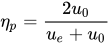
I suspect the 2.5 percent refers to propulsive efficiency.
"Mathematically the propulsive efficiency :
where
velocity of the vehicle
velocity of the exhaust
Thus reducing the exhaust velocity will give a higher propulsive efficiency. The thrust of the engine is given by
where is the mass flow through the engine. Thus to for a given thrust the exhaust velocity can be decreased if the mass flow is increased."
Ion drives by nature accelerate a small mass by a large amount and are inherently inefficient. Entraining the surrounding air results in more mass and lower velocity which does increase efficiency. Still, at low speeds, the efficiency is very low.
However, air-breathing electric propulsion is being developed for low altitude satellites. It ionizes the small amount of air present and provides thrust to prevent orbit decay due to drag. In this application, the high exhaust velocity is more efficient.
would it work in stages, one array after the other, increasing the velocity of the air....?
My guess is that you would be better off running in parallel rather than serial because you want to bring in as much air as possible.
AFAIK, an ion drive is a high-speed engine, energy is transferred to only a small amount of air which is accelerated to high velocity, whereas what you need is a large amount of air moving more slowly.
Maximum thrust occurs when the fluid coming into any kind of "jet" engine is 1/2 the speed of the fluid going out (with respect to the engine).
Vin = intake speed (or speed of vehicle)
Vout = exit speed (with respect to vehicle)
rho = density (assumed constant)
A = intake area.
mass of fluid entering = rho*A*Vin;
fluid is accelerated (Vout - Vin)
F = ma = rho*A*Vin*(Vout-Vin) = rho*A*(Vin*Vout-Vin2)
At max thrust, dF/dVin = rho*A*(Vout-2Vin) = 0, or Vin = Vout/2
Well yes it appears they have 4 high and 2 deep, arrays....I just wonder if say the you had a ducted air flow with the array like 10 deep or something, would the air continue to accelerate from each array....thus becoming more of a jet engine...
This appears to gain some of it's lift from the 8 narrow airfoils...
__________________
All living things seek to control their own destiny....this is the purpose of life
I see you're right, the aft units may get some boost in efficiency, operating in the exhaust stream from the front units.
I doubt there is any significant lift from the "8 narrow airfoils", they're just the electrodes that neutralize the air and provide a return electrical circuit and apparently not designed to transfer any lift forces.
Interesting drive application but ion drive is not a new technology.
This video is over six years old. I realize this earlier video is not holding aloft the supply and power source. On the other hand, the ion plane requires a catapult launch to get airborne, so neither are practical yet. I wonder if ducting would help or hinder?
__________________
"Don't disturb my circles." translation of Archimedes last words
"A new MIT plane is propelled via ionic wind. Batteries in the fuselage (tan compartment in front of plane) supply voltage to electrodes (blue/white horizontal lines) strung along the length of the plane, generating a wind of ions that propels the plane forward.