Previous in Forum: Easy, Cheap, Accurate Level   Next in Forum: Interchange
Close
Close
Close
12 comments
Rate Comments: Nested
Guru

Join Date: Oct 2006
Location: 44.56024"N 15.307971E
Posts: 8277
Good Answers: 270

Cooling with No Moving Parts

01/26/2019 2:23 PM

Check out this link to a cooling system with no moving parts:

https://newatlas.com/soundenergy-thermoacoustic-cooling/58169/

__________________
"A man never stands so tall as when he stoops to help a child." "Never argue with a stupid person.They will drag you down to their level and beat you with experience" "To create an apple pie from scratch, first you must create a universe"
Register to Reply
Interested in this topic? By joining CR4 you can "subscribe" to
this discussion and receive notification when new comments are added.

"Almost" Good Answers:

Check out these comments that don't yet have enough votes to be "official" good answers and, if you agree with them, vote them!
Participant

Join Date: Jan 2019
Location: Karachi
Posts: 3
#1

Re: Cooling with no moving parts

01/26/2019 3:33 PM

CR4 ADMIN: Deleted Post

Spam: This post was deleted because it contained advertising outside the Commercial Space forum. Please review Section 14 of the CR4 Site FAQ about advertising.

__________________
zee
Register to Reply Off Topic (Score 5)
Guru

Join Date: Mar 2007
Location: by the beach in Florida
Posts: 33392
Good Answers: 1817
#2

Re: Cooling with no moving parts

01/26/2019 3:50 PM
__________________
All living things seek to control their own destiny....this is the purpose of life
Register to Reply
Guru
Technical Fields - Technical Writing - New Member Engineering Fields - Piping Design Engineering - New Member

Join Date: May 2009
Location: Richland, WA, USA
Posts: 21017
Good Answers: 795
#3

Re: Cooling with no moving parts

01/26/2019 3:59 PM

If it's acoustic, something is moving.

__________________
In vino veritas; in cervisia carmen; in aqua E. coli.
Register to Reply Score 1 for Good Answer
Guru

Join Date: Apr 2010
Location: About 4000 miles from the center of the earth (+/-100 mi)
Posts: 9912
Good Answers: 1141
#4

Re: Cooling with no moving parts

01/26/2019 6:18 PM

Converting heat energy to sound, the Rijke tube:

The tube is a resonant oscillator, sound waves consisting of expansion and compression of the air. As cool air flows past the heated screen, the sound vibration is amplified in a similar way as the motion of a swing increases as it is pushed on each cycle (heat initiating the expansion).

Register to Reply
Guru

Join Date: Apr 2010
Location: About 4000 miles from the center of the earth (+/-100 mi)
Posts: 9912
Good Answers: 1141
#5

Re: Cooling with no moving parts

01/27/2019 5:47 PM

Apparently, their system uses a traveling wave thermoacoustic device. Here's how I think it works.

First, consider a Stirling Engine/Heat Pump. It is reversible just as a Motor/Generator can be used in either direction. Apply heat and it produces work, or drive it mechanically and it pumps heat.

The Stirling Engine operates because heated gas expands and cooled gas contracts. The gas is shuttled between a heat source and a cooled heat sink, and as the gas expands and contracts, it moves a piston.

The Stirling Heat Pump operates because compression heats a gas and expansion cools it. The gas is shuttled between the cold side where heat is being removed to the hot side where heat is being dumped. The piston compresses and expands the gas.

In either application, there are two processes, compression/expansion, and transport of gas. These two processes occur 90 degrees apart in the cycle.

Stirling engine / Heat Pump

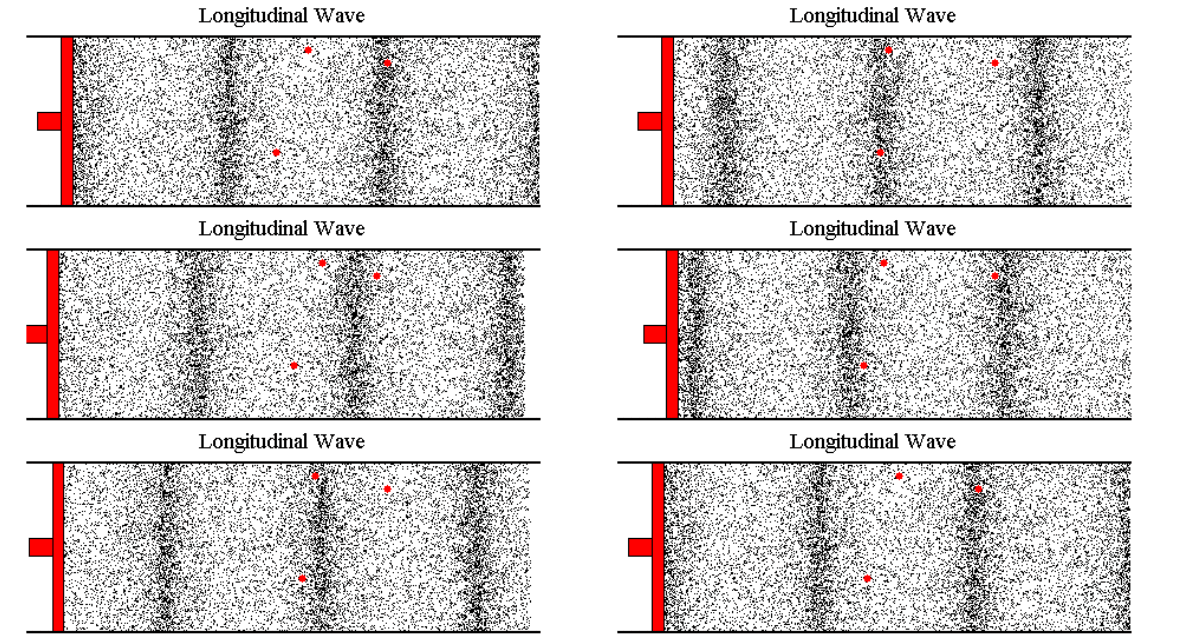
Consider a sound wave moving through a gas. A small parcel of gas undergoes compression/expansion and movement (transport), just as the gas in a Stirling Engine (red dot in diagram below).

The compression/expansion cycle and movement of this parcel are 90 degrees out of phase, just as in a Stirling engine/heat pump, and the compression/expansion causes cooling and heating cycles. The addition of a number of wire screens called regenerators capture the heat from the gas, store it and pass it along to the next parcel of gas, so that the system acts like a series of Stirling heat pumps.

Just as a Stirling engine/heat pump is reversible, so is a traveling wave thermoacoustic is reversible. A thermal gradient will cause sound amplification or spontaneous oscillation at a resonant frequency as in a Rijke tube.

Here is an example of a traveling wave thermoacoustic cooler driven by a thermoacoustic generator (sound source).

https://phys.org/news/2016-12-refrigerator-multistage.html

Register to Reply Score 1 for Good Answer
Commentator

Join Date: Apr 2018
Location: Newtongrange (10 miles from Edinburgh, Scotland, UK (1,000,000 miles from the real world)
Posts: 63
Good Answers: 1
#6

Re: Cooling with No Moving Parts

01/28/2019 5:39 AM

The idea of a heat engine with no moving parts is attractive this one leaves me with a few questions:

1/ What is the temperature/ velocity/ pressure condition of the Argon gas? and how is this achieved with 'no moving parts';

2/ How is acoustic vibration achieved without moving parts. Any form of resonator must move to work; and

3/ How efficient is this system? Comparable with a Stirling engine?

Register to Reply
Guru

Join Date: Apr 2010
Location: About 4000 miles from the center of the earth (+/-100 mi)
Posts: 9912
Good Answers: 1141
#8
In reply to #6

Re: Cooling with No Moving Parts

01/28/2019 12:00 PM

Here's my understanding.

A resonator is just a closed cavity filled with gas. It can be cylindrical and closed at both ends or toroidal (donut shaped). Its primary characteristic is that there are certain frequencies of sound that it "resonates" at, similar to the way a guitar string vibrates at certain frequencies. The resonant frequencies are determined by the dimensions of the resonator and the wavelength of the sound.

The thermoacoustic device works in both directions. Sound traveling through the device will produce a temperature difference, and a temperature difference will amplify sound. Minute fluctuations are amplified and the resonant frequencies of the resonator are reinforced. (It's similar to the way a Laser works, where the resonant cavity consists of mirrors and the pumping source provided the amplification.)

Here is a thermoacoustic generator. Sound waves are produced, driven by the temperature difference.

"The thermoacoustic Stirling engine consisting of a looped tube, resonator and tank. A joint position connecting the looped tube with the resonator is set to x ϭ 0 as an origin and the direction of x is taken anti-clockwise in the looped tube and towards the right in the resonator, respectively. "

https://www.researchgate.net/figure/The-thermoacoustic-Stirling-engine-consisting-of-a-looped-tube-resonator-and-tank-A_fig1_257959017

Heat engines are limited to the Carnot Efficiency, Eff = (Thot - Tcold)/Thot . The numbers I've seen for the TA heat engine are about 40% of the Carnot Efficiency, comparable to a Stirling Engine.

Register to Reply
Commentator

Join Date: Apr 2018
Location: Newtongrange (10 miles from Edinburgh, Scotland, UK (1,000,000 miles from the real world)
Posts: 63
Good Answers: 1
#10
In reply to #8

Re: Cooling with No Moving Parts

01/29/2019 8:21 AM

I get the idea that a resonant cavity will amplify a waveform at its resonant frequency. The diagrams comparing the TA cycle to a Stirling cycle has a reciprocating pump at one end; the photograph of a unit shows a loudspeaker to generate sound and the TA Engine that went up on your space shuttle refers the same component. All of this begs the questions: How is the sound generated to at least start the process? Is it then self sustaining or is continuing sound input required? Did the author of the original article mean 'no rotating parts'?

Register to Reply
Guru

Join Date: Apr 2010
Location: About 4000 miles from the center of the earth (+/-100 mi)
Posts: 9912
Good Answers: 1141
#11
In reply to #10

Re: Cooling with No Moving Parts

01/29/2019 10:01 AM

Any kind of oscillator consists of two things, an amplifier and a tuned circuit (resonator). Any little bit of noise at the resonant frequency gets amplified until you have oscillation. In a thermoacoustic device, the thermoacoustic effect provides the amplification. It starts spontaneously like most other kinds of oscillators. The only "thing" moving is the gas vibrating back and forth.

Here is an example of a thermoacoustic sound generator, a "thermoacoustic prime mover" in (a). The sound is reflected from the solid end and also partially from the open end forming a resonator (it's the principle of many musical instruments). If there is a great enough temperature difference, there will be enough acoustic gain to make up for the loss at the open end and oscillation will start.

The systems with no moving parts use this "prime mover" (a) in place of the loudspeaker in (b). So an input temperature difference is converted to sound which is then used to pump heat for refrigeration.

Fig. 2. a: schematic diagram of a thermoacoustic prime mover; b: schematic diagram of a thermoacoustic refrigerator.

"Thermoacoustic systems[edit]

Acoustic oscillations in a medium are a set of time depending properties, which may transfer energy along its path. Along the path of an acoustic wave, pressure and density are not the only time dependent property, but also entropy and temperature. Temperature changes along the wave can be invested to play the intended role in the thermoacoustic effect. The interplay of heat and sound is applicable in both conversion ways. The effect can be used to produce acoustic oscillations by supplying heat to the hot side of a stack, and sound oscillations can be used to induce a refrigeration effect by supplying a pressure wave inside a resonator where a stack is located. In a thermoacoustic prime mover, a high temperature gradient along a tube where a gas media is contained induces density variations. Such variations in a constant volume of matter force changes in pressure. The cycle of thermoacoustic oscillation is a combination of heat transfer and pressure changes in a sinusoidal pattern. Self-induced oscillations can be encouraged, according to Lord Rayleigh, by the appropriate phasing of heat transfer and pressure changes.[4] "

https://en.wikipedia.org/wiki/Thermoacoustics

Register to Reply
Guru
Engineering Fields - Electrical Engineering - Been there, done that. Engineering Fields - Control Engineering - New Member

Join Date: Dec 2008
Location: Long Island NY
Posts: 15602
Good Answers: 982
#7

Re: Cooling with No Moving Parts

01/28/2019 11:00 AM

I dislike when an article uses mixed metaphors to seemingly explain a phenomenon but the actual intent of mixing these metaphors is to obfuscate.

A Sterling engine has movable parts, therefore, this motionless system does not use a Sterling engine. The guiding principle of a Sterling engine is Carnot's theorem, or even more generally the second law of thermodynamics. Nowhere in this article is Carnot or thermodynamics ever mentioned.

Lastly, a Sterling engine and this system use a heat source and a heat sink to transfer thermal energy from A to B. The Sterling engine then produces mechanical work on some point C. It is implied in many places that this cooler is able to achieve temperatures less than the ambient (heat sink?) temperature. It is also not even implied if this cooling point is the heat sink point B where most of the heat transfers or a third point C where less heat can transfer but at a lower, minimum temperature.

__________________
"Don't disturb my circles." translation of Archimedes last words
Register to Reply Score 1 for Good Answer
Guru

Join Date: Apr 2010
Location: About 4000 miles from the center of the earth (+/-100 mi)
Posts: 9912
Good Answers: 1141
#9
In reply to #7

Re: Cooling with No Moving Parts

01/28/2019 1:26 PM

I agree the nomenclature is a bit confusing. The bottom line is that it's analogous to connecting the shaft of a Stirling engine running off of waste heat to the shaft of a Stirling Heat Pump (same type of device) to produce cooling. The difference is that instead of turning a shaft, the thermoacoustic device (TA) is producing sound waves (motion of gas atoms) which are then used by another TA to pump heat.

Of course, Carnot's law applies as with any other heat engine whether the output is shaft rotation or organized molecular motion (sound).

Register to Reply
Guru
Hobbies - HAM Radio - New Member Hobbies - Model Rocketry - New Member

Join Date: Jan 2007
Posts: 787
Good Answers: 52
#12

Re: Cooling with No Moving Parts

01/29/2019 12:11 PM

I visited a company making thermoacoustic cooling equipment called qdrives that no longer exists. The CEO John on this video gave us a tour of the facility and products. Here is a video of the product they made (not me in the video). They had working products that I saw when I was there and were selling them. The product I saw had moving parts to make the sound but this is very similar.

Register to Reply
Register to Reply 12 comments

"Almost" Good Answers:

Check out these comments that don't yet have enough votes to be "official" good answers and, if you agree with them, vote them!
Copy to Clipboard

Users who posted comments:

David H (2); frankd20 (1); redfred (1); Rixter (5); SolarEagle (1); Tornado (1); zeeshanarain (1)

Previous in Forum: Easy, Cheap, Accurate Level   Next in Forum: Interchange

Advertisement