Previous in Forum: 3 Phase Power Data Logger   Next in Forum: Electrical Surge Protection
Close
Close
Close
14 comments
Rate Comments: Nested
Guru

Join Date: Aug 2008
Location: England & Ireland
Posts: 1063
Good Answers: 61

Small DC/DC Converters

03/07/2019 7:08 AM

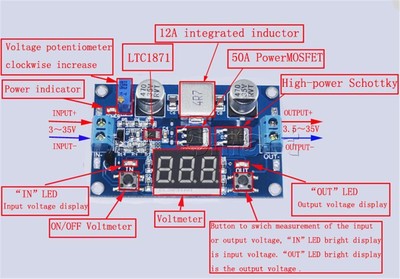
I've been meddling with supercapacitors (2 X 50F/3v. in series) and a small DC/DC Boost Converter driving various loads - 3W/6v bulb, small 6v brushed motor/propeller, 18W/6v bulb. With Vin at about 5.5v and Vout set to 6v, the currents were 0.5, 1.02 & 2.4A respectively. The converter input range is stated to be 3-35v, so below 3v it ceases to 'boost' - fair enough, understood. I measured the Vin at which the Iout & Vout starts to collapse and found it varies according to Iout. The Vin went from 3.1, 3.35 & 3.7v respectively with these different loads. This leaves too much of the supercap energy 'unconverted' to a higher voltage. Not what I expected!

These are the specs for the converter - (copied & pasted):

1. Input Voltage: 3-35V DC (Note: When input voltage is less than 4V, onboard voltmeter will not work).

2. Input Current: 9A (max).
3. Output Voltage: 3.5-35V DC (this board is boosting board, output voltage>=Input voltage).
4. Output Current: 6A (max).
5. Output Power: 65W (when the input and output voltage greater than 20V up to 100W).
6. Conversion Efficiency: 96% (the highest).
7. Output Ripple: 40mV (TYP).
8. Onboard Voltmeter Range: 4-40V.
9. Error:+/-0.1V.

So, the question is: Why?
Register to Reply
Pathfinder Tags: DC/DC converter problem
Interested in this topic? By joining CR4 you can "subscribe" to
this discussion and receive notification when new comments are added.

"Almost" Good Answers:

Check out these comments that don't yet have enough votes to be "official" good answers and, if you agree with them, vote them!
Guru

Join Date: Apr 2010
Location: About 4000 miles from the center of the earth (+/-100 mi)
Posts: 9910
Good Answers: 1141
#1

Re: Small DC/DC Converters

03/07/2019 8:23 AM

I'm surprised that the input voltage would increase with increasing output current. I would expect the opposite.

Here is a circuit you might want to try. It is designed to scavange energy even at low voltages:

Joule Thief

Example of a joule thief circuit driving an LED. The coil consists of a standard ferritetoroid core with two windings of 20 turns each using 0.15 mm (0.006 inch) diameter wire (38 swg) (34-35 AWG). The circuit can utilize an input voltage down to about 0.35 Vand can run for weeks using a 1.5 VLR6/AA. The battery voltage is usually 1.5 V. The resistor is ~1 kΩ, 1/4 W. The transistorcould be a 2N3904, BC547B, 2SC2500, BC337, 2N2222, 2N4401 or other NPN. Vceo= 30 V, P= 0.625 W. A white light-emitting diode with Vf= 3.2 V might be used.[8]

https://en.wikipedia.org/wiki/Joule_thief

Register to Reply
Guru

Join Date: Aug 2008
Location: England & Ireland
Posts: 1063
Good Answers: 61
#2
In reply to #1

Re: Small DC/DC Converters

03/07/2019 8:42 AM

I think you may have misunderstood my comment:

"I measured the Vin at which the Iout & Vout starts to collapse and found it varies according to Iout."

The Vin is deceasing (of course) during the discharge. I'm measuring it at the point that the 'boost' no longer functions.

Yes, have looked at Joule Thief - seems appropriate for very low powers.

Register to Reply
Guru

Join Date: Apr 2010
Location: About 4000 miles from the center of the earth (+/-100 mi)
Posts: 9910
Good Answers: 1141
#9
In reply to #2

Re: Small DC/DC Converters

03/08/2019 11:42 AM

OK, that makes more sense.

So, the question is: Why?

Whenever you have a voltage regulator or voltage boost circuit, there's a voltage overhead (like a tax) that the circuit takes off the top and the rest you have to pass on to the load. For example, a 5-volt regulator requires about 7-8 volts on the input. In your case, it looks like a bit over 3 volts "overhead". The overhead increases as you draw more current, IR loss.

The capacitance of 2 x 50F capacitors in series is 25F. The energy you can store in a capacitor is E = 1/2 C V2. At 6 volts, this comes out to be E = .5 x 25 x 36 = 450 Joules. At 3 volts (where it cuts out) the energy left is E = .5 x 25 x 9 = 112.5 Joules. So you have 75% of your energy available.

The only way around this inefficiency, other than to use a circuit with a lower overhead, is to operate at a higher voltage. For example, 4 x 25 F capacitors would store the same amount of energy (450 J) as 2 x 50 F, but in series, charged to 12 v the unavailable energy would be 56.25 and 87.5% of the energy would be available.

Register to Reply
Guru

Join Date: Aug 2008
Location: England & Ireland
Posts: 1063
Good Answers: 61
#11
In reply to #9

Re: Small DC/DC Converters

03/11/2019 7:36 AM

Yes, thanks. I've gone through all the permutations & combinations of series & parallel supercaps and how much I can recover at a fixed output voltage. My intended Vout is 7.4v. to match the output of 2-cell LiPo battery. My next experiment is to be 3 X 50F/3v supercaps in series, charged to 9v. and using a buck/boost converter to get 7.4v out. Unfortunately all the ones I see, and the one I have, have a lower cut-off point at 5v. (worse than the boost converters), so I can only convert from 9v to 5v., which represents 82.6% of the energy - slightly better than the 75%. So, as you say, 4 X 25F would be even better, but still subject to the 5v cut-off.

Note: When the cut-off point has been passed, the output still exists and merely follows Vin.

Register to Reply
Guru

Join Date: Aug 2005
Location: Hemel Hempstead, UK
Posts: 5826
Good Answers: 322
#3

Re: Small DC/DC Converters

03/07/2019 9:16 AM

You need to look at the datasheet for the LTC1871 along with the circuit diagram for the Converter Module #61105

You may need to reverse engineer the relevant part of the circuit diagram if it's not supplied with the board.

__________________
If you spend all your time looking for people and things to complain about: trust me, you will find plenty to complain about.
Register to Reply
Guru

Join Date: Mar 2007
Location: by the beach in Florida
Posts: 33392
Good Answers: 1817
#4

Re: Small DC/DC Converters

03/07/2019 12:50 PM

You're not using these devices at the most efficient levels...Your using a bus with 5 people on it and complaining about the gas mileage...

__________________
All living things seek to control their own destiny....this is the purpose of life
Register to Reply Score 1 for Good Answer
Guru
Hobbies - DIY Welding - Wannabeabettawelda

Join Date: May 2007
Location: Annapolis, Maryland
Posts: 7940
Good Answers: 458
#5
In reply to #4

Re: Small DC/DC Converters

03/07/2019 5:16 PM

Good analogy.

Register to Reply
Guru

Join Date: Aug 2008
Location: England & Ireland
Posts: 1063
Good Answers: 61
#6
In reply to #4

Re: Small DC/DC Converters

03/07/2019 5:24 PM

Explain.

Register to Reply
Guru
Hobbies - DIY Welding - Wannabeabettawelda

Join Date: May 2007
Location: Annapolis, Maryland
Posts: 7940
Good Answers: 458
#7
In reply to #6

Re: Small DC/DC Converters

03/07/2019 5:44 PM

It's mostly in the magnetics but switch utilization plays a part as well. See the chart below for a comparison on one company's buck converter against their competition.

It doesn't matter if it is buck, boost, or buck-boost or whatever. They all look similar. Some may also roll off at the high end too.

https://www.maximintegrated.com/en/app-notes/index.mvp/id/4266

https://www.electronicdesign.com/power/fundamentals-buck-converter-efficiency

https://www.analog.com/media/en/technical-documentation/application-notes/an46.pdf

http://www.engr.colostate.edu/ECE562/lecture_supplements/chapter6_switch_utilization.pdf

and so on . . . .

Register to Reply Score 1 for Good Answer
Guru

Join Date: Mar 2007
Location: by the beach in Florida
Posts: 33392
Good Answers: 1817
#8
In reply to #6

Re: Small DC/DC Converters

03/07/2019 5:56 PM

At extremely light load the efficiency is low...the more current you draw the efficiency goes up then levels off and usually declines slowly...Look at the performance curve for your boost component....

...maybe something like this...

__________________
All living things seek to control their own destiny....this is the purpose of life
Register to Reply
Guru

Join Date: Aug 2008
Location: England & Ireland
Posts: 1063
Good Answers: 61
#10
In reply to #8

Re: Small DC/DC Converters

03/11/2019 6:55 AM

Thanks - my intended output is about 30W - 7.4v and 4 amps. The 7.4v is to simulate the output of a 2-cell LiPo battery, which is commonly used to power small model motors, so we are in the 'efficient' area according to you graph. The next voltage of interest would be 3-cell LiPo at 11.1v.

As regards the performance curves - these devices are made in China, have little information and sell for about the price of a cheeseburger on eBay & Amazon. On the other hand they are very well made and I'm staggered that anyone makes a profit on them. Perhaps that's part of the problem.

Register to Reply
Guru

Join Date: Aug 2005
Location: Hemel Hempstead, UK
Posts: 5826
Good Answers: 322
#12
In reply to #10

Re: Small DC/DC Converters

03/11/2019 11:40 AM

I wouldn't buy a cheeseburger on eBay

Yes: the units are made in china, but the heart of it is a good old Linear Tech. LTC1871, and the relevant part of the circuitry should be easy to reverse engineer.

You could even then use LTspice to eveluate its performance.

__________________
If you spend all your time looking for people and things to complain about: trust me, you will find plenty to complain about.
Register to Reply
Guru

Join Date: Aug 2008
Location: England & Ireland
Posts: 1063
Good Answers: 61
#13
In reply to #12

Re: Small DC/DC Converters

03/11/2019 11:53 AM

You might be able to, but I am but a humble chemist.

Register to Reply
Guru
Hobbies - HAM Radio - New Member Hobbies - Model Rocketry - New Member

Join Date: Jan 2007
Posts: 787
Good Answers: 52
#14

Re: Small DC/DC Converters

03/11/2019 4:58 PM

Your Vin is 5.5v and Vout is at 6v so you are only stepping up half a volt? I don't know that particular device but in my experience with DC to DC converters with that small of a difference they either didn't work or are very inefficient and unpredictable at that small difference. For all the cheap ebay devices I tested when Vin=Vout the converter didn't work at all. You might want to try stepping up to a higher voltage for your testing.

For my use I needed a stable 5v out while the input would vary from 4v to 12v and while I could find buck boost converters capable of this they were more expensive. I ended up using a step up converter to go to about 20v (could have been less) and then from the 20v a step down to go to 5v. A round about way to me indeed but it worked fine and given the cost of the converters was the least expensive solution.

Register to Reply
Register to Reply 14 comments

"Almost" Good Answers:

Check out these comments that don't yet have enough votes to be "official" good answers and, if you agree with them, vote them!
Copy to Clipboard

Users who posted comments:

Brave Sir Robin (2); energyconversion (5); frankd20 (1); Randall (2); Rixter (2); SolarEagle (2)

Previous in Forum: 3 Phase Power Data Logger   Next in Forum: Electrical Surge Protection

Advertisement