The researchers say it will be a decade before this is commonly available in hospitals. The heart is definitely a difficult one, but others could be done sooner.
The success rate and lifespan of an organ transplant will go way up when the rejection issues are taken out of the equation. The issue of waiting for a donor match while health deteriorates is also removed (in theory... it will take something else to address general wait times for care in this country!).
And of course, the criminal market for organs will be finished. That alone will be a big step towards a better world.
Researchers since the 70s, predicted human extinction 6 or 7 times.... Let's all be optomistrists here, and look through the lenz for a more positive outlook.
I have a lit of parts I would like to replace, after a little editing...
__________________
I need all the equipment that "pays for itself" because I am tired of doing the paying !
This a critical, important step in organ repair/replacement worthy of praise. A lot more work and study has to be done before any 3D printed organ can be placed into a patient. First, this heart does use human cells and patient-specific biological materials but it is the size of a rabbit's heart, not a human heart. I wonder how much bigger is an infant's heart to this heart? Also, there is not one word mentioned in the article about this heart beating or pumping any fluid at all.
So don't expect this technology to save anyone soon. Nonetheless, this is a great achievement.
__________________
"Don't disturb my circles." translation of Archimedes last words
Really? You believe the only way one can test a pump is to transplant it into a living creature. Let me introduce you to peristaltic pump testing. Transplanting into a similarly sized animal will be the penultimate test but certainly not the only way to test a pump.
__________________
"Don't disturb my circles." translation of Archimedes last words
I guess the additional concern is for specialized cells to behave as needed - that does require in vivo.
What flaws would you anticipate in the pumping action of a heart that follows the basic blueprint? The design has been tested extensively.. A material failure is possible, given the cells are not the expected or intended size, according to the article.
I'm guessing that they didn't expect the heart to be so tiny...
With bioprinting, the "ink" is key. What cells do you start with, and how do you nurture them, what are the best ways to influence gene expression for the desired result.
In scaling up a heart, you wouldn't want to do anything that would cause the basic blueprint to fail.
You still seem to be missing my point. (Yes, I'm mostly to blame for that.)
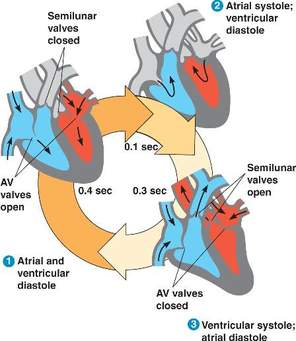
If the printed heart does not perform this sequence of actions, at about this nominal rate while moving the necessary volume of fluid then what good is it. The article didn't even mention if the muscle moved at all by itself or with external stimuli applied. Printing a dead heart is amusing. Printing a pumping heart is something to really celebrate.
__________________
"Don't disturb my circles." translation of Archimedes last words
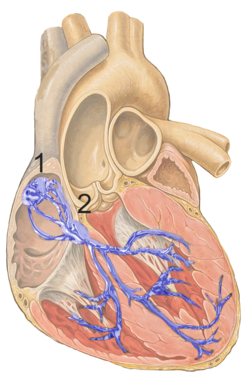
Forget the myocardial muscle! Just print functioning blue parts in the drawing below!
1 : Sinoatrial node
2: Atrioventricular node
PIECE OF CAKE!
These are specialized myocardial cells that do not work not as muscles, but as nerves !!!
Electrical stimuli are generated in specific nodes to keep the heart working autonomously. A backup / relay system is capable of keeping the heart beating if things go wrong.
__________________
the more I move, the deeper I get stuck !
Methane produced by cattle is one of the sources of the "green house effect". 3D printed muscles in the food factories of the future will help to reduce global warming and number of vegans as well.
__________________
the more I move, the deeper I get stuck !
The complexity of the human body exceeds by far the human understanding: it is great that researchers were able to print a tissue in the form of a human heart, no matter how big it is... BUT, to expect this organ-like printed tissue to work as an organ (even in 50 years from now) is very naive.
PS: how much for a new brain?
__________________
the more I move, the deeper I get stuck !
Bioprinted blood vessels have already been successfully transplanted in animals. Much easier to print than a heart, but it will have an impact on the treatment of arterial / heart disease.
This article from June 2017: scroll down for details about the animal transplants.
Well, there is a slight difference between a blood vessel or a human bone and a heart.
At the company I work for we manufactures -among other products- implantable hydroaxyapatite (HAP).
HAP is the scaffold a healthy body needs to generate bone. By mixing this hydroxyapatite with a biological polymer like Polylactic acid (PLA) we could easily make a filament to custom print any bone in this machine.... but that is not core business
__________________
the more I move, the deeper I get stuck !
"Almost" Good Answers: