Previous in Forum: Harmonic Test Error   Next in Forum: Deep Borehole Nuclear Waste Disposal
Close
Close
Close
9 comments
Rating: Comments: Nested
Associate

Join Date: Feb 2019
Posts: 38

Inductance Boost of a Flat Planar Coil Using Ferrite

06/24/2019 9:58 AM

Hi All, I am trying to find an equation that can accurately calculate the inductance boost of a flat planar coil as an air coil vs. a coil with a sheet or block of ferrite underneath. This can be simulated fairly well using programs like EMS for SolidWorks, so I figured that there must be some equation that the program uses to derive something out of it. Many factors are known like area, shape, material of the coil, permeability and size of the ferrite, ect.

Register to Reply
Interested in this topic? By joining CR4 you can "subscribe" to
this discussion and receive notification when new comments are added.

Good Answers:

These comments received enough positive votes to make them "good answers".

"Almost" Good Answers:

Check out these comments that don't yet have enough votes to be "official" good answers and, if you agree with them, vote them!
Guru

Join Date: Mar 2007
Location: by the beach in Florida
Posts: 33392
Good Answers: 1817
#1

Re: Inductance Boost of a Flat Planar Coil Using Ferrite

06/24/2019 10:28 AM

  • Where:
  • N is the number of turns
  • A is the cross-sectional Area in m2
  • Φ is the amount of flux in Webers
  • μ is the Permeability of the core material
  • l is the Length of the coil in meters
  • di/dt is the Currents rate of change in amps/second

A time varying magnetic field induces a voltage that is proportional to the rate of change of the current producing it with a positive value indicating an increase in emf and a negative value indicating a decrease in emf. The equation relating this self-induced voltage, current and inductance can be found by substituting the μN2A / l with L denoting the constant of proportionality called the Inductance of the coil.

The relation between the flux in the inductor and the current flowing through the inductor is given as: NΦ = Li. As an inductor consists of a coil of conducting wire, this then reduces the above equation to give the self-induced emf, sometimes called the back emf induced in the coil too:

https://www.electronics-tutorials.ws/inductor/inductor.html

https://www.allaboutcircuits.com/tools/coil-inductance-calculator/

__________________
All living things seek to control their own destiny....this is the purpose of life
Register to Reply Score 1 for Good Answer
Associate

Join Date: Feb 2019
Posts: 38
#2
In reply to #1

Re: Inductance Boost of a Flat Planar Coil Using Ferrite

06/24/2019 10:46 AM

Thank you. So I assume the variable changing in my case would be the magnetic flux. What I have now is a planar air coil measured at 3.8uH inductance testing at 100kHz and 1VRMS. When I use a sheet of ferrite with a permeability of 3000u' and measure the inductance of the coil, I get 6.77uH. Am I going to be using Maxwell's equations for this?

Register to Reply
Guru

Join Date: Mar 2007
Location: by the beach in Florida
Posts: 33392
Good Answers: 1817
#3
In reply to #2

Re: Inductance Boost of a Flat Planar Coil Using Ferrite

06/24/2019 11:28 AM
__________________
All living things seek to control their own destiny....this is the purpose of life
Register to Reply
Guru

Join Date: Apr 2010
Location: About 4000 miles from the center of the earth (+/-100 mi)
Posts: 9910
Good Answers: 1141
#4

Re: Inductance Boost of a Flat Planar Coil Using Ferrite

06/24/2019 4:55 PM

Within a few percent, this formula can be used:

Flat "pancake" coil

L (uH) = r^2 * n^2 / (8 * r + 11 * w)

where

r = radius to center of windings in inches
w = width of windings (in inches)
n = number of turns

http://home.earthlink.net/~jimlux/hv/wheeler.htm

For most coils you can multiply by the permeability of the core as long as the current does not saturate.

https://www.allaboutcircuits.com/tools/coil-inductance-calculator/

Register to Reply
Associate

Join Date: Feb 2019
Posts: 38
#5
In reply to #4

Re: Inductance Boost of a Flat Planar Coil Using Ferrite
06/24/2019 5:07 PM

If the permeability is 3000u’, what do I multiply that with to get an inductance similar to what was in the original post?

Register to Reply
Guru

Join Date: Apr 2010
Location: About 4000 miles from the center of the earth (+/-100 mi)
Posts: 9910
Good Answers: 1141
#6
In reply to #5

Re: Inductance Boost of a Flat Planar Coil Using Ferrite

06/24/2019 7:02 PM

Let me clarify #4. For the inductance to be multiplied by the permeability, there has to be a complete magnetic circuit, like a toroidal inductor.

If you have a planar coil with a ferrite block next to it, the increase in inductance would likely be less than a factor of 2 higher than the coil without ferrite. It would essentially be a ferrite core with a very large air gap.

Register to Reply
Associate

Join Date: Feb 2019
Posts: 38
#8
In reply to #6

Re: Inductance Boost of a Flat Planar Coil Using Ferrite

06/24/2019 7:25 PM

Yeah I am trying to find an equation to calculate inductance boost of a planar coil. I see its usually around less than a factor of 2 though, you’re correct.

Register to Reply
2
Guru

Join Date: Apr 2010
Location: About 4000 miles from the center of the earth (+/-100 mi)
Posts: 9910
Good Answers: 1141
#9
In reply to #8

Re: Inductance Boost of a Flat Planar Coil Using Ferrite

06/24/2019 8:59 PM

Here's how you figure it. An inductor reacts to its own magnetic field. When the current and magnetic field change, there is a voltage generated in the inductor. That voltage opposes increasing current and aids decreasing current.

Actually, analyzing a magnetic circuit with an air gap is not that difficult.

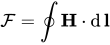
From the number of turns, N, and current, I, you can calculate the line integral of the H field around the magnetic circuit,

(Where H is constant, the line integral is just length x H)

https://en.wikipedia.org/wiki/Magnetic_circuit

The flux density B = μH, is continuous, i.e., the flux lines have no ends, the total number of flux lines around the magnetic circuit remains constant. This means that the H field has to change at different parts of the circuit, and where μ is small (the air gap), H must be large. Since μ for ferrous materials is large (>1000μ0), virtually all of H drops across the air gap, and so the line integral simplifies to H times the width of the air gap, g.

It's similar to an electric circuit where the wires have very low resistance. Almost all of the voltage drop is across the resistor. Almost all of the magnetomotive force in a magnetic circuit is across the air gap.

http://info.ee.surrey.ac.uk/Workshop/advice/coils/gap/index.html

Knowing the total H x g, where g is the air gap width, you can calculate B.

Bottom line: NI = gH = gB/μ, or B=μNI/g.

B is inversely proportional to the air gap width, g.

If you have a block of ferrite covering half of your magnetic circuit, your air gap is approximately half the distance of your air gap without the ferrite and the B field would be about twice the field without the ferrite.

The induced voltage, which determines your inductance, is proportional to the rate of change of B. Hence, the estimate is that your inductance would be slightly less than twice as large with the ferrite in place.

Register to Reply Good Answer (Score 2)
Guru

Join Date: Mar 2007
Location: by the beach in Florida
Posts: 33392
Good Answers: 1817
#7
In reply to #5

Re: Inductance Boost of a Flat Planar Coil Using Ferrite

06/24/2019 7:17 PM
__________________
All living things seek to control their own destiny....this is the purpose of life
Register to Reply
Register to Reply 9 comments

Good Answers:

These comments received enough positive votes to make them "good answers".

"Almost" Good Answers:

Check out these comments that don't yet have enough votes to be "official" good answers and, if you agree with them, vote them!
Copy to Clipboard

Users who posted comments:

Rixter (3); SolarEagle (3); tws26 (3)

Previous in Forum: Harmonic Test Error   Next in Forum: Deep Borehole Nuclear Waste Disposal

Advertisement