Previous in Forum: Hydrotesting Lines Going from Ground to 52 m Height at Tank Top   Next in Forum: Flux Core MIG Welding
Close
Close
Close
18 comments
Rate Comments: Nested
Power-User

Join Date: Nov 2008
Posts: 121
Good Answers: 4

How to Calculate Sommerfeld Number?

01/12/2020 9:02 AM

How to calculate Sommerfeld no for vertical pump thrust bearing. What will be the value of c, i.e. clearance.

Register to Reply
Pathfinder Tags: Sommerfeld no
Interested in this topic? By joining CR4 you can "subscribe" to
this discussion and receive notification when new comments are added.

Good Answers:

These comments received enough positive votes to make them "good answers".

"Almost" Good Answers:

Check out these comments that don't yet have enough votes to be "official" good answers and, if you agree with them, vote them!
Guru

Join Date: Apr 2010
Location: About 4000 miles from the center of the earth (+/-100 mi)
Posts: 9917
Good Answers: 1142
#1

Re: Sommerfeld no

01/12/2020 11:15 AM

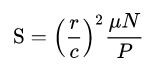
The Sommerfeld Number is typically defined by the following equation.[1]

Where:

S is the Sommerfeld Number or bearing characteristic number
r is the shaft radius
c is the radial clearance
µ; is the absolute viscosity of the lubricant
N is the speed of the rotating shaft in rev/s
P is the load per unit of projected bearing area

https://en.wikipedia.org/wiki/Sommerfeld_number

Register to Reply Score 1 for Good Answer
Power-User

Join Date: Nov 2008
Posts: 121
Good Answers: 4
#2
In reply to #1

Re: Sommerfeld no

01/12/2020 11:24 AM

What will be the value of c for tilting pad type thrust bearing. All other parameters I have got.

Register to Reply
2
Guru

Join Date: Apr 2010
Location: About 4000 miles from the center of the earth (+/-100 mi)
Posts: 9917
Good Answers: 1142
#3
In reply to #2

Re: Sommerfeld no

01/12/2020 5:46 PM

It's out of my field, but I'm thinking that "Sommerfeld number" only applies to journal bearings and not thrust bearings.

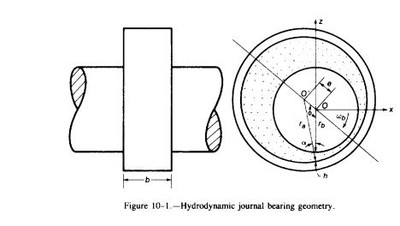
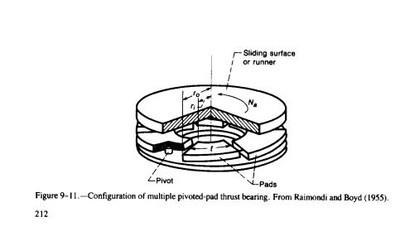
A journal bearing is lubricated by a layer of lubricant between the rotating shaft and the outer bearing, supported by the rotation. A corresponding thrust bearing has a series of inclined planes (pivoted-pads) that serve the same purpose. It's a different geometry, and I'm not sure the same formula can apply.

Journal Bearing

Thrust Bearing

https://ntrs.nasa.gov/archive/nasa/casi.ntrs.nasa.gov/19910021217.pdf

https://pdfs.semanticscholar.org/304f/b3e6e7db3be97354802616ad7e2fd70999bc.pdf

Register to Reply Good Answer (Score 2)
Guru

Join Date: Mar 2007
Location: by the beach in Florida
Posts: 33392
Good Answers: 1817
#4
In reply to #2

Re: Sommerfeld no

01/12/2020 8:54 PM

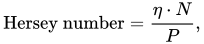
..."where η is the dynamic viscosity of the fluid, N is the speed of the fluid and P is the normal load per length of the tribological contact. Hersey's original formula uses the rotational speed (revolutions per unit time) for N and the load per projected area (i.e. the product of a journal bearing's length and diameter) for P. Thus, for a given viscosity and load, the Stribeck curve shows how friction changes with increasing velocity. Based on the typical progression of the Stribeck curve (see right), three lubrication regimes can be identified.

  1. Boundary lubrication
    • Solid surfaces come into direct contact, load supported mainly by surface asperities, high friction
  2. Mixed lubrication
    • Some asperity contact, load supported by both asperities and the liquid lubricant.
  3. Hydrodynamic lubrication
    • Negligible asperity contact, load supported mainly by hydrodynamic pressure.

http://digital.pumpsandsystems.com/publication/?i=609672&article_id=3452809&view=articleBrowser&ver=html5#{%22issue_id%22:609672,%22view%22:%22articleBrowser%22,%22publication_id%22:%2238812%22,%22article_id%22:%223452809%22}

https://en.wikipedia.org/wiki/Stribeck_curve#Concept

__________________
All living things seek to control their own destiny....this is the purpose of life
Register to Reply
Guru

Join Date: Mar 2007
Location: by the beach in Florida
Posts: 33392
Good Answers: 1817
#6
In reply to #4

Re: Sommerfeld no

01/12/2020 10:50 PM
__________________
All living things seek to control their own destiny....this is the purpose of life
Register to Reply
Power-User

Join Date: Nov 2009
Posts: 296
Good Answers: 27
#5

Re: Sommerfeld no

01/12/2020 9:49 PM

c = radial clearance There is no radial clearance in a thrust bearing.

What are you trying to ascertain. This may help.

__________________
I have no special talent. I am only passionately curious. Albert E
Register to Reply Score 1 for Good Answer
Power-User

Join Date: Nov 2008
Posts: 121
Good Answers: 4
#7
In reply to #5

Re: Sommerfeld no

01/13/2020 12:16 AM

Can anyone tell what is the lower limit of RPM or DN factor for hydrodynamic lubrication. D is dia of shaft N is RPM. I think it has something to do with Sommerfeld no.

Register to Reply
Guru

Join Date: Mar 2007
Location: by the beach in Florida
Posts: 33392
Good Answers: 1817
#8
In reply to #7

Re: Sommerfeld no

01/13/2020 12:50 AM

https://www.tribonet.org/wiki/hydrodynamic-lubrication/

The answer will depend on several variable criteria...first you determine the coefficient of friction, then design or calculate the lubricant and additives...so the viscosity of the lubricant will determine the speed, with the viscosity adding friction as the speed increases, at some point there has to be a trade-off between speed desired and lubricant viscosity...

=friction force
=

coefficient of friction

=

normal force

__________________
All living things seek to control their own destiny....this is the purpose of life
Register to Reply
Guru

Join Date: Mar 2007
Location: by the beach in Florida
Posts: 33392
Good Answers: 1817
#9
In reply to #8

Re: Sommerfeld no

01/13/2020 4:11 AM
__________________
All living things seek to control their own destiny....this is the purpose of life
Register to Reply
Power-User

Join Date: Nov 2008
Posts: 121
Good Answers: 4
#10
In reply to #8

Re: Sommerfeld no

01/13/2020 10:42 AM

Solar eagle, that way, we will determine the highest speed. Suppose we want tilting and thrust bearing for 300 RPM and we know oil properties and load on bearing , how can we say that proper thickness film will be formed and take the axial load. Regards.

Register to Reply
Guru

Join Date: Mar 2007
Location: by the beach in Florida
Posts: 33392
Good Answers: 1817
#11
In reply to #10

Re: Sommerfeld no

01/13/2020 10:54 AM

The lubricating oil will change viscosity when heated, the more friction, the greater the need for cooling and additives to maintain viscosity ...this is why we need a flow of oil and a cooling scheme, all to maintain viscosity under load....

..."Not all oils respond in the same way to a given change in temperature. Many oils contain an ability to resist changes in viscosity due to a change in temperature. This property is referred to as the oil's viscosity index or VI. The higher the VI of an oil, the less its viscosity is altered by temperature changes.

Kinematic viscosity, viscosity index and shear stress/shear rate are all factors that should be taken into account by a lubricant manufacturer when blending lubricating oils, but what does all this mean to the end user? It means that the viscosity of an oil is the first and most important consideration when selecting an oil for a specific application.

Remember, for the most effective lubrication, the viscosity must conform to the speed, load and temperature conditions of the lubricated parts....."

https://www.machinerylubrication.com/Read/29185/oil-viscosity-importance

__________________
All living things seek to control their own destiny....this is the purpose of life
Register to Reply
Guru

Join Date: Mar 2007
Location: by the beach in Florida
Posts: 33392
Good Answers: 1817
#12
In reply to #10

Re: Sommerfeld no

01/13/2020 2:08 PM

Calculations regarding heat generated when at speed and heat transfer ability of the oil will determine the volume of flow necessary to keep the oil in the proper viscosity, the volume of flow and heat transfer characteristics of the oil and supply/cooling design of the oil circulation will dictate the pressure required of the oil pump according to the circulation sump/reservoir and plumbing chosen to meet the necessary criteria...

https://ntrs.nasa.gov/archive/nasa/casi.ntrs.nasa.gov/19720018725.pdf

__________________
All living things seek to control their own destiny....this is the purpose of life
Register to Reply
Guru

Join Date: Mar 2007
Location: by the beach in Florida
Posts: 33392
Good Answers: 1817
#13
In reply to #12

Re: Sommerfeld no

01/14/2020 3:06 AM

https://www.substech.com/dokuwiki/doku.php?id=oil_clearance_and_engine_bearings

https://www.kingsbury.com/pdf/universe_brochure.pdf

The clearance required will depend on the tolerances of the bearing wall thickness...

__________________
All living things seek to control their own destiny....this is the purpose of life
Register to Reply
Guru

Join Date: Mar 2007
Location: by the beach in Florida
Posts: 33392
Good Answers: 1817
#14
In reply to #13

Re: Sommerfeld no

01/14/2020 3:22 AM
__________________
All living things seek to control their own destiny....this is the purpose of life
Register to Reply
Power-User

Join Date: Nov 2009
Posts: 296
Good Answers: 27
#15
In reply to #10

Re: Sommerfeld no

01/14/2020 3:31 AM

The answer my friend is in the link that I sent you.

300 rpm pump requiring a thrust bearing is an interesting duty, but practical with good bearing design and fairly high viscosity oil. If you gave all the details it would make it easier to help you.

__________________
I have no special talent. I am only passionately curious. Albert E
Register to Reply
Guru

Join Date: Mar 2007
Location: by the beach in Florida
Posts: 33392
Good Answers: 1817
#16
In reply to #15

Re: Sommerfeld no

01/14/2020 9:46 PM

I think the oil pressure and lubricating system design is equally important, as are the machine tolerances of the bearing wall thickness which must be taken into account for proper clearance...The details of the formulation of the lubricant must work in concert with pressures, design and environment of the bearing...Stipulating a one-size-fits-all clearance seems a bit risky...giving a range doesn't really solve the problem....I agree without all the details it's the best we can do though... .003" with adequate oil pressure to lift the load on start-up...

__________________
All living things seek to control their own destiny....this is the purpose of life
Register to Reply
Power-User

Join Date: Nov 2008
Posts: 121
Good Answers: 4
#17
In reply to #15

Re: Sommerfeld no

01/14/2020 11:35 PM

What is the industry practice to determine minimum coefficient of friction for bearing. So that we may choose suitable zn/p which should be nearly 5 To 15 times of friction coefficient.

Register to Reply
Guru

Join Date: Mar 2007
Location: by the beach in Florida
Posts: 33392
Good Answers: 1817
#18
In reply to #17

Re: Sommerfeld no

01/14/2020 11:58 PM

..."Friction coefficient is generally below 0.001. Self-lubricated bearings vary widely. It is difficult to predict performance for a given bearing/lubricant system. The range of coefficients of friction is 0.01 to 0.10 for boundary lubrication and 0.01 to 0.3 for self-lubrication."...

...."More important to the equipment designer than frictional force is the amount of frictional torque that must be overcome. This parameter can easily be calculated using the formula below:

where:
P = Equivalent Load on the bearing
μ = Coefficient of friction
dm = Pitch diameter of bearing

https://www.bearingtips.com/bearing-friction-basics-primer/

https://www.machinedesign.com/mechanical-motion-systems/bearings/article/21812621/bearing-friction

__________________
All living things seek to control their own destiny....this is the purpose of life
Register to Reply
Register to Reply 18 comments

Good Answers:

These comments received enough positive votes to make them "good answers".

"Almost" Good Answers:

Check out these comments that don't yet have enough votes to be "official" good answers and, if you agree with them, vote them!
Copy to Clipboard

Users who posted comments:

IRSHAD (4); Kaisan (2); Rixter (2); SolarEagle (10)

Previous in Forum: Hydrotesting Lines Going from Ground to 52 m Height at Tank Top   Next in Forum: Flux Core MIG Welding

Advertisement