Previous in Forum: PB 302 LV2   Next in Forum: Adhesives to Fix Pinion to Nut?
Close
Close
Close
17 comments
Rating: Comments: Nested
Commentator

Join Date: Jun 2009
Posts: 88

Fluids Mixing at Two Different Pressures

06/26/2020 8:41 PM

I have an application as follows:

I have positive displacement pump 1 that is pumping at around 6 BPM ( through a 4" pipe) at pressure P1. There is another smaller positive displacement pump 2 that is pumping at around 0.8 BPM ( through a 1" pipe) at pressure P2. These 2 fluids mix at a point and are discharged to a open tank ( atmospheric pressure). I would like to know the pressure at the mixing point Pm. Is there any empirical formula that i can use to determine the pressure at point Pm? Any guidance is very much appreciated.

Register to Reply
Interested in this topic? By joining CR4 you can "subscribe" to
this discussion and receive notification when new comments are added.

Good Answers:

These comments received enough positive votes to make them "good answers".

"Almost" Good Answers:

Check out these comments that don't yet have enough votes to be "official" good answers and, if you agree with them, vote them!
Guru

Join Date: Oct 2006
Location: 44.56024"N 15.307971E
Posts: 8277
Good Answers: 270
#1

Re: Fluids mixing at two different pressures

06/26/2020 8:55 PM

Not enough information provided.

Your image is not readable at the scale provided.

A lot will depend on the shape of the mixing point and the point of measurement.

If configured as a venturi,the larger flow will actually suck the smaller flow into the main larger flow stream.

The length and diameter of the pipe after the mixing point is also an important factor.

Lots of variables to consider.

More info=More feedback.

__________________
"A man never stands so tall as when he stoops to help a child." "Never argue with a stupid person.They will drag you down to their level and beat you with experience" "To create an apple pie from scratch, first you must create a universe"
Register to Reply
Commentator

Join Date: Jun 2009
Posts: 88
#4
In reply to #1

Re: Fluids mixing at two different pressures

06/27/2020 2:25 AM

I am not able to attach the picture. It is basically two streams of chemicals mixed and going into a tank.

The first positive displacement pump 1 pumps 6 BPM through a 4" pipe. The second displacement pump 2 pumps 0.8 BPM through a 1" pipe. They meet at a point and the discharge to the tank is also 4". The 1 inch line is joined to the 4" line via a couple of expansion joints. I hope this is clear.

Register to Reply
4
Guru

Join Date: Apr 2010
Location: About 4000 miles from the center of the earth (+/-100 mi)
Posts: 9911
Good Answers: 1141
#2

Re: Fluids mixing at two different pressures

06/26/2020 9:30 PM

P1 and P2 are irrelevant. The total flow from the mixing point to the outlet is 6.8 BPM. The pressure drop from the mixing point to the outlet (atmospheric pressure) is a function of this flow rate, the diameter of the outlet pipe (4"), the length of the pipe from the mixing point to the outlet (which is not specified), the roughness of the pipe, etc.

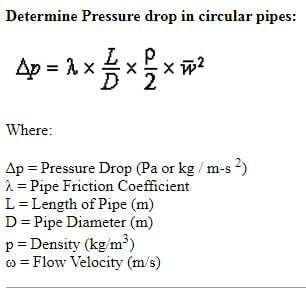
https://www.engineersedge.com/fluid_flow/pressure_drop/pressure_drop.htm

Register to Reply Good Answer (Score 4)
Commentator

Join Date: Jun 2009
Posts: 88
#5
In reply to #2

Re: Fluids mixing at two different pressures

06/27/2020 2:44 AM

I still need to know the pressure at Pm to ensure that from that point to the tank, I have enough pressure to overcome the back pressure of the piping between the Pm to the tank. How will i be able to determine the pressure at Pm?

Register to Reply
Guru

Join Date: Apr 2010
Location: About 4000 miles from the center of the earth (+/-100 mi)
Posts: 9911
Good Answers: 1141
#11
In reply to #5

Re: Fluids mixing at two different pressures

06/27/2020 5:09 PM

You specified the flow rate at each pump. To deliver that flow rate, the pump has to produce a pressure that maintains that flow rate against the flow resistance of the pipes.

You can't specify both the flow rate and pressure at the pump. If you specify flow rate, you can calculate pressure using the flow resistance of the pipes. If you specify pressure, you can calculate flow rate using the flow resistance of the pipes.

It's like an electrical circuit. If you put a resistor of resistance R across a battery of voltage V, you can calculate current I = V / R. If you know the current I, you can calculate voltage V = I x R.

Register to Reply
Participant

Join Date: Apr 2020
Posts: 3
#17
In reply to #5

Re: Fluids mixing at two different pressures

06/29/2020 9:15 AM

If you have "positive displacement pumps" (like piston or screw pumps), they supply a nominal constant flow regardless of the pressure, until their max operating pressure or motor power limit. According to this, pressure at Pm is only due to the pressure drop of the pipe Pm to Tank. The pressure at P1 and P2 is the sum of the pressure at Pm plus respectively the pressure drop of the pipe P1 to Pm and P2 to Pm. To calculate these pressures you can use the equation posted above by Rixter. The difficulty of that equation is the compute of "Friction Factor". I can help you a little on this factor as below:

1. first calculate the Reynolds Number Re = W*D/v where

W is the fluid velocity in "m/s"

D is the pipe internal diameter in "m"

v is the Fluid Kinematic Viscosity in "cSt"

2. secondly calculate the Friction Factor acc.to the following:

IF Re < 2300 then 64/Re

IF Re >= 2300 then 0.25*LOG10((k/(3,7*D))+(5,74/Re^0,9))^(-2))

where k is the Absolute Roughness of the pipe in "mm"

To be more precise, the equation posted by Rixter should be completed by adding to L/D the ∑Le/D , where each Le/D represents the Equivalent Length of the fittings in the piping route, like valves, elbows, bends, joints and tees.

(L/D+∑L_e/D)

Fitting Type

Le/D

Gate valve, full open8
Ball valve full bore3
Ball valve red. Bore, or Check valve25
Globe/Needle valve, full open320
90° elbow fitting30
90° long radius bend13
45° elbow fitting16
45° long radius bend10
Joint or Thru-run-tee10
Thru-branch-tee60
Register to Reply
Guru

Join Date: Mar 2007
Location: by the beach in Florida
Posts: 33392
Good Answers: 1817
#3

Re: Fluids mixing at two different pressures

06/26/2020 9:59 PM
__________________
All living things seek to control their own destiny....this is the purpose of life
Register to Reply
Guru
United Kingdom - Member - Indeterminate Engineering Fields - Control Engineering - New Member

Join Date: Jan 2007
Location: In the bothy, 7 chains down the line from Dodman's Lane level crossing, in the nation formerly known as Great Britain. Kettle's on.
Posts: 32175
Good Answers: 839
#6

Re: Fluids mixing at two different pressures

06/27/2020 4:16 AM

The pressure at the mixing point is only related to the pressure drop due to the flow of 6.8 <...BPM...> downstream, assuming no chemical reaction, and whatever discharge arrangements are provided where the fluid enters the tank. There are established formulae for pressure drop in pipes that go back to Osborne Reynolds’ initial experiments in 1875.

Most Process Engineers wouldn’t need to calculate it. If it is a relevant process measurement then a pressure gauge installed at the mixing point would be a worthwhile addition to the equipment already provided.

if there were a risk of blockage as a result of reaction of the two fluids then some way of protecting the arrangements from over-pressure would be provided.

What was the outcome of the HazOp Study for this plant?

__________________
"Did you get my e-mail?" - "The biggest problem in communication is the illusion that it has taken place" - George Bernard Shaw, 1856
Register to Reply
Commentator

Join Date: Jun 2009
Posts: 88
#7

Re: Fluids mixing at two different pressures

06/27/2020 4:53 AM

Let's say the discharge pressure of fluid 1 is 120 psi and the discharge at fluid 2 is about 30 psi. Will there be an issue of the fluid pumped from P2, since the discharge pressure of P2 is small compared to dicharge pressure at P1? Will there be a proper mix?

Register to Reply
Guru

Join Date: Jul 2007
Location: Commissariat de Police, Nouvions, occupied France, 1942.
Posts: 2599
Good Answers: 77
#9
In reply to #7

Re: Fluids mixing at two different pressures

06/27/2020 7:34 AM

The concept of two different discharge pressures is invalid, Mildred.

__________________
Good moaning!
Register to Reply
Guru

Join Date: Jul 2016
Posts: 1367
Good Answers: 105
#13
In reply to #7

Re: Fluids mixing at two different pressures

06/27/2020 11:24 PM

With your pipe size & flow, it is unlikely you can have both flow and pressure as you describe at each pump discharge, but it is theoretically possible. The pressures indicate a very long 4” pipe length, a very high discharge elevation or an extremely viscous liquid.

Register to Reply
Guru
United Kingdom - Member - Indeterminate Engineering Fields - Control Engineering - New Member

Join Date: Jan 2007
Location: In the bothy, 7 chains down the line from Dodman's Lane level crossing, in the nation formerly known as Great Britain. Kettle's on.
Posts: 32175
Good Answers: 839
#15
In reply to #7

Re: Fluids mixing at two different pressures

06/29/2020 3:17 AM

<...Let's say...> that's nonsense.

__________________
"Did you get my e-mail?" - "The biggest problem in communication is the illusion that it has taken place" - George Bernard Shaw, 1856
Register to Reply Score 1 for Good Answer
Guru

Join Date: Oct 2006
Location: 44.56024"N 15.307971E
Posts: 8277
Good Answers: 270
#8

Re: Fluids mixing at two different pressures

06/27/2020 7:25 AM

As I stated,it depends on the shape of the mixing point.Is it a "Y" shape or a straight "Tee" shape?

If the larger flow is at a velocity higher than the lower flow,(determined by pipe size) and the lower flow is joined at the proper angle to the larger flow,there will be a venturi effect that will present a negative pressure to the smaller flow.

If the mixing point is designed to actually mix the two flows,this is probably the way it is designed.

Since both pumps are PD pumps,it will not matter what the back pressure is,they will pump the same volume of fluid,up to the limits of the pumps.

If you must know and are tasked to specify a pressure measurement device for the junction,a Bordon-tube gauge is the simplest and cheapest way to go.

Digital versions are available,but more expensive,

__________________
"A man never stands so tall as when he stoops to help a child." "Never argue with a stupid person.They will drag you down to their level and beat you with experience" "To create an apple pie from scratch, first you must create a universe"
Register to Reply
Guru

Join Date: Mar 2007
Location: by the beach in Florida
Posts: 33392
Good Answers: 1817
#10
In reply to #8

Re: Fluids mixing at two different pressures

06/27/2020 9:03 AM

__________________
All living things seek to control their own destiny....this is the purpose of life
Register to Reply
4
Guru

Join Date: Jul 2016
Posts: 1367
Good Answers: 105
#12

Re: Fluids Mixing at Two Different Pressures

06/27/2020 11:13 PM

There is only one pressure at the mix point.

There will be 2 different discharge pressures at each pump, but the discharge pressure of each pump solely depends on the piping from each pump all the way to the atmospheric discharge, and the relative elevation changes. There are easy solutions that can give you a good approximation, you need to know fluid viscosity at flow conditions, pipe lengths, otherwise you have all of the required information, assuming BPM is barrels per minute. A more exact number can be calculated if you know the inside diameter of the piping.

The pressure capability of each pump is your only limit, which seems likely you are nowhere near it. Each pump will push the required flow, up until you reach the upper pressure limit of each pump. These are low fluid velocities for the pipe size. It is highly unlikely that this installation will not work as desired, unless we’re talking some coal pitch blend that barely qualifies as a fluid. Again, need viscosity to check.

Register to Reply Good Answer (Score 4)
Guru

Join Date: Dec 2010
Location: North West England
Posts: 1170
Good Answers: 153
#14

Re: Fluids Mixing at Two Different Pressures

06/28/2020 5:31 AM

The two fluids will not mix but just flow in two slightly intermingled streams along the discharge pipe into the tank. The pressure at the junction point will be determined by the back pressure created by the discharge pipe for the combined flow rate. In order to get any mixing you need to add a "static mixer" into the discharge pipe. They are not expensive, have no moving parts, consume a tiny amount of power (a marginal increase to pump amperage), require little or no maintenance, last 'forever', don't add much to the pressure drop and give very consistent results. When specifying one you need to know the "Coefficient of Variation" COV. which is a measure of how well you want the fluids mixed. Check out the SULZER web site for a good description of how they work. There are lots of manufacturers. Choose one near you with facilities to demonstrate how their mixers perform with your ingredients and flow rates.

Register to Reply
Guru

Join Date: Mar 2007
Location: by the beach in Florida
Posts: 33392
Good Answers: 1817
#16
In reply to #14

Re: Fluids Mixing at Two Different Pressures

06/29/2020 3:34 AM
__________________
All living things seek to control their own destiny....this is the purpose of life
Register to Reply
Register to Reply 17 comments

Good Answers:

These comments received enough positive votes to make them "good answers".

"Almost" Good Answers:

Check out these comments that don't yet have enough votes to be "official" good answers and, if you agree with them, vote them!
Copy to Clipboard

Users who posted comments:

Crabtree (1); HiTekRedNek (2); jhhassociates (1); LeoN1 (1); PWSlack (2); Rixter (2); rwilliams (2); SolarEagle (3); vanuta (3)

Previous in Forum: PB 302 LV2   Next in Forum: Adhesives to Fix Pinion to Nut?

Advertisement