Previous in Forum: CT Currents Splitting Between Phases in Relay   Next in Forum: Underground Cable Pull Pit or Box Spacing
Close
Close
Close
10 comments
Rate Comments: Nested
Anonymous Poster #1

Battery WH Calculation

07/09/2020 12:00 PM

Hi,

In one of our projects we have a UPS Requirement of 8KVA, Output voltage of 240Vac, Load current of 30A with battery Back up.

We need one hour Back up.

Now to Supply this much Power, what should be the battery rating and ampere hour

Reply
Interested in this topic? By joining CR4 you can "subscribe" to
this discussion and receive notification when new comments are added.

Good Answers:

These comments received enough positive votes to make them "good answers".

"Almost" Good Answers:

Check out these comments that don't yet have enough votes to be "official" good answers and, if you agree with them, vote them!
Guru

Join Date: Mar 2007
Location: by the beach in Florida
Posts: 33392
Good Answers: 1817
#1

Re: Battery WH Calculation

07/09/2020 2:03 PM
  • time = (inverter efficiency * battery volt * AH)/load in watts)

http://www.company7.com/library/C7_upscalc.html

__________________
All living things seek to control their own destiny....this is the purpose of life
Reply
Anonymous Poster #1
#8
In reply to #1

Re: Battery WH Calculation

07/16/2020 6:49 AM

I have considered the below factors, that include UPS Efficiency, Battery C Rate, Battery ageing. is there any other factor need to considered please let me know

Battery calculation for AC UPS

Battery Voltage Vb (V) 24
Standby Hours Tb (hr) 1
Total UPS Load Pups (kw) 7.17
Ampere Hour for the Load (AH) 298.627451
Battery C rate 0.8
Safety and Battering Ageing Factor at 20% 1.2
Total Battery AH required for the Station (AH) 430.0235294
Battery AH Selection 150
12V Series Battery configuration 2
Number of Series Battery configuration in parallel 4
Number of Batteries required for the load 8
Reply
Guru

Join Date: Aug 2014
Location: Port Macquarie N.S.W. Australia
Posts: 1071
Good Answers: 225
#9
In reply to #8

Re: Battery WH Calculation

07/16/2020 9:57 AM

You're drawing 300 amps from a 600Ah pack, or alternatively 300/4 = 75 amps through each of the four individual 150AH series strings.

That's a 0.5C rate, not 0.8C as you suggest.

While this gives you a slightly longer discharge time, if this is a lead acid chemistry being considered here, then you also need to take into account the voltage sag under heavy load that I mentioned previously.

For example:- At a discharge of 0.5C, each cell, which would have a fully charged at rest open circuit voltage of around 2.15V (25.8V terminal voltage) would immediately drop to about 1.9V which equates to a terminal voltage of 22.8V or a 11.6% sag.

After approximately 30 minutes, that terminal voltage will have dropped to about 21.5V which is a 16.7% sag.

After one hour, terminal voltage will be down around 20.3V, a sag of 21.3%.

You will need to confirm that your intended inverter can accommodate that sort of sag for that time span without shutting down prematurely.

You then need to consider that the above figures have not taken into account the Peukert's effect which is very prevalent at these high discharge rates, and which gets even worse with ageing.

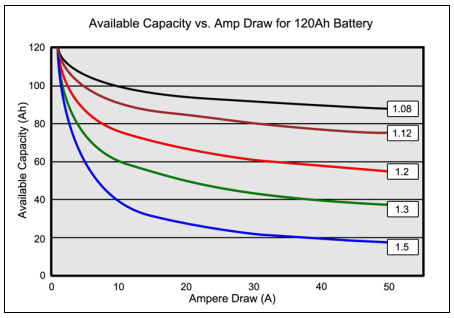
A new 600Ah AGM battery pack with a typical 1.1 to 1.2 Peukert's exponent under constant discharge of 300A (use 1.2 to account for a bit of ageing - which will occur rapidly at these discharge rates) would be deemed to be dead flat after only about 3/4 of an hour.

This is because the actual available capacity of the battery at 0.5C will be less than 50% of its rated capacity. See the chart below and follow the red 1.2 line. The relative equivalences are similar for any battery capacity

The next concern is how often this rate of discharge is envisaged as the pack won't last long with regular high discharges.

The next thing to consider is the time to fully charge the battery, if your charger can supply sufficient charge current (about 150A), you can reach full charge in about 10 hours - can you wait that long before the next discharge cycle?

The above constraints are why I proffered the LiFePo4 alternative.

Reply
Guru

Join Date: Aug 2014
Location: Port Macquarie N.S.W. Australia
Posts: 1071
Good Answers: 225
#10
In reply to #9

Re: Battery WH Calculation

07/16/2020 6:07 PM

I don't know what happened to the chart, it was there when I posted.

I'll try again.

You can clearly see that a 120AH battery with a Peukert's constant of 1.2 will have less than half its rated capacity when discharged at a constant 0.5C.

The same results will apply to any LA battery chemistry or capacity.

Reply
Guru

Join Date: Aug 2005
Location: Hemel Hempstead, UK
Posts: 5826
Good Answers: 322
#2

Re: Battery WH Calculation

07/09/2020 2:31 PM

8 KW for an hour is 8 KWhours

Assuming it's a 48 volt battery that's 167 Amp hours.

Then divide by the efficiency of the inverter.

So probably about 200 Amp hours.

__________________
If you spend all your time looking for people and things to complain about: trust me, you will find plenty to complain about.
Reply Score 1 for Good Answer
Guru

Join Date: Jul 2006
Location: Eastern Kansas USA
Posts: 1503
Good Answers: 128
#3

Re: Battery WH Calculation

07/09/2020 11:30 PM

Check with a Solar PhotoVoltaic system supplier. They have the specifications on battery requirements for a given load. This should be sized to allow for future degradation of the batteries, so I suggest you multiply the calculated amount by 1.5. You will end up with a series/parallel battery bank--four 6v batteries in each string and a sufficient number of strings in parallel, for a 24v input inverter (a very common size).

Have fun!

--JMM

Reply Score 1 for Good Answer
Guru

Join Date: Aug 2014
Location: Port Macquarie N.S.W. Australia
Posts: 1071
Good Answers: 225
#4

Re: Battery WH Calculation

07/10/2020 7:52 AM

Some things to consider:-

The proposed terminal voltage of the battery pack - the higher the voltage, the lower the current required to power the 240V inverter. and the smaller the connecting cable size.

For example (disregarding efficiency losses), to provide 30 amps @ 240V (30 x 240 = 7200 VA) will draw around 600 amps from a 12V pack (600 x 12 = 7200VA), 300 amps from a 24V pack, and 150 amps from a 48V pack.

All batteries have internal resistance which affects the terminal voltage of the battery, particularly at high loads. The resultant "sag" in terminal voltage can be so severe as to cause the inverter to shut down due to low input voltage.

To reduce the impact of internal resistance on the output voltage of the pack at high loads you can either:-

1. Reduce the current through each cell by increasing the number of cells in series, thus increasing the battery voltage and thereby decreasing the current required, or

2. Increase the number of cells in parallel, thus keeping an overall lower voltage, but reducing the individual current through separate series strings. ie. for one 12V string, the current through each cell would be 600 amps, for two parallel 12V strings, the current would be 300 amps through each cell, thereby reducing the voltage drop by 50%, more parallel strings will further improve this result linearly.

3. Use a more efficient cell technology in conjunction with the above points:-

For example, Lead Acid cells have a comparatively high internal resistance which can require a large battery bank to enable the required current for the required time frame. They also have a comparatively high Peukert's constant which reduces the battery's rated AH capacity at higher loads. Both internal resistance and the Peukert's constant increase as the battery ages and also as it becomes discharged. A 600AH 24V LA battery under 300A (0.5C) load will have its terminal voltage drop below 24V in about 15 minutes with consequent failure of the inverter to proceed.

Lithium technologies have a much lower internal resistance and a negligible Peukert's constant which allows them to suffer very little voltage sag at high loads, A 600 AH 24V Lithium battery under 300A (0.5C) load will remain above 24V for about 90 minutes. They are also far lighter and have a smaller footprint for a similar KWhr output. They can be charged with common LA battery chargers an the AGM setting, but do require over charge and discharge protection which is readily available from many suppliers.

A typical LiFePo4 battery (one of numerous Li technologies now available) has a 30% smaller footprint and is 65% lighter than a comparable AH Lead Acid battery.

Reply Score 1 for Good Answer
Guru

Join Date: Mar 2007
Location: by the beach in Florida
Posts: 33392
Good Answers: 1817
#5
In reply to #4

Re: Battery WH Calculation

07/10/2020 5:49 PM

...and cost about 100 times more.....$$$

__________________
All living things seek to control their own destiny....this is the purpose of life
Reply
2
Guru

Join Date: Aug 2014
Location: Port Macquarie N.S.W. Australia
Posts: 1071
Good Answers: 225
#6
In reply to #5

Re: Battery WH Calculation

07/10/2020 8:18 PM

Up front cost is definitely more, at a tad over double for the same AH capacity - not 100 times, but then who cares about exaggeration anyway.

A typical Australian price for a 24V 600AH battery bank would be:-

Lead acid $2550, LiFePo4 $5500 - but also consider that to maintain terminal voltage at heavy loads and for the time period required here, a Lead Acid set up would need to be at least 50% more AH capacity than the Lithium one if it were to perform satisfactorily, so the LA battery price would then be closer to $4000

You then have to consider the lifetime cost which swings way in favour of the Lithiums as they will last at least 3 times and more likely 4 times as long as LAs when used at full potential.

Lead acids when discharged regularly to 50% DOD will maybe last 2 -3 years and even less if taken to 80% DOD, whereas a LiFePo4 set up discharged regularly to 80% DOD will still be usable at 8 years albeit at reduced total capacity.

Lithiums take far less time to recharge which can be critical in a UPS environment, they do not suffer any damage if left in a low state of charge for any length of time - this is generally fatal for LA chemistry, they remain above their rated terminal voltage until almost fully discharged whereas LAs will drop below that voltage after only about 20% discharge, and earlier under heavy load conditions .

Here's a useful link that may give some insight into the pros and cons of both types.

Reply Good Answer (Score 2)
Guru

Join Date: Aug 2005
Location: Hemel Hempstead, UK
Posts: 5826
Good Answers: 322
#7

Re: Battery WH Calculation

07/11/2020 5:21 AM

You should consider buying a second hand submarine battery.

__________________
If you spend all your time looking for people and things to complain about: trust me, you will find plenty to complain about.
Reply
Reply to Forum Thread 10 comments

Good Answers:

These comments received enough positive votes to make them "good answers".

"Almost" Good Answers:

Check out these comments that don't yet have enough votes to be "official" good answers and, if you agree with them, vote them!
Copy to Clipboard

Users who posted comments:

Anonymous Poster (1); jmueller (1); Randall (2); SolarEagle (2); spades (4)

Previous in Forum: CT Currents Splitting Between Phases in Relay   Next in Forum: Underground Cable Pull Pit or Box Spacing

Advertisement