Previous in Forum: VSD with Star Delta Starting   Next in Forum: DGTL ISO 2.5KV GATE DRIVER 8SOIC
Close
Close
Close
87 comments
Rating: Comments: Nested
Anonymous Poster #1

Charge and Discharge Timing

02/21/2021 4:41 PM

Hi,

I was trying to build an astable oscillator using an LM555 timer. In order to obtain a linear triangular wave at the capacitor, I was using two constant current path, one for charge and one for discharge. The charge and discharge currents were 5.96 and 5.92 m Amps respectively. The supply voltage was 15.0. With a 10 uF capacitor, the charge & discharge times were 8100 uS and with 1 uf & .01 uF, the timings were 760 and 75 uS (Micro seconds) respectively. When the capacitance was reduced to 0.001 uF, the charge time was 30 micro seconds and discharge time was 8 micro seconds. also, the the charge - discharge differential increased to 6 V (Instead of 5 v). Can someone give an explanation?

Thanks and regards,

Job

Reply
Interested in this topic? By joining CR4 you can "subscribe" to
this discussion and receive notification when new comments are added.

Good Answers:

These comments received enough positive votes to make them "good answers".

"Almost" Good Answers:

Check out these comments that don't yet have enough votes to be "official" good answers and, if you agree with them, vote them!
Guru

Join Date: Mar 2007
Location: by the beach in Florida
Posts: 33392
Good Answers: 1817
#1

Re: Charge and discharge time.iming

02/21/2021 5:31 PM
__________________
All living things seek to control their own destiny....this is the purpose of life
Reply Score 1 for Good Answer
Commentator

Join Date: Apr 2009
Posts: 91
Good Answers: 1
#5
In reply to #1

Re: Charge and discharge time.iming
02/22/2021 11:57 AM

Dear Guru,

The charge and discharge were at constant current, in my case, 5.96 and 5.92 mA respectively. I believe the curve should be linear; not exponential.

Kind regards,

Job.

Reply
Guru
United Kingdom - Member - Indeterminate Engineering Fields - Control Engineering - New Member

Join Date: Jan 2007
Location: In the bothy, 7 chains down the line from Dodman's Lane level crossing, in the nation formerly known as Great Britain. Kettle's on.
Posts: 32175
Good Answers: 839
#13
In reply to #5

Re: Charge and discharge time.iming

02/23/2021 9:03 AM

That is a false belief, then, because it is not borne out by experience.

__________________
"Did you get my e-mail?" - "The biggest problem in communication is the illusion that it has taken place" - George Bernard Shaw, 1856
Reply
3
Guru

Join Date: Apr 2010
Location: About 4000 miles from the center of the earth (+/-100 mi)
Posts: 9912
Good Answers: 1141
#2

Re: Charge and discharge time.iming

02/21/2021 9:36 PM

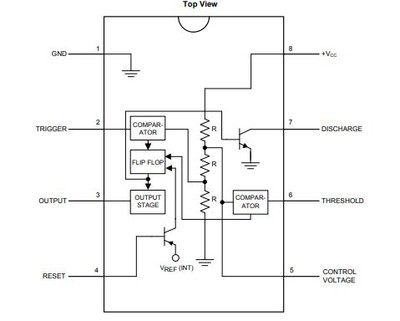
In a 555 timer, the output is triggered high when the trigger drops below 1/3 the supply voltage and triggered low when the threshold exceeds 2/3 the supply voltage. To generate an astable output, 2 and 6 are tied together. I assume you are charging and discharging the capacitor with two constant current sources which have almost equal currents, giving a linear ramp up and down. Apparently, this fails when the capacitor is very small resulting in a high frequency.

I'm guessing that the 555 output flip-flop switching your current sources is not symmetrical, or in other words, the rise time and fall time are unequal. At low frequencies (larger capacitor values) this results in a small error. At high frequencies (small capacitor) this results in a large error. This asymmetry could be either due to the 555 flip-flop or the constant current circuits.

Reply Good Answer (Score 3)
Commentator

Join Date: Apr 2009
Posts: 91
Good Answers: 1
#7
In reply to #2

Re: Charge and discharge time.iming

02/22/2021 12:43 PM

Dear Guru,

You are correct. I have two separate links for charging and discharging. With a constant current of 5.96 & 5.2 mA the voltage rise and fall were linear from 5 to 10 V and 10 to 5 V. With a 0.1 uF capacitor, the timing was 75 uS. I expected the time to fall to around 7.5 with a 0.01 uF capacitor; instead, the charge time was 30 uS. The discharge time was 8 uS instead of 7.5 which is reasonable. The ramps were perfectly linear on both charge and discharge. What is puzzling me is why it took about four times longer that what it took to discharge at the same rate?.

A small oscillation (with a few mV amplitude) for about 1 uS at the beginning of the on ramp.

Kind regards,

Job.

Reply
Guru

Join Date: Aug 2005
Location: Hemel Hempstead, UK
Posts: 5826
Good Answers: 322
#3

Re: Charge and Discharge Timing

02/22/2021 5:49 AM

"with 1 uf & .01 uF, the timings were 760 and 75 uS"

Are you sure, or is that a typo: only a ten fold decrease in time for a 100 fold decrease in capacitance.

Depending on the way it's prototyped, down at 1 nF, stray capacitance may be having a significant effect.

Can you show us a circuit diagram; a picture of the physical circuit, and, any waveforms (have you got a scope?)?

__________________
If you spend all your time looking for people and things to complain about: trust me, you will find plenty to complain about.
Reply
Commentator

Join Date: Apr 2009
Posts: 91
Good Answers: 1
#4
In reply to #3

Re: Charge and Discharge Timing

02/22/2021 11:44 AM

Hi Randall,

You are correct; it was a typo. The values were 1.0 and 0.1 uF.

Let me see if I can tale a snapshot of the waveform and attach.

Kind regards,

Job.

Reply
Power-User

Join Date: Jan 2015
Location: Johannesburg, South Africa
Posts: 248
Good Answers: 3
#6
In reply to #4

Re: Charge and Discharge Timing

02/22/2021 12:14 PM

Can you give us the circuit, draw it around Rixter's 555 Layout. Thank you.

__________________
Tragedy for Engineers is thinking they know so much that they can not learn from any body else.
Reply
Commentator

Join Date: Apr 2009
Posts: 91
Good Answers: 1
#8
In reply to #6

Re: Charge and Discharge Timing

02/22/2021 1:17 PM

Ho Oomborrie,

Please see below.

Kind regards,

Job

Reply
Guru

Join Date: Aug 2005
Location: Hemel Hempstead, UK
Posts: 5826
Good Answers: 322
#25
In reply to #8

Re: Charge and Discharge Timing

02/24/2021 10:25 AM

This is what LTspice says. Notice 10 fold reduction in caps. and time scales of 4ms, 400µs, 40µs and 10µs

1µf

100nf

10nf

1n

__________________
If you spend all your time looking for people and things to complain about: trust me, you will find plenty to complain about.
Reply Score 1 for Good Answer
Power-User

Join Date: Dec 2019
Posts: 160
Good Answers: 14
#27
In reply to #25

Re: Charge and Discharge Timing

02/24/2021 12:48 PM

Very cool! In my day Spice was just getting started and I never had the opportunity to use it. I guess I'm only seeing the dust of the current generation. Still, I think what you've done is, as I said, very cool!

Reply
Guru

Join Date: Aug 2005
Location: Hemel Hempstead, UK
Posts: 5826
Good Answers: 322
#31
In reply to #27

Re: Charge and Discharge Timing

02/25/2021 6:53 AM

LTspice is free and easy to use. I am retired now, but, when I was at work the company paid for another spice package which included a several day course for myself and several others. It probably would have been more powerful, but, I always went back to LTspice for ease of use.

__________________
If you spend all your time looking for people and things to complain about: trust me, you will find plenty to complain about.
Reply
Commentator

Join Date: Apr 2009
Posts: 91
Good Answers: 1
#32
In reply to #31

Re: Charge and Discharge Timing

02/25/2021 8:32 AM

Hi Randall,

Does "LT" stand for Linear Technologies?

I am a retired mechanical engineer, who graduated 51 years ago. In my university days, we had the opportunity to learn about only diodes and bipolar transistors. Had known about integrated circuits but never seen them. Whatever I know is just referring the data books and never worked with a company which manufactured electronic gadgets. This is my background.

For a person with my background how difficult is to learn and use this LT spice? how can I install this software and use this? Are there ant training manual available?

Kind regards,

Job.

Reply
Guru

Join Date: Aug 2005
Location: Hemel Hempstead, UK
Posts: 5826
Good Answers: 322
#33
In reply to #32

Re: Charge and Discharge Timing

02/26/2021 6:24 AM

Yes: Linear Tech.

Just follow the link

and, follow the instructions. Lots of tutorial stuff available there.

Here are some clues to get you started (there will be mistakes in here so expect a little fiddling).

from left to right: add wire, ground symbol, resistor, capacitor, inductor, diode, "component"**, move, and drag (keeps connectivity).

**component brings up the library

The NE555 is in [Misc]

The LT317 is in [Power Products]

I always forget how to place a power rail: you need to use the Voltage component in the top level library. This component can also be used to create an AC signal source.

Use the escape key or choose another function to stop doing something.

When you have placed all the components and wired them together: hover over each component and RMC (Right Mouse Click) to enter details.

You only need the values (210, 1K etc) for resistors.

Same for capacitors

15 V for voltage supply.

Obviously you can enter other details if you want to get other information from the tool.

Finally click on simulate

Edit Simulation Cmd

leave it on transient and enter the end time

and click OK

Then just click on the running man (for RUN)

Hover over the signal your interested in (say Out) and a probe appears click and the signal is shown in the output screen.

Followed by pin2/6

Hover over D1 and click and you get the current in D1

Good luck.

__________________
If you spend all your time looking for people and things to complain about: trust me, you will find plenty to complain about.
Reply
Commentator

Join Date: Apr 2009
Posts: 91
Good Answers: 1
#37
In reply to #33

Re: Charge and Discharge Timing

02/26/2021 12:03 PM

I Appreciate it very much Randall;

I will try and see. Since you have already wished me good luck, am not asking for one.

Kind regards,

Job.

Reply
Commentator

Join Date: Apr 2009
Posts: 91
Good Answers: 1
#29
In reply to #25

Re: Charge and Discharge Timing

02/24/2021 4:37 PM

Hi Randal,

Thank you very much for the help. It appears that I will not be able to achieve a 50 5 duty cycle, triangular wave with linear ramps if the frequency is greater than 60 to 70 K Hz.

Kind regards,

Job.

Reply
Guru

Join Date: Aug 2005
Location: Hemel Hempstead, UK
Posts: 5826
Good Answers: 322
#34
In reply to #29

Re: Charge and Discharge Timing

02/26/2021 8:25 AM

Bob Pease always recommends this constant current circuit

I've used the inverse for the sink

__________________
If you spend all your time looking for people and things to complain about: trust me, you will find plenty to complain about.
Reply
Power-User

Join Date: Jan 2015
Location: Johannesburg, South Africa
Posts: 248
Good Answers: 3
#35
In reply to #34

Re: Charge and Discharge Timing

02/26/2021 11:19 AM

Randall, In his 317 circuit he also use a diode like, D1 in the charge circuit, in the discharge circuit.

__________________
Tragedy for Engineers is thinking they know so much that they can not learn from any body else.
Reply
Guru

Join Date: Aug 2005
Location: Hemel Hempstead, UK
Posts: 5826
Good Answers: 322
#36
In reply to #35

Re: Charge and Discharge Timing

02/26/2021 11:46 AM

Definitely not needed for this circuit, and I don't think it makes much difference in the original.

__________________
If you spend all your time looking for people and things to complain about: trust me, you will find plenty to complain about.
Reply
Power-User

Join Date: Jan 2015
Location: Johannesburg, South Africa
Posts: 248
Good Answers: 3
#38
In reply to #36

Re: Charge and Discharge Timing

02/26/2021 12:04 PM

Thank you.

__________________
Tragedy for Engineers is thinking they know so much that they can not learn from any body else.
Reply
Commentator

Join Date: Apr 2009
Posts: 91
Good Answers: 1
#39
In reply to #34

Re: Charge and Discharge Timing

02/26/2021 12:18 PM

Hi Randall,

Learned something new. What is the equation for output current?

Kind regards,

Job.

P.S.

No offence; it is not "Bob". Just to let you know, "Job" is a common Christian name in Kerala state (in India).

Reply
Guru

Join Date: Aug 2005
Location: Hemel Hempstead, UK
Posts: 5826
Good Answers: 322
#40
In reply to #39

Re: Charge and Discharge Timing

02/27/2021 6:46 AM

Job, not unknown over here, it occurs in the bible: my brother in law's middle name is Job; when he was young he was always known as Joby.

The drop across D4 matches the drop across the emitter in Q1, and, that fixes voltage at the "bottom" of R3 equal to the voltage at the junction of D3 and D4. So the current in R3 is

IR3=VD3/RR3

and of course most of that current (>99% depending on the Hfe of the transistor) goes down the collector.

I was aiming at 6 mA, and assuming about 0.6V drop across D3: hence 100 Ohms

__________________
If you spend all your time looking for people and things to complain about: trust me, you will find plenty to complain about.
Reply
Commentator

Join Date: Apr 2009
Posts: 91
Good Answers: 1
#42
In reply to #40

Re: Charge and Discharge Timing

02/27/2021 8:56 PM

Thank you Randall;

Kind regards,

Job.

Reply
Power-User

Join Date: Dec 2019
Posts: 160
Good Answers: 14
#9

Re: Charge and Discharge Timing

02/22/2021 1:24 PM

I think you are running into the lower limits of operation of the LM555. Rounding off your constant current sources to 6ma and the capacitor at 10-3 μF your charge discharge rate is is 6V/μS. A 5V swing, 5 to 10 charging and 10 to 5 discharging is around 800 nS. I assume you are using the output (pin 3) to steer the current sources, if that is the case then the LM555 spec on fig. 8 shows a propagation delay of 300-800 nS @ 25°C, when switch between charge and discharge. 1V @ 6V/μS is around 180 nS which might account of the shift you see from 5V to 6V. It looks to me as if you are operating at the margins of the device. The fact you see 30 μS and 8 μS seems odd considering the capacitance and charge/discharge currents involved and the expected cycle time of 800 nS; this too makes me think the input characteristics of the comparators are coming into play as well as the propagation delay of the output.

Reply
Commentator

Join Date: Apr 2009
Posts: 91
Good Answers: 1
#10
In reply to #9

Re: Charge and Discharge Timing

02/22/2021 2:23 PM

Hi Rich,

Please see the circuit that I posted just a few minutes ago. The charge current is provided by the main supply not from pin 3. The output was left floating. The output swings between 1/3 and 2/3 VCC as expected.

We have a steady supply voltage and a constant current source which supplies a charging current of 5.96 mA.

The expected charge time for a 10 uF capacitor is approximately = 5 X .0000001 / 0.00596 seconds, which is 8389 uS, and the observed one was 8,100 uS. for 1 uF, the observed time was 760 us and for 0.1 uF it was 75. If the pattern is followed, why should it take 30 uS instead of around 8 micro seconds to charge the 0.01 uF capacitor unless the capacitor is a leaky one? A few capacitors of different makes and voltages ( More than 25 v) were tried but gave the same result indicating that leakage was not the factor.

kind regards,

Job.

Reply
Guru

Join Date: Mar 2007
Location: by the beach in Florida
Posts: 33392
Good Answers: 1817
#11
In reply to #10

Re: Charge and Discharge Timing

02/22/2021 3:52 PM

There might be a delay in the ramp-up of the constant current source.....

__________________
All living things seek to control their own destiny....this is the purpose of life
Reply
Commentator

Join Date: Apr 2009
Posts: 91
Good Answers: 1
#12
In reply to #11

Re: Charge and Discharge Timing

02/22/2021 4:33 PM

You are correct; there is a slight delay; the discharge transistor unclamps only after one micro second after the output goes high which does not account for the total ramp up time of 30 micro seconds.

Job

Reply
Power-User

Join Date: Jan 2015
Location: Johannesburg, South Africa
Posts: 248
Good Answers: 3
#14
In reply to #12

Re: Charge and Discharge Timing

02/23/2021 10:01 AM

Thankan, the output on pin 7 never goes high. It only switch inside the 555 to pull pin 7 to ground, that is after all its purpose. The voltage rise on pin 7 is an exsternal action and depends on your 317 between Vcc and pin 7. The rise in Voltage on pin 7 charge the capacitor through the diode between pin 7 and 2/6. The voltage at pin 7 is also the control voltage for the 317 and the 317 need to proses the rise in voltage to adjust the voltage it clamps pin 7 at, (regulate) for sure that will add time to the rise in voltage on pin 7 and therefore the rise in voltage on pin 6/2.

__________________
Tragedy for Engineers is thinking they know so much that they can not learn from any body else.
Reply
Commentator

Join Date: Apr 2009
Posts: 91
Good Answers: 1
#16
In reply to #14

Re: Charge and Discharge Timing

02/23/2021 11:34 AM

Hi Oomborrie,

I was talking about switching of pin 3, which is the totem-pole output; not the open collector pin # 7 of the IC.

Upon rising the voltage to 2/3 Vcc (10 V in my case), the discharge transistor turns ON discharging the capacitor through return branch. The function of this transistor is only to discharge the capacitor. Upon reaching the voltage at 1/3 Vcc (5V in my case) the discharge transistor turns OFF, unclamping the source (5.96 mA) allowing the current to flow to the capacitor until the voltage reaches 2/3 again. The voltage on pin 7 will always depended on the voltage on pin 6. During the charge cycle, this voltage will ride 0.7V (Which is the forward voltage of the diode) above the capacitor voltage.

There is a slight delay between the output (Pin 3) going high and un-clamping of the discharge transistor (Pin 7). The delay is only 560 nS. This delay, in my opinion should not make any appreciable difference

Another strange thing is that it did not make any difference in charge time when the charge current was increased to 10 mA.

Kind regards,

Job

Reply
Power-User

Join Date: Jan 2015
Location: Johannesburg, South Africa
Posts: 248
Good Answers: 3
#15
In reply to #12

Re: Charge and Discharge Timing

02/23/2021 10:30 AM

What in effect happens is that the control voltage on the adjust leg of the 317 depends on the rise in voltage on the charging capacitor and therefore the action of the 317 gets throttled by the charging capacitor. There will always only be 0,6 volt more on the Control leg of the 317 than the voltage on the chargeing Capacitor.

__________________
Tragedy for Engineers is thinking they know so much that they can not learn from any body else.
Reply
Commentator

Join Date: Apr 2009
Posts: 91
Good Answers: 1
#17
In reply to #15

Re: Charge and Discharge Timing

02/23/2021 11:43 AM

Hi Omborrie,

If it is the case, Why is it not happening when the capacitance is 0.10 uF and above?

kind regards,

Job.

Reply
Power-User

Join Date: Jan 2015
Location: Johannesburg, South Africa
Posts: 248
Good Answers: 3
#18
In reply to #17

Re: Charge and Discharge Timing

02/23/2021 12:05 PM

Look at Rich's answer again and remember that every that happen is directly dependent on what happens at pin 6 and 2. Can you post your complete test circuit with test instruments. A measuring instrument with internal resistance will always subtract time from discharging circuit and add time to a charging circuit if working with short time periods.

__________________
Tragedy for Engineers is thinking they know so much that they can not learn from any body else.
Reply
Commentator

Join Date: Apr 2009
Posts: 91
Good Answers: 1
#19
In reply to #18

Re: Charge and Discharge Timing

02/23/2021 12:48 PM

Hi Oomborrie,

You are correct in saying that the resistance of the measuring instrument will have a loading effect and extend the charge time and reduce the discharge time. All of us can agree. The resistance of the probe remaining the same, why the charge time remained with 5.96 mA and 10 mA charge current?

The instrument that I am using is an old one, a Tetronix TDX220 with a P6112 probe.

Kind regards,

Job

Reply
Power-User

Join Date: Dec 2019
Posts: 160
Good Answers: 14
#20
In reply to #10

Re: Charge and Discharge Timing

02/23/2021 1:17 PM

I've used the LM317 in the past for a current source for trouble shooting but the way you've used it is rather unique. I think the problem may be your running out of voltage as the capacitor is discharging to keep the LM317 operating as you expected it too. The specification for the input voltage range for the LM317L is 3.75-40V. You need to add the 1.25V needed for the resistor to keep it operating as a current device. You are now at 5V needed across the LM317L with the Resistor (3.75+1.25). Now add the diode drop of 0.75 to 1V and the saturation voltage drop across the open collector capacitor and you're at 6V. When the LM555 capacitor is charged to 10V and the pin 7 switches to low, the capacitor discharges down 4V leaving 6V across the LM317L. The discharge current has dropped to whatever leakage current can get through the device, it appears to continue to discharge at a slower rate so instead of 8 μS you are at 30 μS. This problem was always there but the larger capacitor values masked it out because the extra 22 μS wasn't significant enough to notice. I suspect if you had a scope across the capacitor you would see a funny looking waveform at the 6 to 5 volt level where the linearity starts looking more like an exponential waveform.

Reply Score 1 for Good Answer
Commentator

Join Date: Apr 2009
Posts: 91
Good Answers: 1
#21
In reply to #20

Re: Charge and Discharge Timing

02/23/2021 2:52 PM

Hi R_i_c_h,

The linearity is perfect on both charge and discharge as shown below on the snap-shot. The upper trace is the voltage at discharge pin (#7) and the lower one is the voltage of the timing capacitor, which is one diode drop below the upper one on the charging ramp.

Kind regards

Job

Reply
Power-User

Join Date: Dec 2019
Posts: 160
Good Answers: 14
#22
In reply to #21

Re: Charge and Discharge Timing

02/23/2021 11:48 PM

Job

I agree the waveform shows linearity in charge and discharge and it is apparent the LM 317 discharge side I was concerned about stays in control so it doesn't stop regulating at 5V. So what to think about the anomaly? The theoretical rise time for 10, 1, .1 and .01 capacitors is 8445 μS for 10 μF to 84.45 μS for .1 μF. The measured values are low by 6%, 10%, and 11%. The .01 μF is high by 355%. With the linearity displayed on charging it would appear the charging current dropped to less than 2mA or the charging current is being split into two parts, the latter doesn't seem viable because I don't see a path to accomplish it. The discharge side doesn't have a similar problem so you have a real head scratcher. I would suggest you put a 10 ohm resistor between Vcc and the charging LM317 and use a scope to monitor the waveform across the resistor. As you switch from between charging and discharging the waveform across the resistor would give you an idea of the stability of the charging regulator current. I will be very interested to what you discover.

Thanks for your patience,

Take care,

Reply Score 1 for Good Answer
Power-User

Join Date: Dec 2019
Posts: 160
Good Answers: 14
#23
In reply to #21

Re: Charge and Discharge Timing

02/24/2021 12:59 AM

Job

It just occurred to me why your charging time is extended out to 30 μS. I think the charging current is being split between pin 7 and the capacitor when the output transistor is turned off. It just occurred to me when the output is turned off there is a residual charge on the base of the NPN transistor. This allows the transistor to be in a conducting mode for a short time as the base charge is dissipated. During this period the collector remains in a conduction mode for a short period of time which allows the constant current from the charging side to split until the transistor has turned off. This is affecting the other times as well but, again, it doesn't register because it doesn't have much affect on the longer charge times. This affect wouldn't have as much affect on the discharge cycle as charge/discharge modes are switching from one to the other. The specs indicate a rise time of typically 0.1 μS but the rise and fall times are affected by the load current. The schematic shows a 3.3K resistor to shunt the base charge to common. You might be able to overcome this with a 1K resistor between Vcc and pin 7 and then another diode, cathode to pin 7 and anode to the junction pin 7 was previously connected to. Just a thought and something relatively easy to try. Your little issue has occupied way to much time in my mind but it's been fun...

Take care.

Reply
Commentator

Join Date: Apr 2009
Posts: 91
Good Answers: 1
#24
In reply to #23

Re: Charge and Discharge Timing

02/24/2021 8:26 AM

Hi R_i_c_h,

I did not follow. Can you please attach a circuit?

Kind regards,

Job.

Reply
Power-User

Join Date: Dec 2019
Posts: 160
Good Answers: 14
#26
In reply to #24

Re: Charge and Discharge Timing

02/24/2021 12:42 PM

It's a pretty pathetic drawing but it is what I have at the moment to work with. The thought is leaving the collector open to follow the charge on the capacitor leaves a leakage path for some of the current through the open collector until the charge is dissipated from the base-emitter junction. The time is affected by the LM555 base-emitter resistor, in this case 3.3K, to drain the base charge off. I haven't enough info to make any calculations but your cycle time is short enough that it might be affecting the charging rate. The pull-up resistor helps pull up to Vcc and the diode blocks the pull-up resistor from affecting the charge/discharge timing. Hope this shows improvement, something is taking current away from the charge cycle, so it's a thought. There also may be something in the LM555 that is allowing the output to maintain some conduction longer than otherwise expected. The schematic is involved and not necessarily exact. Happy hunting...

Take care,

Reply
Guru

Join Date: Aug 2005
Location: Hemel Hempstead, UK
Posts: 5826
Good Answers: 322
#30
In reply to #26

Re: Charge and Discharge Timing

02/25/2021 6:47 AM

It seems to me that you could also get rid of D2 (in my diagram)

It has improved the discharge time but has left the charge time as it was.

__________________
If you spend all your time looking for people and things to complain about: trust me, you will find plenty to complain about.
Reply
Power-User

Join Date: Jan 2015
Location: Johannesburg, South Africa
Posts: 248
Good Answers: 3
#28
In reply to #24

Re: Charge and Discharge Timing

02/24/2021 2:02 PM

Thankan, my opinion is that the heart of your problem is around the way you employ the charging 317. The control on a 317 is dependent on the supply Voltage on the input leg and the regulating voltage on the control leg. Trying to run it effective from a near 0volt base is totally opposite to what it was designed for. It works on the voltage difference between input and control to determine and clamp the output voltage. Your circuit want it to control the rise in voltage from the output pin. I asked you in a previous answer for the complete circuit with measuring devises. You want us to read the speed on the speedo while you obstruct the view. Try to pull the control voltage up with a control resistor from Supply. In the present circuit the control of the 317 has to wait for the output to rise before it can react and clamp the output. How much time that add is just a guess.

__________________
Tragedy for Engineers is thinking they know so much that they can not learn from any body else.
Reply
Guru

Join Date: Dec 2010
Posts: 1686
Good Answers: 116
#41

Re: Charge and Discharge Timing

02/27/2021 6:57 PM

Hi Anonymous/Thankan/Job,

What you observe has not been explained by anyone yet!!

I will use your diagram with numbers added to the diodes.

Suppose you have reached time just before discharge changes to charge.

  1. Pin 7 is connected to pin1 [zero volts, common] by a "single pole" switch. Pin 7 is open circuit when not connected to pin1. U2 is discharging the timing capacitor through diode 2. U1 is delivering its set current through pin 7 to common. Diode 1 is reverse biased because pins 2 & 6 are at +5 volts.
  2. When capacitor is below 5 volts, NE555 switches, pin 7 becomes open-circuit. Pin7 voltage will move positive at a rate set by the circuit capacity and sum of U1 & U2 currents. Note that U2 is still discharging the timing capacitor, so pins 2,6 will fall below 5 volts.
  3. As voltage across U2 falls its current may fall but it will still discharge the timing capacitor more before the rising voltage at pin 7 forward biases diode 1 and pin 2,6 voltage rises as expected.
  4. So part of charge Q required to raise pin 7 circuit capacity by 5 volts is removed from the timing capacitor. This will increase the voltage swing at the timing capacitor, but its effect will not be noticeable until the timing capacitor is small e.g. Q = CV ; 10 volts on 100 pF becomes 1 volt on 1000 pF = 1nF.

You could add 1000 pF from pin 7 to pin 1 to exaggerate & verify the effect.

This does not explain why the charge time is increased from expected 8 μs to 30μs.

It seems most likely that U1 is giving less than its set current initially with fast voltage steps.

The LM317 data sheet does not give any transient performance as a current source e.g. when the voltage from IN to ADJ terminals is reduced quickly. Again this would not be noticeable until frequency is high. Since U2 seems to discharge at near the expected rate with 1 nF, current behaviour is different for sudden voltage step-up.

You could change the NE555 to a conventional RC oscillator @ 10 kHz with e.g. a 6 volt supply, then apply its pin 3 output via 3 x 1.5V manganese dry cells in series to an LM317 current source; while observing its output current on oscilloscope. This would give a 4.5 to 9.5V step test [bypass with single 10μF tantalum capacitor across the 3 cells]

The LM317 circuit does have some internal capacitors, which affect its transient response......

Regards,

67model

Reply
Guru

Join Date: Aug 2005
Location: Hemel Hempstead, UK
Posts: 5826
Good Answers: 322
#43
In reply to #41

Re: Charge and Discharge Timing

02/28/2021 8:07 AM

"Note that U2 is still discharging the timing capacitor, so pins 2,6 will fall below 5 volts."

I don't think so: pin 7 is behaving as expected; I'm not sure why you think it would take a long time to rise when its transistor is switched off.

First this is the wave forms with 100nf; the blue trace is pins 6/2 and the red trace is pin 7.

Note that the current scale goes down to -5mA (both diodes are fully off when they're supposed to be).

Now if we switch to 1nf

The charging 317 is not turning on properly (quickly enough), which I think is what you said in the second half of your post.

__________________
If you spend all your time looking for people and things to complain about: trust me, you will find plenty to complain about.
Reply
Commentator

Join Date: Apr 2009
Posts: 91
Good Answers: 1
#45
In reply to #43

Re: Charge and Discharge Timing

02/28/2021 1:45 PM

Hi Randall,

1) What is the red trace seen below the red charge ramp?

2) I could not agree with guru 67model since the charge IC (U1) is always conducting (Not turned OFF) irrespective of the state of the discharge transistor. While the transistor is ON, the current will be directed to the common ground and as soon as the clamp is released, the current will be flowing to the capacitor.

Randall, is it possible to simulate the current through U1 and see how the trace look like?

Kind regards,

Job.

Reply
Guru

Join Date: Aug 2005
Location: Hemel Hempstead, UK
Posts: 5826
Good Answers: 322
#50
In reply to #45

Re: Charge and Discharge Timing

03/01/2021 10:25 AM

"1) What is the red trace seen below the red charge ramp?"

Not sure what you mean. The traces are

Green: out; Blue: 2/6; Red: 7; Pale Green: I D2; Pink I D1

In this shot the green trace is the voltage on pins 2 and 6, and, the blue trace is the current into the chargeing 317 (unfortunately it's U2 in the LTspice circuit because the 555 is U1). The Adj. pin is designed to not source or sink current so apart from the very brief spikey bits the input current is representative of the current supplied to the rest of the circuit

These are traces of the voltages either side of R1.

You can see that in the second charge cycle the voltage never gets close to the required 1.25V.

This is why

As the voltage on the Adj pin rises that rise is seen on the other side of C2 slowing down the correcting amplifier. I believe this is called the Miller effect.

__________________
If you spend all your time looking for people and things to complain about: trust me, you will find plenty to complain about.
Reply
Power-User

Join Date: Jan 2015
Location: Johannesburg, South Africa
Posts: 248
Good Answers: 3
#51
In reply to #50

Re: Charge and Discharge Timing

03/01/2021 12:06 PM

They used this as reference.

__________________
Tragedy for Engineers is thinking they know so much that they can not learn from any body else.
Reply
Guru

Join Date: Dec 2010
Posts: 1686
Good Answers: 116
#52
In reply to #50

Re: Charge and Discharge Timing

03/03/2021 4:55 AM

Thanks for using the model to analyse, Randall!

It must actually be a good simulation of LM317, it does not always follow that a computer model actually reproduces all the (about 20) transistors in an LM317.

I started wrong on the reasons for the circuit behaviour, but did note that the problem could be the LM317 cannot be stepped from one in-out voltage to another instantly and still regulate.

The circuit below is from an article by Bob Pease, the designer of LM117/317.

The important point is that the two transistors marked E and 10E in Fig 4 [Q16 & Q17 in your post #51] and the two above them are the 1.25 volt reference. The E and 10E indicate they operate at 10 to 1 difference in current & the 1.25 volt comes from the emitter base voltage of the lower pair (and difference across R6] plus R5 volt drop. The transistor with base connected to two capacitors works as the error amplifier with the pair at top right carrying the power current to the current setting resistor from OUT to ADJ.

But with the capacitors putting current into the reference with fast voltage changes, its balance is upset & it delivers a reduced voltage.

The U2 stepping from off to 5V seems to work better than U1 stepping +10V to +5V.

As I noted, Thankan/Job could apply volt step cycles to U1 or U2 LM317 samples with the aid of the NE555 [as an R-C oscillator] and observe how they behave as current regulators separate from the timing/oscillator circuit.

Reply Score 1 for Good Answer
Guru

Join Date: Aug 2005
Location: Hemel Hempstead, UK
Posts: 5826
Good Answers: 322
#53
In reply to #52

Re: Charge and Discharge Timing

03/03/2021 7:01 AM

Thanks: I looked for that circuit, and found another even more simplified circuit schematic which just helps understanding the basic operation.

In this pdf

https://www.pearl-hifi.com/06_Lit_Archive/02_PEARL_Arch/Vol_16/Sec_53/Pease_Lab_Notes/Bob_Pease_Lab_Notes_Part_9.pdf

Which also includes the circuit you found

Loads of good stuff in that article

AND there's more in the directory above

https://www.pearl-hifi.com/06_Lit_Archive/02_PEARL_Arch/Vol_16/Sec_53/Pease_Lab_Notes/

__________________
If you spend all your time looking for people and things to complain about: trust me, you will find plenty to complain about.
Reply
Commentator

Join Date: Apr 2009
Posts: 91
Good Answers: 1
#57
In reply to #53

Ringing when switching OFF a MOSFET

05/22/2021 11:48 AM

Dear Guru Randall,

I have made an inverter, a low power one, as per the circuit shown below. A ringing occurs at the drain terminals (junction of primary windings and the drains of the MOSFETs). Can you help me with this problem, as you have with some other problems in the past, in understanding why this happens and guide me to rectify this problem? The amplitude of the first wave is 50 volts above the Vcc with a duration of 100 n Seconds. The amplitude of the second one is only 10 V above the Vcc. The total duration of the ringing is about 400 n S. Cycle time approximately = 34 u S.

Kind regards,

job Thykkoottathil

Reply
Guru

Join Date: Dec 2010
Posts: 1686
Good Answers: 116
#58
In reply to #57

Re: Ringing when switching OFF a MOSFET

05/22/2021 3:57 PM

I am sure Randall will put the same message in another way.

1/ Ringing is normal when you suddenly turn off current through an inductive load.

2/ A classic case is contact & coil ignition on petrol engines before electronics. A contact connected the coil [a transformer] to battery. While it was closed, current rose in the coil primary until limited by resistance or closed time too short to reach resistance limit at higher rev/min. A capacitor [condenser] across the contact stopped arcing causing short contact life. When the contact opened, the stored energy in the inductor caused the current to keep flowing - it had to flow into the capacitor with contact open. The stored energy in coil was enough to raise the voltage on the capacitor & primary to several hundred volts - transformed to 20000 volts or more on secondary connected to spark plug. The coil time constant is milliseconds and the "ringing" time tens of microseconds. Side note - When Mr Royce designed his first motor car, the first thing he did was design a good ignition coil - he was already a proven manufacturer of electric cranes.

3/ Your circuit has a transformer and its winding capacitance + capacitance of FET drain + "wiring" capacitance [mostly due to the thin insulating washer between FET drain & grounded heatsink if present] make the capacitor.

4/ Since you have a 650V FET, & your Vcc of 15V + 50V overshoot is much less, there is probably not a problem of FET failure.

5/ The FET can take turn-off at 650V peak for 10 microseconds at 9 amps.

6/ Being careful, one should know that the drain current of the FET is < 9 amp when it turns off.

7/ Maybe the DC resistance of the transfo half-primary is 15/9 = 1.66 ohms or more, which satisfies 6/.

However, you could blot out Long/Medium Wave AM & shortwave broadcast locally with a "spike" maker of this power - just try a radio near your inverter!!

The ringing may be bigger than necessary because the transformer is saturating which makes the stored energy high, this is inefficient (and the wasted energy heats the FET) - How many turns on half-primary, what DC resistance?

Reply Score 1 for Good Answer
Guru

Join Date: Aug 2005
Location: Hemel Hempstead, UK
Posts: 5826
Good Answers: 322
#59
In reply to #57

Re: Ringing when switching OFF a MOSFET

05/23/2021 7:11 AM

You need to add quench diodes across the two halves of the primary.

Same as you would across a relay coil:-

https://en.wikipedia.org/wiki/Flyback_diode

If you're still having problems start a new thread.

__________________
If you spend all your time looking for people and things to complain about: trust me, you will find plenty to complain about.
Reply
Commentator

Join Date: Apr 2009
Posts: 91
Good Answers: 1
#60
In reply to #59

Re: Ringing when switching OFF a MOSFET

05/23/2021 7:46 AM

Dear Guru,

What kind of diode? does it have to be a fast recovery type or will a 1N4007 do?

Kind regards;

Job

Reply Off Topic (Score 5)
Commentator

Join Date: Apr 2009
Posts: 91
Good Answers: 1
#61
In reply to #59

Re: Ringing when switching OFF a MOSFET

05/23/2021 10:16 AM

Dear Guru,

Diodes D3 & D4 were inserted as shown below with no success. The diodes were getting very hot indicating that a large amount of current was flowing through the diodes. For some reason, the voltage at the junction of the winding, diode and the drain was clamping down to 5 volts; why?

Kind regards;

Reply
Guru

Join Date: Dec 2010
Posts: 1686
Good Answers: 116
#62
In reply to #61

Re: Ringing when switching OFF a MOSFET

05/23/2021 11:53 AM

Diodes do not work in "push- me - pull - me" - even with Dr Doolittle's help.

With switch closed, imitating FET, you get positive voltage on upper diode - near short circuit.

As I wrote in my first reply, the 50V +15V is nothing to worry about, so long as current limits of FET are observed.

As Randall suggests, another post is best.

67model

Reply
Guru

Join Date: Aug 2005
Location: Hemel Hempstead, UK
Posts: 5826
Good Answers: 322
#63
In reply to #61

Re: Ringing when switching OFF a MOSFET

05/23/2021 8:06 PM

1N4007s should be fine.

The circuit looks Ok, are you sure that the diodes cathodes are connected to +Vcc?

__________________
If you spend all your time looking for people and things to complain about: trust me, you will find plenty to complain about.
Reply
Commentator

Join Date: Apr 2009
Posts: 91
Good Answers: 1
#64
In reply to #63

Re: Ringing when switching OFF a MOSFET

05/24/2021 8:19 AM

Dear Guru,

The diodes were oriented in the correct direction ( Cathodes connected to positive ).

"As I wrote in my first reply, the 50V +15V is nothing to worry about, so long as current limits of FET are observed".

The MOFETs are rated for 9 Amps and therefore it will be able (I guess) to handle the current. My concern is the amplified (Doubled when transformed) peak voltage of the ringing which comes to around 100 Volts at the output of the bridge. The voltage regulator, LM 317, is only rated for 37 Volts and obviously will be an issue if I cannot get rid of the ringing.

Another issue that I have observed is the heating of the bridge. When loaded with a 270 ohm resistor (The regulator and battery omitted), the bridge was heating up. The bridge (DF1510) is rated for 1.5 Amps with a PRV of 1 Kv. The average current through the bridge should only be 111 mA (30 / 270). Can you suggest why it is heating up?

Kind regards,

Job.

Reply Off Topic (Score 5)
Guru

Join Date: Dec 2010
Posts: 1686
Good Answers: 116
#65
In reply to #64

Re: Ringing when switching OFF a MOSFET

05/24/2021 9:15 AM

Thankan did not clarify in original post if the inverter was loaded or not.

Unloaded, charging 50 pF of circuit capacity to 50 volts would require only 0.01 microjoule of energy, compared to the 100 microjoules of an electrostatic discharge ESD test of an integrated circuit. I judge 0.01 μJoule x 32000 = 320 μJoule/second = 320 microwatts to be harmless.

If feeding output to bridge rectifier, it would be essential to have a reservoir/filter capacitor across the bridge output - LM317 data sheet suggests 1 microfarad tantalum minimum capacitor at its DC input for stability anyhow.

You should not judge the spikes until the inverter is loaded with the bridge/capacitor.

The bridge may not like 32 kHz & without a heatsink its dissipation is limited.

There are ways to clamp spikes, like zener diodes, but one needs to know how much energy they have to absorb. Particularly, saturation of the transformer would make any overvoltage spike worse than necessary.

As pointed out in my reply to suggested suppression diodes direct across primary half windings, this does not work on a push-pull drive

Reply Off Topic (Score 5)
Guru

Join Date: Aug 2005
Location: Hemel Hempstead, UK
Posts: 5826
Good Answers: 322
#67
In reply to #65

Re: Ringing when switching OFF a MOSFET

05/24/2021 10:22 AM

"As pointed out in my reply to suggested suppression diodes direct across primary half windings, this does not work on a push-pull drive"

I don't understand: the quench diodes can only conduct when their FET is turned off: they will only clamp the spikes to just above the +Vcc rail.

__________________
If you spend all your time looking for people and things to complain about: trust me, you will find plenty to complain about.
Reply Off Topic (Score 5)
Guru

Join Date: Dec 2010
Posts: 1686
Good Answers: 116
#68
In reply to #67

Re: Ringing when switching OFF a MOSFET

05/24/2021 3:40 PM

Hello Randall,

I put a diagram in my post #62.

The problem is that when one FET is on, the polarity of the other half of the primary will forward bias the suppression diode across it. The diode does have the winding resistance in series but my guess at the winding resistance of 45 turns #31 AWG on 1 x 1 cm square core is 0.75 ohm, adding 0.4 ohm for FET with 15V supply is ~13 amps.

Since Thankan reports supply drop to 5V, the 1N5407?? just survives.

67model

Reply Off Topic (Score 4)
Guru

Join Date: Dec 2010
Posts: 1686
Good Answers: 116
#69
In reply to #68

Re: Ringing when switching OFF a MOSFET

05/24/2021 6:39 PM

Randall/Thankan,

I tried to find an EE10 core, found RD ltd chinese 2 x E section cores, but core section only 5.6 x 2.5; units not given but suppose mm rather than cm. This is a rather small core - a bobbin claiming to be for EE10 was 1 cm internal diameter, a reasonable size for 10 watts. Another gives EE10 transfo with PC40 Mn-Zn core 0.5 W @20kHz - which I feel will easily saturate with 15V on 45 turns @ 32 kHz. If you want 30 volts /0.1 amp that is 3 watts.

Another data Yangzhou R & D Ltd gives Ae ~25 Le ~28 which are effective core area and magnetic circuit length, presume mm: Al = 1100 which is usually nanohenries per turn, so 1.1 μH/turn. That would give 1.1 x 45 x 45 = 2227 μH for half primary.

Using basic formula for emf e = L di/dt [ so di/dt = e/L] and 15 volt supply one gets rate of rise of current di/dt = 15/(2227* 10-6) = 0.0067 x 10+6 Amp/second or 0.0067 A/μsecond. In 30 μs half period current reaches 0.2 amps for which stored energy is 0.5*L*i2 = (2227/2)*0.2*0.2 = 45 microjoules. At 32 kHz that makes 1.45 Joules/second = watts - noting finally this is just one FET on while there are 2, one gets ~3 watts which is going to take 0.2 amp input at 15 volts DC supply N.B. A half primary resistance + FET resistance of 1.2 ohms will only drop 0.2 amp * 1.2 = 0.24 volts so e = 15 - 0.24 = 14.76 volts at least, so one can assume linear current rise & a triangular sawtooth supply current with 30 μs period.

A peak current of 0.2 amp with path length Le = 28 mm and 45 turns gives 45*0.2/0.028 amp-turs/metre = 320 amp-turns/metre magnetising force. It is getting late night, so will leave seeing how that compares with saturation amp/metre of ferrite later! However, I see that 320 A/m would saturate an iron transformer lamination, which I think has much higher saturation level than any ferrite.

If the inductance value is correct, one must suppose 0.2 amp supply current - with no secondary load - so what is actual measurement please??

Also 3 watts must be going somewhere ; so what is getting warm, the transformer or the FETs?? Give it 30 minutes operation to warm up.

Please clarify dimensions & ferrite core data - most relevant would be nanohenries per turn/permeability/Bmax milliTesla or Ae, Le, Al as above.

Note that your diagram shows no bypass capacitor from the 15V supply + at the primary centre tap to the source terminals of the FETs ( about 100 microFarad would be usual). Without this, most fast circuits will malfunction, say upsetting the FET driver IC.

67model

Reply Off Topic (Score 4)
Commentator

Join Date: Apr 2009
Posts: 91
Good Answers: 1
#72
In reply to #69

Re: Ringing when switching OFF a MOSFET

05/25/2021 8:09 PM

Dear Guru,

"If the inductance value is correct, one must suppose 0.2 amp supply current - with no secondary load - so what is actual measurement please??"

On power-up, the current was 121 mA @ 12.9 VDC supply voltage, which gradually increased to 130 mA in 30 minutes. What could be the reason?

The transformer remained cool while the MOSFETS heated up to 120F (A small heat sink was used).

The Bridge rectifier which is rated for 1.5 Amps gets hot even with no load. The opencircuit voltage with a 10 uF, 100V smoothing capacitor is 65 volts. Could be due to the peak voltage of the ringing. When a 270 Ohm load is applied, the voltage dropped to 30 and the primary current rose to 750 mA. That is for 111 mA load current, the primary current was 750 mA instead of 250 mA. The temperature of the bridge rose to more than 200 F within a few minutes with this 111 mA which is strange.

"Note that your diagram shows no bypass capacitor from the 15V supply + at the primary centre tap to the source terminals of the FETs ( about 100 microFarad would be usual). Without this, most fast circuits will malfunction, say upsetting the FET driver IC."

I actually have a 100 uF electrolytic capacitor in addition to a 1 uF tantalum capacitor used as bypass capacitors.

"That would give 1.1 x 45 x 45 = 2227 μH for half primary."

45 is the number of turns; what is the second 45?

"Also 3 watts must be going somewhere ; so what is getting warm, the transformer or the FETs?? Give it 30 minutes operation to warm up."

Reply Off Topic (Score 5)
Guru

Join Date: Aug 2005
Location: Hemel Hempstead, UK
Posts: 5826
Good Answers: 322
#70
In reply to #68

Re: Ringing when switching OFF a MOSFET

05/25/2021 7:51 AM

OK: I'm sure you're right.

Looking at your diagram I'm trying to work out what happens to the current after it goes through the diode. If for example you put another rectifier in the output of the power supply: wouldn't the extra current from the second half of the primary just boost the current in the first half. (Just thinking aloud really; haven't got a clue.)

I've removed the off topic, so that if you reply I can give you a proper GA.

__________________
If you spend all your time looking for people and things to complain about: trust me, you will find plenty to complain about.
Reply
Guru

Join Date: Dec 2010
Posts: 1686
Good Answers: 116
#71
In reply to #70

Re: Ringing when switching OFF a MOSFET

05/25/2021 3:21 PM

In reply to post #70 by Randall.

  1. The optimum way to put a centre-tapped winding on a core is to twist two wires together, then wind the bifilar pair into a coil on the core. Since the two wires are as near co-located as possible and the twisting serves to equalise capacitance turn-turn they are as equal as possible, share the same magnetic flux and have the same end-end e.m.f. Bifilar is necessary for balanced high frequency windings. Externally, wires from opposite ends of the coil are interconnected to make the centre tap, leaving two ends to connect to the FETs. To get a good 1:1:1 three winding transformer or a good 1:2 ratio (1:1+1), trifilar windings are used.
  2. So if you apply 15 volts to the lower primary half, you will get 15 volts on the upper half. Unfortunately, this forward biases the upper diode and current flows from the winding, through the diode and back into the winding at the centre tap.
  3. The circulating current in the upper winding must come from the lower winding by auto-transformer action. So the lower winding must carry an equal current to the upper winding [plus a magnetising current for the core, which provides a back-emf to oppose the DC power voltage less voltage drop across winding resistances].
  4. If the core had a third winding, with a load, there would be the expected current in the lower primary to get this , so the current in the lower primary can be described as "boosted" by the unwanted current in the upper diode.

It is not necessary to add a rectifier in the power supply side for the above to happen; since current is always flowing the same way from power supply, a diode would just add a [non-linear] volt drop.

Actually, there is an unmentioned ghost in the machine. To get e.g. +15V supply + 17V = +32V at the high end of the winding you must get +15 -17 = -2V volts at the low end; but this would forward bias the inverse source-drain diode in the FET and act as a clamp.

Spikes of 50V seen are due to FET breaking the current in the leakage inductance of the primary which is due to the primary flux which does not link to another winding. The leakage inductance shows up if you short circuit the secondary and measure the primary - rather than the short circuit for an ideal transformer, you get a small inductance plus the winding resistance. In a real circuit you will get the effect of the DC supply wiring inductance etc..

I goofed in the calculation in post #69 - the mean value of an 0.2 amp peak triangular sawtooth current would be 0.1 amp.

Reply Score 1 for Good Answer
Commentator

Join Date: Apr 2009
Posts: 91
Good Answers: 1
#73
In reply to #71

Re: Ringing when switching OFF a MOSFET

05/26/2021 12:25 PM

Dear Guru,

"So if you apply 15 volts to the lower primary half, you will get 15 volts on the upper half. Unfortunately, this forward biases the upper diode and current flows from the winding, through the diode and back into the winding at the centre tap".

I could not quite follow what you have explained. can you show a circuit showing current path?

Frankly, I am not that good in these circuit theories as I am only a mechanical engineer who graduated in the sixties. So please excuse my ignorance and bear with me if I ask questions which may not make sense.

when the upper MOSFET is OFF, the drain will be at the supply potential; say + 15 volts. In order that a current to flow from the ground plane through the body diode, there a potential which is more positive than the supply. I cannot visualize how?

Now, if I use an IGBT in place of the MOSFET, which does not have a body diode, will the effect of the "unmentioned ghost" be over and what will be the outcome?

"To get a good 1:1:1 three winding transformer or a good 1:2 ratio (1:1+1), trifilar windings are used."

How is the output stepped-up if the winding ratio is only 1:1+1 since all three strands are of the same length and therefore the number of turns of the secondary will be the same as the number of turns of the half secondary and I guess the transformer ratio is only one.

Kind regards,

Job.

P.S.

I guess that my choice of transformer size was wrong.

Reply Off Topic (Score 5)
Guru

Join Date: Dec 2010
Posts: 1686
Good Answers: 116
#74
In reply to #73

Re: Ringing when switching OFF a MOSFET

05/26/2021 7:24 PM

The circuit diagram explaining the "Clamp" diode effect was in my post #62 - not surprising you are puzzled without it!

It will probably help if you do as below....

If you right click on the image in post #62, you will get a "drop down list" with a copy option, click on it. Then open a viewing program in Windows, "Paint" will do. Put the cursor in the Paint image area and use keyboard Ctrl-V action. You will then have the circuit in Paint and can reduce the size of the Paint window so you can lay it over or beside the CR4 window so you can see both words & circuit together.

The arrows in the circuit show the direction of the voltage in each winding - arrow head is positive end.

If you centre tap a winding, the two halves must each have half the total voltage across them and voltages have the directions shown - else the two halves would oppose each other and the whole winding would suddenly have zero voltage end to end. [the two halves, in reality, must have the same magnetic flux passing through them - this is true to a high degree when both are wound around a ring core of high permeability - Michael Faraday wound the first transformer on a toroid (ring) core of iron wires - you can imagine your two E cores as making two "Square" rings through the windings : "pot" cores which surround the windings with ferrite are even better, but unnecessary for most applications. The trouble with true toroids is getting the windings on, OK by slow hand but difficult with a speedy machine]

It may help to think the upper coil replaced by a battery representing its voltage The diode anode is clearly positive to cathode and it will conduct with current limited by diode, power supply and winding resistances, circulating in winding & diode in the direction indicated by the arrow of the diode symbol.

More tomorrow; it is late night.

Reply Off Topic (Score 4)
Guru

Join Date: Dec 2010
Posts: 1686
Good Answers: 116
#75
In reply to #73

Re: Ringing when switching OFF a MOSFET

05/28/2021 1:20 PM

Hello again, Thankan,

To continue from my post #74, replying to your post #73. I tried to think of mechanical comparison which would help.

The circuit with two FET driving a centre-tapped transformer is usually called "push-pull". When it was first introduced, it was also called "see-saw" - a name for the play machine which is a beam, raised off the ground and pivoted at its middle.

  • If one end is + 1 metre high relative to pivot, the other end is "- 1 m" relative to pivot.
  • If the pivot is 1 m above ground, one end at "- 1m" will hit the ground.
  • The high end cannot go over 2 m above ground.
  • A stiff spring below each beam end could reduce the shock of hitting ground.

You can imagine :-

  • The pivot height as like the DC supply voltage.
  • Height of the beam ends relative to pivot as like the transformer primary voltages.
  • The spring as like the Source-Drain diode.

The model could be elaborated by allowing the beam to swing into a hole in the ground, so the spring only works for "height (voltage) negative to ground", like diode, or even having a spring with coils spaced apart un-equally to be non-linear like a real diode.

Similarly, you can imagine the beam with a flexible end part so its end can move above the simple height limit - like a school ruler projecting beyond a table top and deflected to start a vibration. A real transformer does not have perfect fixed ratio transfer; it can be modelled with independent inductance [Leakage Inductance] & resistance in series with each winding of an ideal transformer - these have small effect until the current or frequency are much above the intended design values, when you get overshoot and ringing . However, like friction, bending, inertia and vibration in machines, ignoring them sometimes causes defective operation, low efficiency or failure.

IGBT - these usually have "reverse" diodes too, but the diodes do not stop effective operation of circuits unless no reverse conduction is essential.

Trifilar Transformer Windings

With 3 equal windings you can use one as primary, and interconnect the other two (externally) in series addition as secondary to get a 1:2 ratio.

On a transformer core, you can...

  • put primary and secondary windings on separate bobbins for greater high voltage isolation (even on opposite sides with two U cores).
  • Or you can put windings one on top of the other, with extra insulation between windings.
  • Use bifilar or trifilar windings, but with problems when high insulation resistance or high breakdown voltage winding-winding are required

These are in order of perfection of magnetic coupling winding-winding and decreasing "leakage inductance" which is due to magnetic flux from current in one winding which does not link to another winding.

PROBLEM WITH YOUR INVERTER

1/ The temperature of the FETs indicates only ~0.5 watt loss each.

2/ The transformer is not very hot

3/ The bridge is getting very hot.

4/ No secondary load, DC input 0.125 amp @ 13V = 1.6 watts - I calculated 0.2 amp peak sawtooth in previous post which would be 0.1 amp mean (not 0.2 amp - my error) so as expected. Using the inductance value 850 nH/turn2 in the ferrite core data you have given, inductance for 45 turns is L = 0.85 x 45 x 45 = 1721 microHenries with peak current 0.25 amp. N.B. The core AL value in your data sheet is nH/N2 where N is number of turns - inductance is always proportional to N2 for same winding dimensions. Energy stored in an inductor is 0.5 LI2 [L = Henries, I = amps, energy in joules]; so each turn-on of a FET stores 0.5 x 1721 x 0.25 x 0.25 microJoules = 54 μJoules. With 32000 x 2 turn-ons per second, that is 3.4 watts - more than DC input 1.6 watts. It has to go somewhere & it seems about half is pumped back into the supply, via the source-drain diodes, and half disappears as losses.

5/ Bridge/capacitor load - DC supply current 0.25 amp - 2watts more going somewhere.

6/ Bridge/capacitor/LM317/ LM317 load. 0.75 amps x 13 volts = 9.75 watts.

It seems something is wrong with the bridge. Most bridges are made for 50/60 Hz, but I have used 1N4007s at 0.1 amp & 10 kHz without trouble. Try testing each diode and its connection.

67model

Reply Off Topic (Score 5)
Guru

Join Date: Dec 2010
Posts: 1686
Good Answers: 116
#76
In reply to #73

Re: Ringing when switching OFF a MOSFET

05/29/2021 6:12 PM

Thankan,

There may be a problem with the driving of your inverter FETs from the CD4047. The datasheet for the FET shows switching times which are got with a 5 ohm drive source. However, the 4047 is about a 1000 ohm source. This would cause slow FET turn-on or turn-off which could be several microseconds - a lot with a half cycle of 16 microseconds. Once a load is applied the FET has a longer turn-on/turn-off and higher losses.

FETs appear to have easy driving, but this neglects their high capacitance gate to source of about 600 picofarads and gate to drain of about 50 picofarads for your FET. The gate-drain capacity causes "Miller effect" which was a major problem for radio receivers until the tetrode valve/tube was developed about 1930, with capacitance equivalent of 0.01 picofarad gate-drain.

What happens with a high gain for the FET of ~1000 is that with output voltage changing at 1000 times the input, the gate-drain capacitance of 50 pF requires 1000 times the charge. This has to come from the driver. Effectively, the driver sees a load of 50 pF x 1000 = 0.05 microfarad. With a drive current of about 10 milliamps, FET input voltage can change at about 0.2 volts per microsecond.

I would suggest you examine the FET input & output waveform with an oscilloscope for no-load and 270 ohm resistance load and see the slope of voltage rise/fall around 3 to 5 volts [Gate Threshold voltage in data sheet] when the FET is coming into/out of conduction. One would expect a "plateau" in the gate waveform at the threshold voltage.

67model

Reply Off Topic (Score 4)
Commentator

Join Date: Apr 2009
Posts: 91
Good Answers: 1
#77
In reply to #76

Re: Ringing when switching OFF a MOSFET

05/30/2021 11:41 AM

Dear Guru,

Please see below.

kind regards,

Job.

P.S.

There was not difference in wave form when loaded with 270 ohm resistor.

Reply Off Topic (Score 4)
Commentator

Join Date: Apr 2009
Posts: 91
Good Answers: 1
#78
In reply to #77

Re: Ringing when switching OFF a MOSFET

05/31/2021 4:32 PM

Dear Guru,

This is a continuation of my post # 77.

I just noticed that the source voltages of MOSFETS are double the Vcc in their non-conducting (OFF) state. Can you explain why?

King regards,

Job.

Reply Off Topic (Score 5)
Guru

Join Date: Dec 2010
Posts: 1686
Good Answers: 116
#79
In reply to #78

Re: Ringing when switching OFF a MOSFET

06/01/2021 5:34 AM

Hello Thankan,

In reply to your post #78;

The explanation for the "off" drain voltage of FET (a) being +26V or twice DC supply is that the other FET (b) is on & connecting the other end of primary winding to 0 volts. The voltage across the half primary to FETb drain is 13V, so by transformer action, the whole primary must have 2 x 13 = 26V across it, which puts FETa drain at +26V.

This can be seen as a "see-saw" behaviour, as described in my post #75.

The source voltage going nearly as high as the drain suggests 0 volt or ground is not a solid reference as it should be. Or maybe the oscilloscope is connected nearer the power supply and is showing the transient voltage across an excessive wiring inductance to the source.

The technique for avoiding unwanted inductance in wiring in a real circuit with fast switching needs some diagrams and explanation & I will write again later.

Regards,

67 model

Reply Off Topic (Score 5)
Commentator

Join Date: Apr 2009
Posts: 91
Good Answers: 1
#80
In reply to #79

Re: Ringing when switching OFF a MOSFET

06/01/2021 6:59 PM

Pranam Guru;

So is it correct to say the primary is acting like an autotransformer winding in a step-up mode?

Look forward to your next post.

Kind regards,

Job.

Reply Off Topic (Score 5)
Guru

Join Date: Dec 2010
Posts: 1686
Good Answers: 116
#81
In reply to #80

Re: Ringing when switching OFF a MOSFET

06/02/2021 6:29 PM

Thankan,

In reply to your post #80; Auto-transfo action is a good way to see it.

For actual construction of circuits, it is often convenient to make a "breadboard" with supply strips at bottom & top like the circuit diagram. With fast switching there may be circuit components which do not put themselves onto your circuit diagram!

Looking at your latest oscilloscope trace of source voltage...

  1. there is a pulse about 90V peak with width ~ 100ns. This can be seen as half of a cycle with period 0.2 μsecond i.e. things are happening at 5 MHz rate.
  2. there is a "ringing" with about 50ns period - this is 20 MHz. It decays to roughly 1/e of initial peak [e is exponential number 2.7183] in one cycle. This indicates there is a resonance with a magnification [Q] about 3 - if it were 1/e after 10 cycles, then Q would be ~30 and so on.

N.B. I have done vibration testing on electronic equipment. Mechanical Resonances of mounting brackets or circuit boards can have alarming Q values of >100.

According to the circuit, the FET source is at ground, so it should be zero volts to the ground of the scope probe. Most likely there is actually an impedance between the scope ground and the FET which is carrying inverter current.

It is helpful to see what a bit of wire causes as inductive reactance.

This extract is from "VHF UHF Manual" by G.R. Jessop ISBN 0 900612 63 0. The (leftmost) curve D shows 0.075 microHenry for 1 turn. This seems negligible till one finds its reactance at 5 MHz; 2πfL = 2 x 3.142 x 5 x 106 x 0.075 x 10-6 = 2.35 ohms.

The FET is in a circuit of ~1 ohm DC with 13V supply - 13 amps possible (also you have measured 0.75 amp DC in loaded inverter test - 1.5 amp peak?) . One amp through 2.35 ohms is 2.35 volts. Between ground & source this will add or subtract from gate drive to affect gate source voltage & is not negligible compared to FET threshold voltage of ~4 volts.

See the effect of power wires to the inverter being spread apart 10 mm instead of touching.

The formula comes from www.rfcafe.com. It gives 0.075 μH for dimensions shown, which is the same 2.35 ohms.

You can see that for fast switching it is bad for wires carrying large current to have big loops - they should enclose the minimum area - this ensures minimum magnetic field to affect other equipment (including your test equipment) and makes the smallest antenna to cause radio frequency interference. Try putting a battery AM radio close to a house compact fluorescent lamp (CFL) or LED lamp these have inverters of 3 to 100 watts built in!!.

Supply, capacitor and FET sources all returned to one ground tag is best - similar for + supply. The radio frequency folk sometimes use the "ugly" technique where everything is wired as short as possible & to one point on the copper side of a piece of printed circuit board as a "ground plain" - similarly +ve supply, interconnections kept close to ground copper have minimum inductance (double sided PCB can have one side as groundplane). This is not essential at 10 MHz, but the principle applies [look at the PCB in a 230V AC CFL lamp or LED lamp, you will see that connections are kept short].

Your supply bypass capacitors must be close to the inverter to get a stiff supply and to avoid noise fed back to the supply.

It is useful to find what a supply bypass capacitor can give you at 5 MHz.

https://www.avx.com/design-tools/tantalum-capacitor-models/ for a 10 μF 16V size C type TAJ tantalum capacitor at 25 'C.

The inductance of 2.2 nH is very small and the impedance of 0.291 ohm is mostly resistance 0.286 ohm.

At 64 kHz, impedance is 0.65 ohm with a ripple current rating of 0.43 amp (64 kHz because each 32 kHz half cycle is same, giving a 64 kHz sawtooth).

It is usual to have a ceramic multilayer capacitor in parallel for lower high frequency impedance.

So even if current is 0.5 amp, a voltage fluctuation of only a fraction of a volt at the capacitor is possible.

It would help a lot to know what currents are flowing to the FET source in your inverter. Resistors of 0.47 ohm metal film (low inductance) 1/2 watt can be inserted between source and ground as a measurement shunt. This would only give 50 mV at 0.1 amp & I do not know how sensitive your oscilloscope can be.

If you do not have such resistor it is possible to make a low inductance resistor from 31 AWG enamelled copper wire (0.43 ohms/metre) or thinner, by folding and twisting enough to make a bifilar winding. This then wrapped around a flat former, slots in former may help. The opposing currents in the wires cancel their magnetic fields & hence the inductance.

Regards,

67model

P..S. Pardon my ignorance, what is Pranam Guru?

Reply Off Topic (Score 5)
Commentator

Join Date: Apr 2009
Posts: 91
Good Answers: 1
#82
In reply to #81

Re: Ringing when switching OFF a MOSFET

06/03/2021 8:22 PM

"P..S. Pardon my ignorance, what is Pranam Guru?"

Dear Guru'

I believe that you know the meaning of "GURU".

"PRANAM" is used as away to show respect. It is an Indian way of saluting a person whom you consider intellectually or physically (Or by age, power etc.) superior.

I consider that you are intellectually superior to me considering your knowledge in the field (Though you may be a lot younger). "Pranam" is a Sanskrit word commonly used in India (Only to salute superiors).

Kind regards,

Job.

Reply Off Topic (Score 5)
Guru

Join Date: Dec 2010
Posts: 1686
Good Answers: 116
#83
In reply to #82

Re: Ringing when switching OFF a MOSFET

06/04/2021 6:58 AM

Thankan,

In reply to your last, #82

Kind of you, Job. I am really 76.

John

Re- your inverter, I should have suggested a current shunt measurement in the secondary circuit, since it appears your problem shows more when secondary has bridge.

Reply Off Topic (Score 5)
Commentator

Join Date: Apr 2009
Posts: 91
Good Answers: 1
#84
In reply to #83

Re: Ringing when switching OFF a MOSFET

06/06/2021 7:59 AM

Well, I am 3 years older than you; still I must salute you "Pranam" since your knowledge in electronics is superior to mine and continue calling you GURU.

"Re- your inverter, I should have suggested a current shunt measurement in the secondary circuit, since it appears your problem shows more when secondary has bridge."

Do you mean a load in the secondary side? I tried a 270 Ω load at the output of the bridge. The wave form at the output of the transformer remained though the voltage dropped (But the amplitude of the oscillation remained the same).

I was just wondering whether I should try a totem pole driver (at the output of CD4047) so that the charge and discharge of the gate will be faster. Please advice.

Kind regards,

Job.

Reply Off Topic (Score 5)
Guru

Join Date: Dec 2010
Posts: 1686
Good Answers: 116
#85
In reply to #84

Re: Ringing when switching OFF a MOSFET

06/06/2021 5:25 PM

In reply to Thankan #84.

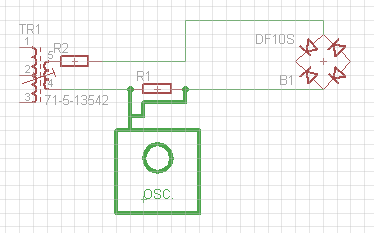
Diagram below shows connection of oscilloscope for measure of current in secondary.

Please excuse diagram - I tried to use an unfamiliar circuit diagram/PCB program & it was not worth the time!

R2 is the resistance of the secondary winding, R1 is a metal film resistor of 1 ohm 0.5 watt or other low inductance resistor.

R1 acts as a shunt, which makes a voltage proportional to secondary current, but does not cause enough volt drop to affect the circuit. Shunts got their name from a parallel resistor used to extend the range of of a DC panel ammeter, a standard was to have a shunt which dropped 75 millivolts at meter full scale. A 1 ohm shunt gives 1 millivolt per milliamp.

The oscilloscope is connected across R1, the left lead is the "ground" clip - this just ensures, if R2 winding end is positive, scope gets positive.

By starting with just bridge, then adding capacitor, then regulator etc. you can see what is adding the current - ideally bridge without load will draw negligible current.

Your graphs suggest your FET is switching in about 0.5 μs or less. Taking a rough view, that the load is resistance and current & voltage change linearly over 0.5 μs, also that current peak is 0.75 amp & 13 volts you have ~10 watts loss for 1 μs in each cycle of 32 μs - an average of 10/32 = 0.31 watts or 0.15W per FET.

It is not worth the trouble of building a "high drive" circuit to reduce that loss in a 10W output inverter.

You can also put the shunt in the source lead of a FET to view its current, a sharp rise of current part way through a half cycle reaching high values is the sign of saturation.

I feel that part of your problem is that your ferrite core is rated 10W at 100 kHz but capacity is proportional to frequency, due to magnetic saturation - so only 3W at 32 kHz. A simple test to try is to reduce the voltage to the transformer by feeding from 6V of AA size manganese cells, leaving the 4047 at 13V & see what it does to losses & your 50V transient. Or an LM317 adjustable regulator....

Having looked at the bridge data sheet, there are some footnotes which must be noted.

  • voltage drop in graph is per diode.
  • temperature rise of 40K/watt is with 13 mm2 area of PCB copper as heatsink, which is so small I think it means per pin maybe double-sided copper, thicker than standard 0.035mm.

So at 0.15 amp DC, the volt drop is 1.6, a loss of 0.24 watts. Temperature rise for an old metal case TO5 transistor of 220K/W junction-air [of similar surface area, no heatsink] would give rise of 220 x 0.24 = 53K above ambient [too hot to touch, 44'C, a genuine "rule of thumb", is too hot to hold for long].

You report 100'C, so I wonder if you have any heat-sinking.

Regards,

67model

Reply Off Topic (Score 4)
Commentator

Join Date: Apr 2009
Posts: 91
Good Answers: 1
#86
In reply to #85

Re: Ringing when switching OFF a MOSFET

06/21/2021 6:08 PM

Dear Guru,

Please see below.

Kind regards,

Job

Reply Off Topic (Score 5)
Guru

Join Date: Dec 2010
Posts: 1686
Good Answers: 116
#87
In reply to #86

Re: Ringing when switching OFF a MOSFET

06/22/2021 12:46 PM

Hello again, Job, I hope you are well,

Thanks for the trace. Could not see the basic scale grid, but your image was good, so copying & "Blowing up" I decided the vertical marks must be 1/10 divisions from the voltage trace 35.6 volts @ 25V/div. The current trace came out at +0.15 volt on the right, which would require 1.5 amp @ 13V DC input - so I think you had the x10 probe set but input direct!

The current trace at middle [end of -ve half-cycle] has gone down to zero; in fact it got to zero 1/3 way through half-cycle. In contrast, +ve half-cycle stays at 3 divisions, Ξ 0.15 amp. Counting -ve current, because it is smaller & 1/3 cycle as zero, +ve cycle is 0.15 amp x 35.6 volts = 5.34 watts - only half a cycle so half that DC input; call it 3 watts @ 13V = 0.23 amps.

Because the +ve current settles in ~ 1 μs to a steady value it seems it would be same at DC. Such a current in a bridge on open circuit load is not the way it should be!

I suggest you test the bridge out of inverter with a DC source; ideally about 40V, but I suspect it would still "leak" at 13V. Put your load resistor in series with source, to prevent supply short-circuit.

If you look at the bridge diagram, you will see that you can connect DC to each diode in turn by selecting two bridge pins i.e.

- to ~(1) : - to ~(2)

+ to ~(1) : + to ~(2)

If all diodes work as they should.....

One of the other 3 diodes will always be reverse biased, whatever polarity you apply, so you should measure zero current for one polarity and current limited by load resistor + one diode forward voltage drop for the other polarity.

But I expect you will find one diode is resistive in reverse polarity, but would behave similar if it were a 35V zener, hence suggestion of 40V PSU.

Semiconductors sometimes have faults, when unsealed from the packet. I had a strip of 5 regulators similar LM137 - when I used one it gave high output. Problem was resistance of ~200 ohm measured ADJ to OUT by meter [with regulator off PCB]. I thought "How did I damage that"? But every one of the strip had the same rogue resistance value! Sometimes faulty parts are sent as "good" by the crooked, but those came from a reliable stockist.

Regards,

67model

Reply Off Topic (Score 5)
Guru

Join Date: Aug 2005
Location: Hemel Hempstead, UK
Posts: 5826
Good Answers: 322
#66
In reply to #64

Re: Ringing when switching OFF a MOSFET

05/24/2021 10:12 AM

"The diodes were oriented in the correct direction ( Cathodes connected to positive )."

OK but are all three Positives circled in blue, the same point?

I'm just trying to work out why the voltages at the anodes is clamped at 5V.

__________________
If you spend all your time looking for people and things to complain about: trust me, you will find plenty to complain about.
Reply Off Topic (Score 5)
3
Commentator

Join Date: Apr 2009
Posts: 91
Good Answers: 1
#54
In reply to #50

Re: Charge and Discharge Timing

03/12/2021 11:32 AM

Dear Randall, R_i_c_h, Oomborrie & every one tried to help,

I appreciate the valuable help that you provided. I had been trying to decipher the comments posted in the final few days but must admit that I could not understand much. For an engineer who graduated in the late nineteen six-tees with only a little exposure (academically) to electronics, it was too much to understand to the full extent though it was very helpful.

Kind regards,

Job Thykkoottathil

Reply Good Answer (Score 3)
Guru

Join Date: Dec 2010
Posts: 1686
Good Answers: 116
#55
In reply to #54

Re: Charge and Discharge Timing

03/12/2021 1:55 PM

Thanks Job,

Thanks is appreciated - it does not happen much but when it happens it tells folk their efforts have helped to answer a question.

You could compare the current regulator to a mechanical bottling plant, bottles have to be loaded, filled & a cap fitted. There is a limit to how fast you can start or stop the line and the bottles per minute. Too fast & you have part-filled bottles, contents clogging the machine and less good bottles per minute!

Apologies for final posts about details difficult to understand. Got diverted into the detail.

The LM117/137 is an electronic integrated circuit which has been made with minor change for 50 years - like a water level control ball valve there are probably one or more in millions of houses.

67model

Reply
Commentator

Join Date: Apr 2009
Posts: 91
Good Answers: 1
#56
In reply to #55

Re: Charge and Discharge Timing

03/13/2021 8:35 AM

Pranam Guru!

"You could compare the current regulator to a mechanical bottling plant, bottles have to be loaded, filled & a cap fitted. There is a limit to how fast you can start or stop the line and the bottles per minute. Too fast & you have part-filled bottles, contents clogging the machine and less good bottles per minute!"

For someone of my understanding the analogy is good.

Kind regards,

Job Thykkoottathil.

Reply
Commentator

Join Date: Apr 2009
Posts: 91
Good Answers: 1
#44
In reply to #41

Re: Charge and Discharge Timing

02/28/2021 1:05 PM

Hi Guru,

  1. "When capacitor is below 5 volts, NE555 switches, pin 7 becomes open-circuit. Pin7 voltage will move positive at a rate set by the circuit capacity and sum of U1 & U2 currents. Note that U2 is still discharging the timing capacitor, so pins 2,6 will fall below 5 volts."

I am just wondering how the capacitor can continue to discharge after the discharge transistor is turned off.

I think that the charging and discharging take place independent of each other. In the charge cycle, the current is blocked by D2 and during discharge cycle the current supplied by U1 is passed to the common ground by the discharge transistor preventing the capacitor to receive any current.

U2 will remain in conduction independent of the state of the discharge transistor. Therefore, the capacitor must get charging current as soon as the "clamp" is removed. The voltage at pin 7 should jump from 0.7 (Collector emitter voltage of discharge transistor) to 1/3 VCC and start rising. There should not be any question of any delay in supplying the charge current by U1

Clearly, we can see that at lower frequencies, the charging and discharging takes place in a linear fashion with equal timing, but why the charge time increased on charge, while still at a linear fashion, at higher frequencies? Why it did not affect the discharge cycle?

I think that the voltage at pin 2/6 should fall below 5 volts (1/3 VCC) only if the control voltage at pin # 5 is less than 2/3 VCC.

Kind regards,

Job.

Reply
Power-User

Join Date: Jan 2015
Location: Johannesburg, South Africa
Posts: 248
Good Answers: 3
#46
In reply to #44

Re: Charge and Discharge Timing

02/28/2021 4:32 PM

1st, the 0,7V, collector emitter voltage you talk about is a miss conception, the only place with forward bias voltage is the Base Emitter. If the base emitter current is high enough which it is on a 555 pin 7 goes to hard ground 0V. U2 circuit can only reverse bias the discharge diode if the voltage on pin 7 (the cathode side of the diode) rise to higher than the Anode voltage and that depends on the switching on of the U1 317 of which the control voltage on the control pin tells it to be 0V. The way you use the 317 in the charging circuit is the problem with your circuit at higher frequencies. Put the U1 and U2 circuits in parallel but opposite ways around. Pull pin 7 up with a 100 Ohm resistor. Now you will have exactly the same current circuit for charging and Discharging between Pin 7 and the Capacitor. You will pull pin 7 down to 0V with a short circuit when the 555 pulls it low and you will pull pin 7 up to Supply with the 100 Ohm resistor when the 555 allow pin 7 to go high. Use a 10 Ohm if the 555 internal circuit allows it. Make the 2 circuits as equal as possible.

__________________
Tragedy for Engineers is thinking they know so much that they can not learn from any body else.
Reply
Power-User

Join Date: Jan 2015
Location: Johannesburg, South Africa
Posts: 248
Good Answers: 3
#47
In reply to #44

Re: Charge and Discharge Timing

02/28/2021 4:43 PM

See that 1k pull up resistor. But for higher frequencies the 1 k will drop the voltage to much and limit the current you need for your experiment. Do not add the diode on pin 7.

__________________
Tragedy for Engineers is thinking they know so much that they can not learn from any body else.
Reply
Power-User

Join Date: Jan 2015
Location: Johannesburg, South Africa
Posts: 248
Good Answers: 3
#48
In reply to #44

Re: Charge and Discharge Timing

02/28/2021 4:54 PM

Drive, supply U1 from pin 7 in my suggestion. u1 and U2 is connected to pin 7 and pin 6/2. 0V on pin 7 comes from the switching of 555 to discharge time and pull up of pin 7 comes through the 100E or 10E pull up resistor between Supply voltage and pin 7.

__________________
Tragedy for Engineers is thinking they know so much that they can not learn from any body else.
Reply
Guru

Join Date: Dec 2010
Posts: 1686
Good Answers: 116
#49
In reply to #44

Re: Charge and Discharge Timing

03/01/2021 7:58 AM

Thankan,

You are correct in how you describe the operation of the circuit if all the parts are theoretically ideal & they are, for practical purposes, for long timings. If you add a capacitor Cx (U2 self capacitance) from pin7 to GND or V+ to circuit you will see that U2 can can continue to discharge the timing capacitor while drawing current through Cx & charging it +ve.

Real circuits have capacitances which are not on the block diagram and these affect operation for microsecond periods when timing capacitor voltage charges/discharges at about 5 volts in 8 microseconds [about 0.7 volts/μs]. The detectors which switch at the 1/3 & 2/3 supply volts cannot switch instantly & the bistable in the 555 which controls pin 7 will not switch instantly nor will the transistor whose collector pulls pin 7 to 0 volts. It is usual for turn-off times to be much longer than turn-on times.

If the pin 2/6 detectors actually takes 0.5 microsecond to switch, the voltage at pin 2/6 will actually overshoot by 0.5 μs x 0.7 volt/μs = ~0.35 volts, at both 1/3 & 2/3 supply - you report ideal 5 volt increases to 6 volts at expected half periods of ~ 8μs; which is more.

Another commentator has simulated your circuit with 0.001 μF timing capacitor and found a charge time greatly exceeding expected.

Although U1 seems to have an easy task, it has to conduct at the same current before and after pin 7 switching, it actually sees a 5 volt step in the voltage across it. Some LM317 data sheets show response graphs for 1 volt step of 10 volt input on output voltage and it fluctuates - for a load resistance R this means current through LM317 must fluctuate in same proportion, as a current source it has same transients.

It appears a 5 volt step down can initiate a step drop to about 25% of the set current for 30 μs. As I pointed out, you can test this by using 4.5V dry cells and the NE555 to apply 5V step cycles to your actual LM317 "U1" and observe the response on your oscilloscope.

67model

Reply
Reply to Forum Thread 87 comments

Good Answers:

These comments received enough positive votes to make them "good answers".

"Almost" Good Answers:

Check out these comments that don't yet have enough votes to be "official" good answers and, if you agree with them, vote them!
Copy to Clipboard

Users who posted comments:

67model (18); Oomborrie (11); PWSlack (1); R_i_c_h (6); Randall (16); Rixter (1); SolarEagle (2); thankan (32)

Previous in Forum: VSD with Star Delta Starting   Next in Forum: DGTL ISO 2.5KV GATE DRIVER 8SOIC

Advertisement