Previous in Forum: Flying Fish Ancestry?   Next in Forum: Hurricane Resistant Structures
Close
Close
Close
34 comments
Rate Comments: Nested
Guru
Hobbies - RC Aircraft - New Member

Join Date: Aug 2007
Posts: 901
Good Answers: 9

Pressures?

09/03/2025 12:04 PM

Ok I have a thin plastic film balloon that is shaped like a cylinder.

It has a circumference of 106 feet and is 20 feet tall.

at launch just enough hydrogen was put into the balloon to give it 0.7 ounces of positive lift. and was released of course as it rises it expands. eventually it reaches an altitude where the balloon is totally filled, but the pressure is still the same inside and outside of the balloon.

Now the balloon envelope will not let the hydrogen expand any more but because of the 0.7 lift it still does rise. Now the air displaced by the balloon is getting less and less dense. and eventually the bouyancy equals that 0.7 lift and the balloon stops rising and floats.

My question is what is the pressure differential between in the balloon and out side the balloon?

Register to Reply
Interested in this topic? By joining CR4 you can "subscribe" to
this discussion and receive notification when new comments are added.

"Almost" Good Answers:

Check out these comments that don't yet have enough votes to be "official" good answers and, if you agree with them, vote them!
Guru

Join Date: Mar 2007
Location: by the beach in Florida
Posts: 33392
Good Answers: 1817
#1

Re: Pressures?

09/03/2025 1:42 PM

..."Now the balloon envelope will not let the hydrogen expand any more but because of the 0.7 lift it still does rise"...

That's when your balloon pop's....

__________________
All living things seek to control their own destiny....this is the purpose of life
Register to Reply Score 1 for Good Answer
Power-User
United States - Member - Western Wisconsin

Join Date: Mar 2007
Location: Wisconsin USA
Posts: 305
Good Answers: 25
#2

Re: Pressures?

09/03/2025 3:08 PM

It will depend on the weight of the balloon.

The density of air is about 14.4 times the density of hydrogen. If we assume the balloon is weightless, the pressure inside would need to be about 14.4 times the pressure outside to have neutral buoyancy.

The heavier the balloon, the lower the pressure difference required to maintain neutral buoyancy.

__________________
Troy
Register to Reply
Guru

Join Date: Apr 2010
Location: About 4000 miles from the center of the earth (+/-100 mi)
Posts: 9911
Good Answers: 1141
#3

Re: Pressures?

09/03/2025 8:55 PM

Here's a guess: P = Lift force / Area of Balloon

Lift force = 0.7 oz / 16 oz/lb = 0.04375 lb

Circumference of cylindrical balloon = 106 ft

Area of top of balloon =2 * pi r2 = 2*pi*C2/pi2 = 2*C2/pi = 7153 sqft

Area of bottom of cylinder = 7153 sqft.

Side area of balloon: 106 ft x 20 ft = 2120 sqft

Pressure = Force/Area = 0.04375 lb / (2*7153+2120) sqft = 2.663 x 10⁻⁶ lb/sqft

Register to Reply
Guru
Popular Science - Weaponology - New Member Hobbies - Fishing - New Member

Join Date: May 2007
Location: Aloha or
Posts: 659
Good Answers: 19
#4

Re: Pressures?

09/04/2025 1:23 AM

assuming your balloon does not change shape, staying a cylinder with flat top and bottom,(stiff non flexible surfaces) the pressure differential is ? Not enough info provided.

A balloon with a circumference of 106 feet and 20 feet tall has a volume of 17881.75 ft cubed. The volume of displaced air at std temp and pressure of 17881.75 feet weighs 1367.95 pounds or 21,887.26 ounces. Your balloon plus helium weighs 21.886.56 ounces.

or 0.7 ounces of lift. You did mean 0.7 ounces of total lift right.

Helium weighs .0114 pounds per cubic ft. 0.0114 at std temp and pressure. what does your balloon weigh? then we can calculate the amount of helium you put in to get up to the 21.866.56 ounces. then we can calculate the pressure of that weight of helium.

more than likely the sides, top and bottom, of your balloon are flexible and will expend to a larger volume with the same weight making it more buoyant.

For a flexible balloon the pressure inside must be slightly higher inside to inflate the balloon. still need to know the balloons weight to calculate the pressure inside to create the lift.

__________________
Closed biased minds are utterly impervious to any factual evidence which contradicts their beliefs
Register to Reply
Power-User

Join Date: Jul 2017
Posts: 236
Good Answers: 9
#5
In reply to #4

Re: Pressures?

09/04/2025 6:07 AM

Hi SilvCrow, think you missed the fact that the OP stated Hydrogen, not Helium.
That the OP is using a highly dangerous gas ( Hindenberg disaster 1937) instead of the safe Helium gas is another question.

Difference in Density / Weight between Hydrogen and Helium

The density of gases is a crucial factor in their behavior and applications. Here's a comparison of the density of hydrogen and helium:

Register to Reply
Guru
Popular Science - Weaponology - New Member Hobbies - Fishing - New Member

Join Date: May 2007
Location: Aloha or
Posts: 659
Good Answers: 19
#7
In reply to #5

Re: Pressures?

09/04/2025 11:33 AM

Thank you- good catch. I guess my mind just wanted to be safe. Still need the weight of the balloon to find his answer.

__________________
Closed biased minds are utterly impervious to any factual evidence which contradicts their beliefs
Register to Reply
Guru
Hobbies - RC Aircraft - New Member

Join Date: Aug 2007
Posts: 901
Good Answers: 9
#8
In reply to #7

Re: Pressures?

09/04/2025 12:03 PM

The balloon weighs 6.34 ounces.

No need to tell me about the "DANGERS" of H2. Been using it for 40 years on these flights. the next one is #60 flight.

The Hindenburg 99% of the flames was the highly flammable covering they used on the thing. NOT the H2.

H2 when NOT mixed with O2 doesn't even burn. OR even more importantly EXPLODE!

I can show you videos of balloons intentionally filled and a flame. It burns Yes, mainly the rubber is the dangerous part hot melted rubber flaming falling down. but there is NO explosion.

Explosions happen when the burning material is not allowed to expand. and then the restricting of pressure finally breaks and we have a sudden release of pressure.

Example a Firecracker, yes BOOM, yup but it is the paper that makes it go BOOM not the black powder inside! open a firecracker and light the powder, and it sparks and smokes but thats about it no Explosion.

Register to Reply
Power-User

Join Date: Jul 2017
Posts: 236
Good Answers: 9
#11
In reply to #8

Re: Pressures?

09/05/2025 6:14 AM

Why are you using Block Capitals ? Nobody mentioned the Hydrogen exploding, SE mentioned your "Sealed balloon going pop, he did not state the Hydrogen exploded, he meant the Balloon went pop because the gas expanded and the material reached a point where the material could not stretch any more so the material went pop.
Hydrogen does not explode, it burns very quickly in an upward direction only as it's lighter than air. unlike petrol or diesel fumes as they are heavier than air and settle at ground level.
During my career, I have also worked on Hydrogen Projects involving storage tanks for cars and exhaust gas sensors in Hydrogen motors used in cars.
Two questions still; one is why you choose to use a dangerous material (Hydrogen) as opposed to a safe gas like Helium?
Two; which plastic material are you using for your balloon ? According to the given weight 6.34 oz. and your dimensions 20ft x 106ft. that gives an surface area of about 6000 ft² including the two ends.
That gives a weight of 2.87g (0,101 oz.) per square meter and the only plastic that comes in at that weight is POM. which is not known for its elasticity as it is used for injection molded parts as it is extremely hard.

Register to Reply
Guru

Join Date: Oct 2006
Location: 44.56024"N 15.307971E
Posts: 8277
Good Answers: 270
#6

Re: Pressures?

09/04/2025 8:06 AM

Earthquake-proof cities?

Frank Llyod Wright said that a hemispherical building of at least 5 miles diameter would float using standard building materials.

This was due to the differential weight of the air inside/outside vs the materials. As the temperature of the air changed, the lift of the sphere would change. The city would be self ventilating because of the natural air flow around a sphere creating an updraft. The city being anchored would control the maximum height.

Anyone care to calculate the weight of the air inside of a 5+ mile diameter hemisphere or comment on this?

__________________
"A man never stands so tall as when he stoops to help a child." "Never argue with a stupid person.They will drag you down to their level and beat you with experience" "To create an apple pie from scratch, first you must create a universe"
Register to Reply Off Topic (Score 5)
Guru

Join Date: Mar 2007
Location: by the beach in Florida
Posts: 33392
Good Answers: 1817
#9
In reply to #6

Re: Pressures?

09/04/2025 8:43 PM

I don't think so....

Frank Lloyd Wright never proposed a hemispherical building of at least 5 miles in diameter. The structure that fits this description is the proposed mile-high skyscraper, The Illinois, which he announced in 1956. The idea of a hemispherical building 5 miles in diameter is more likely related to a different architectural or theoretical concept. Here's a comparison to clarify:

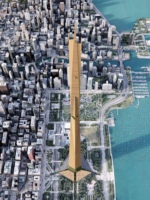
  • The Illinois: In 1956, Wright announced a plan for a mile-high (5,280 ft) skyscraper with 528 stories. It was to be a needle-like, tripod-based spire for Chicago that would consolidate urban life vertically. Wright believed this would free up surrounding land for his "Broadacre City" concept.
  • The Hemispherical Myth: While Wright's Broadacre City proposal did emphasize decentralization and large open spaces, his vision did not include a gigantic hemispherical building. The massive, all-encompassing city-under-glass model is an entirely separate concept that has been explored by others, such as science fiction writers, but not by Wright.

In summary, the quote about a hemispherical building is an inaccurate conflation of two different ideas: Wright's ambitious, but different, skyscraper plan and the unrelated concept of a five-mile dome. "The Illinois (Chicago)

In 1956, Wright held a small press conference to announce a gleaming new tower project in Chicago. The Illinois was set to be 528 stories and stand a mile high, four times as tall as the world’s tallest building at the time. “The Empire State Building would be a mouse by comparison,” Wright boasted.

At more than 18 million square feet, three times the floor space of the Pentagon, the Illinois would contain space for more than 100,000 people, for which reason Wright dubbed it “a city in the sky.” Four major highways, along with rail lines and a heliport, would provide access to the building, with docking space for more than 100 aircraft and parking space for more than 15,000 cars.

Getting people to the top of the building would be the task of 76 elevators, each with five-story-high cabs delivering passengers to five floors at a time. These elevators would be atomic-powered, and, Wright said, run at a mile a minute—three times faster than the fastest elevators today."...

https://franklloydwright.org/frank-lloyd-wrights-unbuilt-skyscrapers-come-to-life-with-never-before-seen-3d-imagery/

__________________
All living things seek to control their own destiny....this is the purpose of life
Register to Reply Off Topic (Score 5)
Power-User

Join Date: Jul 2017
Posts: 236
Good Answers: 9
#10
In reply to #9

Re: Pressures?

09/05/2025 5:14 AM

Wonder how he would compensate for the differences between ground level and top of the skyscraper ,for example a reduced Oxygen level at 5200ft compared to ground level and ambient air temperature affecting outside surfaces of the building materials.

Register to Reply Off Topic (Score 5)
Guru

Join Date: Mar 2007
Location: by the beach in Florida
Posts: 33392
Good Answers: 1817
#12

Re: Pressures?

09/05/2025 4:06 PM

__________________
All living things seek to control their own destiny....this is the purpose of life
Register to Reply
Guru
Hobbies - RC Aircraft - New Member

Join Date: Aug 2007
Posts: 901
Good Answers: 9
#13
In reply to #12

Re: Pressures?

09/05/2025 4:11 PM

Burst altitude is super easy I have been doing that for 40+ years. and am usually within +/- 1000 feet of predicted burst altitude.

Register to Reply
Guru

Join Date: Mar 2007
Location: by the beach in Florida
Posts: 33392
Good Answers: 1817
#14
In reply to #13

Re: Pressures?

09/05/2025 6:16 PM
__________________
All living things seek to control their own destiny....this is the purpose of life
Register to Reply
Guru
Hobbies - RC Aircraft - New Member

Join Date: Aug 2007
Posts: 901
Good Answers: 9
#15
In reply to #14

Re: Pressures?

09/05/2025 7:42 PM

As stated before I can do burst altitude in my sleep.

read closely the riginal posting, it has very little to do with burst altitude.

Register to Reply
Guru
Popular Science - Weaponology - New Member Hobbies - Fishing - New Member

Join Date: May 2007
Location: Aloha or
Posts: 659
Good Answers: 19
#16

Re: Pressures?

09/05/2025 10:22 PM

At what altitude are your balloons leveling off?

__________________
Closed biased minds are utterly impervious to any factual evidence which contradicts their beliefs
Register to Reply
Guru
Hobbies - RC Aircraft - New Member

Join Date: Aug 2007
Posts: 901
Good Answers: 9
#17
In reply to #16

Re: Pressures?

09/05/2025 10:48 PM

Technically it doesn't matter.

Register to Reply
Power-User

Join Date: Jul 2017
Posts: 236
Good Answers: 9
#18

Re: Pressures?

09/06/2025 4:13 AM

Dear NSS, having reviewed your original post and your subsequent comments, including the "I've being doing this for 40 years" and "I can do Burst calculations in my sleep" with all this "Experience" why are you asking us for an answer to a question nobody can accurately answer due to the lack of information provided.
1: the amount of gas you filled x plus 7 oz. What is X ? You state the balloon reaches an altitude where it is totally filled. I presume from that comment that the balloon to start was not fully inflated and as the balloon rose the gas expanded until expansion was restricted by the ballons capacity to stretch.
So we have an unknown start weight so we cannot calculate the effect of gravity as gravity decreases as altitude increases. i.e. the point where floating occurs is where lift and gravity level off
2: You answered SilvCrow that the Altitude is technically irrelevant, however, the Air Pressue drops the higher you go, so when you ask for the pressure differential the outside air pressure is obviously extremely relevant as that is one side of the equation necessary for your answer, so his question was relevant, imo.

Register to Reply
Guru
Australia - Member - New Member

Join Date: Feb 2008
Location: Australia
Posts: 2181
Good Answers: 255
#19

Re: Pressures?

09/06/2025 9:48 AM

Have a look at p x v = n x r x t.

Your delivered Hydrogen volume "v" will be the same as the displaced air volume and work from there.

Solving might look like p (Hydrogen)/p (air) = (n x r x t (Hydrogen))/(n x r x t(Air)).

I suppose you could assume "t" to be the same for both.

__________________
Just an Engineer from the land down under.
Register to Reply
Guru
Hobbies - RC Aircraft - New Member

Join Date: Aug 2007
Posts: 901
Good Answers: 9
#20

Re: Pressures?

09/06/2025 10:31 AM

A pressure differential is absolutely the same regardless of altitude.

It it is fully inflated and has 7 ounces of positive lift. be it at 10 feet or 100 thousand feet it still has 7 ounces of positive lift.

Register to Reply
Guru
Popular Science - Weaponology - New Member Hobbies - Fishing - New Member

Join Date: May 2007
Location: Aloha or
Posts: 659
Good Answers: 19
#21
In reply to #20

Re: Pressures?

09/06/2025 11:01 AM

if the lift is the same at all altitudes why does it stop rising and levels off at some height?

__________________
Closed biased minds are utterly impervious to any factual evidence which contradicts their beliefs
Register to Reply
Guru
Hobbies - RC Aircraft - New Member

Join Date: Aug 2007
Posts: 901
Good Answers: 9
#23
In reply to #21

Re: Pressures?

09/06/2025 12:06 PM

Because if the envelop does not stretch anymore, the gas inside can not expand to be equal to the outside pressure and at the same time become less dense.

So as the air outside is gettng less and less dence the gas inside relative to the outside is getting more and more dense relative to the outside.

Register to Reply
Guru
Popular Science - Weaponology - New Member Hobbies - Fishing - New Member

Join Date: May 2007
Location: Aloha or
Posts: 659
Good Answers: 19
#24
In reply to #23

Re: Pressures?

09/06/2025 5:47 PM

so if the air is gradually getting less dense then you need to know the altitude to calculate the pressure.

__________________
Closed biased minds are utterly impervious to any factual evidence which contradicts their beliefs
Register to Reply
Guru
Hobbies - DIY Welding - Don't Know What Made The Old Title Attractive... Popular Science - Weaponology - New Member United States - US - Statue of Liberty - 60 Year Member

Join Date: Apr 2009
Location: Yellowstone Valley, in Big Sky Country
Posts: 7425
Good Answers: 295
#22
In reply to #20

Re: Pressures?

09/06/2025 11:41 AM

These two statements seem to contradict paragraphs #4 and #5 of your original post.

__________________
Semper Ubi Sub Ubi
Register to Reply
Guru
Popular Science - Weaponology - New Member Hobbies - Fishing - New Member

Join Date: May 2007
Location: Aloha or
Posts: 659
Good Answers: 19
#25

Re: Pressures?

09/06/2025 7:50 PM

I am going to guess that you are using very close to 100 lbs of helium. To get your balloon to altitude

__________________
Closed biased minds are utterly impervious to any factual evidence which contradicts their beliefs
Register to Reply
Guru
Hobbies - RC Aircraft - New Member

Join Date: Aug 2007
Posts: 901
Good Answers: 9
#26
In reply to #25

Re: Pressures?

09/06/2025 10:07 PM

Huh?

A tiny bit more than 6 cu ft of H2

Register to Reply
Guru
Popular Science - Weaponology - New Member Hobbies - Fishing - New Member

Join Date: May 2007
Location: Aloha or
Posts: 659
Good Answers: 19
#27
In reply to #26

Re: Pressures?

09/07/2025 1:10 AM

my mistake. I used my estimated total volume for the balloon at sea level to fill the balloon instead at your top altitude. I realized the balloon is not a perfect cylinder at altitude and came up with some estimates for its volume. You are getting way higher than I guessed.

__________________
Closed biased minds are utterly impervious to any factual evidence which contradicts their beliefs
Register to Reply
Power-User

Join Date: Jul 2017
Posts: 236
Good Answers: 9
#28

Re: Pressures?

09/07/2025 6:55 AM

@ SilvCrow, you are still referring to Helium instead of Hydrogen, NSS uses Hydrogen !
My calculation is as follows: Height 20 feet.
given circumference is 106 feet therefore 106/3.14 (PI) = 33.75 feet diameter
These measurements give a total volume of 17,892 cu. ft. which converted to Hydrogen is 93 lbs, so your guess of 100lbs is near the mark
If you meant Helium you are off by 85 lbs.
@ NSS. you keep changing the rules as you go. First you talk about weights, plus 0,7oz, now you talk about cubic feet. So 12 cubic feet of Hydrogen is your "plus 0.72 ounces" but you have never said what your initial fill weight was, so how many pounds of Hydrogen did you use before you added your "magical 0,72 ozs?
As to your comments regarding densities inside and outside your balloon, once your balloon has ascended to the height where it floats, the pressure difference is zero.
If the pressure outside was higher than the pressure inside your balloon would implode, if the pressure inside the balloon was greater, your balloon would explode, due to material disintergration, not the Hydrogen exploding.

Register to Reply
Guru
Popular Science - Weaponology - New Member Hobbies - Fishing - New Member

Join Date: May 2007
Location: Aloha or
Posts: 659
Good Answers: 19
#29
In reply to #28

Re: Pressures?

09/07/2025 11:29 AM

I did not use your volume. I think the balloon at altitude will be very close to a sphere, so I used a height of 32 feet and then used the volume for a spheroid. This adds another 7 lbs. Still I was wrong to forget the altitude. He is getting those balloons about 135 thousand feet in my estimate. Since we don't know the temp, its impossible to accurately know a good answer. I used 70 below F to try and come up with a good answer for height using his 6 cubic feet answer.

Doing the math was fun.

__________________
Closed biased minds are utterly impervious to any factual evidence which contradicts their beliefs
Register to Reply
Guru

Join Date: Oct 2006
Location: 44.56024"N 15.307971E
Posts: 8277
Good Answers: 270
#30

Re: Pressures?

09/08/2025 9:32 AM

While thinking about this problem, I strayed a bit OT.:

Blimps use weights to control altitude by releasing weights.

Why not use compressors and storage tanks to inflate or deflate the blimp?

Weights when dropped they are not retrievable, so they only work to raise the height.

Compressing the helium into a tank would lower the blimp, and releasing it back into the blimp would raise the blimp.

Two way height control.

Jus' thinkin'

__________________
"A man never stands so tall as when he stoops to help a child." "Never argue with a stupid person.They will drag you down to their level and beat you with experience" "To create an apple pie from scratch, first you must create a universe"
Register to Reply Off Topic (Score 5)
Guru

Join Date: Apr 2010
Location: About 4000 miles from the center of the earth (+/-100 mi)
Posts: 9911
Good Answers: 1141
#31

Re: Pressures?

09/16/2025 9:50 AM

OK, the balloon starts with enough hydrogen for 0.7 oz of lift. As the balloon rises, the volume of the hydrogen increases with decreasing external pressure until it reaches an altitude where the balloon is full and cannot expand further. Call the pressure at that altitude P1. The balloon displaces (V=7153 * 20 = 14306 cu ft) the weight of the air at this altitude plus 0.7 oz.

It continues to rise until the air pressure drops to P2 where the balloon displaces its weight in air. (The pressure inside the balloon is still P1). So the weight of 14306 cu ft of air decreases by 0.7 oz or .04375 lb. This works out to .04375/14306 = 3.058 x 10⁻⁶ lb/cuft

Convert lb / cuft to psi:

Air at sea level (14.7 psi) weighs 0.075 lb / cu ft or 0.075 /14.7 = .00510 (lb/cu ft) / psi)

P1 - P2 = (3.058 x 10⁻⁶ lb/cuft) / (0.00510 (lb/cuft) )/ psi = 5.996 x 10⁻⁴ psi

Register to Reply
Guru
Popular Science - Weaponology - New Member Hobbies - Fishing - New Member

Join Date: May 2007
Location: Aloha or
Posts: 659
Good Answers: 19
#32
In reply to #31

Re: Pressures?

09/16/2025 11:18 AM

I believe your number for volume is off. At altitude the balloon will not be a perfect cylinder. The formula for volume of a sphere is 4/3 pi r cubed. We know two of the r's. You will have to guess at the third one. I think the volume is closer to 19,000 cubic feet.

The rest of your math is dead on.

__________________
Closed biased minds are utterly impervious to any factual evidence which contradicts their beliefs
Register to Reply
Guru

Join Date: Apr 2010
Location: About 4000 miles from the center of the earth (+/-100 mi)
Posts: 9911
Good Answers: 1141
#33
In reply to #32

Re: Pressures?

09/16/2025 1:45 PM

I was also a bit skeptical about a cylindrical balloon, but I used the numbers the OP provided. A fully inflated balloon would probably be spherical or nearly so.

The volume is what is important.

Register to Reply
Guru

Join Date: Apr 2010
Location: About 4000 miles from the center of the earth (+/-100 mi)
Posts: 9911
Good Answers: 1141
#34
In reply to #31

Re: Pressures?

09/17/2025 8:06 AM

Correction:

In converting lb/cu ft to psi, you need to take temperature into account. STP is

293 deg K and 14.7 psi. P1-P2 should be (T/293) x 5.996 x 10-4 psi, where T is degrees Kelvin (Co + 273)

I

Register to Reply
Register to Reply 34 comments

"Almost" Good Answers:

Check out these comments that don't yet have enough votes to be "official" good answers and, if you agree with them, vote them!
Copy to Clipboard

Users who posted comments:

Doorman (1); HiTekRedNek (2); Just an Engineer (1); NSS (7); Rixter (4); silvCrow (9); SolarEagle (4); The Wizard (5); Troy36 (1)

Previous in Forum: Flying Fish Ancestry?   Next in Forum: Hurricane Resistant Structures

Advertisement