Shell Distortion — including weld misalignment, angular misalignment, peaking, and general out-of-roundness — creates a condition that closed-form code formulas handle conservatively and sometimes inadequately.
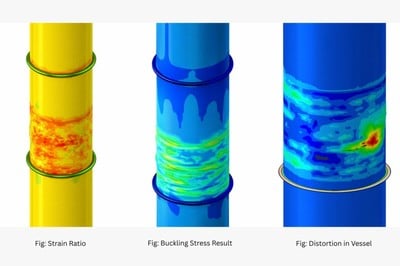
API 579-1/ASME FFS-1 Part 8 provides the framework for shell distortion assessments. At Level 1 and Level 2, the standard uses geometric deviation ratios compared to allowable limits derived from shell bending theory. These are intentionally conservative for simple geometries.
Where distortion patterns are complex — multiple misaligned welds, peaking combined with thinning, or out-of-round nozzle reinforcements — Level 3 is appropriate. This invokes a full nonlinear FEA model.
For a recent pressure vessel shell distortion case: Level 2 flagged the vessel as requiring action. Level 3 FEA with accurate as-found geometry confirmed that the peak plastic strain at the worst-case weld toe was within API 579 Part 9 strain limits at operating pressure. The vessel was cleared for continued operation with revised inspection intervals.
Key FEA outputs required:
- Elastic-plastic load application to operating + hydrotest pressure
- Strain concentration at measured distortion peaks
- Comparison against Part 9 ductile failure strain limits
- Documented load case traceability
Case study available here — shell distortion FFS assessment with Level 3 FEA methodology
Happy to discuss the Level 2 vs Level 3 trigger boundary in more detail if anyone is working through a similar case.


 Shell Distortion FFS: How Nonlinear FEA Resolves Code Ambiguity for Out-of-Round Vessels


