When discussing foundation design, we often focus on whether the soil can support the building load. But for large-scale facilities, another question can be just as important:
Will different parts of the building move by different amounts?
This is known as differential settlement, and it can create problems even when the overall settlement of the building remains within an acceptable range.
For example, a logistics facility with high-bay racking may have very tight tolerance requirements. A relatively small difference in ground movement can affect rack alignment and building operation. In a data center, differential movement can also affect raised floors, equipment, and other building systems.
Why total settlement isn't the whole story
Imagine two parts of a building settling by 20 mm. If both areas move approximately the same amount, the structural consequences may be limited.
Now imagine one area settles by 10 mm while another settles by 30 mm.
The total movement is still within a similar range, but the 20 mm difference between the two areas can create distortion and additional stresses.
This is why foundation design needs to consider not only how much a building may settle, but also where and how that settlement occurs.
What influences differential settlement?
Several factors can contribute:
- Variations in soil stiffness across the site
- Different foundation types within the same building
- Uneven structural loading
- Concentrated column or equipment loads
- Changes in groundwater conditions
- Different foundation depths
Large facilities can be particularly sensitive because their footprints are extensive. Ground conditions may vary significantly from one part of the site to another.
This is also why the foundation solution should be considered together with the structural loading and the results of the geotechnical investigation.
Why foundation selection matters
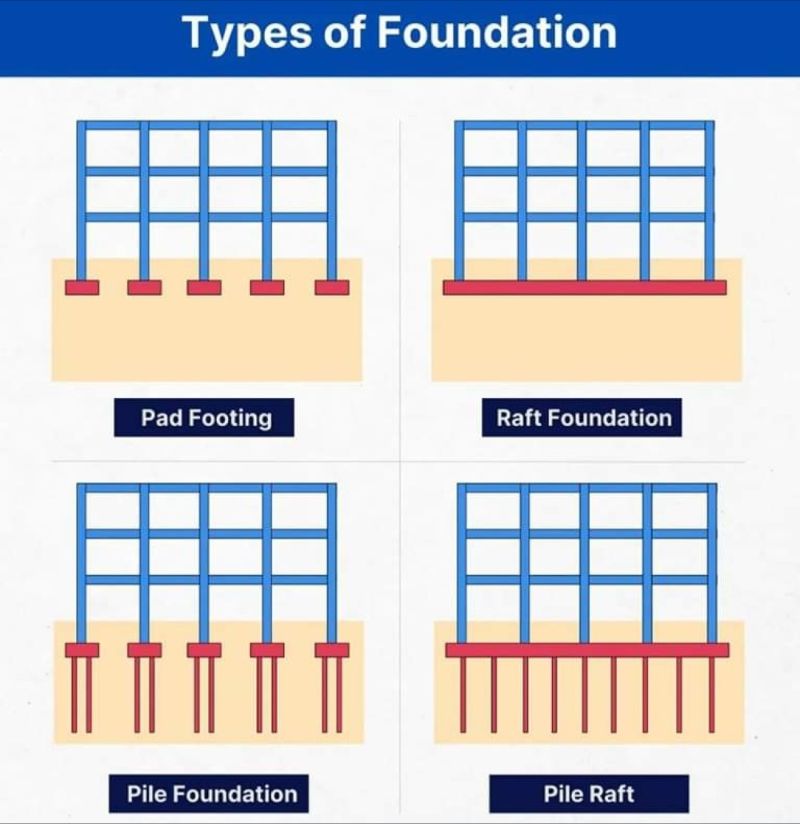
A raft foundation spreads loads across a larger area, which can help distribute structural loads where near-surface soil conditions are suitable.
Pile foundations, on the other hand, transfer loads deeper into the ground through mechanisms such as shaft friction and base resistance. They may be appropriate where upper soil layers are weak or where settlement requirements are particularly demanding.
In some cases, combining piles with a raft can provide additional control of settlement. However, this requires careful consideration of the interaction between the piles, raft, and surrounding soil.
There is therefore no universal foundation solution for large-scale facilities.
The right approach depends on the ground conditions, loading pattern, settlement criteria, and construction constraints of the specific project.
For a broader comparison of how these factors influence the choice between pile and raft foundations, see Pile Foundations vs. Raft Foundations: How to Choose for Large-Scale Facilities.
The key question for project teams
Before selecting a foundation system, it is worth asking:
“What is our allowable differential settlement, and does the proposed foundation strategy realistically achieve it?”
This question shifts the discussion from simply designing a foundation that can carry the load to designing one that supports the actual operational requirements of the facility.
For large-scale projects, that distinction can make a significant difference.


 Why Differential Settlement Matters More Than Total Settlement


