Previous in Forum: what is O-0.3s-CO-3min-CO for a Circuit breaker?   Next in Forum: lab book
Close
Close
Close
23 comments
Rate Comments: Nested
Commentator

Join Date: Mar 2008
Location: San Diego
Posts: 86

How Does a Power Inverter Work? + Installation Questions

03/12/2008 6:54 PM

I answered a post in another section that prompted me to ask this... and I apologize if the questions sound naive but I am not an EE...

#1 How does a Power Inverter work?

See below:

http://www.dcacpowerinverters.com/

#2

What devise can be used in a residential solar power application to convert DC to AC?

#3

If I want to install solar panels that feed a bank of batteries then convert the DC to AC ... how is that system then connected to the house electrical installation? Immediately after the Electric Meter? or at any other point in the house is ok?

#4 Can you connect a small Electrical generation system like the one above to a power outlet to feed power to the house?

Register to Reply
Interested in this topic? By joining CR4 you can "subscribe" to
this discussion and receive notification when new comments are added.

Good Answers:

These comments received enough positive votes to make them "good answers".
Guru
Engineering Fields - Control Engineering - New Member China - Member - New Member

Join Date: Sep 2006
Location: CHINA
Posts: 2945
Good Answers: 14
#1

Re: How does a Power Inverter Work? + installation questions

03/12/2008 9:03 PM

I dont know how you call the inverter or converter.

the front can do AC-DC-AC and later can do DC-AC. you can understand the concept then you can choice either of them.

the type and power you would refer to your requirement.

you cna connect them either through meter or not.

its an easy thing for an engineer. even an electrician can do it. no problem.

Register to Reply
5
Guru
United States - Member - New Member Engineering Fields - Power Engineering - New Member

Join Date: Sep 2006
Location: California, USA, where the Godless live next door to God.
Posts: 4665
Good Answers: 804
#2

Re: How does a Power Inverter Work? + installation questions

03/12/2008 11:20 PM

#1 - "How does a Power Inverter work?"

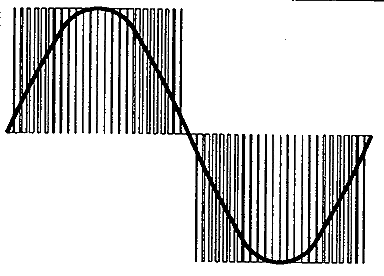
Too long of an answer to be specific. But the condensed version is that the DC is fired by high speed transistors in very short pulses. The pulses and the spaces between them are combined into small groups of "On" and "Off". These groups of pulses are fed into an inductor (or induction motor in the case of a VFD) so that the inductive time constant will "delay" the effective rise in voltage on the load side of the inductor. But before it begins to fall again, another group of pulses if fired and the effective voltage keeps rising. The rate of output voltage rise is manipulated by this pulse firing scheme to resemble the slope of an RMS (root-mean-squared) sine wave. This is repeated over and over until the output reaches the input peak, then brought back down again until the output equals zero. It is then repeated in the negative bias of the DC so that you have the negative side of that pseudo sine wave. The pulse firing technique is called PWM, for Pulse Width Modulation because the magnitude of the pulses is always the same; maximum available, but the final output voltage is manipulated into looking and acting like an AC sine wave by messing with the width of the pulses (or groups of pulses really) and the spaces between them. The groups are made up of very very short pulses as mentioned, and the rate at which those littlest pulses are fired is called the "carrier frequency". The rate at which the positive and negative PWM sequences are varied is called the Modulation or Output Frequency and is fixed (in the case of a Solar Inverter) or variable (in the case of a Variable Frequency Drive).

#2 - "What devise can be used in a residential solar power application to convert DC to AC?

The device is called an "Inverter" because it takes the DC that you already have and "inverts" it to pseudo-AC. A different device, one that changes AC into DC is called a "Rectifier", but the DC output is very rippled because the DC mainly flows only at the peaks. If you marry a rectifier to a capacitor system that smooths out the ripple of the newly formed DC, we call that a "Converter". A Variable Frequency Drive or a "double conversion" UPS will ave both a Converter and an Inverter. In the case of solar PV systems where the DC is already being created from the array, all you need is the Inverter part.

#3 - "If I want to install solar panels that feed a bank of batteries then convert the DC to AC ... how is that system then connected to the house electrical installation? Immediately after the Electric Meter? or at any other point in the house is ok?"

This is a relatively complex issue and depends totally on your local electrical codes as well as any regulations and requirements of your electrical utility. But in general yes, you typically see them wired to the house power panelboard behind (downstream of) the Main Circuit Breaker. But it will need its own Main Circuit Breaker (or fuses) as well since it is a new power source. I don't recommend doing this if you are not experienced by the way. There are a lot of potential pitfalls.

#4 - "Can you connect a small Electrical generation system like the one above to a power outlet to feed power to the house?"

Yes, done all the time, but again, it depends on your local codes and regulations.

__________________
** All I every really wanted to be, was... A LUMBERJACK!.**
Register to Reply Good Answer (Score 5)
Guru

Join Date: Aug 2007
Location: Earth - I think.
Posts: 2143
Good Answers: 165
#3
In reply to #2

Re: How does a Power Inverter Work? + installation questions

03/12/2008 11:51 PM

Well put. Clear, concise, and to the point.

__________________
TANSTAAFL (If you don't know what that means, Google it - yourself)
Register to Reply Off Topic (Score 5)
7
Guru
Canada - Member - New Member Hobbies - Musician - New Member

Join Date: Dec 2006
Location: Western Canada
Posts: 1863
Good Answers: 39
#4
In reply to #2

Re: How does a Power Inverter Work? + installation questions

03/14/2008 12:50 AM

Jraef replied to a question.

#4 - "Can you connect a small Electrical generation system like the one above to a power outlet to feed power to the house?"

Yes, done all the time, but again, it depends on your local codes and regulations.

COMMENT!

Whoa there! Something important just WENT by un-noticed.

You DO NOT! ever plug in a power generator source via an outlet to feed the house.

This is absolutely forbidden by every electrical code, standard and common sense practical reason. Such a practice is highly dangerous both to the user and to utility workers. .

Back up power systems, inverters etc must only be connected to a household system by way of an isolating transfer switch. This switch must be certified and approved by the local power authority. Some juristictions are more stringent than others.

In the event of a utility power failure, the residence is changed over to work from an inverter. If you do not first disconnect (isolate) the house from the utility grid, one of two things happen. your inverter wil try and feed power to your neighbor as well as your own houe. Best case; it trips it's own output breaker. Worst case, you do not have a neighbor, just miles of wire along the road. A tree branch or wind damage dragged the wires down to the ground. some unsuspecting person comes into contact with this downed wire thinking it is dead. After all, the power is off. Except your home based power generator is pumping current into the wires. The transformer that stepped down the voltage to your house now runs in reverse and step up the voltage to a very high potential thus causing shock hazard and possible electrocution risk to the poor unsuspecting person touching the wire somewhere down the road. You are responsible for any injury or death suffered by this person. The isolating switch prevents such an ocurrence.

The other possibility being, nothing goes wrong until the power is restored; but now your inverter or genset is back-fed with a lot more power than it can produce. End result.\; the inverter output stage blows up! Sometimes with enough force to injure anuyone standing close by the inverter when it happens.

I know the practice of feeding a household via an unused outlet is done more often that peopele admit. However, its an unsafe practice, its dangerous and can often result in damaged equipment. It should never be condoned by any safety minded electrician or engineer. All the juristictions I know of makes it illegal.

__________________
Elnav
Register to Reply Good Answer (Score 7)
Guru
United States - Member - New Member Engineering Fields - Power Engineering - New Member

Join Date: Sep 2006
Location: California, USA, where the Godless live next door to God.
Posts: 4665
Good Answers: 804
#5
In reply to #4

Re: How does a Power Inverter Work? + installation questions

03/14/2008 2:51 AM

Whoops, excellent point. I was a bit too hasty and didn't think of the alternate interpretation that you just pointed out. I was thinking of a dedicated "outlet" (an inlet really) such as are used all the time when portable power generators need to be connected to equipment or facilities through a transfer switch. I should have realized he could be (and probably was) thinking of a standard outlet already used for plugging in appliances etc.

So elnav is correct. If that is what you meant, then NO, you absolutely cannot do that!

__________________
** All I every really wanted to be, was... A LUMBERJACK!.**
Register to Reply
Commentator

Join Date: Mar 2008
Location: San Diego
Posts: 86
#6
In reply to #4

Re: How does a Power Inverter Work? + installation questions

03/14/2008 2:59 AM

Hi Jraef..

Thanks for your comment... can you expand on "isolating transfer switches"?

Register to Reply
Anonymous Poster
#9
In reply to #6

Re: How does a Power Inverter Work? + installation questions

03/14/2008 11:05 AM

can you expand on "isolating transfer switches"?

It's basically a glorified relay. Power from the utility company side feeds the coil. If the power goes out, a normally open set of contacts between the meter and your breaker box disconnect you from the outside world. It's also common to use a normally closed set to connect a battery to a motor starter for emergency gas generators, etc. For systems that are intended to backfeed through the meter it may be slightly more complex.

It's also probably important to mention phase matching.... Arbitrarily throwing 115 vac on another 115 vac will most probably fail the smoke test. :)

Register to Reply
Guru
Canada - Member - New Member Hobbies - Musician - New Member

Join Date: Dec 2006
Location: Western Canada
Posts: 1863
Good Answers: 39
#11
In reply to #6

Re: How does a Power Inverter Work? + installation questions

03/14/2008 1:19 PM

Not to disparage Jraef's explanation of an isolating relay, most juristictions in North America prefer a more positive means of isolating and transferring the connection from utility to self power. They also want to guard against a failure wherin the contacts weld together, thus creating a wrong connection.

Lightining strikes were mentioned. Vehicles sometimes hit poles and the wires snap. Tree limbs fall on wet wires and may burn off or may break the wires.

Power utilities have self protection schemes that sometimes reclose the big breakers on their power lines as many as three times. This could take as much as couple of seconds.

Isolating transfer switches take this into account.

They disconnect all feeder lines to prevent energy from lightning strikes or a reclosure from passing into the house. They also follow a timed sequence to avoid a back feed if a reclosure scheme is used on that utility feeder.

__________________
Elnav
Register to Reply
Power-User
Technical Fields - Education - New Member Technical Fields - Technical Writing - New Member

Join Date: Sep 2006
Posts: 367
Good Answers: 1
#7
In reply to #4

Re: How does a Power Inverter Work? + installation questions

03/14/2008 6:29 AM

+ another situation just after lightning strike or induce enough high voltage to create an arc on overhead el-line. A Fast acting protection will disconnect arcing line from HV substation expecting the arc to fade, but your illegal power source will still supply energy (even in milliseconds) to the arc and there is no chance to restore power supply to the transmission line because the arc would still creating the short circuit.

Register to Reply
Guru
Hobbies - Fishing - New Member

Join Date: Jun 2006
Location: Rochester, NY
Posts: 867
Good Answers: 11
#8
In reply to #4

Re: How does a Power Inverter Work? + installation questions

03/14/2008 7:39 AM

lol, you just hit elnav's hot button. not that I disagree, but it's always fun to watch him get on a roll on this one. I gave him a "good answer" just for reminding everybody.

__________________
Eric
Register to Reply
Guru
Canada - Member - New Member Hobbies - Musician - New Member

Join Date: Dec 2006
Location: Western Canada
Posts: 1863
Good Answers: 39
#10
In reply to #8

Re: How does a Power Inverter Work? + installation questions

03/14/2008 1:06 PM

Calicocat you got that right! I worked for apower utility company once. One of the inspectors ( former lineman) walked around on his articficial foot and didn't have any fingers on one hand because he got caught that way once. System was supposedly down and dead. It was during a storm. Foreman gave the all clear to go to work. Ooops! The arc burned through his glove and boot. Everybody was soaked by rain. Whole town was out and the pressure was on to restore power quickly.

Seeing this guy served as a daily reminder to double check everything and never take anybody's word for granted.

__________________
Elnav
Register to Reply
Anonymous Poster
#23
In reply to #4

Re: How does a Power Inverter Work? + installation questions

07/30/2009 3:01 PM

Another issue not mentioned is that if you were to try to feed the house while connected to the utily, who knows what you could end up with at the outlet. The sine waves from the two sources must be syncronized.

I would also guess that to replace a $600 generator with solar cells would require 10 or more times the money.

Register to Reply
Anonymous Poster
#22
In reply to #2

Re: How does a Power Inverter Work? + installation questions

06/11/2008 8:33 AM

hi,

really, i am looking for an answer for this question for long time, i read this answer but i am still not clear that i understand it very well. can u please if u do not mind make it simple answer? ''i am not an engineer''

your cooperation is highly appreciated

Register to Reply
Power-User

Join Date: Dec 2006
Posts: 408
Good Answers: 5
#12

Re: How Does a Power Inverter Work? + Installation Questions

03/15/2008 3:34 AM

I think not mentioned that the power down your line is sinewave- inverters can be modified square wave or pure sinewave- the latter are needed for proper operation of things like fridges, microwaves etc. Pure sinewave cost much more than msw. As to using "suicide connectors"- ie male to male plug to connect an inverter or genset to gpo of house- I have never done it- the reasons stated against are valid- but if the main power switch at the meter were switched off, thus isolating the power supply lines, it would be safe!?. or would the meter (after the switch) continue to charge you for your own power?!.

Register to Reply
Guru
Canada - Member - New Member Hobbies - Musician - New Member

Join Date: Dec 2006
Location: Western Canada
Posts: 1863
Good Answers: 39
#14
In reply to #12

Re: How Does a Power Inverter Work? + Installation Questions

03/15/2008 3:57 AM

The statement that pure sinewave cost much more than MSW is only true in the short term for equipment acquisition. The longer term cost of using non power factor corrected equipment will negate your up front savings. Motors tend to run hot and burn out sooner.

Regarding the "suicide connector" approach being safe. That all depends on how your particular house service is wired. Also depends on you remembering to open the main breaker every time. Looking at some house systems, I only see a double pole breaker on the service entrance. The neutral is not switched. So that means you are in fact connected to the utility grid by one wire and maybe one ground. Too many iffy variables for comfort.

When was the last time you saw a portable genset properly wired with a ground rod? So now you have a situation where the neutral is connected and your system is not tied to ground. How much potential is required to cause a 50 milliamp current to pass through a peson in accidental contact with a power generator source neutral and the wet earth under their feet? This is not someting I would choose to gamble on being safe at all times.

__________________
Elnav
Register to Reply
Power-User

Join Date: Dec 2006
Posts: 408
Good Answers: 5
#15
In reply to #14

Re: How Does a Power Inverter Work? + Installation Questions

03/17/2008 3:34 AM

Hi Elnav- good points- here in West Australia we have MEN system(multiple earth neutral) where every 3rd power pole neutral line is earthed, & again at the house meter box- but I have seen where some older houses were never earthed at the meter boxes- regulations are made to protect the uninformed from lethal consequences- I myself would always recommend a double disconnect switch from the mains- & if a genset was used to earth the neutral with a copper stake into wet ground- & if the mains was doubly isolated, then a safety tag would be stuck over the switch- this is hypothetical, as I have never had to do any of this- but in the future, if a disaster occurred?.

Register to Reply
Power-User
Technical Fields - Education - New Member Technical Fields - Technical Writing - New Member

Join Date: Sep 2006
Posts: 367
Good Answers: 1
#19
In reply to #15

Re: How Does a Power Inverter Work? + Installation Questions

03/18/2008 6:22 AM

Do you have also Surge Protectors on those poles / grounded ones?

Register to Reply
Power-User

Join Date: Dec 2006
Posts: 408
Good Answers: 5
#21
In reply to #19

Re: How Does a Power Inverter Work? + Installation Questions

03/19/2008 2:16 AM

No- there is a lightning protector at the transformer which feeds into the house- in the event of lightning strike of the active line- this protector feeds the excess to ground at the transformer pole- during a storm, it can be heard operating as interference on am radio after a lightning strike close by. The ist 3 years I lived here, my am radio had static, changing- a danged nuisance- it was worse at some times than others-eg in early morning after foggy night- I naively thought that neighbours down the line were doing something that threw interference down the power line- finally I got the local power co engineer out- He had a good idea of what the prob was- a faulty lightning protector- the model had been found faulty at multiple locations- the work crew fitted an improved model (from U.S.A.)- nomore trouble many years since.

Register to Reply
Active Contributor

Join Date: May 2007
Posts: 20
Good Answers: 1
#13

Re: How Does a Power Inverter Work? + Installation Questions

03/15/2008 3:50 AM

Dear jfmart,

Your questions are a good way to obtain knowledge in an area that you're not familiar with, but I am concerned that you might be jumping into something that can be very dangerous unless you have a lot more knowledge than your questions imply. Question #3 implies you plan to actually try to implement some of these thoughts. A bad idea with your current knowledge! I suggest you check on line for businesses that sell solar equipment and obtain their catalogues. Most of these catalogues have a section in them that explains the different types of solar, wind, and hydro systems. They will have the different type of equipment needed, prices, and how they work together. With this as a background you should be in a better position to understand the answers to your own questions and the ones that have been given to you here.

Register to Reply
Guru
Hobbies - HAM Radio - New Member

Join Date: Oct 2006
Location: Vancouver (not BC) Washington (not DC) US of A
Posts: 1261
Good Answers: 12
#16

Re: How Does a Power Inverter Work? + Installation Questions

03/17/2008 4:30 AM

Related to #4, a small power converter would probably NOT be able to furnish enough power to drive everything in your house. I believe typical household supplied current is 100 amps... times 240 volts = 24 K watts of power at the meter. I don't think you will find this kind of power in a UPS or in a Honda powered sized generator.

In case of an emergency, I would just string extension cords from the generator to where the power is needed... or if someone wanted something more permanent, wire in a second system (in the walls) with a few circuits. I would use duplex outlets of a different color to discriminate between it and the utility mains, and I would also route the output from the generator through a small breaker panel... but this scenario is also a bit expensive, and I have no idea of how it corresponds to code.

But of course if one can afford the 24Kw generator, and wants status quo operation, then I would consider powering the current circuits with an alternate source, at the service entrance.

Another thought that comes to mind is the DC to AC conversion. If you need 24Kw of power, AND the inverter is 100% efficient, then using 12 volt batteries, you have to handle an amperage of 2000 amps...which is not wire... it is busbar. BIG busbar.

Think about it before you do it...

Bill

t

Register to Reply
Guru
Canada - Member - New Member Hobbies - Musician - New Member

Join Date: Dec 2006
Location: Western Canada
Posts: 1863
Good Answers: 39
#17
In reply to #16

Re: How Does a Power Inverter Work? + Installation Questions

03/17/2008 1:08 PM

You are right about the amount of power that a typical home could possibly consume, but the reality is much less. The companies that provide back up power generators to a home typically offer 12 - 15kW gensets as being suitable for a typical one family home.

Intelligent power management can reduce the amount of energy needed to somewhere around 3 - 4 kilowatts of inverter power.That also makes for a smaller and thus afoprdable battery bank size.

The original question came from San Diego of S. California. Unfortunately the market hype, not to mention news paper stories, have created an impression in the general public's mind that bears little resemblance to reality.

The technical solutions are easy if sometimes complex, but the cost of doing all this is astounding. In most cases you can only afford to buy commercial systems and have them installed by taking out a mortgage on the house.

I have most of the equipment already sitting in my garage and know how to install it. However the compliance with local building and electrical codes would make a permanent installation prohibitively expensive for me. What I will be doing is, as you suggest. Run some extension cords to essential equipment like a fridge and maybe the micro wave and the water pump in the well. We heat with wood and we have many LED flashlights around including many of the type you hand crank. Until the power outage extends to several days we wil not be unduly discomfited. We did that in the old place we lived at. We just moved here and haven't even had time to set up anything.

Some of the questions that show up on the forum clearly show the questioner has no real concept of how this technology works or what safety codes apply. Evidently they are going by what they have read in the popular press. And th epress usually gets it wrong.

__________________
Elnav
Register to Reply
Power-User
Technical Fields - Education - New Member Technical Fields - Technical Writing - New Member

Join Date: Sep 2006
Posts: 367
Good Answers: 1
#20
In reply to #17

Re: How Does a Power Inverter Work? + Installation Questions

03/18/2008 6:35 AM

Thanks for clear "real world explanations".

I live in South of the USA and our problems are:

_ heavy storms with strong lightnings so outages are often, and long lasting if MV overhead line is down/broken.

_ almost always in summer time, after storm, air temperature returns to 85-105 deg F (30 -40 C) so children and oldies have hard time without air conditioners (A/C). A/C Units are usually 2 to 5 kW. This aspect is solved by fuel powered gen-sets, rearly by Solar PV systems w/inverters.

Register to Reply
Guru
Engineering Fields - Control Engineering - New Member China - Member - New Member

Join Date: Sep 2006
Location: CHINA
Posts: 2945
Good Answers: 14
#18

Re: How Does a Power Inverter Work? + Installation Questions

03/17/2008 9:12 PM

The issue seems to be getting mor e and more complex.

I thought the author had known what is the invertor in his the seconde condition.

the question is how much power ha want and how much voltage he want and etc?

so that you all can help him rightly.;

however, I dont think the installation and selection is not a problem.

Register to Reply
Register to Reply 23 comments

Good Answers:

These comments received enough positive votes to make them "good answers".
Copy to Clipboard

Users who posted comments:

Anonymous Poster (3); ca1ic0cat (1); cnpower (2); elnav (5); jfmart (1); JRaef (2); Kilowatt0 (1); Neil Kwyrer (3); pismire (1); Sciesis2 (1); southern123 (3)

Previous in Forum: what is O-0.3s-CO-3min-CO for a Circuit breaker?   Next in Forum: lab book

Advertisement