Can you let me know if this has any relavence to what you have in mind please?
Abstract. A low-vacuum standard, which is based on the static expansion method and can generate vacuum in the wide range of 1 Pa–100 kPa, has been developed. The largest chamber of this system, in which the known pressures are generated,
has an orifice-flow pressure generator for gauge calibration.
This dual function for the largest chamber permits a more efficient routine calibration of gauges than a traditional chamber as follows: reference gauges attached to the largest chamber are calibrated by the static expansion method which generates known pressures; these gauges are then left in place in the calibration chamber; other gauges to be calibrated can be attached to the large chamber and calibrated against the reference gauges by the comparison method. The reference gauges only need to be recalibrated infrequently.
Take care..........................
__________________
Take it easy, bb. >"HEAR & you FORGET<>SEE & you REMEMBER<>DO & you UNDERSTAND"<=$=|O|=$=>"Common Sense is Genius dressed in its Working Clothes"<>[Ralph Waldo Emerson]
Dead weight testers are a piston-cylinder type measuring device. As primary standards, they are the most accurate instruments for the calibration of electronic or mechanical pressure measuring instruments.
They work in accordance with the basic principle that P= F/A, where the pressure (P) acts on a known area of a sealed piston (A), generating a force (F). The force of this piston is then compared with the force applied by calibrated weights. The use of high quality materials result in small uncertainties of measurement and excellent long term stability.
Dead weight testers can measure pressures of up to 10,000 bar, attaining accuracies of between 0.005% and 0.1% although most applications lie within 1 - 2500 bar. The pistons are partly made of tungsten carbide (used for its small temperature coefficient), and the cylinders must fit together with a clearance of no more than a couple of micrometers in order to create a minimum friction thus limiting the measuring error. The piston is then rotated during measurements to further minimise friction.
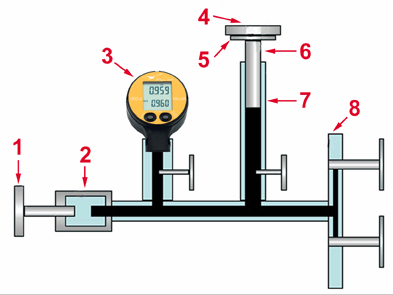
The testing pump (2) is connected to the instrument to be tested (3), to the actual measuring component and to the filling socket. A special hydraulic oil or gas such as compressed air or nitrogen is used as the pressure transfer medium. The measuring piston is then loaded with calibrated weights (4). The pressure is applied via an integrated pump (1) or, if an external pressure supply is available, via control valves in order to generate a pressure until the loaded measuring piston (6) rises and 'floats' on the fluid. This is the point where there is a balance between pressure and the mass load. The piston is rotated to reduce friction as far as possible. Since the piston is spinning, it exerts a pressure that can be calculated by application of a derivative of the formula P = F/A.
The accuracy of a pressure balance is characterised by the deviation span, which is the sum of the systematic error and the uncertainties of measurement.
Today's dead weight testers are highly accurate and complex and can make sophisticated physical compensations. They can also come accompanied by an intelligent calibrator unit which can register all critical ambient parameters and automatically correct them in real time making readings even more accurate.
This article has been kindly supplied by:
Calibration Dynamics Ltd.
For details of their Calibration Products and Services, visit their website at www.calibrationdynamics.com
I hope you find this helpful OK?
Good luck and take care.................
__________________
Take it easy, bb. >"HEAR & you FORGET<>SEE & you REMEMBER<>DO & you UNDERSTAND"<=$=|O|=$=>"Common Sense is Genius dressed in its Working Clothes"<>[Ralph Waldo Emerson]
Simply saying -- NO.
First, you should get zero of gauge. To do so, you should evacuate a volume connected to the gauge. Without drag, it's difficult.
After tuning of zero, you may tune a span. The procedure depends of a range of the gauge. For gauge of 1000 Torr range, one may use atmospheric pressure measured with a barometer, calibrated on regular basis . Measure atmospheric pressure with the gauge, compare it with true reading, tune gauge.
Hang it upside down (Only I don't know whether the agencies will approve it )
__________________
Fantastic ideas for a Fantastic World, I make the illogical logical.They put me in cars,they put me in yer tv.They put me in stereos and those little radios you stick in your ears.They even put me in watches, they have teeny gremlins for your watches
Why would anyone who hasn't got a vacuum pump want to calibrate a vacuum gage? Just my stupid little question...
And a vacuum pump is hardly enough... you will need a calibration reference also. If you have an accurate Atmospheric pressure gauge (Barometer) than at least one point could be your starting point, when both are open to atmospheric pressure they should read the same. around 29.92" or 760mm Hg.(depending on the day and your location) which exists on most vacuum and pressure gauges.If your scale is in Torr, just cool both gauges inside a container to 0°C.
And if you really need it and don't have the means to calibrate, than why not send it to a calibration lab?...
yes i really feel it, all answers are not perfact and my quetion is that how to we calibrate vaccum gauge with dead weight tester. before i asked here question someone also reffered me to use of DWT.
second your suggetion of send calibration lab , dear thanks for your valuable suggetion. i will send it but i only want to know if it is possible or not. thanks for your extra advice.
You are not stupid! This situation might happen that a gage needs to be re-calibrated and the Dead Weight system seems to be very accurate and easy to you. Did you read the explanation in post # 6? I found it very clearly written.
Take care, and you are not stupid! OK?
__________________
Take it easy, bb. >"HEAR & you FORGET<>SEE & you REMEMBER<>DO & you UNDERSTAND"<=$=|O|=$=>"Common Sense is Genius dressed in its Working Clothes"<>[Ralph Waldo Emerson]
Before or when you send it out for calibration, you might want to verify with the lab what their procedure is for your calibration and that it meets your requirements.
Normally any gauge is calibrated by an outside source, however you can do it yourself but you will need to convince your customer, not to mention yourself that your calibrations are valid and accurate. Since you seem to be working in the millimeter of Mercury range, a simple mercury manometer would be the best and most accurate standard. A McLeod gauge in considered a standard and can usually be purchased with a certificate of calibration traceable to the National Bureau of Standards (now called NIST). Use this as your standard and calibrate several of your gauges every 6 months or so, or, if dropped, after it's been dropped, to it and you should be in pretty good shape. Use the McLeod gauge as the "Standard" and the other gauges as working gauges.
__________________
Fantastic ideas for a Fantastic World, I make the illogical logical.They put me in cars,they put me in yer tv.They put me in stereos and those little radios you stick in your ears.They even put me in watches, they have teeny gremlins for your watches
Dear Hitesh,
Yes... You can calibrate the Vaccum Guage without Vaccum Pump.
But of course you will still need a vaccum source. You may try to use a "Big Bellow" which can be manually compressed for generating positive pressure and de-compressed for generating vaccum. To measure the generated vaccum, you will need a Manometer or any other standard gauge, which you can refer to. You may need to repeat the compression and decompression of bellows few times till you reach a required vaccum level. Simple setup can be made by using small shut-off valves, so that it can be closed while you are compressingthe bellow unit. But again, remember you will not be able to generate the vaccum as high as Vaccum Pump.
If you wish to use a dead weight calibration standard, you would need to put a bell jar on the deadweight and evacuate it to the desired reference pressure in order to reference the pressure to absolute zero. Not possible without vacuum pumps and pressure / vacuum standards.