Previous in Forum: Is Increased Variability a Good Way to Prove Global Warming?   Next in Forum: Safety Engineering
Close
Close
Close
66 comments
Rating: Comments: Nested
Anonymous Poster

Why Do Blue and Red Make Violet?

02/15/2010 5:14 PM

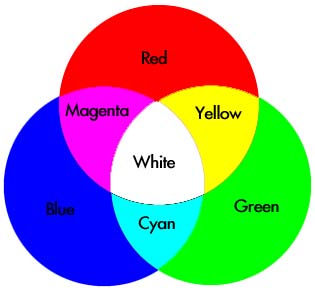
Most of us have been taught about mixing light, primary colors and what not. Green and red make yellow, green and blue make cyan, and red and blue make magenta. as show in this common diagram.
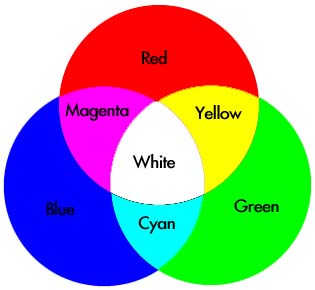
Now we look at the color spectrum, and looking at red~650nm and green~530nm, yellow~590nm is in the middle, for blue~470nm and green~530nm , cyan~500nm is between them. And then we get to blue~470nm and red~650nm, where this doesn't work or we would get about~560nm which is green . So what is going on here, why do blue and red make violet~420nm.

Is their a calculation with wavelength or frequency that you can use that will yield the correct color output from these mixings? I have searched the web but not found this calculation if one exists. The best I have found so far is color mixing based on percentage of each color, but this doesn't explain why blue and red make violet.

I have found some information in regards to what is going on, but nothing clear, and I would rather not post it so that I do not influence the answers. So please help clear this up for me.

Reply
User-tagged by 1 user
Interested in this topic? By joining CR4 you can "subscribe" to
this discussion and receive notification when new comments are added.

Good Answers:

These comments received enough positive votes to make them "good answers".

"Almost" Good Answers:

Check out these comments that don't yet have enough votes to be "official" good answers and, if you agree with them, vote them!
Guru

Join Date: Jul 2007
Posts: 4448
Good Answers: 143
#1

Re: Why do Blue and Red make Violet?

02/15/2010 6:22 PM

You're mixing up addition (like in mixing paint) with subtraction (like light filters). If you take blue and red filters together, you get almost black. If you mix blue and red paint together, you get violet (or magenta). Get yourself some colored film and some paints and try this.

__________________
"Well, I've wrestled with reality for 35 years, Doctor, and I'm happy to state I finally won out over it." Elwood P. Dowd
Reply
Anonymous Poster
#2
In reply to #1

Re: Why do Blue and Red make Violet?

02/15/2010 10:32 PM

I have mixed paint and used color filters, but I am talking about neither in this case.

If you shine a blue light on a spot on a screen, and a red light on the same spot, you get violet. That is not the question, I know this is what happens, the question is why and how could one calculate this with wavelength.

Reply
Guru

Join Date: Jul 2007
Posts: 4448
Good Answers: 143
#6
In reply to #2

Re: Why do Blue and Red make Violet?

02/16/2010 6:59 AM

Oh, I got you now. I never met a tangent I didn't go off on.

The two colors do not make another. The resulting "color" whether it be magenta, purple, or whatever, is not a single frequency. What happens is a result of the human visual system.

__________________
"Well, I've wrestled with reality for 35 years, Doctor, and I'm happy to state I finally won out over it." Elwood P. Dowd
Reply
Guru

Join Date: Mar 2007
Location: City of Light
Posts: 3943
Good Answers: 183
#7
In reply to #6

Re: Why do Blue and Red make Violet?

02/16/2010 8:46 AM

The way you write I am not sure that you agree so that I suggest an experiment to convince you:

- take a paper disc and draw several sectors (multiple of 4) with different basic colour put a nail through an spin it, do not do under a "neon lamp" since it flickers with the frequency of your grid ( 60 or 50 Hz) and you will see how the colour becomes the combination of the two as speed goes up.

- if you use the neon lamp as light source you will see at a given speed how the sectors rotate forward or backward or stay and mix only at different speed. You remember may be how in the movies some time the wheel of the carriages turned "back" although the carriage went forward. It is the same phenomenon due to the image remanence in the eye.

Reply
Guru

Join Date: Jul 2007
Posts: 4448
Good Answers: 143
#9
In reply to #7

Re: Why do Blue and Red make Violet?

02/16/2010 6:26 PM

Yeah, I agree. I was just using sloppy language. I use spectra enough that I think of color and wavelength as the same thing. Bad habit, eh?

__________________
"Well, I've wrestled with reality for 35 years, Doctor, and I'm happy to state I finally won out over it." Elwood P. Dowd
Reply
Anonymous Poster
#53
In reply to #6

Re: Why do Blue and Red make Violet?

02/22/2010 3:02 PM

Hi Tvp45,

You pinpoint that we have "light", the "coloured subject", and the human "eyes" and we register what we visualize. Don't let someone influence your true opinion, which can be easily verified. Your supporter on this matter, Gil.

Reply
Guru
Hobbies - Musician - New Member Greece - Member - New Member

Join Date: Mar 2007
Location: Greece / Athens
Posts: 722
Good Answers: 28
#10
In reply to #1

Re: Why do Blue and Red make Violet?

02/17/2010 5:43 AM

Not correct. If you mix blue and red light (light through blue and red filters) you get magenta. If you mix blue, red and green light you get white light. If you mix blue, red and green paint you get black paint.

__________________
George
Reply
Guru

Join Date: Jul 2007
Posts: 4448
Good Answers: 143
#11
In reply to #10

Re: Why do Blue and Red make Violet?

02/17/2010 7:45 AM

Filters, lad, filters.

__________________
"Well, I've wrestled with reality for 35 years, Doctor, and I'm happy to state I finally won out over it." Elwood P. Dowd
Reply
Guru

Join Date: Aug 2006
Posts: 4484
Good Answers: 246
#21
In reply to #11

Re: Why do Blue and Red make Violet?

02/17/2010 12:39 PM

George is correct. There is a huge difference between projecting three filtered lights onto one spot (additive) and putting the same three filters over a single light source (subtractive). In one case you get white, in the other you get black. (More precisely you get two different levels of grey). If the filters are perfect, then the red filter subtracts everything but red, the blue filter subtracts everything but blue, etc. So no light emerges from the last filter, if they are stacked over one light source.

Pigments work in essentially the same way as filters stacked over one light source, absorbing everything but their named color, and reflecting only the named color. Thus the mixture of red and blue paint is perceived, correctly, as "darker" than either of the constituents (and not as magenta, which is brighter than either constituent.)

__________________
There is more to life than just eating mice.
Reply
Guru

Join Date: Jul 2007
Posts: 4448
Good Answers: 143
#24
In reply to #21

Re: Why do Blue and Red make Violet?

02/17/2010 1:24 PM

Yes, I know how it works. I said it wrong the first post.

__________________
"Well, I've wrestled with reality for 35 years, Doctor, and I'm happy to state I finally won out over it." Elwood P. Dowd
Reply
Anonymous Poster
#62
In reply to #21

Re: Why do Blue and Red make Violet?

06/04/2010 8:18 AM

Hi Blink,

Yes, George is correct but doesn't answer to the question, Gil.

Reply
Guru

Join Date: Aug 2006
Posts: 4484
Good Answers: 246
#19
In reply to #1

Re: Why do Blue and Red make Violet?

02/17/2010 12:09 PM

If you mix blue and red paint together, you get violet (or magenta).

By convention**, and to avoid the confusion the OP is experiencing, magenta is usually considered the additive color produced by the mixing of red and blue light. (To mix magenta from paints requires the addition of white.) Subtractive mixing (the mixing of pigments or filters*) produces the darker color that we usually call purple or violet.

In additive mixing of light, the resulting color is always brighter than the constituents, with equal RGB mixing producing white.

Of course, if one looks at the spectrum analysis of the mixing of two lights, there is no peak at the average of the two -- there are two peaks at each of the constituents. The psychology of perception comes into play here, with sound and light working in different ways. We perceive the mixing of two colors as a single "pure" color, whereas when we hear two fundamental frequencies, we can pick out the frequencies and can call the mixture harmonious or dissonant.

Feeling the urge to ramble: When I was in college (in the days of kerosene TVs) I did a project in which I made photographs of a banana and a Hershey bar, and adjusted the colors to be physically identical. With the Hershey bar on a light backgound and the banana on a dark background, everyone called the Hershy bar "brown", and the banana "yellow" despite the fact that they both emitted exactly the same spectrum and brightness.

*stacked filters... one on top of another with a single light source. If there are two or more light sources, each filtered to a particular color (as in some video projectors) then the mixing of the emitted light is additive.

** Thus, people can generally agree on what is meant by CYM and RGB systems, and leave the traditional RYB to artists working with paint, who must often add white to get the desired color.

__________________
There is more to life than just eating mice.
Reply Score 1 for Good Answer
Anonymous Poster
#52
In reply to #1

Re: Why do Blue and Red make Violet?

02/22/2010 2:40 PM

Hi Tvp45,

You absolutely right. By mixing red and blue paint we get violet or magenta, depending if the red or the blue is the dominant part, with a touch of white. Some people wants to confuse the whole subject and intervenes just to disapprove the opinion or the words of someone else.

We are on the right track, Gil.

Reply
Associate

Join Date: Feb 2010
Posts: 43
Good Answers: 5
#3

Re: Why do Blue and Red make Violet?

02/15/2010 11:03 PM

Mixing red and blue light produces purple light (alternatively, magenta), not violet. Were you to reflect purple light from a diffraction grating (a CD or DVD works just as well) you will see the purple light split into its red and blue components. If you were to do this same experiment with violet light, however, you will see only a violet component and nothing else. Unlike purple/magenta, violet is not a composite of other colors. Purple is.

RGB displays cannot reproduce violet. Violet is usually "simulated" by the display as blue or purple.

Reply
Guru

Join Date: Aug 2006
Posts: 4484
Good Answers: 246
#25
In reply to #3

Re: Why do Blue and Red make Violet?

02/17/2010 2:10 PM

RGB displays cannot reproduce violet. Violet is usually "simulated" by the display as blue or purple.

I'd argue that there is no physical distinction between the nature of purple and violet, (in other words it is not true that that one cannot be reproduced on an RGB monitor but the other can). In practice, I think it is an entirely semantic difference. Our family is like many, in which we cannot agree on color names: an orange can be reddish to one, yellowish to another, and brownish to another. (My daughter calls our great room "salmon puke" but my wife calls it "coral confection".)

Human cones do not respond in the same way from individual to individual, yet there are no individuals (of normal color vision) who cannot find the color they want when they go to a paint store with a computerized color sensing and selection system. Anyone with normal color vision can find 10-20 colors they would consider violet, 10-20 they would consider purple, etc.

The advent of 24 bit (16 million) color computer displays has made many people think of colors as being mixtures of R, G, and B in integer levels from 0 to 255. Practically speaking, there is no color that cannot be produced from this system -- there are only arguments about what to name colors*. Pre-press systems are accurately calibrated so that the computer displays very closely mimic the color perception of the actual inks on white (or other-colored) papers in the desired lighting. You can photograph a violet flower, and adjust the display to look just like what you saw, and adjust the printer to reproduce just what you saw. Obviously, you cannot perfectly produce every color with a 24 bit system, but most people can not discriminate between one color such as (245,230,221) from another that differs by one bit (245, 230, 220)... and no one can come up with a reasonable name for each of the 16 million possible colors.

So violet is no different than any other color, and many viewers will call 128, 128, 255 violet, it being close to the average we see reflected from violet flowers. Other colors have standard names in this system, with 255, 0, 255 almost universally called magenta. (16 such color names can be used in all HTML code. Violet is not one of these, but the extended standard CSS has a violet, albeit different than mine: EE82EE -- more red.)

Whether you can create colors perfectly with only 256 levels of each color is subject to argument, but the 24 bit system has been in use for decades now, and is adequate to the task of picking out inks, paints, calibrating video projectors, etc. The panel above is from Paint, and experimenting by inputting numerical values for RGB shows than you can create any color you want, and that violet is no different than any other color in this respect.

* Obviously, no black can be produced that is darker than the monitor when turned off, and no white can be produced that is brighter than the monitor's maximum light output.

__________________
There is more to life than just eating mice.
Reply
Guru

Join Date: Oct 2007
Posts: 734
Good Answers: 70
#26
In reply to #25

Re: Why do Blue and Red make Violet?

02/17/2010 2:21 PM

I think you may be wrong. Violet has a very narrow bandwidth and a single peak wavelength. Purple has a very wide bandwidth (nearly the entire visible spectrum) and has a peak in the red and another peak in the blue. We perceive these two colors to be related because of the limits of our biological vision system, but a spectrometer would not agree.

Reply
Guru

Join Date: Aug 2006
Posts: 4484
Good Answers: 246
#27
In reply to #26

Re: Why do Blue and Red make Violet?

02/17/2010 3:48 PM

I think you may be wrong.

That cannot possibly be the case, because in one of my dreams I was declared infallible.

Violet has a very narrow bandwidth and a single peak wavelength. Purple has a very wide bandwidth (nearly the entire visible spectrum) and has a peak in the red and another peak in the blue. We perceive these two colors to be related because of the limits of our biological vision system, but a spectrometer would not agree.

I agree with all this, at least as regards the physics. However, I think this Wikipedia article is correct in saying that the perceived color violet was named for the flower. I think that you will agree that we can see a violet as being violet on an RGB monitor and also on a CYMK print, despite the fact that the perception is arrived at by different means. If Newton lived in the days of RGB monitors (or spectrum analyzers) he would probably not have come up with roygbiv, I'd think.

An RGB monitor does not produce spectral yellow, it produces two frequency (rounded) peaks we perceive as yellow.

My point was, I think, that an RGB monitor can generate a color we perceive as violet, generate another we perceive as purple (and that no two people will necessarily agree about which is which), and also generate a color we perceive as yellow. Also, (which I did not write) you can get from one color judged purple to one judged as violet by straightforward, predictable adjustments of RBG values. I'm not sure if that is the point with which you are disagreeing, though.

__________________
There is more to life than just eating mice.
Reply
Associate

Join Date: Feb 2010
Posts: 43
Good Answers: 5
#28
In reply to #27

Re: Why do Blue and Red make Violet?

02/17/2010 4:48 PM

"My point was, I think, that an RGB monitor can generate a color we perceive as violet, generate another we perceive as purple ..."

I have 405 nm so-called "violet" LEDs and a 405 nm "violet" diode laser whose color my RGB displays cannot mimic no matter what combination of RGB values I give them. Conversely, I have never seen purple/magenta in a rainbow nor in the spectral reflection from a diffraction grating; but I have seen violet in both. Consequently I agree with johnfotl that the eye can perceive violet as a color distinctly different than purple/magenta. At the same time I agree with many of your assertions concerning the perception of color. Evidently not everyone can perceive violet to the same degree nor be able to distinguish between violet and purple/magenta.

At any rate, "spot on" to both of you.

In your dream, Blink, were you garbed in feline Papal robes?

Reply Score 1 for Good Answer
Guru

Join Date: Oct 2007
Posts: 734
Good Answers: 70
#32
In reply to #27

Re: Why do Blue and Red make Violet?

02/17/2010 10:14 PM

I think this hinges on whether you want to define violet as a spectral color, confined to as specific part of the visible electromagnetic spectrum, or as an all purpose term referring to range of colors produced by the various chemical dyes found in plants that have the word violet in their common names.

In the first case there is no way an RGB monitor can produce violet because it lies beyond the shortest wavelength the monitor can generate. Likewise, no combination of RGB can produce a deep red with a wavelength of 680 nm.

But if you use the second definition then I suppose the RGB monitor can produce a very dark bluish purple that with a willful suspension of disbelief could be interpreted as a 'violetish' color, particularly if presented in the form of a photo of a flower. But since it would have to be produced by a mixture of red and blue, it would be purple.

Reply
Guru

Join Date: Aug 2006
Posts: 4484
Good Answers: 246
#37
In reply to #32

Re: Why do Blue and Red make Violet?

02/18/2010 5:03 PM

I think this hinges on whether you want to define violet as a spectral color, confined to as specific part of the visible electromagnetic spectrum, or as an all purpose term referring to range of colors produced by the various chemical dyes found in plants that have the word violet in their common names.

I generally agree, although I think there is a third possibility. Consider that magenta is almost universally agreed to be 255, 0, 255 in the 24 bit color scheme. That value matches closely the magenta used in four color printing, traditionally cmyk (with k, the key, being black) Yellow is 255, 255, 0, and cyan is 0, 255, 255. In the same way, there can be a specific color that we call violet: for Pantone (which I think is the most broadly recognized standard for print colors), that color is 75, 8, 161.

Here's a solar spectroscope image showing Fraunhofer lines. (It came from an article, Build your own Spectrograph.)

Here is a zoomed-in version, with a pantone violet rectangle added, for comparison. The Pantone color was darkened by adjusting the luminosity slider in Paint. (This resulted in an RGB value of 51, 5, 107.)

To me the darkened pantone violet looks like a reasonably good match for the spectrograph violet, if I mentally average the colors in the band where I inserted the violet. (Some of the original pixel groups are a little redder and a little darker, and some are bluer.) (This could, however, look different on a CRT, rather than the LCD monitor I am using.)

If I use a CD as a diffraction grating, what I see, with sunlight as the source, is very close to the spectrograph image above. I don't see the band of what I would call a variation on magenta that the OP's spectrum representation shows at 405nm. I wouldn't expect to, because magenta seems to me to be what we perceive when we see equal amounts of red and blue light. Can the sensation be produced by very high intensity light at around 405 nm? Maybe. For me, 405nm is getting too close to black. I'd think that perhaps I am color blind, but find that I can see very distinct and dramatic differences from one spectrum depiction (like the OP's) to another (like the spectrograph one above).

My perception of color matches pretty well with the colors presented in this article.

But if you use the second definition then I suppose the RGB monitor can produce a very dark bluish purple that with a willful suspension of disbelief could be interpreted as a 'violetish' color, particularly if presented in the form of a photo of a flower. But since it would have to be produced by a mixture of red and blue, it would be purple.

Without any suspension of disbelief (assuming I am not color blind) I can photograph any violet flower (with a digital camera for ease) display it on my monitor and adjust the color, if necessary, to make it look exactly like the flower looks: if it looks too red, I can make it less red, etc. In that sense, the monitor is capable of displaying a visual representation of any violet, or an violet object (whether or not the violet is colored with Pantone's violet, or with the muted magenta shown in the OP's spectrum at 405nm) with near perfection.

A typical digital camera is capable of recording in the IR range, but even if that information was not thrown away, we cannot "show" infra red on a monitor because we cannot see it (and because no combination or RGB produces IR). If we cannot see violet on a monitor, then we cannot see violet, at all. The situation is analogous to seeing yellow on a monitor. An RGB monitor does not produce a wavelength of 580 nm, but it produces the sensation of yellow. In the same way, it does not produce a violet at 405 nm, but it produces the sensation of violet.

A real sodium yellow (which is a very narrow spike) cannot be produced by any computer monitor, but the identical sensation of the color can be. I think the same is true of violet, and, for that matter, for the much different color, magenta.

Perhaps I'll see if I have a violet (405nm) diode and see what it looks like when photographed, etc. I'm not sure that I am understanding your point.

__________________
There is more to life than just eating mice.
Reply
Guru

Join Date: Oct 2007
Posts: 734
Good Answers: 70
#39
In reply to #37

Re: Why do Blue and Red make Violet?

02/18/2010 6:46 PM

Hi Blink,

You have done a lot of work on this and most of it is helpful, but I think you might still be missing something about the difference between the actual color of a flower (illuminated by sunlight for example), with the colors that a digital camera can record and an RGB monitor can reproduce. Bringing in the Pantone system adds another layer of potential confusion.

The folks who invented color photography certainly knew what they were doing, and their product is so good that it's easy to forget that the best color photos are just a 'shorthand' for the real thing. Whether we are talking about color film and photographic prints, color digital cameras, or RGB monitors, we are talking about the same six colors (red-green-blue colored filters for additive color, or magenta, yellow, cyan for subtractive color), and these colors were selected with great attention to the response curves of the cones in the human eye.

But they apparently decided that reproducing violet wasn't very important - maybe because there really isn't much of it around, or maybe because lots of people don't really see it very well, or maybe because the necessary dyes were not readily available. At any rate the three color system works incredibly well. But what it can't do is accurately reproduce a color that contains light with a longer wavelength than the red color they use, nor can it accurately reproduce a color that contains wavelengths shorter than the blue color they use. Between these limits it does a great job. I suspect that some early pioneers experimented with violet/blue dyes and deep red dyes and found that it 'messed up' the colors in between.

I work in optics, and I see 'real' violet on a regular basis. When I look at the spectra you posted I don't see any violet. I see very dark blue, and in a few cases a bit of purple. But that is not surprising: I'm looking at a monitor with red green and blue pixels. No violet pixels. Now it is true that I also don't have any violet sensors in my eyes, but what I do have is blue sensors that are very slightly sensitive to violet light. When I see violet light it stimulates these receptors, but it doesn't stimulate the green or red receptors at all. When I see blue light it stimulates the blue receptors, but it also slightly stimulates the green and red receptors. So my brain sorts it out:

  • If my blue receptors respond just a little, but not the green and red then it must be violet.
  • If my blue receptors respond strongly and the green and red respond a little then it must be blue.

Before working in optics I worked in graphic arts and used the Pantone system. I don't remember a violet color, but there is no technical reason why you can't make an ink or paint with a true violet color. But you can't make a four-color process image with violet. If you need violet you add a fifth color to your press run. If we added a fourth color (violet) to our monitors the problem would be solved.

John

Reply
Guru

Join Date: Aug 2006
Posts: 4484
Good Answers: 246
#49
In reply to #39

Re: Why do Blue and Red make Violet?

02/20/2010 3:06 PM

Thanks for all your great input.

If I can find the time, I'll have to play around with some diodes, and see what I can see.

One could make an analog color analyzer pretty inexpensively, I suppose... It's certainly the kind of thing that every family needs. Maybe I already effectively have one in one of our digital cameras... Or... if I had an iPhone, there is probably an app for that.

__________________
There is more to life than just eating mice.
Reply
Associate

Join Date: Feb 2010
Posts: 43
Good Answers: 5
#40
In reply to #37

Re: Why do Blue and Red make Violet?

02/18/2010 6:54 PM

Hi Blink and johnfotl,

This thread may interest you. The OP writes that "400 nm Nichia UV LEDs" were used to illuminate the subject.

I have a number of 365-, 375- and 385-nm Nichia UV LEDs that are not so narrow-band that I cannot see spillover into the violet. I am looking at a 385-nm unit now and the color I see does not compare with any color in this photo nor in your spectrogram. As we speak I am viewing the photos on a CRT and on an LCD display and noting the differences between the displayed colors and the LED.

It is hard to describe the LED color in terms other than "violet." Unlike the highlighted area in your spectrogram it is certainly bright enough, but the color has a pallid, ghostly quality about it. It is definitely not a magenta or purple, shades of which I see in your spectrogram and in the photo above. I must also view the LED from some distance because, apart from the safety hazard the UV light poses, at close range it causes the interior of my eyes to fluoresce a pale diffuse blue.

On a related topic, I will see if I can find the link(s) concerning early research on artificial corneal implants which, as it so happened, were highly transparent to UV (modern artificial corneas are not). When exposed to sources of UV light test subjects reported being able to see "magnificent" or "amazing" colors they had never seen before. I don't recall whether the researchers' choice of UV-transparent materials was deliberate or accidental, but admitting UV into the interior of the eye is a dangerous proposition. A clandestine part of the study, perhaps? Who knows.

SR

Reply
Anonymous Poster
#4

Re: Why do Blue and Red make Violet?
02/16/2010 1:19 AM

You have already answered your own question. When you shine your colors onto the same spot, their wavelengths combine and produce a wavelength which is violet.

Reply
Associate

Join Date: Feb 2010
Posts: 43
Good Answers: 5
#8
In reply to #4

Re: Why do Blue and Red make Violet?

02/16/2010 11:33 AM

"...their wavelengths combine and produce a wavelength which is violet."

Not so. Wavelengths do not "combine" to produce other wavelengths.

Like the OP, you are:

1) Confusing the human perception of color with the physics of light.

2) Confusing violet light with purple light. The two are distinctly different both in terms of perception and the physics involved.

SR

Reply Score 1 for Good Answer
Guru

Join Date: Oct 2007
Posts: 734
Good Answers: 70
#22
In reply to #8

Re: Why do Blue and Red make Violet?

02/17/2010 1:09 PM

Good answer. Another point to keep in mind, is that we (most of us) have three types of color sensors (cones) in our retinas, and for convenience sake we refer to them as red, green and blue. But this is a great oversimplification. The spectral response curves of these three types of cones actually are very broad (large bandwidth) and overlap considerably. (click on the empty box below for an illustration).

A red light with a wavelength of 633 nm stimulates both the red (L) receptors and the green (M) receptors, but the L receptors respond more strongly, so we perceive correctly that the color is red. Interestingly we (most of us) have no receptor that is very sensitive to violet light. The blue(S) receptors have low sensitivity to violet, and the green and red almost none. So when we 'see' violet what we really see is a weak response from the blue cones, and virtually nothing from the green and red. We 'know' from experience that blue light at ~450 nm strongly stimulates the blue receptor, but also the green and red, so we 'know' this is not blue. Therefore we 'deduce' that it is violet.

We tend to confuse the terms 'color' and 'wavelength', but color is a perception while wavelength is a measurable physical quality. We also tend to confuse 'violet' with 'purple'. Violet light has a narrow bandwidth, with a single peak intensity, while purple has a very broad bandwidth, and two peaks. I guess we can be forgiven because our sensory apparatus is almost completely blind to violet, so we are in a sense talking about something that is beyond or sensory understanding. Many birds (and apparently some women) have an extra type of cone that is truly sensitive to violet. We can only speculate what the world of color looks like to them.


Normalized responsivity spectra of human cone cells, S, M, and L types

Reply Score 1 for Good Answer
2
Guru

Join Date: Mar 2007
Location: City of Light
Posts: 3943
Good Answers: 183
#5

Re: Why do Blue and Red make Violet?

02/16/2010 3:16 AM

What you see depends on the way the retina cells react to colours and how your brain process the signals coming from the eye. The combination of colours to obtain an other is only due to the process in the brain. Has nothing to do with combination of wave lengths. It is not a physical aspect but a physiological one.

Reply Good Answer (Score 2)
Guru

Join Date: Apr 2008
Location: Toronto, Ontario, Canada
Posts: 684
#14
In reply to #5

Re: Why do Blue and Red make Violet?

02/17/2010 9:52 AM

Hi Nick,

Excellent, this is the exact definition of what we see: Light supply, coloured object, and observer's eyes. I would like to add the word "memory" of colours which is very personnel and varies from individual to individual. I match colours when a painter, architect, or just a customer wants the replication of an item with the same colour. My eyes see colours one way and sometime the customer can see differently which can create some argument because different memorization in the past.

It can be funny or harsh but I enjoy it for decades, Gil.

__________________
Just an opinion.
Reply
Anonymous Poster
#54
In reply to #5

Re: Why do Blue and Red make Violet?

02/22/2010 3:05 PM

Hi Nick,

You just precised as a scientific what was said before by simple observers of coloured objects. Thanks again, Gil.

Reply
Anonymous Poster
#12

Re: Why Do Blue and Red Make Violet?

02/17/2010 7:53 AM

The human eye responds to the spectrum of visible light, which the brain 'sees' as white light. All colours in between as perceived by the brain, are thus white minus a colour.

Thus what the eye sees as red light, is white light without any blue or green. And what the eye sees as blue light, is white light with no red or green.

So when you mix red and blue light, the eye sees a colour that is white without any green - which the brain thinks is magenta - or violet - or mauve - or purple depending on personal perception of purity etc.

What the eye sees as red paint however, is a substance that in white light, has absorbed blue and green.

Blue paint is a substance that has absorbed red and green light.

So when you mix red paint with blue paint, you get a substance that absorbs blue, red and green (in various proportions) .

So in white light, the eye sees a colour that the brain thinks is mauve, or violet, or purple or shades thereof.

If red, blue and green light are mixed in equal proportions, you get white light.

If (pure) red, blue and green paints are mixed in equal proportions, you get a substance that absorbs white light. i.e Black paint !

I hope this helps.

And finally a little trick. Stare intently with fixed gaze at any colour for about 30 seconds. Then close your eyes. You will 'see' in the darkness a persistent image that is the opposite colour.

Reply
Guru

Join Date: Apr 2008
Location: Toronto, Ontario, Canada
Posts: 684
#13

Re: Why Do Blue and Red Make Violet?

02/17/2010 9:41 AM

Hi Guest,

In colourimetric fundamentals the most important is to understand the elements which cause the colour stimulus: First, the light source (Sun for example). Second, the coloured object ( a car for example), and the observer (the human eyes).

I work in the coating industry and I personally use the five different pigments: Red, Blue, Yellow, White, and Black. Honestly, because of costs, we add yellow, red, black oxides, and an umber (I prefer "burnt umber"). So, nine cannisters gives you a colouring machine to reproduce every customer's desire.

Printing industry working with 4 colours, Red, Yellow, Cyan or Green, and Blue.

I suggest to visit www.datacolor.com or talk to DataColor International 3735 Beam Road, Charlotte NC 28 217 (704) 357-0400 in the US. They are the most important technical advisors in colour management and solutions.

Enjoy a colour at your choice, Gil.

__________________
Just an opinion.
Reply Score 1 for Off Topic
Guru
Popular Science - Cosmology - New Member

Join Date: Feb 2009
Location: Halcottsville, NY
Posts: 665
Good Answers: 16
#47
In reply to #13

Re: Why Do Blue and Red Make Violet?

02/20/2010 10:41 AM

Thank you Gil!

Green is not a Primary color, which is the error in the first diagram. Yellow should have been where the green disc was forced. The color wheel used by artists goes from yellow at the top, clockwise to blue (green in between), to violet, red, orange and back to yellow. Green, purple (or violet) and orange are Complimentary colors, opposite on the color wheel.

I must say the rest if this thread has been entertaining

__________________
De gustibus non est dispudandum.
Reply Off Topic (Score 5)
Anonymous Poster
#15

Re: Why Do Blue and Red Make Violet?

02/17/2010 10:48 AM

The old spec. NTSC, that may have the anser you want! But formular of calculation with source's wavelength or frequency to get the mixed color wavelength or frequency is not so useful! Better get it through the diagram you showed.

Reply
Guru
Hobbies - Musician - New Member Greece - Member - New Member

Join Date: Mar 2007
Location: Greece / Athens
Posts: 722
Good Answers: 28
#16

Re: Why Do Blue and Red Make Violet?

02/17/2010 11:26 AM

I agree with the others. Yellow component just happens to be between red and green components. Cyan just happens to be between green and blue components. That's why you confused things. Also Magenta is not a component of the white light. The combinations [R+G=Y], [G+B=C] & [R+B=M] are simply the perceptions of the combined colours by the human eye & brain.

__________________
George
Reply
Guru

Join Date: Oct 2006
Location: New Jersey U.S.A.
Posts: 1114
Good Answers: 38
#17

Re: Why Do Blue and Red Make Violet?

02/17/2010 11:33 AM

In the dark, all cats are gray!

It's all in the eye and brains perception.

__________________
The last fight was my fault. My wife asked "What's on the TV?" I said "Dust!"
Reply Off Topic (Score 5)
Anonymous Poster
#18

Re: Why Do Blue and Red Make Violet?

02/17/2010 11:39 AM

It "looks" like no one has addressed the curious problem described in your question: "Why is the wave length of two of the three color mixes between the two individual colors but for the third, it is not?"

How we see color does not address this question, or perhaps it does, but is a curious deviation in a pattern that is objectively, perhaps? based on a mathematical relationship between natural phenomena of light. I don't have an answer, but am curious as to why the pattern is inconsistent.

Any ideas?

Reply
Power-User

Join Date: Oct 2009
Location: Oklahoma
Posts: 137
Good Answers: 5
#42
In reply to #18

Re: Why Do Blue and Red Make Violet?

02/18/2010 11:59 PM

I addressed the question in a post , but my charts never came through (It appears that I do not have a green camera icon to post photos, charts, graphs...can anyone help me with this problem?)

The answer lies in understanding how the three types of human retinal cones function and how the brain interprets the nerve impulses they send. When the chromaticity of light (observed by humans) is plotted correctly (frequency is not the only factor ~ magnitude and temperature are others), it does not form a straight line. It forms a circle with a flat base line (the base line is the magenta which now is between the red and blue frequencies. The flat base line is created due in part to the fact only one of our cones (range) can detect magenta, and it takes at least two cone (rods can contribute to color at low magnitudes) impulses to differentiate (which is different to detecting) colors. Thus colors on the base line and the center of the circle are dichromatic or multichromatic colors.

It would take a chapter in a book along with pictures and charts to understand this concept well, but I have done the best I can (limited time and inability to post pictures).

Think of the letter "c" where the end of the letter are red and blue frequencies (the letter indicates only monochromatic colors), this is how we detect light. Draw a line from red to blue: this is the magenta (purple, violet, etc.) region.

Look up chromaticity charts and cone visual ranges on Google.

Reply Score 1 for Good Answer
Power-User

Join Date: Oct 2009
Location: Oklahoma
Posts: 137
Good Answers: 5
#44
In reply to #42

Re: Why Do Blue and Red Make Violet?

02/19/2010 2:16 AM

These are the charts I tried posting (#30 to recent...had to install firefox from Gozilla.com) Chromaticity Chart (top) and cone and rod ranges (bottom).:

Reply
Associate

Join Date: Feb 2010
Posts: 43
Good Answers: 5
#45
In reply to #44

Re: Why Do Blue and Red Make Violet?

02/19/2010 2:32 AM

Any idea why that diagram contains Mach bands? I saw that earlier.

Reply
Guru

Join Date: Aug 2006
Posts: 4484
Good Answers: 246
#48
In reply to #44

Re: Why Do Blue and Red Make Violet?

02/20/2010 1:18 PM

The cone response graph is interesting, because is is so different from that posted by johnfotl in post #43. Your graph seems to indicate that the short wl cones are very responsive to UV, but John's indicates that they have almost no response to UV.

In your chart, absorbence is measured. In John's, it is response, which could be measured by nerve firing rate, I suppose.

This discussion has been very interesting. I will have to find a few diodes to experiment with. I wonder if, for example, the perception of a red diode and IR diode together would be different than that of only a red diode. (SR's description of his perception of the violet emissions of the UV diode is interesting, in this regard -- I wonder if he is "seeing" violet or "sensing" it by reaction of rods or cones to UV in a way that makes it hard to say: a little redder, a little bluer, a little more intense, etc.)

__________________
There is more to life than just eating mice.
Reply
Anonymous Poster
#20

Re: Why Do Blue and Red Make Violet?

02/17/2010 12:18 PM

Taking your question one step farther, "...why do red and blue and green make white ~____ nm?"

Reply
Guru

Join Date: Apr 2008
Location: Toronto, Ontario, Canada
Posts: 684
#23

Re: Why Do Blue and Red Make Violet?

02/17/2010 1:21 PM

Hi Guest,

Your colour strip or ribbon should start from about 375 nm and finish at near 725 nm. Fold the strip and you see the magenta. If you start at short wavelength you find violet at around 425 nm. Use the colour strip in a circle at place of straight. The two ends are without values for the eyes. We have to limit wavelengths to our eyes. Just a suggestion, Gil.

__________________
Just an opinion.
Reply
Anonymous Poster
#29

Re: Why Do Blue and Red Make Violet?

02/17/2010 7:13 PM

Your brain does the mixing of color information from the eyes.Use a magnifying glass and look at an old color tv monitor.The phosphorous dots are RGB. All colors displayed are a result of how many of each color are turned on.The screen cannot produce anything except RGB.It is the brain that combines the mixture of these three colors into a coherent color image.

The brain plays lots of tricks.A dotted line from a distance looks solid.A strobe light can make a moving object appear stationary, due to retinal memory.

What you see is not always what you get.

Especially after a few beers!

Reply
Guru

Join Date: Apr 2008
Location: Toronto, Ontario, Canada
Posts: 684
#36
In reply to #29

Re: Why Do Blue and Red Make Violet?

02/18/2010 3:19 PM

Hi Guest,

Can we stay with the "light" (The Sun for example), the "object" in colour "violet", and the "observer" (human eyes)? I teach myself and others that the best light you have is the Sun, outside without directly on the object (eliminate reflections) to match paint. I think paint or other coloured objects are fine for our reflection, isn't it? Stay put and wait for others' comments, Gil.

__________________
Just an opinion.
Reply
Anonymous Poster
#50
In reply to #29

Re: Why Do Blue and Red Make Violet?

02/22/2010 9:58 AM

Hi Guest,

Don't be "sarcastic" like "you are" all the time when something doesn't fit to your opinion. Forget the beer! Don't push people to alcoholism! I don't drink because I let you do it! Again, my wife told me that I was right with a kiss, Gil.

Reply
Associate

Join Date: Feb 2010
Posts: 43
Good Answers: 5
#51
In reply to #50

Re: Why Do Blue and Red Make Violet?

02/22/2010 1:32 PM

"Again, my wife told me that I was right with a kiss"

You've been drinking again, haven't you?

Reply
Guru

Join Date: Aug 2006
Posts: 4484
Good Answers: 246
#56
In reply to #51

Re: Why Do Blue and Red Make Violet?

02/23/2010 12:33 PM

Gil,

Are you aware that your posts could come across as very insulting? Insults are one of the things that can get you booted from CR4.

Perhaps for you, this all seems like we are shaving a point too fine, and for you, perhaps mixing blue and red paint results in violet or magenta or purple... and which one doesn't matter much. You may say "Who cares?" about the differences in perceptual psychology, nerve and brain response, physics, etc. But there are others here who wish to dig deeper, and should be allowed to do so without having to put up with your insults.

__________________
There is more to life than just eating mice.
Reply Score 1 for Good Answer
Guru

Join Date: Apr 2008
Location: Toronto, Ontario, Canada
Posts: 684
#57
In reply to #56

Re: Why Do Blue and Red Make Violet?

02/23/2010 5:24 PM

Hi Blink,

In my comments I never mentionned "beer". I never said nothing other than the subject. I hope you did your duty to everyone like you did to me, thanks for it.

Yes, I mix paints and colours. My customers are very happy with that! I mixed, mix, and will mix red and blue . However, it's my observation after 5 decades, we have 9 out of 10 people say this is purple, violet or magenta at your choice. Never an uniform answer! Why is there a variation in observation or opinion? Because we all have different education, point of view, experience, and other habits influencing view of a colour. You are specialized in colour measured in wavelengths, I never did and probably never do, and never talk about wavelengths. I work with my eyes like all my customers do. However, someone else, in this blog, is already made some confusion about magenta, violet or purple. But it's fine.

I step out of this blog, my personnel view, because many other things are more important than the subject.

Wish you all the best result and personnel satisfaction, and I sign as do all the time, Gil.

__________________
Just an opinion.
Reply
Anonymous Poster
#61
In reply to #56

Re: Why Do Blue and Red Make Violet?

06/03/2010 11:08 AM

Hi Blink,

You try to teach me something but I never told someone through blog that the person see colour after a beer.

You have to read comments and reflect, Gil.

Reply
Power-User

Join Date: Oct 2009
Location: Oklahoma
Posts: 137
Good Answers: 5
#30

Re: Why Do Blue and Red Make Violet?

02/17/2010 9:27 PM

The visual spectrum of electromagnetic waves (frequencies/colors) in humans (but vary among different and within species due to phylogenic factors and anatomical/physiological defects) are a creation of our nervous system. Our retinas have rods (detect magnitude of light) and three types of cones (detect color: low, medium, or high frequency waves) which capture photons from red, green, and blue waves (some scientists contradict this trichromic concept). Genes on the "X" and "7th" chromosomes provide us with the ability to detect and mix these colors. However, our nervous system can combine these to form other colors such as magenta (called violet in the OP). Physiological reactions (chemical and electrical) can be examined mathematically and plotted:

http://www.giangrandi.ch/optics/spectrum/visible-s.jpg

When chart of monochromic colors that most humans (note some humans may be color blind) detect are plotted (range from blue to red ~ note that magenta is not inclusive) along with other dichromic and multichromic colors (where magenta is a component), the following cyclic CMI diagram of chromaticity is produced. Now magenta falls between blue and red frequencies (hopefully this will help you understand the phenomenon, and your logic is correct that there are mathematical equations to explain the apparent contradiction)

http://static.arstechnica.com/cie_color_bag.png

Note that on the edge of the curved line, all of the colors (waves) are monochromic, but our retina does not actually detect (but can create similar dichromic colors) all of them. All the colors within the circle and on the base line are dichromic and multichromic and can be created by our mind by mixing the monochromic waves. Some of these concepts were collected from advanced human physiology and some are pure speculation on my part. I welcome your comments and critique.

Respectfully Dave

Reply Score 1 for Good Answer
Power-User

Join Date: Oct 2009
Location: Oklahoma
Posts: 137
Good Answers: 5
#31
In reply to #30

Re: Why Do Blue and Red Make Violet?

02/17/2010 9:33 PM

Charts did not come through...can someone help me with this problem.

http://static.arstechnica.com/cie_color_bag.png

Reply
Anonymous Poster
#33

Re: Why Do Blue and Red Make Violet?

02/18/2010 2:12 PM

Since other guests have replied, just letting you know I am the OP

What I had originally suspected but didn't put in my original post is that Magenta (I apologize for calling it purple) and the other colors for that matter are just how our eyes interpret two colors.

The answer that satisfies me is that the wavelengths don't mix it is just that our eyes and brain mixes the two wavelengths. This being the case no calculation exists to give you a resulting wavelength. It is curious that the others happen to work out, but appears to be happenstance.

So this being the case, could one set up two beams of say yellow light where one is generated by the combination of a red and green beam, and the other is generated by a single wavelength emitter.

Such that both beams appear identical to our eyes, but when a prism is place in front of both, one splits into red and green, and the other just comes out yellow. If this is the case, it would make a powerful presentation.

Reply
Anonymous Poster
#34
In reply to #33

Re: Why Do Blue and Red Make Violet?

02/18/2010 2:15 PM

Me again let me correct myself again (I apologize for calling it violet) not purple, I don't apologize for that.

Reply
Guru

Join Date: Oct 2007
Posts: 734
Good Answers: 70
#38
In reply to #33

Re: Why Do Blue and Red Make Violet?

02/18/2010 5:43 PM

You could use a beam splitter to combine a beam of red light with a beam of green light. Set one up shining straight through, and the other coming in from the side such that the diagonal of the beam splitter reflects the light along the same axis the straight through light is following. The resulting combined beam will contain both the red light and the green light, and will appear yellow to the human eye. The third beam of yellow light should be parallel to the combined red/green beam at a spacing of ~65 mm (approximate interocular distance). You could get really fancy and put a collimating lens on each beam to keep the beams from expanding endlessly, getting dimmer in the process. If you use a 25 mm beamsplitter, then a lens with a focal length of ~100 mm, located one focal length in front of the light source(s). You should also use halogen lamps so you will have enough green light to play with. Dimmers will help balance the light intensities.

With this type of set up you can then use your prism to split the red/green axis back into red and green light. This would be a great way to demonstrate this. Good OP.

Reply
Associate

Join Date: Feb 2010
Posts: 43
Good Answers: 5
#41
In reply to #38

Re: Why Do Blue and Red Make Violet?

02/18/2010 7:16 PM

johnfotl, the two images at the bottom of your post did not come thru.

SR

Reply
Guru

Join Date: Oct 2007
Posts: 734
Good Answers: 70
#43
In reply to #41

Re: Why Do Blue and Red Make Violet?

02/19/2010 2:03 AM

Sorry about that. I tried to paste directly. This diagram shows the spectral response curves for the three types of cones: red(L), green(M), and blue(S). I think it is important that violet light would stimulate the S cones slightly, and the M and L cones not at all. It may be that for some people the S cone response is shifted slightly to the right (longer wavelengths), and these people might not see violet at all.

Reply
Associate

Join Date: Feb 2010
Posts: 43
Good Answers: 5
#46
In reply to #43

Re: Why Do Blue and Red Make Violet?

02/19/2010 2:35 AM

Ah, much better now. Thank you!

Reply
Power-User

Join Date: Feb 2009
Location: CT USA
Posts: 258
Good Answers: 14
#35

Re: Why Do Blue and Red Make Violet?

02/18/2010 2:59 PM

"Cold hearted orb that rules the night, removes the colours from our sight.

Red is grey and yellow white, but we decide which is right and which is an illusion."

The Moody Blues

Nights in White Satin

Reply
Guru
Engineering Fields - Electrical Engineering - New Member

Join Date: Sep 2006
Location: El Lago, Texas, USA
Posts: 2639
Good Answers: 65
#55

Re: Why Do Blue and Red Make Violet?

02/22/2010 6:09 PM

I have built several LED machines that cycle red, blue and green LEDs through their range of intensities, and I can tell you that yea, verily, red and blue do make violet.

Reply
Anonymous Poster
#58

Re: Why Do Blue and Red Make Violet?

05/28/2010 1:12 PM

This is my actual amateur theory:

Well, something that nobody mentioned is the following:

The sum of two sinewaves is the same as modulating a single sinewave with a frequency of the difference of the two original sinewaves:

Example: 999hz + 1001hz = 1000hz modulated by 1hz.

In other words, if you mix two audible tones of similar frecuency you percieve a single tone with a changing volume.

In the case of light, two sinewaves mixed would look like a single one of intermediate frecuency, but because their frecuencies are so high, the modulation would be many orders of magnitude too fast to be percieved.

mixing green with blue or red with green gives a intermediate color.

But oddly mixing red and blue doesn't give an intermediate color but a color (purple) that looks similar to a color of higher frecuency than blue color (violet).

Some RGB systems of color look like a wheel, where between red and blue there is purple which to me is similiar to violet at least.

It maybe that our vision thinks of colors being a wheel, so violet wavelenght is next to red just like 0º degrees is next to 359º.

But I ask a question. When I take a photography of violet, do the red sensors get excited?it seems like they do get excited, and then in the monitor violet is show as red and blue, then red camera sensors MUST BE sensible to violet SOMEHOW even is the frecuency is in the other extreme.

It may be the same for the eyes, even if the response graphics did not show that red cones are sensible to violet light maybe they are.

And the fact the RGB monitor can't produce violet could be because they should have violet instead of blue. The problem is that eye need to much intesity to see violet so this makes blue much more efficient.

Reply
Guru

Join Date: Mar 2007
Location: City of Light
Posts: 3943
Good Answers: 183
#63
In reply to #58

Re: Why Do Blue and Red Make Violet?

06/04/2010 8:31 AM

Do they have same amplitude?

If not the effect of one can be so small that it is not felt.

Any way your theory is a "physical" one and the colour recognition is a "brain function" related to the signal processing of signals from different sources (cells of retina) so that it is NOT a physical process as you assume. The sensors are sensitive to the photon energy which will generate a chemical reaction in the cell and give a signal stronger or weaker according to the quantity of photons of same energy. It is in fact much more complex this is in a "nut shell" and strongly simplified.

The best is you take a book on eye physiology (not on eye optics) and get all explanations.

Reply
Anonymous Poster
#59

Re: Why Do Blue and Red Make Violet?

06/03/2010 10:41 AM

Hi Guest,

Yohannes Innes described in his book hot and cold colours, all colouration by mixing different colours and its effect on our eyes and mind. After seven decades, his teaching is one of the best in that matter.

Primary colours are red, blue, and yellow. We obtain from these primary colours the secondary colours, red and yellow make orange, red and blue create magenta, and yellow and blue produce green. We can continue by mixing primery and secondary colours, and secondary with another secondary, and it never stops.

Why do blue and red make violet? We named one colour red, another blue, and the mixed and new colour was entitled "violet". It could be named any other word telling a colour to someone else, Gil.

Reply
Anonymous Poster
#60

Re: Why Do Blue and Red Make Violet?

06/03/2010 10:59 AM

Hi Guest,

It's me again because I made a mistake about the name of the Swiss Johannes Itten. I hope everyone pardon my error. This man worked and evelopped colours from its colour wheel, Gil.

Reply
Power-User

Join Date: Jan 2009
Posts: 250
Good Answers: 7
#64
In reply to #60

Re: Why Do Blue and Red Make Violet?

06/04/2010 10:30 AM

Dear Guest,

The original question refers to additive color mixing (i. e. colored lights), according to the diagram:

This is the kind of color mixing that occurs on an electronic color display. Take a look at your monitor with a lens, there are no yellow dots on it. Yellow is a subtractive primary color. Additive primaries are red, green and blue.

Itten dealt with colors obtained with inks and paints, not lights. This has to do with subtractive color mixing. A painted color can best be seen under strong daylight; TV is easier to see in the dark.

The original question is not why we call the blue + red mix violet.

The question is, most [additive] color mixing results are explained this way: when you "mix" 2 lights with different wavelengths, the resulting color lies in the middle. Blue + red = violet is an exception.

best regards

Snel

Reply
Participant

Join Date: Sep 2013
Posts: 1
#65

Re: Why Do Blue and Red Make Violet?

09/11/2013 11:35 AM

The red sensors in the eye have a secondary small bump in the blue. If you activate two wavelengths at once, blue with a little red then the ratio of blue and red cones that fire is the same as if you illuminated with violet. The eye cannot distinguish as it uses the ratio of the types of cones that fire to define the colour. If the red sensors did not extend out to the blue then one would not be able to do this. Note that when pure blue light illuminates the eye both red and blue cones fire. It took me a long time to work this out, but as soon as I saw the overlapping spectral sensitivities of the three types of cones it became obvious.

Reply Score 1 for Good Answer
Power-User

Join Date: Jan 2009
Posts: 250
Good Answers: 7
#66
In reply to #65

Re: Why Do Blue and Red Make Violet?

09/11/2013 12:26 PM

Nice explanation! GA.

An important consequence is you don't need a 4th. (violet) phosphor.

Could that secondary bump be variable among different populations? The names for "purple" and "violet" are mixed up in some languages, suggesting that some people cannot really see the difference.

brgds

Snel

Reply
Reply to Forum Thread 66 comments

Good Answers:

These comments received enough positive votes to make them "good answers".

"Almost" Good Answers:

Check out these comments that don't yet have enough votes to be "official" good answers and, if you agree with them, vote them!
Copy to Clipboard

Users who posted comments:

akldb1 (1); Anonymous Poster (18); bhankiii (1); Blink (8); Calnet42 (1); charsley99 (1); G.K. (2); Gil Becker (5); johnfotl (6); nick name (3); okiescienceprof (4); Snel (2); Sonos Research (8); Tippycanoe (1); TVP45 (5)

Previous in Forum: Is Increased Variability a Good Way to Prove Global Warming?   Next in Forum: Safety Engineering

Advertisement