Previous in Forum: Were There Giants in the Land?   Next in Forum: Acoustical Ceiling Tiles
Close
Close
Close
32 comments
Rate Comments: Nested
Power-User

Join Date: Feb 2008
Location: Waterford, Ireland
Posts: 109

Making a Flute

04/24/2010 1:14 PM

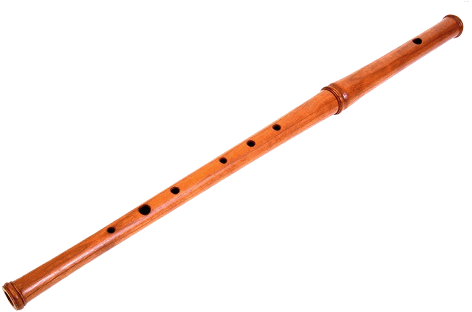
Strange question I know but I am attempting to make a wooden flute and have two small problems. First one is that I need to measure the internal diameter of the sections (3) as I hand bore it and I must get accurate measurements. What instrument is available that will take the measurement and have external indication? Second is that some of the air holes are tapered with the wider diameter of the hole being on the internal wall of the pipe and the smaller diameter being outside and I am stumped as to how I can do this easily. Any whizz kids out there who can help please? I will dedicate forst tune to the resolver.:-)

__________________
You see things; and you say, 'Why?' But I dream things that never were; and I say 'Why not?' George Bernard Shaw.
Register to Reply
Interested in this topic? By joining CR4 you can "subscribe" to
this discussion and receive notification when new comments are added.

Good Answers:

These comments received enough positive votes to make them "good answers".

"Almost" Good Answers:

Check out these comments that don't yet have enough votes to be "official" good answers and, if you agree with them, vote them!
Guru
Technical Fields - Technical Writing - New Member Engineering Fields - Piping Design Engineering - New Member

Join Date: May 2009
Location: Richland, WA, USA
Posts: 21017
Good Answers: 795
#1

Re: Making a Flute

04/24/2010 2:30 PM

For measuring the bores, some telescoping hole gauges should work. You might need more than one to cover the size ranges. They look like a letter T; the ends of the crossbar spring out to the hole size, are locked into position with a thumbscrew, and then measured with a micrometer or vernier caliper.

To go fancy (about US$ 600 each) you could use one or more Brown & Sharpe "Intrimik" bore gauges, with an extension handle or two.

I saw these in a McMaster-Carr catalog, which is available on line.

__________________
In vino veritas; in cervisia carmen; in aqua E. coli.
Register to Reply Score 1 for Good Answer
2
Guru

Join Date: Oct 2008
Posts: 42355
Good Answers: 1693
#2

Re: Making a Flute

04/24/2010 2:45 PM

If you know what internal dimensions you need, just make some "plug gauges" out of Popsicle sticks or tongue depressors. Then you can measure the outside of your gauge with any ruler. When it fits inside the tube, you have the proper dimension.

Or conversely, whittle the stick/depressor/paint stirrer down till it fits inside the present opening in the tube, when you get close. Then measure it with the ruler and you will have the present ID.

I hope this makes sense.

Register to Reply Good Answer (Score 2)
Power-User

Join Date: Feb 2008
Location: Waterford, Ireland
Posts: 109
#3

Re: Making a Flute

04/24/2010 5:02 PM

I think that I recognise the T concept but trying to work our how the measurement is taken. Have to get my thinking cap on . Thank you guys.

__________________
You see things; and you say, 'Why?' But I dream things that never were; and I say 'Why not?' George Bernard Shaw.
Register to Reply
Guru
Technical Fields - Technical Writing - New Member Engineering Fields - Piping Design Engineering - New Member

Join Date: May 2009
Location: Richland, WA, USA
Posts: 21017
Good Answers: 795
#4

Re: Making a Flute

04/24/2010 5:19 PM

Lynlynch's approach is probably more practical, and certainly more economical. For the finger holes, I am thinking of drilling them to the smaller diameter and then using a needle file to form the taper. That would be a test of manual artistry!

On the main bore again, I have done custom sized holes by grinding the side edges of spade (or paddle) type wood bits. You could grind several of these to the correct taper, using as many as it takes to cover the length of the bore. In a fairly small hole like this, you'll need to watch relief angle pretty closely, and maybe chamfer off the lagging edges.

For finishing, how about making a tapered dowel and gluing sandpaper around it?

I hope we get some other woodcrafters like Del and Ronseto to weigh in.

__________________
In vino veritas; in cervisia carmen; in aqua E. coli.
Register to Reply Score 1 for Good Answer
2
Guru
Popular Science - Weaponology - New Member United Kingdom - Member - New Member

Join Date: May 2007
Location: Harlow England
Posts: 16512
Good Answers: 670
#5

Re: Making a Flute

04/24/2010 6:31 PM

I think you'll proably need to make your own tool for the tapers. A tapered scraper which is split so that it can be expanded by screwing or sliding a centre piece down the middle.
Alternatively make tapered holes, tapered the easy way into cylindrical plugs of wood, then glue these pluges in parallel holes drilled in the body.
Del

__________________
health warning: These posts may contain traces of nut.
Register to Reply Good Answer (Score 2)
Guru

Join Date: Oct 2008
Posts: 42355
Good Answers: 1693
#8
In reply to #5

Re: Making a Flute

04/24/2010 7:30 PM

Good idea. I get the sense that irelandeng could benefit from your bow making experience. I had an idea for the reverse tapers, but yours are better. (X-acto knife and careful carving from the outside seems iffy).

Register to Reply
Guru
Technical Fields - Technical Writing - New Member Engineering Fields - Piping Design Engineering - New Member

Join Date: May 2009
Location: Richland, WA, USA
Posts: 21017
Good Answers: 795
#6

Re: Making a Flute

04/24/2010 6:55 PM

Ingenious! And they could be made in a contrasting wood. Maple-bushed finger holes would hold up well, and would look cool along a darker barrel.

__________________
In vino veritas; in cervisia carmen; in aqua E. coli.
Register to Reply
Power-User

Join Date: Feb 2008
Location: Waterford, Ireland
Posts: 109
#7

Re: Making a Flute

04/24/2010 7:20 PM

Thanks guys for helpful answers. I should maybe explain that the reason I am attempting to build the flure is because,1, I wish to experiment and 2 a new flute is going to set me back about €4000. This will take me a few months total and I will get parts from Vienna Austria. Think I have enough to go on now and have a few helpful tips there. Again thank you all for your input. Maybe James Galway will buy it when finished. LOL

__________________
You see things; and you say, 'Why?' But I dream things that never were; and I say 'Why not?' George Bernard Shaw.
Register to Reply
Guru
Technical Fields - Technical Writing - New Member Engineering Fields - Piping Design Engineering - New Member

Join Date: May 2009
Location: Richland, WA, USA
Posts: 21017
Good Answers: 795
#11
In reply to #7

Re: Making a Flute

04/24/2010 11:37 PM

We eagerly await the CD, "James Galway on the Irelandeng Flute!"

I heard him in concert in Seattle around 1990, with a tin whistle encore. A great player, and a gracious and engaging person.

__________________
In vino veritas; in cervisia carmen; in aqua E. coli.
Register to Reply
Guru
Technical Fields - Technical Writing - New Member Engineering Fields - Piping Design Engineering - New Member

Join Date: May 2009
Location: Richland, WA, USA
Posts: 21017
Good Answers: 795
#9

Re: Making a Flute

04/24/2010 7:56 PM

There was a fellow from around Seattle who handcrafted a flute that was valued around US$ 20,000. It was stolen, but later recovered. Alas, I have forgotten his name, and my guessful searching so far has not borne fruit. I'm not a musician myself, but I have a nice Moeck recorder (looks like maple), and thus your project resonates. Best of success!

__________________
In vino veritas; in cervisia carmen; in aqua E. coli.
Register to Reply
Anonymous Poster
#10

Re: Making a Flute

04/24/2010 11:29 PM

Hello irelandeng,

Are trying to make a tinwhistle? I play tinwhistle, but never gave serious thought to construction of such. If I understand you correctly, the pitch holes are chamfered from inside the instrument. Since there are existing instruments, I am sure that there are tools for doing what you require. I would search [undercut chamfer].

Muirsheen Durkin, The Fields of Athenry, The Wild Rover, A Nation Once Again, The Irish Rover - some of my favorite songs!

Best of luck,

Michael

Register to Reply
Power-User

Join Date: Feb 2008
Location: Waterford, Ireland
Posts: 109
#14
In reply to #10

Re: Making a Flute

04/25/2010 6:49 AM

@Guest, certainly not a tin whistle. I can buy one for 3 Euro. Thanks. This project will cost about €600 to €800 hopefully not more ,with my labour and travel costs plus plus plus out of the equation.

__________________
You see things; and you say, 'Why?' But I dream things that never were; and I say 'Why not?' George Bernard Shaw.
Register to Reply
2
Guru
Hobbies - DIY Welding - New Member

Join Date: Apr 2008
Location: Bristol, Tennessee
Posts: 1177
Good Answers: 58
#12

Re: Making a Flute

04/25/2010 12:38 AM

I would expect flutes were made from the center out. That is, the hole was done in a piece of wood, and then the piece was mounted on a mandrel to finish the outside. To try to hand bore down a thin piece of wood is risky. If you break through, the flute is ruined.

A simple bore gauge can be made by splitting the end of a dowel, and inserting a wedge into the split. As the hole gets bigger, push the wedge deeper into the split. If the end of the dowel with the split is ball-shaped, you can easily check size with any calipers, precision or simple screw type.

Del has the best idea for the tapered holes, contrasting wood would be beautiful.

__________________
mike k
Register to Reply Good Answer (Score 2)
Guru

Join Date: Oct 2008
Posts: 42355
Good Answers: 1693
#13
In reply to #12

Re: Making a Flute

04/25/2010 12:53 AM

As we often do, we have lost the thread. The guy wants to know how to measure the ID not cut it.

Cheers

Register to Reply
Guru

Join Date: Oct 2008
Posts: 42355
Good Answers: 1693
#27
In reply to #12

Re: Making a Flute

04/26/2010 4:44 PM

Now that, "simple bore gauge" is a very good idea. I'll remember that one.

Although this flute thing may be more exacting than my popsicle sticks or your dowel.

I wonder if anyone makes an expandable sleeve internal micrometer?

Del's a peach.

Register to Reply
Guru
Hobbies - DIY Welding - New Member

Join Date: Apr 2008
Location: Bristol, Tennessee
Posts: 1177
Good Answers: 58
#28
In reply to #27

Re: Making a Flute

04/26/2010 7:51 PM

Regular internal mics only reach in a little bit. Inside mics only come so small. Telescoping gauges are great, but the regular ones only have handles so long. Adjustable bore gauges, like what I described in a simple wood model, have a split ball on the end, and a wedge on a rod with a thread and adjusting knob on the hollow handle. For deep, small holes, the adjustable bore gauge is used. But even they only come so long, standard.

In the old days, all they had were lots of different calipers, still popular.

__________________
mike k
Register to Reply
2
Power-User
New Zealand - Member - Member Australia - Member - Member

Join Date: Oct 2008
Location: Auckland, New Zealand
Posts: 463
Good Answers: 43
#15

Re: Making a Flute

04/25/2010 7:46 AM

Hi irelandeng, If you can locate a reamer bit that has a height less than the inner diameter of the flute bore AND with a means of attaching a spindle at the narrow end, you can slide the reamer bit down the tube and attach the spindle through the hole. With the spindle thru the hole to the outside you would be able to cut your taper on the inside. It is a little like those router bits which have a follower bearing on the lower end. They are usually held with a 1.5 to 2mm socket set screw (for removal of the brg) and the female thread would be used for attachment of the driving spindle.

A lot of hassle for a 1-off and Del's insert may prove easier on a 1-off exercise. Would be interesting to assess any musical difference.

Register to Reply Good Answer (Score 2)
Anonymous Poster
#16

Re: Making a Flute

04/25/2010 10:09 AM

Really delicate work you've undertaken.

For the finger holes--and your description of finger holes and three parts... suggests we are perhaps actually talking about a recorder (held vertically and blown into) rather than a flute (held sideways and breathed with embrochure)--may I suggest using fine hole saw to cut and remove oversized disks at the fingering positions; then, bore/taper thru inside (concave) aspect of each disk. When finished (probably near end of instrument assembly just before finish coat, place backer within instrument bore (this will ensure flush fit at outer surface) and then (for each disk) apply wood adhesive in holes and found disk edge, fit back into hole, and let cure thoroughly.

But, before you do all this, try to ascertain why the holes in your model instrument are tapered outward. Is the model also of wood? Or perhaps plastic...could the model have been assembled and welded as front and back sections (not bored from cylinder as with your instrument)? If the material differs as between your instrument and the model, the tapering might by simply an artifact of manufacture, having no real impact on finger-ability. (ISMW, if the reverse tapering can be avoided, it should be.)

Register to Reply
Anonymous Poster
#17
In reply to #16

Re: Making a Flute

04/25/2010 10:12 AM

maybe some one will post picture of flute and recorder instruments to show the diff.

Register to Reply
Power-User

Join Date: Nov 2009
Posts: 296
Good Answers: 27
#18
In reply to #17

Re: Making a Flute

04/25/2010 10:37 PM

Different recorders and one wooden flute.

__________________
I have no special talent. I am only passionately curious. Albert E
Register to Reply Score 1 for Good Answer
Anonymous Poster
#20
In reply to #18

Re: Making a Flute

04/26/2010 12:27 AM

Thanks. Note that the flute at bottom makes sound by blowing across the solitary hole, same as "sounding" off by blowing across (or rubbing around) top of pop bottle.

Recorders at top, on the other hand however, have mouthpiece to blow into; but, actually, work on same principle...in that mouthpiece is designed so that air stream from breathing into tip of mouthpiece (unlike reed instruments) is directed across a secondary hole cut into top of mouthpiece to make sound in same fashion as "true" flute. Apparently, it was discovered at one time that having fingering patterns out front and not going to side would make learning easier; same with having artificial embrochure (the mouthpiece) to simply blow into (need only control breath and tongue-ing) rather than natural (lip) embrochure. There was a trade off, however, in recorders' not having same range and timbre capability as natural flutes.

(click picture to go to Wikipedia article and pic source)

Register to Reply
Power-User

Join Date: Feb 2008
Location: Waterford, Ireland
Posts: 109
#23
In reply to #20

Re: Making a Flute

04/26/2010 6:05 AM

I am building a professional flute

Thanks anyway

__________________
You see things; and you say, 'Why?' But I dream things that never were; and I say 'Why not?' George Bernard Shaw.
Register to Reply
Power-User

Join Date: Nov 2009
Posts: 296
Good Answers: 27
#29
In reply to #23

Re: Making a Flute

04/27/2010 1:52 AM

Apart from a couple of Boehm system flutes I have two very similar to the one that you show. They both need some tender loving care. The old cork "pads" and the springs are in poor condition. They were played by members of the Prince Alfred Guard Military Band. Not sure of their age.

__________________
I have no special talent. I am only passionately curious. Albert E
Register to Reply
Guru
United Kingdom - Member - Hearts of Oak Popular Science - Paleontology - New Member Engineering Fields - Mechanical Engineering - New Member

Join Date: May 2005
Location: In the Garden
Posts: 3389
Good Answers: 75
#22
In reply to #16

Re: Making a Flute

04/26/2010 5:41 AM

Not entirely true - flutes can be played both ways. I have a couple which are played vertically - it's actually all about where the air blade happens to be.

Recorders are a subset of the flute family.

__________________
Chaos always wins because it's better organised.
Register to Reply
3
Guru

Join Date: Jun 2006
Location: Ottawa Canada
Posts: 1975
Good Answers: 117
#19

Re: Making a Flute

04/25/2010 11:03 PM

I know that legend has it that the ulian pipe chanters were bored with an old French triangular bayonette. If you can bore it, you really don't need the measurements since of course, that is automatic with the boring.

You can make tapered finger holes easier than I can explain it but here goes. You say the taper should be wider as you go inside. Piece of cake. You need to make a jig that looks like a funnel on the inside. The outside top opens out in the desired taper angle, and the outside bottom must be shaped to sit on the shaft like a saddle fits on a horse. Since the workpiece is only wood, a standard drill bit will do. This drill bit should be a smidgin smaller than the opening in the bottom of the "funnel". Clamp your guide onto the shaft, and drill down through the shaft wall. You can waggle the drill around to expand the hole, but the jig will keep it from walking away from centre at the outside of the shaft.

Anybody who can make a flute can make a jig. I would make it from a block of steel, and it could be made on a fairly standard drill press.

Is this a good explanation?

__________________
If it was easy anybody could do it.
Register to Reply Good Answer (Score 3)
Guru

Join Date: Aug 2005
Location: Hemel Hempstead, UK
Posts: 5826
Good Answers: 322
#21
In reply to #19

Re: Making a Flute

04/26/2010 4:26 AM

Is this a good explanation?

Yes GA. The only change I would suggest is that he keeps the drill bit fixed, and, manipulates the flute and funnel guide about the tool rather than the other way round.

__________________
If you spend all your time looking for people and things to complain about: trust me, you will find plenty to complain about.
Register to Reply
Power-User

Join Date: Feb 2008
Location: Waterford, Ireland
Posts: 109
#24
In reply to #19

Re: Making a Flute

04/26/2010 6:23 AM

Thanks Yusef why I need to be able to take measurements is that I wish to experiment with various bore sizes to compare sounds. I am usually critical of flutes that I test and the 2 I have purchased are good but I am sure that I can improve tones. I am reluctant to play with expensive flutes but to do so on my own creation will be less expensive and my guilt will be lesser. I should also add that I am not a concert musician but an amateur who plays Celtic style music. This is an example of the slow airs we practice and play. I should add that I am not comparing myself with this famous musician ..... I am better http://www.youtube.com/watch?v=nDCpGYuw3Og&feature=related

__________________
You see things; and you say, 'Why?' But I dream things that never were; and I say 'Why not?' George Bernard Shaw.
Register to Reply
Guru

Join Date: Jun 2006
Location: Ottawa Canada
Posts: 1975
Good Answers: 117
#26
In reply to #24

Re: Making a Flute

04/26/2010 11:15 AM

I applaud the goal. I see that you will be making several expendable flute bodies during your experiments; one for each change of variable. So this is not a "one off" instrument, but rather a fairly large project. Like all experiments, you have to keep really good records. Sounds like a very fun project, and the end result will be a perfect musical instrument. How cool is that!

The question begs to be asked...are you re-inventing the wheel here? Are there existing bodies of experimental data which you can access to find the information? Reverse engineering an existing flute is a good start, and for that, a set of inside calipers is invaluable. But of course, this would give you a poor copy of the original....and you will still need to continue on to adjust the variables.

I too would like to see the results posted here someday. Perhaps a link to a youtube page which would show different results in sound and tone with different bores, tapers and so forth.

Regards

Yusef1

__________________
If it was easy anybody could do it.
Register to Reply Off Topic (Score 5)
Power-User

Join Date: Feb 2008
Location: Waterford, Ireland
Posts: 109
#25

Re: Making a Flute

04/26/2010 7:27 AM

Thank you English Rose for you help also.

__________________
You see things; and you say, 'Why?' But I dream things that never were; and I say 'Why not?' George Bernard Shaw.
Register to Reply
Guru
Popular Science - Weaponology - New Member United Kingdom - Member - New Member

Join Date: May 2007
Location: Harlow England
Posts: 16512
Good Answers: 670
#30

Re: Making a Flute

04/27/2010 2:43 AM

The other alternative for internal bore measurement is the good old plasticine (or other suitable medium) on a stick.
Push it in pull it out and then measure using regular vernier/micrometer.
Of corse there may be adhesion problems with wood, but probably nothing a wipe of beeswax & turps polish couln't cure.
(It can always be put in the fridge after extraction to harden it up to make measurement less twitchy.)
(Actually the same put it, pull it out measure it mathod could be uses for a relatively simply diy tapered plug gauge.)
Del

__________________
health warning: These posts may contain traces of nut.
Register to Reply
Guru

Join Date: Aug 2005
Location: Hemel Hempstead, UK
Posts: 5826
Good Answers: 322
#31

Re: Making a Flute

04/27/2010 4:11 AM

If you used a low melting point rubber you could make a model of the whole of the internal shape at one go: with the right stuff you would even be able to stretch and pull out larger diameter sections through smaller diameter sections.

__________________
If you spend all your time looking for people and things to complain about: trust me, you will find plenty to complain about.
Register to Reply Score 1 for Good Answer
Power-User
New Zealand - Member - Member Australia - Member - Member

Join Date: Oct 2008
Location: Auckland, New Zealand
Posts: 463
Good Answers: 43
#32
In reply to #31

Re: Making a Flute

04/27/2010 4:18 AM

or some silicon from a squeezee tube- it seems to dry up in my tube but it never has that flute shape!

Register to Reply
Register to Reply 32 comments

Good Answers:

These comments received enough positive votes to make them "good answers".

"Almost" Good Answers:

Check out these comments that don't yet have enough votes to be "official" good answers and, if you agree with them, vote them!
Copy to Clipboard

Users who posted comments:

Anonymous Poster (4); AussieBob (2); English Rose (1); irelandeng (6); Kaisan (2); lyn (4); mike k (2); Randall (2); Tornado (5); user-deleted-1105 (2); Yusef1 (2)

Previous in Forum: Were There Giants in the Land?   Next in Forum: Acoustical Ceiling Tiles

Advertisement