Previous in Forum: Room Index in Lux Calculation   Next in Forum: Star Delta Switch drws
Close
Close
Close
14 comments
Rate Comments: Nested
Anonymous Poster

Power Factor of Small Home/Office Appliances

07/06/2010 12:42 PM

If anybody has a record of power factor of appliances like CFL/mercury vapour/sodium vapour/metal halide/LED lights,ceiling fan, table fan, fridge, TV, air conditioners(window/split), PC, photocopier, printer, grinder/mixer, washing machine, dish washer etc. please publish to keep it as a data base.

Reply
Interested in this topic? By joining CR4 you can "subscribe" to
this discussion and receive notification when new comments are added.

"Almost" Good Answers:

Check out these comments that don't yet have enough votes to be "official" good answers and, if you agree with them, vote them!
Guru

Join Date: Oct 2008
Posts: 42355
Good Answers: 1693
#1

Re: Power factor of small home/office appliances

07/06/2010 12:47 PM

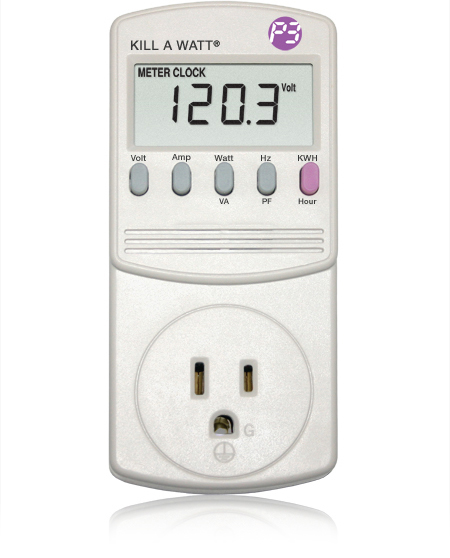
For $20.00USD you can develop your own data base.

This is not an endorsement, but I have one and they are neat.

Empowers you to save $100's on electric bills!

ThinkGeek :: Kill-A-Watt

Reply
Anonymous Poster
#3
In reply to #1

Re: Power factor of small home/office appliances

07/06/2010 10:26 PM

thank you.Can this be used in a 220V(L/N)system?

Reply
Guru

Join Date: Oct 2008
Posts: 42355
Good Answers: 1693
#4
In reply to #3

Re: Power factor of small home/office appliances

07/06/2010 10:30 PM

Sorry, the plug configuration on the front might be a clue. It's 120V 15 AMP service.

Someone may make other one's but they are more expensive.

Reply
Guru

Join Date: Jun 2010
Location: srilanka
Posts: 2725
Good Answers: 5
#13
In reply to #4

Re: Power factor of small home/office appliances

07/08/2010 11:52 AM

Can somebody recommend a manufacturer making same item suitable for 220V 50Hz to be used in countries like UK

__________________
pnaban
Reply
Guru

Join Date: Oct 2008
Posts: 42355
Good Answers: 1693
#14
In reply to #13

Re: Power factor of small home/office appliances

07/08/2010 12:05 PM

Power Factor Meter | Products & Suppliers On GlobalSpec Find power factor meter related suppliers, manufacturers, products and ... Fluke 345 Power Quality Clamp Meter Our Inventory tool shows you who may have a ...
www.globalspec.com/industrial-directory/power_factor_meter - Cached Don't be shocked by the price.

Reply
Guru
United States - Member - New Member Engineering Fields - Power Engineering - New Member

Join Date: Sep 2006
Location: California, USA, where the Godless live next door to God.
Posts: 4665
Good Answers: 804
#2

Re: Power Factor of Small Home/Office Appliances

07/06/2010 1:48 PM

Why do you care?

__________________
** All I every really wanted to be, was... A LUMBERJACK!.**
Reply
Anonymous Poster
#5
In reply to #2

Re: Power Factor of Small Home/Office Appliances

07/07/2010 7:11 AM

JRaef, normally your responses are well worth reading but not in this instance. This was a response I would expect from others and not from you.

Reply
Guru
United States - Member - New Member Engineering Fields - Power Engineering - New Member

Join Date: Sep 2006
Location: California, USA, where the Godless live next door to God.
Posts: 4665
Good Answers: 804
#9
In reply to #5

Re: Power Factor of Small Home/Office Appliances

07/07/2010 5:22 PM

My intent was to start a dialog with the OP 'Guest" as to why they want to know the PF of household appliances, rather than my guessing as to why they wanted to know. PF of household appliances is almost completely meaningless in the bigger scheme of things. Often, people have been sold on "energy savers" that claim to reduce energy by improving power factor, and this is essentially false.

But we still don't know why he wanted to know.

Please register people, it's hard to address you all as Guest...

__________________
** All I every really wanted to be, was... A LUMBERJACK!.**
Reply
Anonymous Poster
#6

Re: Power Factor of Small Home/Office Appliances

07/07/2010 8:49 AM

The power factor of many of the devices you mentioned can vary widely by manufacturer or even by model from the same manufacturer. And generally it's not even the sort of data that anyone keeps track of for any useful purpose.

Reply
Guru

Join Date: Jun 2010
Location: srilanka
Posts: 2725
Good Answers: 5
#7
In reply to #6

Re: Power Factor of Small Home/Office Appliances

07/07/2010 12:28 PM

If we make measurements and keep a record and compare with the nameplate data we can assure the users that the product is safe.Some may inject harmonics/EMI into the system .These parameters should measured at the factory by authorised persons and marketing to be allowed only if they are within safe limits.Some salespersons will give a safe figure to convince the buyers.

__________________
pnaban
Reply
Anonymous Poster
#8
In reply to #7

Re: Power Factor of Small Home/Office Appliances

07/07/2010 2:30 PM

Yes, we *could* do that. But we have certification agencies that do that sort of thing for us, don't we? That's assuming of course that you trust that when a product is marked as tested that the mark itself isn't fake. (And belive me, some are).

If you're suggesting that we should do such things to keep people safe (?) then I should think there are many other more important safety parameters with products that we should inspect for ourselves than the harmonics / EMI they emit.

Reply
Guru

Join Date: Jun 2010
Location: srilanka
Posts: 2725
Good Answers: 5
#10
In reply to #8

Re: Power Factor of Small Home/Office Appliances

07/07/2010 5:42 PM

In under developed countries low-efficient products(low initial cost) which consume much higher power than energy efficient counterpart are freely available causing innocent users more power bill and other side effects mentioned earlier(pf,emi,harmonics,flicker,noise,safety aspects etc).Due to economic reasons and due to their political connection with those countries exporting those items governments in under developed countries do not ban them.The Engineers cannot over rule politicians. The engineer,s importance is overshadowed by politicians and even some engineers keep silent to get favours.

__________________
pnaban
Reply
Guru
United Kingdom - Member - Indeterminate Engineering Fields - Control Engineering - New Member

Join Date: Jan 2007
Location: In the bothy, 7 chains down the line from Dodman's Lane level crossing, in the nation formerly known as Great Britain. Kettle's on.
Posts: 32175
Good Answers: 839
#11
In reply to #7

Re: Power Factor of Small Home/Office Appliances

07/08/2010 3:49 AM

Hang on. There are several topics here and they are becoming confused.

  1. The power factor of a particular domestic appliance is of little interest, as electricity providers do not charge domestic users on poor power factor. There is nothing to be gained by improving it, which is why power factor correction [PFC] at domestic premises is practically unheard of. If a feeder cable is becoming warm and perceived to be in need of power factor improvement, then the supply is too small and the utility company needs to be contacted to arrange for an aup-grade to the supply cable. Usually, domestic power cables are well-oversized for the average daily demand. Here, for example, the daily domestic electricity consumption is about 10.2kWh per day, an average of 445W, which is less than 2A continuous on a 240VAC supply. The feeder cable has a 100A fuse in it and will support 100A as a continuous load (even though home finances will not!). The tariff is based upon kWh consumed only. There is no scope for PFC as the feeder cable is sized for the peak load and not the average load. Contrarily, on a distribution network where a cable is running near its maximum rating, it is very attractive to squeeze more out of the same cables by putting PFC at the users' ends, as feeder losses will be reduced across the network. Suppliers encourage this by penalising poor power factor as part of their user tariffs.
  2. The safety of electrical equipment used in the home is the domain of the manufacturer, the supplier and the maintainer in national laws. The manufacturer and the supplier have duties to make sure that the equipment as supplied is safe and can be prosecuted if it causes injury or kills someone. However the maintainer also has a duty to keep it safe by making sure that it is in good order throughout its useful life. The manufacturer and supplier exclude this from their liability by referring to "fair wear and tear" in their product warranty.
  3. Harmonics and EMI are only relevant with respect to the compatibility of equipment with other equipment. For example, if a neighbour's television causes interference to the radio next door, then it is neither a safety nor a power factor issue, though the television user can certainly be prosecuted for causing it in the UK. That is why EMI suppression and equipment compatibility tests are carried out, which has nothing to do with safety, PFC, marketing or much else.

Most domestic users couldn't give a damn, though. So is this advocated database-thingy really "much ado about nothing"?

__________________
"Did you get my e-mail?" - "The biggest problem in communication is the illusion that it has taken place" - George Bernard Shaw, 1856
Reply Score 1 for Good Answer
Guru

Join Date: Jun 2010
Location: srilanka
Posts: 2725
Good Answers: 5
#12
In reply to #11

Re: Power Factor of Small Home/Office Appliances

07/08/2010 11:49 AM

Lights,air conditioners,computers,ceiling fans are used not only in homes but in offices too. In a large office, say with 50 a/c units,200 fluorescent lights,100 computers etc the overall pf will be low thereby increasing the kVA(MD) charges

__________________
pnaban
Reply
Reply to Forum Thread 14 comments

"Almost" Good Answers:

Check out these comments that don't yet have enough votes to be "official" good answers and, if you agree with them, vote them!
Copy to Clipboard

Users who posted comments:

Anonymous Poster (4); JRaef (2); lyn (3); pnaban (4); PWSlack (1)

Previous in Forum: Room Index in Lux Calculation   Next in Forum: Star Delta Switch drws

Advertisement