Previous in Forum: Effect in Steam Turbine Due to High Vaccum in Condensor   Next in Forum: Mitigation of Stress Concentrations Around Holes Drilled In the Web of A Beam
Close
Close
Close
34 comments
Rate Comments: Nested
Power-User

Join Date: Jan 2011
Location: Scotland
Posts: 361

Small Induction Motor Generator Project
01/04/2011 3:42 PM

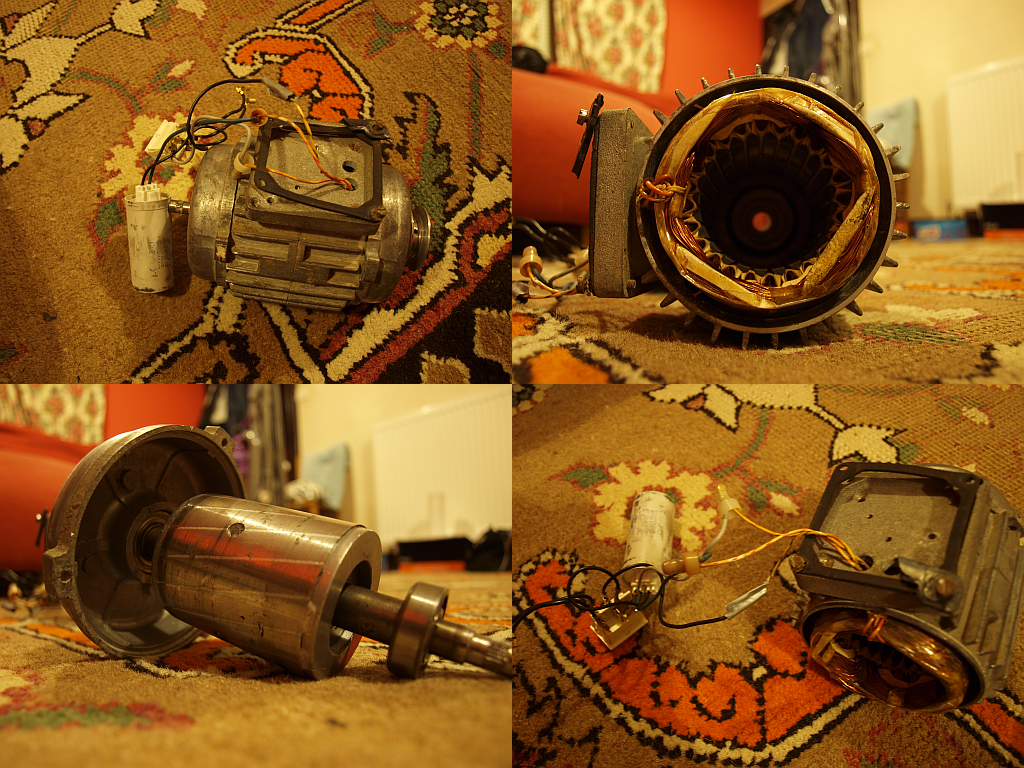
Shown below is a 4000 watt induction motor that I was wanting to convert to a generator. Is it best to drill holes in the rotor and insert neodymium magnets or magnetise the rotor with a high voltage DC current?

Register to Reply
Interested in this topic? By joining CR4 you can "subscribe" to
this discussion and receive notification when new comments are added.
Guru

Join Date: Oct 2008
Location: Deepest Darkest Rutherford Oz
Posts: 951
Good Answers: 145
#1

Re: Small induction motor generator project

01/04/2011 4:12 PM

There are a couple of things to need to appreciate with this little project.

If you drill the armature and place magnets in the holes you will need to find an appropriate adhesive that will hold them in place while the armature is spinning.

You will also need to have the armature dynamically rebalanced, as the mass of the magnets will cause an issue. Note that while the magnets may seem of equal size they may not necessarily be of equal weight.

The placement pattern and polarity of the magnets will also influence your results.

If you were to "magnetise" the armature you may still not get the desired result due to the how the poles of the armature respond to the treatment.

But that's the fun of tinkering.

__________________
There are two reasons for a man to do a thing, One that sounds good, and the real one...
Register to Reply
Power-User

Join Date: Jan 2011
Location: Scotland
Posts: 361
#2
In reply to #1

Re: Small induction motor generator project

01/04/2011 4:24 PM

Notice how the rotor has slanting lines going along it? Would I drill holes along these lines and insert the magnets that way? The magnets are small neodymium ones out of a magnetix toy set.

Register to Reply
Guru

Join Date: Oct 2010
Posts: 1294
Good Answers: 35
#3
In reply to #2

Re: Small induction motor generator project

01/04/2011 5:22 PM

Don't do anything (especially drilling) until you explain what your trying to do.

A nifty way to use an induction motor as a generator is simply to drive it faster than its synchronous speed (while connected to the "mains"). For example, if the motor is nominally rated at 1750 rpm, its synchronous speed is 1800 rpm, and if you turn it at a faster speed, you will get power out.

This can be useful in, for example, a windmill (or small hydro) project. You do need some safeguards, mainly mechanical to keep it from overspeeding on loss of the mains. An advantage of this type of generator is that it will not backfeed into the mains when the mains are depowered. (This is not good if you want to use it for backup power, but very nice for a sort of cogeneration.)

Register to Reply
Power-User

Join Date: Jan 2011
Location: Scotland
Posts: 361
#4
In reply to #3

Re: Small induction motor generator project

01/04/2011 5:31 PM

I am trying to add magnets to the rotor to make a more powerful kind of generator for use without the mains. I was wanting to put around 24 small magnets into the rotor.

Register to Reply
Guru
United Kingdom - Member - New Member

Join Date: Aug 2010
Location: Resting under the Major Oak
Posts: 4347
Good Answers: 181
#5

Re: Small induction motor generator project

01/04/2011 5:50 PM

Before you start drilling holes have a look at how a rotor is constructed. You will ruin the isolation between the lamination stampings.

__________________
The reports of my death are greatly exaggerated.
Register to Reply
Guru

Join Date: Jun 2009
Location: South of Minot North Dakota
Posts: 8376
Good Answers: 775
#6

Re: Small Induction Motor Generator Project

01/04/2011 6:30 PM

Here is how I did it with a similar sized three phase motor. Pictures included.

http://www.electro-tech-online.com/renewable-energy/103033-3-ph-motor-conversion-pm-alternator.html

Register to Reply
Power-User

Join Date: Jan 2011
Location: Scotland
Posts: 361
#7
In reply to #6

Re: Small Induction Motor Generator Project

01/05/2011 7:22 AM

I have marked out part of the armature. I am not sure whether the magnets should follow the lines on the armature or be in a straight line. I once heard that if the magnets are slanted it reduces the cogging effect.

Slanting layout:

Straight layout:

Register to Reply
Guru

Join Date: Jun 2009
Location: South of Minot North Dakota
Posts: 8376
Good Answers: 775
#8
In reply to #7

Re: Small Induction Motor Generator Project

01/05/2011 12:16 PM
Register to Reply
Guru

Join Date: Feb 2010
Posts: 1013
Good Answers: 36
#9
In reply to #7

Re: Small Induction Motor Generator Project

01/05/2011 1:31 PM

Suppose you inserted the magnets as planned.

How do you regulate the voltage to keep it steady with the load varying?

Unless you want to convert the output to DC, charge a battery.... then reconvert to AC.... ?!

An iduction motor can be used as a generator even not connected to the mains, but you need to connect some Capacitors to supply the required reactive power for it to become a generator. You can google 'Asynchronous Generators' or 'Induction motors as Generators' and sift through...

Register to Reply
Power-User

Join Date: Jan 2011
Location: Scotland
Posts: 361
#10
In reply to #9

Re: Small Induction Motor Generator Project

01/05/2011 2:14 PM

I have capacitors that I can use. I was going to use the slanting method of inserting the magnets. But how do I orient the magnets poles? Would it be a row of north poles on one side of the rotor, and a row of south poles on the opposite side?

Register to Reply
Guru

Join Date: Feb 2010
Posts: 1013
Good Answers: 36
#11
In reply to #10

Re: Small Induction Motor Generator Project

01/05/2011 6:20 PM

Since you are experimenting, then yes you can do it like that.

The rpm to exceed will depend on the number of poles the stator winding has per phase...

the efficiency and wave shape will depend on the size (diam.) of the magnets.

Do not forget that since the magnets are imbedded into the rotor, there will be no air gap between the N and S poles: the magnetic flux will tend to go into the rotor irons directly rather than thru the stator winding and back to the next pole! therefore, you may need to groove the rotor in two places, parallel to the magnets rows, and at mid points.

Register to Reply
Guru

Join Date: Jun 2009
Location: South of Minot North Dakota
Posts: 8376
Good Answers: 775
#12
In reply to #10

Re: Small Induction Motor Generator Project

01/05/2011 6:31 PM

That depends on how many poles it is wound for. If its a 4 pole motor it would have been rated for around 1725 RPM or if it is two pole it would have been rated at around 3450 RPM. Your rotor has to have the same number of poles as the stator windings.

To get the greatest magnetic flux going though the stator you do need to have half of each magnet anchored into the stator and as many magnets per pole as you can possibly fit as well.

Register to Reply
Power-User

Join Date: Jan 2011
Location: Scotland
Posts: 361
#13
In reply to #12

Re: Small Induction Motor Generator Project

01/06/2011 11:52 AM

I have added in the first row of magnets today. I am not sure how to tell how many poles the motor has, but it looks to me as if it has 24 poles on the stator, and 16 poles on the rotor.

I have embedded 4 magnets in the rotor so far. They are just held in with hot melt glue. I spun the generator as fast as i could by winding string onto the pulley at the end and managed to get 166 volts out. That should hopefully increase with more magnets.

Register to Reply
Power-User

Join Date: Jan 2011
Location: Scotland
Posts: 361
#14
In reply to #13

Re: Small Induction Motor Generator Project

01/06/2011 1:12 PM

I forgot to add the image of the waveform that this generator now produces.

It seems a bit messy.

Register to Reply
Guru

Join Date: Feb 2010
Posts: 1013
Good Answers: 36
#15
In reply to #13

Re: Small Induction Motor Generator Project

01/07/2011 3:34 AM

If there is a nameplate still on the motor body, then you can read the rpm. If the motor nameplate also shows the Frequency, then the number of poles an easily be deducted: 50Hz ==> use 3000 rpm as the speed for a 1 pair of poles (1 north & 1 south). the next speed is 1500 rpm for 2 pair of poles (4 poles). for 60 Hz, it will be 3600rpm and 1800rpm respectively.

I hope we are looking at a 3phase induction motor (does not need a capacitor when running as a motor!). If not, then the windings on the rotor will need to be looked at differently!

On your last submission, you show the wave shape you are getting, but no idea of the frequency of that wave.

You did not state the number of rows you used: did you put 2 rows of magnets or 4 rows at 90 degrees of each other?

To have a good idea of what you are getting when you rotate as a generator, you need to drive it at a steady rpm for sometime to allow any testing and measuring. The wave shape must be steady and you need to measure the frequency and compare to the rpm at which you are rotating.Do all this with no load at first, so that you can measure the voltage generated at the speed you will be running at. (you can use another motor to rotate this one for the testing/experimenting). The motor can be a smaller one for this purpose, as long as it is able to drive the rotor without getting overloaded (since no load...).

Register to Reply
Power-User

Join Date: Jan 2011
Location: Scotland
Posts: 361
#16
In reply to #15

Re: Small Induction Motor Generator Project

01/07/2011 11:23 AM

There are just 4 magnets in the middle of the rotor. One magnet every 45 degrees. All magnets have theit north poles facing outwards.

Register to Reply
Power-User

Join Date: Jan 2011
Location: Scotland
Posts: 361
#17
In reply to #16

Re: Small Induction Motor Generator Project

01/07/2011 2:35 PM

No, it is one magnet every 90 degrees. I am needing to add more though because with the first 4 magnets there is a slight cogging effect.

Register to Reply
Guru

Join Date: Feb 2010
Posts: 1013
Good Answers: 36
#18
In reply to #17

Re: Small Induction Motor Generator Project

01/08/2011 3:25 AM

Well, that is experimental domain.

You need to see how many complete waves (sinusoides) you get per revolution of the rotor, with the 4 magnets at 90 degrees and all facing the same way. Also, you did not say if this motor was a 3 phase or single phase wound. (did it have a capacitor attached to it as a motor?)

Register to Reply
Power-User

Join Date: Jan 2011
Location: Scotland
Posts: 361
#19
In reply to #18

Re: Small Induction Motor Generator Project

01/08/2011 7:47 AM

The motor ran on single phase with the supplied capacitor. Although it could work on 3 phase because there are 3 wires coming out the top.

Register to Reply
Guru

Join Date: Feb 2010
Posts: 1013
Good Answers: 36
#20
In reply to #19

Re: Small Induction Motor Generator Project

01/08/2011 1:15 PM

It cannot run on 3 phases just like that!

There are 2 windings: Run winding and Start/Direction winding. The 2 are normally linked at one end that is normally connected to the Neutral conductor. the 2 other ends are connected to 1- Live directly, 2- to the same Live but in series with the capacitor.

The main run winding can take the main current while the other takes a lower current rating.

I need to know the wiring diagram you made when generating.

Register to Reply
Power-User

Join Date: Jan 2011
Location: Scotland
Posts: 361
#21
In reply to #20

Re: Small Induction Motor Generator Project

01/08/2011 2:19 PM

I havent tried to run it on 3 phase because 3 phase here is 415 volts and the motor would be destroyed. I do not have a wiring diagram either. I am just going to have to put some more magnets in it and see what happens.

Register to Reply
Guru
Popular Science - Weaponology - New Member Safety - ESD - New Member Hobbies - Fishing - New Member

Join Date: Sep 2006
Location: Near Frankfurt am Main, Germany. 50.390866N, 8.884827E
Posts: 17996
Good Answers: 200
#27
In reply to #19

Re: Small Induction Motor Generator Project

01/09/2011 1:39 PM

It could still be a single phase induction motor.......although technically speaking a 3 phase motor only requires 3 wires, most have 6 so that a problem on a stator field can be easily identified. Maybe on really tiny motors they only bring out three, I have no experience on tiny 3 phase motors at all........

My bet is a single phase induction motor still.....

Although its possible with electronics to run a 3 phase motor on a single phase, other than that, I personally have never seen a motor that could be run on both either......what would be the point?

I always believed that it was the power/size needed of the motor that basically disctated the number of phases, small motor = single phase, larger = 3 phase.......

Perhaps someone with wider and more recent experience could chime in?

__________________
"What others say about you reveals more about them, than it does you." Anon.
Register to Reply
Guru

Join Date: May 2010
Location: in optimism
Posts: 4050
Good Answers: 130
#30
In reply to #27

Re: Small Induction Motor Generator Project

01/09/2011 3:13 PM

Chiming in;

3 p go down to fractional HP, like 250 W. 500 W are fairly common for industrial fans. Yes generally they only bring out 3 wires, though some have 4 for star.

For what it's worth, the dc brushless motors are wound 3 p and and go down to ~13 mm dia. Change out the pm rotor, and you have an ELV 3p super mini induction motor.

However; the diagram is right and winding comments are right - and that's what he has.

And the car alternator comments are right too.

__________________
There is no sin except stupidity. (Oscar Wilde, Irish dramatist, novelist, & poet (1854 - 1900))
Register to Reply
Guru
Popular Science - Weaponology - New Member Safety - ESD - New Member Hobbies - Fishing - New Member

Join Date: Sep 2006
Location: Near Frankfurt am Main, Germany. 50.390866N, 8.884827E
Posts: 17996
Good Answers: 200
#32
In reply to #30

Re: Small Induction Motor Generator Project

01/09/2011 3:25 PM

Good infos. I concur about the brushless motors too, had a lot to do with them......

__________________
"What others say about you reveals more about them, than it does you." Anon.
Register to Reply
Guru

Join Date: May 2010
Location: in optimism
Posts: 4050
Good Answers: 130
#22

Re: Small Induction Motor Generator Project

01/08/2011 7:41 PM

What you have is a single phase capacitor start/run motor.

Meaning; as a generator (alternator) you have electrically is this;

it may look like this;

and true, were the above this 3 sets of windings, set on each third pole, you could fit something like this;

link

in there and have the same as a car alternator, without the slip-rings and wound rotor. (so long as you had the right pole count and geometry)

But what you want is similar to the above; large bar magnets set in line with the shaft. To know how many (more than two, per Dia 1), you need to find how it's wound, where the poles are, or could be, if it can be reconfigured by separating the windings (if they are of equal value, etc, etc....)

And by the way;

"Cogging" is the magnetic force that is 'broken' in order to generate, so minimising it will result in minimised generation.

And people asking "what rpm is it?", are asking is it 2 pole (biased) or 4 pole, to help you evaluate your reconfiguration options.

__________________
There is no sin except stupidity. (Oscar Wilde, Irish dramatist, novelist, & poet (1854 - 1900))
Register to Reply
Power-User

Join Date: Jan 2011
Location: Scotland
Posts: 361
#23
In reply to #22

Re: Small Induction Motor Generator Project

01/09/2011 6:19 AM

If you look at the pictures at the start there are 3 wires. So would it be best to put capacitors across the wires and connect this to a 3phase bridge rectifier?

Register to Reply
Guru

Join Date: Oct 2010
Posts: 1294
Good Answers: 35
#24
In reply to #23

Re: Small Induction Motor Generator Project

01/09/2011 8:39 AM

It would help at least me if you retook those pictures with a nice plain, light background.

Register to Reply
Guru

Join Date: Feb 2010
Posts: 1013
Good Answers: 36
#25
In reply to #23

Re: Small Induction Motor Generator Project

01/09/2011 10:14 AM

The Normal winding circuit for a single phase motoris as per this picture:

L-L' can have a centrifugal switch that opens when the motor starts running. (some times there is no switch. It depends on the design wheteher the start winding is required to add power to the motor or not...)

The main winding L-N is the workhorse and takes the rating current if there is a starting switch that opens.

The starting winding is at 90 degree geometrically from the main winding. The capacitor ensures that the current going into it is out of phase by ~ 90degrees to decide the direction of rotation.

If you generate an induced voltage, using the magnets you proposed, the two windings will generate voltages out of phase by ~ 90 degrees. the capacitor does not need to be connected and should be removed.

If you turn at a respectfull speed, you must be able to obtain a voltage but should make sure that it does not exceed the motor's rated runing voltage by more than 10-15 %. The loading current should not exceed the motors rated current.

If you want to extract 3 phases from this genset configuration, it will not be balance since the windings are not of the same rating in general. At best, use it for 2 phases and use each phase for a different circuit and protect from overloading separately...

Register to Reply
Power-User

Join Date: Jan 2011
Location: Scotland
Posts: 361
#26
In reply to #25

Re: Small Induction Motor Generator Project

01/09/2011 11:19 AM

Thanks. That seems to be pretty much the setup that i have here. I will just need to get more magnets in and i will drive the motor from a bike to test it.

Register to Reply
Guru
Popular Science - Weaponology - New Member Safety - ESD - New Member Hobbies - Fishing - New Member

Join Date: Sep 2006
Location: Near Frankfurt am Main, Germany. 50.390866N, 8.884827E
Posts: 17996
Good Answers: 200
#28

Re: Small Induction Motor Generator Project

01/09/2011 1:57 PM

Why do you want to go this way, its costly and a lot of work that needs to be done exactly right. Also many motors are not built to work in an outside environment....

If you used car alternators, they are built to run in a hostile environment, can be made to have a Permanent Magnet instead of the wound rotor if that is a requirement. Most if not all are 3 phase and even have the right diodes in place for rectification if needed. Are cheap from the scrap yard. They also have plenty of videos on YouTube showing how to convert them....with a PM instead of a wound rotor, higher voltages can be generated......with a suitable control system, the can generate higher voltages with a wound rotor.

The AC output I saw that you generated was awful, showing a highspeed AC superimposed on the main AC.....that was probably due to the "anti-Cogging" fix to my mind, the magnets are generating "against" each other, which will harm efficiency I believe. Certainly I would not be happy with such an output myself.......sorry......

You need as near to a sine waye as possible for each phase. As you appear to have a single phase motor, one sine wave only......

__________________
"What others say about you reveals more about them, than it does you." Anon.
Register to Reply
Power-User

Join Date: Jan 2011
Location: Scotland
Posts: 361
#29
In reply to #28

Re: Small Induction Motor Generator Project

01/09/2011 2:41 PM

I know, that output is a bit of a disgrace. It must be caused by the small magnetic field already in the rotor being mixed with the magnets.

Register to Reply
Guru
Popular Science - Weaponology - New Member Safety - ESD - New Member Hobbies - Fishing - New Member

Join Date: Sep 2006
Location: Near Frankfurt am Main, Germany. 50.390866N, 8.884827E
Posts: 17996
Good Answers: 200
#31
In reply to #29

Re: Small Induction Motor Generator Project

01/09/2011 3:23 PM

I think is cause by your attempt to stop "cogging" I bet each magnet is contributing its own "AC", you are seeing the mathematical sum of "all" of the ACs mixed together....

Why are you "against" cogging? I would have put the magnets in a line do that they all "acted" together........at 1000RPM, the cogging is gone anyway.......try turning any PM generator or even a stepper motor, they all "cog".......

The good point about PMs in a car alternator is that once you have found the right magnet, removed the rotor coil and placed the magnet in the place, it provides multiple north and souths from just the one magnet (which all "cog" by the way) and you get a nice clean AC per winding.......

Here you can see the rotor lobes:-

http://en.wikipedia.org/wiki/Alternator

You can see this picture and a good explanation st the link:-

__________________
"What others say about you reveals more about them, than it does you." Anon.
Register to Reply
Power-User

Join Date: Jan 2011
Location: Scotland
Posts: 361
#33
In reply to #31

Re: Small Induction Motor Generator Project

01/09/2011 4:22 PM

I have not attempted any anti cogging methods yet. In one of the previous posts someone had posted an anti cogging pdf file. But i think it only applies to generators for wind power.

Register to Reply
Guru

Join Date: Jun 2009
Location: South of Minot North Dakota
Posts: 8376
Good Answers: 775
#34

Re: Small Induction Motor Generator Project

01/13/2011 2:28 PM

Looking at the pictures I would say its a standard 4 pole motor so the rotor would need the magnets aligned north south north south in four sets 90 degrees apart from each other. Each pole of the stator has multiple slots but the winding configuration is what determines the pole count.

As far as the de cogging link goes that for any permanent magnet motor conversion how ever just following the lines on the rotor would probably be close enough for what you are attempting.

Register to Reply
Register to Reply 34 comments
Copy to Clipboard

Users who posted comments:

34point5 (2); Andy Germany (4); hydrogenhead (14); LAA_Lucke (6); rhkramer (2); tcmtech (4); Tobugrynbak (1); TonyS (1)

Previous in Forum: Effect in Steam Turbine Due to High Vaccum in Condensor   Next in Forum: Mitigation of Stress Concentrations Around Holes Drilled In the Web of A Beam

Advertisement