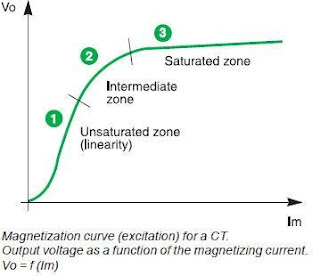
Excitation characteristic gives a graphical or tabular presentation of the relationship between the r.m.s. value of the exciting current and a sinusoidal r.m.s. e.m.f. applied to the secondary terminals of a current transformer, the primary and other windings being open-circuited, over a range of values sufficient to define the characteristics from low levels of excitation up to the rated knee point e.m.f.
The excitation characteristic shall be plotted at least up to the rated knee point e.m.f. The exciting current (I'e) at the rated knee-point e.m.f. and at any stated percentage, shall not exceed the rated value.
Accuracy Class describes the performance characteristics of a CT and the maximum burden allowable on the CT's secondary.
Depending on their Accuracy Class, CTs are divided into Metering Accuracy CTs or Relaying Accuracy CTs (Protection CTs).
Metering Accuracy CTs are rated for specified standard burdens and designed to be highly accurate from very low current to the maximum current rating of the CT. Because of their high degree of accuracy, these CTs are typically used by utility companies for measuring usage for billing purposes.
Relaying (or Protective) Accuracy CTs are not as accurate as Metering Accuracy CTs. They are designed to perform with a reasonable degree of accuracy over a wider range of current. These CTs are typically used for supplying current to protective relays. The wider range of current allows the protective relay to operate at different fault levels.
Rated Ratio Accuracy Rating -The first part of the CT Accuracy Class is a number which is the rated ratio expressed as a percent. For example, a CT with an accuracy class of 0.3 is certified by the manufacturer to be accurate to within 0.3 percent of its rated ratio value for a primary current of 100 percent of rated ratio.
CT Class Rating-
The second part of the CT Accuracy Class is a letter that designates the application for which the CT is rated. Metering CTs are designated with the letter B.
Relaying CTs have several different letter designations: C - The CT has low leakage flux. (Accuracy can be calculated before manufacturing.) T - The CT can have significant leakage flux. (Accuracy must be determined by
testing at the factory.) H -The CT accuracy is applicable within the entire range of secondary currents
from 5 to 20 times the nominal CT rating. (Typically wound CTs.) L - The CT accuracy applies at the maximum rated secondary burden at 20 time
rated only. The ratio accuracy can be up to four times greater than the listed
value, depending on connected burden and fault current. (Typically window, busing, or bar-type CTs.)
Burden:
The third part of the CT Accuracy Class is the maximum burden allowed for the CT. This is the load that may be imposed on a transformer secondary without causing an error greater than the stated accuracy classification. For Metering Class CTs burden is expressed as ohms impedance. For Protection-class CTs burden is express as volt-amperes (VA).
Vinu_Answers Sure_Answers is good answer. Keep it up.
- MS
__________________
"All my technical advices in this forum must be consulted with and approved by a local registered professional engineer before implementation" - Mohammed Samad (Linkedin Profile: http://www.linkedin.com/in/msamad)
"Almost" Good Answers: