Previous in Forum: Motor Sizing   Next in Forum: Regarding Fixture Designing
Close
Close
Close
7 comments
Rate Comments: Nested
Anonymous Poster

formuala for calculating the flow rate (air) in forced convections

04/14/2007 12:41 AM

Hello,

can anyone tell me the formulas for calculating the flowrate required for forced convections applications

abhi

Reply
Interested in this topic? By joining CR4 you can "subscribe" to
this discussion and receive notification when new comments are added.
Anonymous Poster
#1

Re: formuala for calculating the flow rate (air) in forced convections

04/14/2007 9:02 PM

More details please

Reply
Power-User
Peru - Member - New Member Engineering Fields - Biomedical Engineering - New Member Popular Science - Genetics - New Member Fans of Old Computers - Commodore 64 - New Member

Join Date: Nov 2006
Location: Perú
Posts: 111
#2

Re: formuala for calculating the flow rate (air) in forced convections

04/15/2007 2:40 AM

Wikipedia: La convección es una de las tres formas de transferencia de calor y se caracteriza porque ésta se produce a través del desplazamiento de materia entre regiones con diferentes temperaturas. La convección se produce únicamente en materiales fluidos. Éstos al calentarse disminuyen su densidad y ascienden al ser desplazados por las porciones a menor temperatura que, a su vez, descienden y se calientan repitiendo el ciclo. El resultado es el transporte de calor por medio de las parcelas de fluido ascendente y descendente.

La transferencia de calor implica el transporte de calor en un volumen y la mezcla de elementos macroscópicos de porciones calientes y frías de un gas o un líquido. Se incluye también el intercambio de energía entre una superficie sólida y un fluido.

En la transferencia de calor por convección forzada se provoca el flujo de un fluido sobre una superficie sólida por medio de una fuerza externa como lo es una Bomba, un ventilador u otro dispositivo mecánico.

En la transferencia de calor por convección libre o natural en la cual un fluido es más caliente o más frío y en contacto con una superficie sólida, causa una circulación debido a las diferencias de densidades que resultan del gradiente de temperaturas en el fluido.

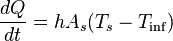
La transferencia de calor por convección se modela con la Ley del Enfriamiento de Newton:

Donde h es el coeficiente de conveccióncoeficiente de película), As es el área del cuerpo en contacto con el fluido, Ts es la temperatura en la superficie del cuerpo y es la temperatura del fluido lejos del cuerpo.

__________________
We must understand the things like are and not to try that they are as we want.
Reply
Power-User
Peru - Member - New Member Engineering Fields - Biomedical Engineering - New Member Popular Science - Genetics - New Member Fans of Old Computers - Commodore 64 - New Member

Join Date: Nov 2006
Location: Perú
Posts: 111
#4
In reply to #2

Re: formuala for calculating the flow rate (air) in forced convections

04/15/2007 1:37 PM

Wikipedia:

Convection is the internal movement of currents within fluids (i.e. liquids and gases). It cannot occur in solids due to the atoms not being able to flow freely. Convection may cause a related phenomenon called advection, in which mass or heat is transported by the currents or motion in the fluid. In the case where the advected substance is heat, the heat itself may cause fluid motion, so the problem of heat transport (and transport of other substances in the fluid due to it) may become quite complicated.

Differential heating of fluids may itself cause convection in a gravity field, due to variations in density due to a transfer of heat and subsequent fluid expansion, combined with differential buoyancy forces on the different parts of fluid which have differing densities. This type of purely heat-driven convection in gravity fields is sometimes referred to as "natural heat convection," in order to distinguish it from various types of forced heat convection (i.e., heat advection not due to buoyancy of heating). In forced heat convection, transfer of heat is due to movement in the fluid from forces other than heat, such as pumps or natural and artificially-driven mechanically-pushed fluid flows (i.e., flow from external motive forces, such as occurs in rivers or pumps). In addition, buoyancy forces in gravity fields which result from sources of density variations in fluids other than those produced by heat, such as variable composition (for example, salinity), are frequent convection causes.

Current movement during convection may be invisibly slow, or it may be as fast as a tornado or twister. Convection occurs in atmospheres, oceans, and planetary mantles.

Tomás

__________________
We must understand the things like are and not to try that they are as we want.
Reply
Guru

Join Date: Mar 2007
Location: City of Light
Posts: 3943
Good Answers: 183
#3

Re: formuala for calculating the flow rate (air) in forced convections

04/15/2007 3:20 AM

The same as for all convection heat transfer problems: P(thermic power in W)= α [convection coefficient depending on boundary conditions in W/K°m²]xConvection area(m²) x Δθ (temperature difference between fluid and wall in °K).

The only factor affected by the fluid velocity ( and thus flow) is "α". Depending on the heat transfer intensity you may choose your flow.

As a basic element as long as you move the fluid by any mean other than the density difference created by the heat exchange you face a forced convection. So your question, as you put it, has no precise answer. Forced convection is when a fan enen several meters from wall moves the flow of air (in your case) or when you blow a puff of air on a surface.

The best is you look for formulas giving the relationship between flow velocity and heat transfer intensity and make a choice. Do not neglect the power you should use to make the fluid move.

Reply
Commentator

Join Date: Mar 2007
Posts: 58
Good Answers: 1
#5

Re: formuala for calculating the flow rate (air) in forced convections

04/15/2007 2:13 PM

Please, clarify:

1. What is the "forced convections applications" in your meaning?

2. What is the force, which is forcing: mechanical, thermal, or ...?

3. "Flowrate of what? Air? Water? or What else?

Anyway expose it naturally if you want to get the answer.

apcco@verizon.net

Reply
Anonymous Poster
#6

Re: formuala for calculating the flow rate (air) in forced convections
04/15/2007 8:13 PM

its your you want values standard it visits my page www.geocities.com/edgarspe

in the link "VALORES MECANISMOS TRANS CALOR"

CHAU

Reply
Associate

Join Date: Jan 2007
Location: Los Angeles, California
Posts: 35
Good Answers: 3
#7

Re: formuala for calculating the flow rate (air) in forced convections

04/16/2007 12:19 PM

If the question involves heating, ventilating, or air conditioning, here are some rules-of-thumb: (1) For cooling with an air conditioner - 400 CFM (Cubic Feet per Minute) per ton of refrigeration, (2) For cooling with a heat pump - 450 CFM per ton of refrigeration, (3) For heating with a furnace - about 80% of the flow for cooling, but adjust the flow to maintain the manufacturers recommended temperature rise, (4) For ventilation only - follow local code, but it might be similar to to the previous values, (5) for outside air make-up, probably between 5 - 50% depending upon the application (School, office, restaurant, hospital, etc.)

If you want to know the formulas used to perform the calculations, then please re-state the question.

Reply
Reply to Forum Thread 7 comments
Copy to Clipboard

Users who posted comments:

Anonymous Poster (2); apcco (1); Gadget Guy (1); Grage Tesla (2); nick name (1)

Previous in Forum: Motor Sizing   Next in Forum: Regarding Fixture Designing
You might be interested in: Gas Flow Meters, Flow Meters, Turbine Flow Meters

Advertisement