Previous in Forum: A.C. Question   Next in Forum: Guideline for CT and PT Ratio Selection for an Energy Meter
Close
Close
Close
13 comments
Rate Comments: Nested
Guru
United States - Member - New Member

Join Date: Feb 2009
Location: Mojave Desert, Southern California
Posts: 515
Good Answers: 13

Electrical Code Question

05/04/2012 11:54 PM

Hi all,

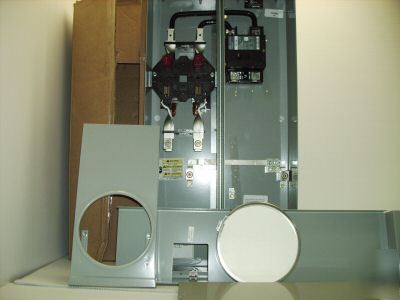
I'm moving my electrical meter to another location, while leaving the main panel attached to the house. The new panel that holds the new meter needs to be connected to back to the old panel and I'm having difficulty doing that as the new 200 amp panel just has a bus bar and a 200 amp breaker, (the main), I was going to just add a lug to each bolt off the main breaker attachment to the bus bar, but I'm told that it will void the UL listing. The other way to go was with a 225 amp circuit breaker sub-feed lug, (costs more than the panel). Any suggestions

Question 2, is there a distance that under ground electrical wiring has to be from ground rods, the only place to put the ground rods is back along the underground to the main panel and I need to know how close I can drive the rods to this buried wire.

Thanks All, Spacecannon

__________________
The person who wrote the above is not resposible for spelling, grammar or puncuation, ......
Register to Reply
Interested in this topic? By joining CR4 you can "subscribe" to
this discussion and receive notification when new comments are added.

Good Answers:

These comments received enough positive votes to make them "good answers".

"Almost" Good Answers:

Check out these comments that don't yet have enough votes to be "official" good answers and, if you agree with them, vote them!
Guru

Join Date: Mar 2007
Location: by the beach in Florida
Posts: 33392
Good Answers: 1817
#1

Re: Electrical code question

05/05/2012 1:38 AM

Well maybe I don't understand your tortured English, but it sounds like you're saying you have a meter can with no wire connections in it....which makes no sense at all....and the rest is well unrecognizable...If you have a 200A meter can with breaker, it should have wire lug connections in it, if you don't, then you got ripped off....

__________________
All living things seek to control their own destiny....this is the purpose of life
Register to Reply
Guru
United States - Member - New Member

Join Date: Feb 2009
Location: Mojave Desert, Southern California
Posts: 515
Good Answers: 13
#4
In reply to #1

Re: Electrical code question

05/05/2012 12:49 PM

Solar Eagle,

Oh come-on, when did engineers become english teachers.

I bought a standard 200amp panel with a bus bar instead of lugs, cause I need the bus bar to connect 2 breakers, one for the solar panels Im installing and one for the electrical outlet I need for power equipment.

So you are saying I need to buy a different panel?

__________________
The person who wrote the above is not resposible for spelling, grammar or puncuation, ......
Register to Reply
Guru

Join Date: Mar 2007
Location: by the beach in Florida
Posts: 33392
Good Answers: 1817
#5
In reply to #4

Re: Electrical code question

05/05/2012 1:34 PM

So far the only thing I know is that you have a 200A meter can with a busbar, some sort of main breaker, and no wiring connections, and you're asking how to hook the wiring up....In the picture I provided, you can see the lug connections are typically attached...Now if you have some some sort of special application piece of equipment, then it would appear to be either incomplete (missing parts) or unsuitable for this application....Now you say you want to use this panel as a grid tie in? and distribution? I must be missing something, how about a picture? and simple component drawing?

__________________
All living things seek to control their own destiny....this is the purpose of life
Register to Reply Score 1 for Good Answer
Guru

Join Date: Feb 2008
Location: East Tenneesse, USA
Posts: 685
Good Answers: 46
#2

Re: Electrical code question

05/05/2012 3:25 AM

Hello, Question one. The meter panel. The main lines come into and through the meter, then that feeds the main buss with the main breaker. You would then attach the wiring on the output of the breaker and then feed it to the other "old panel". Where the wiring from the "old meter" fed into the "old main breaker".

Now You will need to run a ground AND a neutral from the "new panel to the "old panel".

In the old panel you will NEED to separate the ground and neutral bus bars. As this "old panel" becomes a sub panel to the new one.

Question 2. Not exactly sure of the question so I will hazard a answer. (always get verified correct answers from a license professional) {this is from my experience}.

Install a new ground rod or rods [based on ground conduction of the dirt] at the new meter.(don't drive them through the buried cables). Ground rods need to be installed in undisturbed dirt/earth.

As in Q1, the ground and neutral are separated. YOU WILL NEED to disconnect the "old ground rod" from the "old panel" also. It is not needed any more.

You will need to move any other grounds ie: phone system, cable, satellite system, antenna system, gas service, water service etc... to the new ground rod. This will prevent/reduce stray ground loops "not good for people or equipment" .

Hope this gives you what you need.

Millage in your jurisdiction may vary. Check with codes or a license installer as they are the ones who will approve it or not. Do it right do it once.

Charles

__________________
Metal is the material, The forge is life, The anvil and hammer bring character and soul.
Register to Reply Score 1 for Good Answer
Guru
Engineering Fields - Electrical Engineering - Been there, done that. Engineering Fields - Control Engineering - New Member

Join Date: Dec 2008
Location: Long Island NY
Posts: 15600
Good Answers: 981
#3

Re: Electrical Code Question

05/05/2012 11:11 AM

It does not matter at all what we think will meet your local codes. What matters is what these people think. They likely will follow this code. To properly interpret these codes to meet the conditions at your location will require the license and certification found here. I know that you'd like to save some money by doing this yourself. Unless you're qualified to interpret these codes by having an electricians license or at least an electrical engineering degree, you will be putting yourself and anyone in your residence at risk.

__________________
"Don't disturb my circles." translation of Archimedes last words
Register to Reply
Guru

Join Date: Feb 2009
Location: West Coxsackie, NY
Posts: 533
Good Answers: 10
#6

Re: Electrical Code Question

05/06/2012 12:21 AM

Are you serious? You are or have moved your meter, the meter the electric company comes to read? Why would you do that? Are you also moving your underground feeder or overhead feeder? Thankfully you are NOT moving your service panel!

If you have opened the meter can, you have cut off the Electric Companies reg clip, If you did not fill out a disconnect/reconnect file and obtain a SR# you my friend are in violation of the Electric Company in my area anyways. They will NOT reconnect you and if You do it, you will be shut off when they find out. And will not be re-energized until you pass a full blown electrical inspection at your expense. And it is not a cheap ordeal with fines and all , in my area, your looking at $2500.00 easy+.

I don't know why you want to move your meter, you never specified a renovation which I have done before, only with the power companies blessing and all paperwork in order and all NEC codes followed.

__________________
"Real Bass Players" do not use picks
Register to Reply Score 1 for Off Topic
Guru

Join Date: Jul 2006
Location: Eastern Kansas USA
Posts: 1503
Good Answers: 128
#7

Re: Electrical Code Question

05/06/2012 1:04 AM

Spacecannon--

A more complete description of your plans will possibly net you an answer that is valid. From your second post and location, it sounds like you are hoping to incorporate solar PV into your energy mix. If so, you will have to either totally isolate the two sources so it is impossible to have them interconnected, or go through the process and expense of a grid-interactive system, in which excess power can be sold back to the grid.

A good answer told you that separation of the neutral and ground is required everywhere excepting in the panel that houses the main (service) disconnect. That is a code requirement. This separation includes feeders from your old main panel to the electric range and electric dryer (they were commonly fed with a 3-wire cable and allowed to have the frame bonded to the neutral, but this permission is not valid in your case).

Often, purchasing a main-lug panel and a main breaker to fit onto the bus bars in the panel is less expensive than the alternative of a subfeed lug kit. You can also find and buy panels with subfeed lugs already installed, but they are not common at the do-it-yourself stores.

You are allowed up to 10 feet from your meter inside the house to your main disconnect. If this allows you to use the new location and go directly to your old panel, then that is an option. However, the wires have to be protected from physical damage (conduit). If you want to go further, the wires have to be "outside" the structure, such as conduit encased in a specified amount of concrete or beneath a concrete slab 4" thick...

If your meter socket incorporates a main breaker, then the above advice needs to be modified. If your old service has a 200 amp bus, then you can feed it as a subfeed. However, if it is smaller, then you have to follow the rules for feeder taps--to be safe, you would want to start the feeder with a breaker sized for the panel being fed (such as 125 or 100 amps).

I've been doing this, with licenses, permits, inspections, etc. for almost 40 years, and I still occasionally make mistakes. You have many ways to approach this problem, and we aren't being told enough to help wade through the options. Please get competent advice and help, and don't end up becoming another funeral pyre.

--JMM

Register to Reply Score 1 for Good Answer
Guru

Join Date: Aug 2007
Location: London England.
Posts: 583
Good Answers: 10
#8

Re: Electrical Code Question

05/06/2012 4:04 AM

Surly the meter and cableing to the meter is company property and shouldnt be touched unless this is a secondry meter.

Bazzer

__________________
When I die I'd like to go peacefully in my sleep like my dad,not shouting and screaming like his passengers.
Register to Reply Score 1 for Off Topic
3
Guru

Join Date: Apr 2009
Location: USA, Florida
Posts: 1595
Good Answers: 125
#9

Re: Electrical Code Question

05/06/2012 11:12 AM

Dear Spacecannon: Don't be a loose Spacecannon.

1. If you are installing a grid tie solar system, you cannot use your current power company meter. You will need a "special" meter that allows reverse current flow when you overproduce for your home needs, thereby feeding power back to the grid.

2. You must use an inverter that has sensing technology that will shut off solar grid feed when the power grid goes down. This will keep your solar grid from "hotting up" the power grid and killing power restoration workers.

3. The power company will likely shut off your power permanently when they show up to provide your new meter, as they are not normally amused by cowboy power system design antics. They will likely restore power to your home once you provide proof of an engineering design review, permitted installation, and Certificate of Occupancy by local Building Officials.

No one here would discourage someone from doing a little sweat equity work to save some money and maybe learn a little on the way. Why not just mount your solar panels, dig the ditch for the underground wire, and hire an electrical contracting firm to permit this project and do the rest? Everybody's safe, your azz is not in jail, you save some dough.

Capiche ?

__________________
An obstacle is something you see when you take your eyes off the goal.
Register to Reply Good Answer (Score 3)
Guru
United States - Member - New Member Engineering Fields - Power Engineering - New Member

Join Date: Sep 2006
Location: California, USA, where the Godless live next door to God.
Posts: 4665
Good Answers: 804
#10

Re: Electrical Code Question

05/06/2012 11:41 AM

This entire thread sounds like a disaster waiting to happen! I foresee a utility lineman being electrocuted by this idiot's home grown kluge system, I will not participate as an accessory to that poor unfortunate soul's death.

__________________
** All I every really wanted to be, was... A LUMBERJACK!.**
Register to Reply Score 2 for Off Topic
Guru
United States - Member - New Member

Join Date: Feb 2009
Location: Mojave Desert, Southern California
Posts: 515
Good Answers: 13
#11

Re: Electrical Code Question

05/06/2012 2:14 PM

I really like CR4, but sometimes you guys read more into this than is said.

Ok

1) I could have explained more (my apploigies), but I thought it was self explanitory, Who said anything about not having permits or inspections?

2) However the critisizm without provocation or full knowledge is unwarrented.

3) Thanks for the suggestion about the special panel with the built in lugs and a bus bar. The fellow that made this suggestion obviously understood the question and is a good human being.

4) full explanation, ...

a) doing it with permits

b) have had utility companys blessing as long as I pass inspections, but their standard hand out plan-set for this kind of thing doesnt answer my questions and they are very hard to get a call back from, and the people you talk to are low level experience that only will verify their existing planset handouts.

c) Im a General contractor, but no I dont have the NEC memorized.

d) The existing power line comes in via overhead then goes under ground for about 50', to our existing 200amp panel were the current meter is.

e) The new panel location is 15' east off of the existing overhead power pole.

f) The power line will run underground from the existing power pole to the new panel, then under ground to the old panel.

g) I install the the new panel in the new location on a treated plywood board on posts as per utility specs.

h) I install 2 ground rods, 6 feet apart and 6 feet from the new panel location.

i) The utility company attaches the power line to the new panel and installs the new meter after it all passes inspection.

j) my question was about methods of attaching my lines to the new panel, use Lugs or a 200amp breaker with a subfeed lug, or Im told now to buy a panel with lugs and a busbar already built in.

k) my other question was about distance of separation from undergound powerlines and my new ground rods,... any answers?

l) The solar comes in the future and Iam trying to plan for it, Im told all I need is a place to feed in the solar AC lines to the panel, a bus bar connection with a breaker. There will be manuel disconnects required, but they may allow the main breaker on the new panel to function as that.

Now is everyone sufficiently informed or just alienated and ticked-off?

Thanks and GAs to all reasonable people, Spacecannon

__________________
The person who wrote the above is not resposible for spelling, grammar or puncuation, ......
Register to Reply
Guru

Join Date: Jun 2007
Posts: 1035
Good Answers: 40
#12
In reply to #11

Re: Electrical Code Question

05/07/2012 10:15 AM

Let's see if we're all on the same page:
a) being done with permits ~ "ok"
b) have utility company's blessing ~ "ok"
c) GC / General Contractor "in control" ~ ("check")
d) existing power line comes in via overhead then goes underground for about 50', to existing 200A panel (pictured~"D").
e) The new panel location is 15' east off of the existing overhead power pole(pictured~"E").
f) The power line will run underground from the existing power pole to the new panel, then under ground to the old panel (pictured).
g) I install the the new panel in the new location on a treated plywood board on posts as per utility specs ("understood").
h) I install 2 ground rods, 6 feet apart and 6 feet from the new panel location (pictured; 1&2).
i) The utility company attaches the power line to the new panel and installs the new meter after it all passes inspection (red line "i").

Now as for question "j" ~
"I'm told now to buy a panel with lugs and a busbar already built in" (sounds like good advice).

As for question "k" ~
(about distance of separation from undergound powerlines and my new ground rods):
Others have suggested getting a licensed electrician involved. From personal experience, this will only confuse matters more.
When I 'complained' about some the spa belonging to some friends NOT having the equipment properly grounded (and I mean no ground whatsoever, they called a local electrician to check it out. He assured them: "No need to worry. See this (white) wire in your sub-panel for the equipment here...it runs all the way back to your main panel, where it attaches to all the OTHER white wires AND grounds all on the same bar. They're ALL grounded equally! You are as safe as you can get."
So, make certain that there IS a safe distance of separation between undergound powerlines and your new ground rods.

With regard to "l" ~
l) "The solar comes in the future and I'm trying to plan for it" (planning is good). "I'm told all I need is a place to feed in the solar AC lines to the panel, a bus bar connection with a breaker. There will be manual disconnects required, but (the main breaker on the new panel will serve that function)."
Clearly this is planning for WAY down the road. Simply connect the a.c. output from your 35th generation a.c. solar panels as per the photo in Post #1 above, and you are set.

Next!

Register to Reply Score 1 for Good Answer
Guru
United States - Member - New Member

Join Date: Feb 2009
Location: Mojave Desert, Southern California
Posts: 515
Good Answers: 13
#13
In reply to #12

Re: Electrical Code Question

05/07/2012 1:16 PM

ndt-tom,

Thanks, GA, thats all I wanted to know.

Later dudes, Spacecannon

__________________
The person who wrote the above is not resposible for spelling, grammar or puncuation, ......
Register to Reply
Register to Reply 13 comments

Good Answers:

These comments received enough positive votes to make them "good answers".

"Almost" Good Answers:

Check out these comments that don't yet have enough votes to be "official" good answers and, if you agree with them, vote them!
Copy to Clipboard

Users who posted comments:

Bazzer Englander (1); Jimh77 (1); jmueller (1); JRaef (1); metalSmiths (1); ndt-tom (1); redfred (1); SolarEagle (2); spacecannon (3); WJMFIRE (1)

Previous in Forum: A.C. Question   Next in Forum: Guideline for CT and PT Ratio Selection for an Energy Meter

Advertisement