Previous in Forum: Frame Rack   Next in Forum: HVAC Make Up Air (Repair Garage)
Close
Close
Close
13 comments
Rate Comments: Nested
Guru
Hobbies - Target Shooting - New Member Hobbies - Fishing - New Member

Join Date: Jan 2006
Posts: 1059
Good Answers: 12

The OPOC Engine - The Next Big Thing?

07/13/2012 7:36 PM

When you have Bill Gates and Khosla Corporation as backers you have to be good. What do you think of this concept?http://www.ecomotors.com/ Pros and cons.

Register to Reply
Interested in this topic? By joining CR4 you can "subscribe" to
this discussion and receive notification when new comments are added.
Guru

Join Date: Jun 2009
Location: South of Minot North Dakota
Posts: 8376
Good Answers: 775
#1

Re: The OPOC Engine. The Next Big Thing?

07/13/2012 10:16 PM

If it comes out anywhere near the efficiency of Microsoft's typical software designs after its built it may be the first engine to ever break into negative fuel economy number levels!

Just because it has a some rich people backing it still does not mean its a great idea! Its just an expensive one.

Register to Reply
Guru
Hobbies - Musician - New Member United Kingdom - Member - New Member Engineering Fields - Mechanical Engineering - New Member Engineering Fields - Transportation Engineering - New Member

Join Date: Mar 2007
Location: England
Posts: 951
Good Answers: 48
#2

Re: The OPOC Engine. The Next Big Thing?

07/13/2012 10:40 PM

Forget about who your backers are. If they are rich, and have money to throw away, and know nothing of the particular industry/technology, what does it mean?

Revolutionary? (Unfortunate pun!) When I did my thesis on internal combustion engines 30-odd years ago, opposed piston designs were already very old-hat. This solution is at best clumsy and inelegant for minimal (if any) gain, and no figures or direct comparisons are given on their website. If you compare it with typically inefficient US diesels, or the original VW boxer engine (of which I am a huge fan - I have one on my driveway) from 75-odd years ago, you might almost have a case. But I'm sure there are so many better options to pursue.

I am far from convinced.

Register to Reply
Guru
Technical Fields - Technical Writing - New Member Engineering Fields - Piping Design Engineering - New Member

Join Date: May 2009
Location: Richland, WA, USA
Posts: 21017
Good Answers: 795
#3

Re: The OPOC Engine. The Next Big Thing?

07/14/2012 1:15 AM

It looks like incremental gains at best; no thermodynamic breakthroughs.

__________________
In vino veritas; in cervisia carmen; in aqua E. coli.
Register to Reply
Guru
Fans of Old Computers - ZX-81 - New Member

Join Date: Feb 2011
Location: 18N 65W o
Posts: 1003
Good Answers: 28
#4

Re: The OPOC Engine. The Next Big Thing?

07/14/2012 1:12 PM

Ron:

This is the way it works. BG and company have determined this concept is going nowhere and they have not gotten losing their shirts will not get their projected returns. So they make up a press release to generate interest, maybe even get a grant from the DOE or DOT, drive up the stock and bail out.

Register to Reply Off Topic (Score 4)
Guru
Hobbies - Target Shooting - New Member Hobbies - Fishing - New Member

Join Date: Jan 2006
Posts: 1059
Good Answers: 12
#5
In reply to #4

Re: The OPOC Engine. The Next Big Thing?

07/14/2012 4:31 PM

I have seen it. I worked for fifteen years for a furniture company. RB Furniture. They had twenty year leasebacks on about 45 stores. When the leases were starting to run out, they started pumping up the stock. A few years later they started a lot of funny business. Projected a lot more growth etc. Shortly after that they went out of business making millions on their stock holdings. I saw it coming, because I had read the terms of the leasebacks.

I don't think this is true in this case though. Khosla has been stung before, and he is a shrewd man. Gates is no dummy. Khosla started Tata Motors of India, which is a very successful company.

Register to Reply Off Topic (Score 5)
Participant

Join Date: Jul 2012
Posts: 3
#6

Re: The OPOC Engine - The Next Big Thing?

07/16/2012 3:29 AM

When you have the PatOP opposed piston engine:


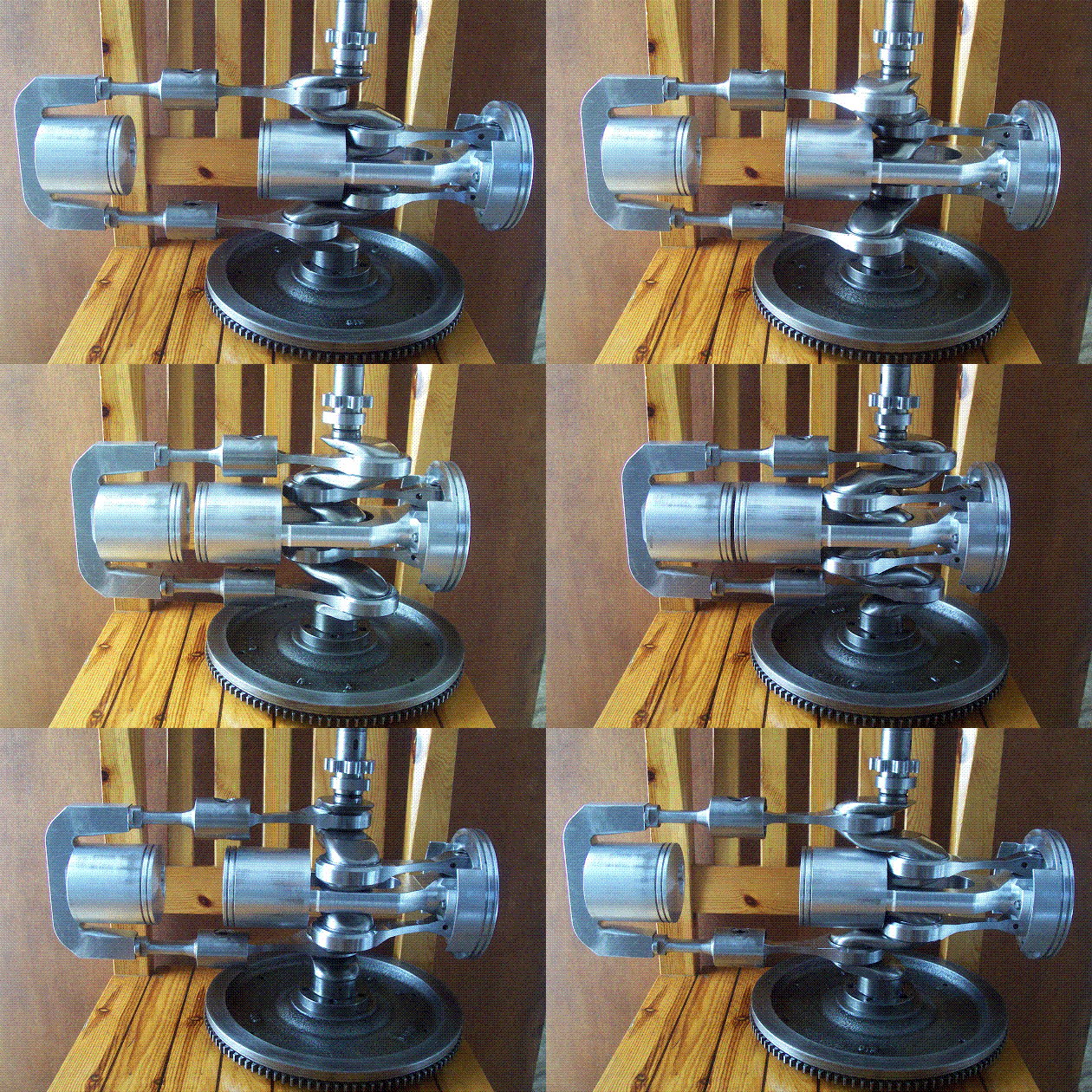
(details and videos of the working prototype at http://www.pattakon.com/pattakonPatOP.htm )

what do you think of the OPOC engine of Bill Gates / Khosla / EcoMotors ?

Thanks
Manousos Pattakos

Register to Reply
Guru
Hobbies - Musician - New Member United Kingdom - Member - New Member Engineering Fields - Mechanical Engineering - New Member Engineering Fields - Transportation Engineering - New Member

Join Date: Mar 2007
Location: England
Posts: 951
Good Answers: 48
#7
In reply to #6

Re: The OPOC Engine - The Next Big Thing?

07/16/2012 5:11 AM

This looks far more interesting, and more worthy of investment.

Register to Reply
Guru
Hobbies - RC Aircraft - New Member Hobbies - Automotive Performance - New Member Hobbies - DIY Welding - New Member

Join Date: Jul 2007
Location: Fort Lauderdale Florida
Posts: 5708
Good Answers: 123
#8

Re: The OPOC Engine - The Next Big Thing?

07/16/2012 9:18 AM

What you have here is some very heavy piston Assemblies that must change direction every revolution. And you have added the inherent breathing restrictions and emission issues of a two cycle engine.

Navistar and Ford have made diesel engines that use the energy stored in high pressure engine oil to operate the fuel injectors. Using computers to decide when, how far, and how fast to fire the injector has yielded good power and emission levels compared to mechanically driven injectors.

They had been working on using this same design to open intake and exhaust valves. Today's current engines use variable camshaft timing to improve efficiency. With the Navistar design, you get cylinders on demand, plus the optimum camshaft profile for the exact speed, load, and other conditions the engine is at.

__________________
Bob
Register to Reply
Participant

Join Date: Jul 2012
Posts: 3
#9
In reply to #8

Re: The OPOC Engine - The Next Big Thing?

07/17/2012 1:33 AM

"What you have here is some very heavy piston Assemblies that must change direction every revolution."

The PatOP has two pistons, one near (or "around") the crankshaft and another away from the crankshaft. The second one is as heavy as the outer piston of the OPOC engine that connects to the crankshaft by a pair of very long connecting rods. In the near to the crankshaft piston of the PatOP it has been added the big diameter piston of the scavenging pump to make the mass of this piston assembly equal to the mass of the other piston of the PatOP. This allows the perfect balance of the inertia forces without balance webs on the crankshaft and without external balancing shafts. See the vibration-free operation of the prototype running on Diesel fuel free on a desk.

With the rev limit at 6500 rpm (mean piston speed near 14 m/sec for the 64+64=128mm stroke of the prototype), which is a high rev limit for a direct injection Diesel engine, the maximum value of the inertia force is less than half than the maximum value of the combustion force on each piston. At normal revs, the peak inertia force is one tenth of the peak combustion force. So, no the "heavy" pistons is not an issue.

The balance program at http://www.pattakon.com/pattakonEduc.htm helps in calculating the inertia forces.

Besides, the total inertia and combustion force on the two main bearings of the crankshaft is permanently zero, reducing the friction. Theoretically you can keep in place the crankshaft by keeping its main bearings by your hands during operation.


"And you have added the inherent breathing restrictions and emission issues of a two cycle engine."

Look more carefully to see how the lubrication, which is the big issue of the 2-stroke Diesel engines, is solved in the PatOP. The thrust loads are taken away from the hot cylinder wall and away from the ports (see where the wrist pins are). Near the wrist pins of the pistons plenty of lube can be used. So, the cylinder of the PatOP, which is a crosshead engine, needs a several times lower quantity of lube on the cylinder liner for the piston rings (like the Opposed Piston engine of Achates Power for which they claim 0.1 gr/KWh specific lube consumption).
Try to figure out how the lubrication of the inner - exhaust piston of the OPOC engine of EcoMotors is realized and how much is its specific lube consumption.

Minimizing the quantity of oil that arrives into the combustion chamber, the emissions drop to the level of the 4-stroke engines (see the http://www.pattakon.com/tempman/LubricationParticulateEmissionDiesel.pdf analysis of MIT).

If by "breathing restrictions" of the two stroke engines you mean the "peaky" volumetric efficiency that gives picky torque curve, the volumetric scavenging pump of the PatOP give as wide rev range as the 4-strokes.

The additional time (20% more than the OPOC and some 35% more than the conventional Diesel) the pistons of the PatOP remain near the combustion dead center (see how at http://www.pattakon.com/pattakonOPRE2.htm ) is another advantage because this way the peak power is further increased at high revs, while the fuel efficiency increases at specific revs. A lightweight 2-stoke di Diesel (the 635cc prototype weighs 20 Kp) revving at 6000 rpm and having flat torque curve can compete any 4-stroke engine (spark or compression ignition).


"Navistar and Ford have made diesel engines that use the energy stored in high pressure engine oil to operate the fuel injectors. Using computers to decide when, how far, and how fast to fire the injector has yielded good power and emission levels compared to mechanically driven injectors.

They had been working on using this same design to open intake and exhaust valves. Today's current engines use variable camshaft timing to improve efficiency. With the Navistar design, you get cylinders on demand, plus the optimum camshaft profile for the exact speed, load, and other conditions the engine is at."

Regarding the Variable Valve Actuation systems you mention, please take a look at www.pattakon.com to see some of the best VVAs. For instance, the VVA roller version prototype (installed on a 1600 cc 4 cylinder engine)

with valve lift varied continuously from zero to 12mm operates reliably to 9000 rpm providing flat torque curve (see the video and the plots at http://www.pattakon.com/pattakonRoller.htm ). The same prototype engine idles at 330 rpm. And it is a throttle-less engine.

The DVVA at http://www.pattakon.com/pattakonDesmo.htm is even better (independently variable lift and duration, rid of valve springs).

Thanks

Manousos Pattakos

Register to Reply
Guru
Hobbies - RC Aircraft - New Member Hobbies - Automotive Performance - New Member Hobbies - DIY Welding - New Member

Join Date: Jul 2007
Location: Fort Lauderdale Florida
Posts: 5708
Good Answers: 123
#10
In reply to #9

Re: The OPOC Engine - The Next Big Thing?

07/17/2012 11:05 AM

The balance of the engine was not what I was objecting to. It is the weight of the pistons, connecting rod assemblies, and counterweight that must start and stop at the end of each stroke that seems to me to be heavy. A quick look at piston weights alone shows a Yamaha piston used to go from 650 to 750 cc weighs 455 grams. Times two (because it is twin cylinder) shows 910 grams of piston weight.

Ford's 302 engine has pistons available for it that weigh 405 to 500 grams each. And each cylinder of the engine is 625 cc.

The Honda 650 engine has pistons available in 334,348 and 404 gram weights. Again two would be required to approach the displacement of your engine.

Do you know the weight of the pistons used in this engine?

Connecting rod weight would have to be heavier in the Pat Op engine as well.

The images shown did not show porting all around the cylinder, so I will Have to rethink the advantages and disadvantages of conventional automotive cylinder head design versus the Pat OP engine design.

I for one, am not ready to declare it the salvation of the ICE.

__________________
Bob
Register to Reply
Participant

Join Date: Jul 2012
Posts: 3
#11
In reply to #10

Re: The OPOC Engine - The Next Big Thing?

07/18/2012 1:06 AM

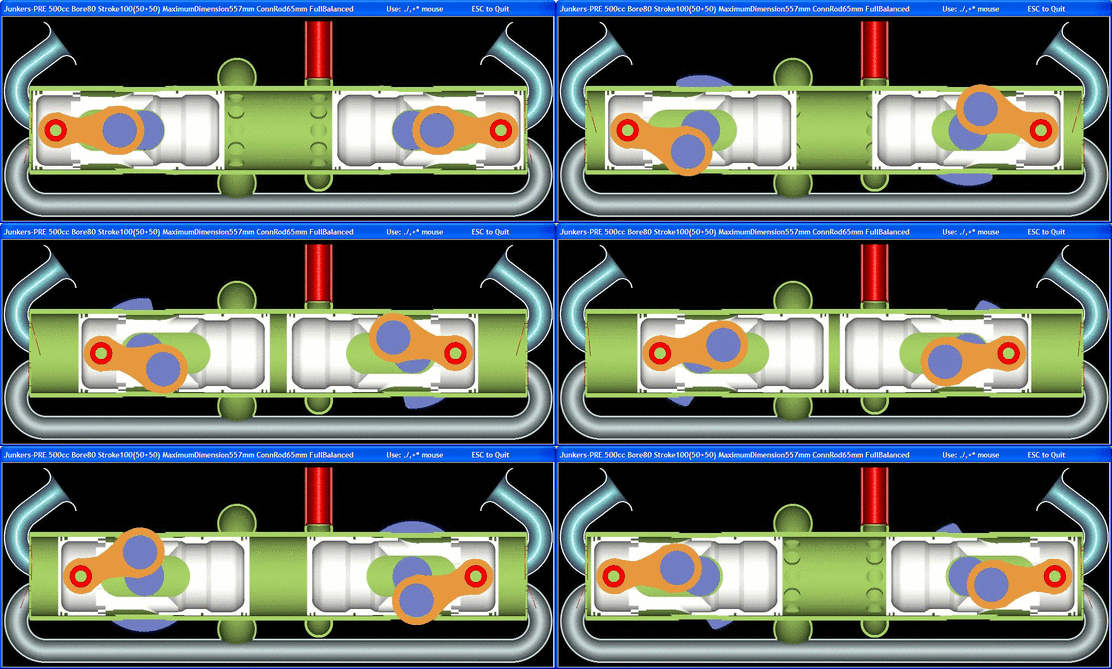
Compare the OPRE architecture (which is the two crankshaft version of the PatOP) at http://www.pattakon.com/pattakonOPRE.htm :


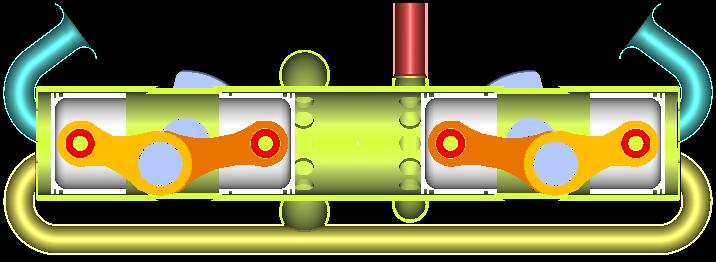
with the "conventional" design below, wherein the combustion piston is connected to the crankshaft by its own con-rod and moves independently from the scavenge pump piston:

In the "conventional case" the weight of each piston is conventional, as well as the weight of each connecting rod. Throw away the inner (brown) connecting rod and connect the left two pistons to form a single one, and similarly the two right pistons. This is the OPRE / PatOP design. Which case is regarded as heavier?

The connecting rods of the PatOP and OPRE engines are pulling-rods or "pullrods" because they are significantly loaded only in tension (combustion and inertia loads), and this allows smaller weight. They tend to straighten by the loads imposed. In comparison, the conventional connecting rods are pushrods and tend to bend by the applied combustion loads.

The porting of the PatOP prototype is all around the cylinder. See the photos of the block.

The discussion is about the OPOC engine of Bill Gates / EcoMotors.
Does anybody see advantages over the PatOP?

Thanks
Manousos Pattakos

Register to Reply
Active Contributor

Join Date: Apr 2008
Location: Valsad, Gujarat, India
Posts: 15
#12
In reply to #9

Re: The OPOC Engine - The Next Big Thing?

07/26/2015 11:39 AM

We should have start to develop new engine, whose piston moving round. I imagine, how to fire ?, how to compress air?.........I determine designed of new ENGINE. If you want any help, you may contact /inform me.

__________________
My aim is findout the new technology for energy where no fuel, required. ,
Register to Reply Score 1 for Off Topic
Guru
Hobbies - RC Aircraft - New Member Hobbies - Automotive Performance - New Member Hobbies - DIY Welding - New Member

Join Date: Jul 2007
Location: Fort Lauderdale Florida
Posts: 5708
Good Answers: 123
#13
In reply to #12

Re: The OPOC Engine - The Next Big Thing?

07/31/2015 1:41 AM

Oh great! Can I send you some money to help you get started?

__________________
Bob
Register to Reply
Register to Reply 13 comments
Copy to Clipboard

Users who posted comments:

B. R. PATEL (1); bob c (3); Holzfeller (2); JWthetech (1); manousos (3); ronwagn (1); tcmtech (1); Tornado (1)

Previous in Forum: Frame Rack   Next in Forum: HVAC Make Up Air (Repair Garage)

Advertisement