Previous in Forum: Sensor Design   Next in Forum: Are CFL More Efficient Than Normal Tube Lights?
Close
Close
Close
13 comments
Rating: Comments: Nested
Participant

Join Date: Nov 2014
Posts: 2

RCB Tripping

11/13/2014 4:36 AM

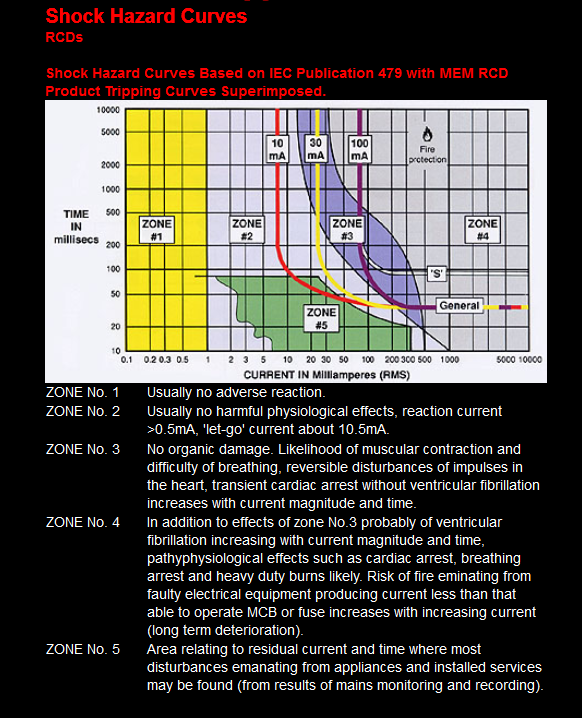
I have a 30milliamp RCB on the main into my house. It works perfectly when tripped either with test button or testing through a lamp with live to earth. My problem is with lightening as the trip nearly always trips, hence problems with freezer, etc. I could as you say "be living on the edge with earth leakage" Would fitting a 100milliamp trip be the answer as all dangerous circuits in the house,i.e.. showers,etc. are also on 30 milliamp breakers. I would appreciate your opinion. I have worked as a marine engineer all my life so do understand technical details to a degree. Regards, Martin Lewis, Chief Eng.(retired)

Register to Reply
Interested in this topic? By joining CR4 you can "subscribe" to
this discussion and receive notification when new comments are added.

Good Answers:

These comments received enough positive votes to make them "good answers".

"Almost" Good Answers:

Check out these comments that don't yet have enough votes to be "official" good answers and, if you agree with them, vote them!
Guru

Join Date: Jul 2007
Location: Commissariat de Police, Nouvions, occupied France, 1942.
Posts: 2599
Good Answers: 77
#1

Re: RCB Tripping

11/13/2014 6:39 AM

You just need to follow your local electrical code, Mildred. Unfortunately, as you don't say which country you're in, the right one to follow is not known at the moment.

__________________
Good moaning!
Register to Reply Score 1 for Off Topic
Participant

Join Date: Nov 2014
Posts: 2
#4
In reply to #1

Re: RCB Tripping

11/13/2014 8:26 AM

This was a serious question so no help moaning about it.Lewmart

Register to Reply
Guru

Join Date: Jul 2007
Location: Commissariat de Police, Nouvions, occupied France, 1942.
Posts: 2599
Good Answers: 77
#5
In reply to #4

Re: RCB Tripping

11/13/2014 8:59 AM

Then seriously hire someone who knows what to do.

__________________
Good moaning!
Register to Reply Score 2 for Off Topic
Power-User

Join Date: Oct 2014
Posts: 143
Good Answers: 4
#2

Re: RCB Tripping

11/13/2014 7:03 AM

30 mA for a whole house doesn't make sense.

Ideally there should be one 30 mA ELCB, RCB, RCD or however you'll call it per circuit (I've that in my house, either 1-phase combined or a 3-phase circuit breaker followed by its 3LN RCD as 3LN combined ones didn't exist at that time).

In some cases local codes require less than 30 mA but where it is not the case I'd recommend to only go with 30 mA. Nominal fault currents above 30 mA are not considered as protection for persons and below 30 mA you increase the risk of suprious trip. Remember that per specs a 30 mA RCD can already trip at just above 15 mA,

In cases of spurious trip problems you may use slightly delayed devices designed for selective schemes but they're more expensive. Also good devices should be protected against some level of line capacitance.

In any case check your local codes.

Register to Reply
3
Guru

Join Date: Mar 2007
Location: by the beach in Florida
Posts: 33392
Good Answers: 1817
#3

Re: RCB Tripping

11/13/2014 7:34 AM

Yes 30ma on all dangerous circuits with 100ma for all others seems appropriate, determined in the absence of codes....

"

Whole House RCD

This is a deprecated way of installing an RCD such that a single low trip threshold device (typically 30mA) protects all the circuits in a property. While counter to the advice given in the present wiring regulations. installations of this type are still commonly found. Whole house RCDs are very vulnerable to nuisance trips, and any such trips remove all power to the property.

Wiring faults

FaultMechanism
Neutral to Earth shortsA particularly problematic fault is a short between neutral and earth on a circuit. Since Neutral and earth are nominally going to be at a similar potential (especially in buildings with

TN-C-S / PME earthing (see Earthing Arrangements)). You can arrive at a situation where the current flow between neutral and earth is lower than the trip threshold of the RCD some of the time, however once the neutral current reaches a high enough level, its potential will be "pulled" away from that of the earth, and you get increased leakage current flow which may cause a trip. Needless to say this threshold will often be reached during transient current peaks caused by equipment being switched on or off.

Insulation breakdown or damageAs

cables and wires age, their insulation can become less effective. This is especially true if you live in an old property that still has rubber insulated cables. Humidity will also reduce insulation effectiveness.

http://wiki.diyfaq.org.uk/index.php?title=RCD

__________________
All living things seek to control their own destiny....this is the purpose of life
Register to Reply Good Answer (Score 3)
Guru
New Zealand - Member - Kiwi Popular Science - Weaponology - New Member Engineering Fields - Power Engineering - New Member Engineering Fields - Electrical Engineering - New Member

Join Date: Sep 2006
Location: Auckland, New Zealand
Posts: 8777
Good Answers: 376
#6

Re: RCB Tripping

11/13/2014 1:56 PM

This all sounds wrong, but again we don't know what country you are in and hence what local codes apply. Down here you don't have a 30mA RCB as the main protection you have these as the sub circuit protection.

Changing the main RCB to 100mA may not be legal, check your local electrical codes for more details, or if you want to be cheap let us know where you live and one of us may whip out our copy of the relevant local codes and offer some country-specific advice.

__________________
jack of all trades
Register to Reply
Power-User
New Zealand - Member - Kiwi

Join Date: Oct 2007
Location: Christchurch, New Zealand
Posts: 328
Good Answers: 29
#7

Re: RCB Tripping

11/13/2014 2:10 PM

It is sheer folly of the cheap-and-nasty kind to put a single 30mA on the main of a house. You will be constantly plagued by nuisance trips of the kind described.

It is better by far to at least break up the circuits into two or more groups and protect each group with a RCD. This costs more but means that nuisance trips only take out a portion of the house.

Best is to use RCBOs, one per circuit, instead of the MCBs fitted. You can now get 2-pole RCBOs that are the same width as a 1P MCB which makes finding space for them a lot easier. This is the most costly option, but it minimises the effect of nuisance tripping, and distributes the residual leakage current of the installation amongst more 30mA devices so making nuisance trips less likely.

If you have an RCD tester that performs the 'ramp test' which measures the amount of leakage current that must be injected to make the RCD trip, then it is a basic electrician skill to use this to track down the biggest sources in earth standing leakage current present in your installation. It seems quite likely that what you have is perhaps 15mA of installation leakage, your RCD actually trips at 20mA (yes, they all do that sir), and so any event which produces more than an additional 5mA will trip the RCD. So by hunting down the sources of the standing leakage current, you may be able to get a bigger margin against nuisance trips. It will most likely prove easier to add more RCDs though.

__________________
paulusgnome
Register to Reply Score 1 for Good Answer
Member

Join Date: Feb 2014
Posts: 8
#10
In reply to #7

Re: RCB Tripping

11/14/2014 1:50 AM

"...It is sheer folly of the cheap-and-nasty kind to put a single 30mA on the main of a house. You will be constantly plagued by nuisance trips of the kind described...."

"...30 mA for a whole house doesn't make sense..."

Shouldn't it depend on how big the house is? Where I live, everyone is on one RCD per house, when the incoming is a single phase 65A. Don't hear of tripping except only sometimes during a really really huge lightning strike that also triggers the burglar alarm in nearly every house and car and makes every child wail.

Register to Reply
Guru

Join Date: Dec 2010
Location: 1° North Singapore
Posts: 568
Good Answers: 17
#8

Re: RCB Tripping

11/13/2014 7:56 PM

I had the same problem before.

My deduction (with some help from CR4 friends) is this: Your home wiring and appliances insulation will degrade over time, especially heating elements. When lighting occurs, high voltage spike is generated and enter your house wiring. Due to these spikes, the leakage current exceed the threshold of tripping current and cause ELCB to trip.

Possible solution: Fix a voltage transient/surge/ spike suppressor at your house distribution board (DB) , i.e, the entry point of the mains supply.

Most MCB manufacturers have it. It is fixed at the DB DN rail. Try it, please PM me the result. I must admit I have not got down to doing myself.

__________________
Sharing knowledge is one thing that defies basic arithmetic logic --- the more you share, the more you get!
Register to Reply
Member

Join Date: Feb 2014
Posts: 8
#9

Re: RCB Tripping

11/14/2014 1:41 AM

"...My problem is with lightening as the trip nearly always trips..."

I assume the above reads as: when there is lightning, the RCD is likely to trip. If this is the case, the cause is a poor ground. I have been in situations like this before and the solution was to take serious steps to improve the earthing, going so far as to bury a iron spike in a hole filled with copper sulfate.

Register to Reply Score 1 for Good Answer
2
Power-User

Join Date: Jun 2012
Posts: 123
Good Answers: 7
#11

Re: RCB Tripping

11/14/2014 7:20 AM

Martin, replace it with one that has a built-in recloser mechanism. The automatic resetting function automatically recloses the earth leakage protection device after clearance of the fault.

Auto-reset RCD

These aren't cheap, but the cost of a freezer full of frozen fillet mignon would more than cover the investment.

Regards,

Zvi

Register to Reply Good Answer (Score 2)
Guru

Join Date: Oct 2012
Location: 100 miles North from the World Center
Posts: 879
Good Answers: 42
#12

Re: RCB Tripping

11/17/2014 6:58 AM

In my opinion 30 mA is good. I came across -no once-a similar problem. A not well closed outside cable junction box may facilitate water penetration-for instance. A flexible cord receptacle may reduce the insulation level. For a 120 V- live to ground- 2000 ohm insulation resistance presents 60 mA leakage current. It is difficult indeed to find the location of the damaged insulation but no other solution it is available. By the way, I agree with Zvi. It seems to be a solution.

__________________
Julius
Register to Reply
Power-User

Join Date: Oct 2014
Posts: 143
Good Answers: 4
#13

Re: RCB Tripping

11/17/2014 8:23 AM

Time-Selective RCD are less expensive than the auto-reclosers. They are insensitive to short disturbations which allows a higher immunity about transient faults (up to about 100-150 ms IIRC).

In my house I've each circuit protected by an individual 30 mA standard (though with the usual diodes against capacitive nuisance trips) RCD since over 20 years and never had any single spurious trip during thunderstorms and the only trips were true insulation faults, mostly heating elements. Nor had any single Test (button) failure but the devices are from CMC (Swiss made, now belonging to ABB).

Portable electronic RCD are way less reliable but they aren't allowed for critical loads because they trip on each power failure (as test-function).

Register to Reply
Register to Reply 13 comments

Good Answers:

These comments received enough positive votes to make them "good answers".

"Almost" Good Answers:

Check out these comments that don't yet have enough votes to be "official" good answers and, if you agree with them, vote them!
Copy to Clipboard

Users who posted comments:

7anoter4 (1); bravo88 (1); Crabtree (2); Heng (2); jack of all trades (1); lewmart (1); Paulusgnome (1); Plimos (2); SolarEagle (1); Zvi (1)

Previous in Forum: Sensor Design   Next in Forum: Are CFL More Efficient Than Normal Tube Lights?

Advertisement