Engineering News Blog

Engineering News

Latest news of interest to engineers. Sourced from GlobalSpec's Engineering News

Previous in Blog: Tooth Tunes   Next in Blog: Scientists Consider Burying CO2 in Cold Storage
Close
Close
Close
3 comments
Rate Comments: Nested

Telescope Nears Completion

Posted February 08, 2007 11:30 AM

From BBC News | Technology | World Edition:

A giant mirror that will fly on the James Webb Space Telescope (JWST) - Nasa's next space observatory - is a step closer to completion. Engineers have finished making the 18 hexagonal elements that will come together to form the telescope's 6.6m primary mirror. The size of a mirror determines how much light a telescope can collect, and therefore how much detail it can see. JWST is seen as the heir to the hugely successful Hubble Space Telescope. JWST will study every phase in the history of our Universe. Its large primary mirror will help it "see" further into the cosmos than other telescopes, to detect some of the first stars to emerge in the Universe. JWST could even shed light on the origins of life in other planetary systems. The orbiting observatory is due to launch in 2013 on an Ariane 5 rocket from Kourou in French Guiana.

Read the whole article

Reply

Interested in this topic? By joining CR4 you can "subscribe" to
this discussion and receive notification when new comments are added.
Guru

Join Date: Sep 2006
Posts: 4513
Good Answers: 88
#1

Re: Telescope Nears Completion

02/09/2007 11:18 AM

"The size of a mirror determines how much light a telescope can collect, and therefore how much detail it can see."

-----

The size of the telescope mirror in comparison to the wavelength of the light it collects determines the ultimate resolution of the instrument, but the resolution does not depend at all on how much light the telescope can collect. Rather, a larger mirror can see more detail AND a larger mirror collects more light. They are distinctly different properties of the instrument which simply happen to be both related to the mirror size but not to each other.

-e

Reply
Guru

Join Date: Sep 2006
Posts: 4513
Good Answers: 88
#2

Re: Telescope Nears Completion

02/09/2007 12:01 PM

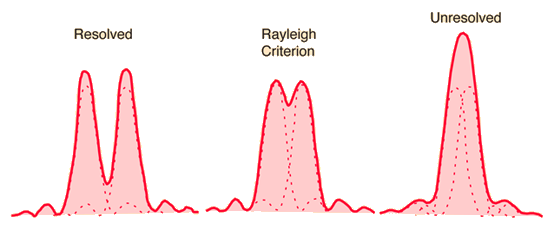
The Rayleigh criterion is the generally accepted criterion for the minimum resolvable detail - the imaging process is said to be diffraction-limited when the first diffraction minimum of the image of one source point coincides with the maximum of another.

Single-slit resolution: sinθR = λ/d, and

Circular aperture resolution: sinθR = 1.22 λ/d,

where,

θR = angular resolution, in radians
λ = wavelength, in meters

and

d = size of aperture, in meters.

If all parts of an imaging system are considered to be perfect, then the resolution of any imaging process will be limited by diffraction. Considering the single slit expression above, then when the wavelength is equal to the slit width, the angle for the first diffraction minimum is 90°. This means that the wave is spread all the way to the plane of the slit and will not contain resolvable information about the source of the wave. This leads to the simplified statement that the limit of resolution of any imaging process is going to be on the order of the wavelength of the wave used to image it.

The mirror of the JWST can be considered a circular aperture of 6.6 meters diameter. Consequently, the telescope's ideal resolution in greenish light (535 nm) is:

θR = sin-1(1.22 λ/d), or

θR = sin-1(1.22 * 535e-9/6.6)

θR = 9.9e-8 radians, or

5.7e-6 degrees.

Roughly, this means the telescope can just resolve the width of a dime (again, in greenish light) 182.0 km away. About 113.1 miles.

Not bad.

My eyesight used to be that good. Now I wear glasses.

-e

Reply
Guru

Join Date: Sep 2006
Posts: 4513
Good Answers: 88
#3

Re: Telescope Nears Completion

02/09/2007 12:21 PM

"The orbiting observatory is due to launch in 2013 on an Ariane 5 rocket from Kourou in French Guiana."

-----

Interesting that NASA no longer has the launch vehicles it needs to put something like this in orbit.

But we have the shuttle and the ISS. And King George says we're gonna go to Mars.

Also on a (French) Ariane rocket?

-e

Reply
Reply to Blog Entry 3 comments

Previous in Blog: Tooth Tunes   Next in Blog: Scientists Consider Burying CO2 in Cold Storage
You might be interested in: Mirror Mounts, Space Heaters and Room Heaters

Advertisement