Science fiction movies try to startle and surprise us,
offering seemingly impossible scenarios such as giant mutated octopi fighting mega
sharks, or the oh-so popular zombie invasions. What most people don't
realize is that the natural world around them can be so much more surreal and
frightening than most of the Hollywood films they've seen.
Enter the Zombie Ant
Deep in the tropical forests of Africa, Brazil, and Thailand,
you can stumble upon a lone carpenter ant, covered in a particular fuzz and roaming
high up in the trees. You notice it swaying back and forth, unsure of its
movements, and find it curiously moving towards the under part of a nearby
leaf. It grips the leaf with such ferocity and then stops moving altogether as
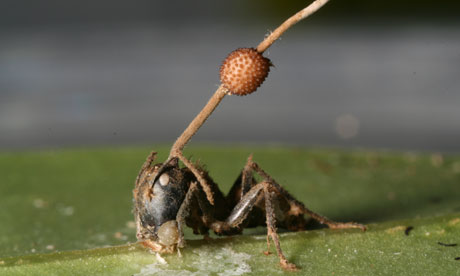
the fuzz begins to cover more and more of the ant's body. You then notice a
fungal sprout grow out of its head and release spores all over the ground. In a
panic, you sprint away only to find hordes of undead ants hanging from the
trees, fungus growing from each and every one. The invasion has begun.
The Cordyceps
Unilateralis
Unlike science fiction, these "zombie" ants actually occur
in nature. The fungus Cordyceps
Unilateralis cannot survive on its own in tropical forests, so it has an
ability to act like a parasite and attach itself to unsuspecting carpenter ants
that cover the areas below the canopy. After an ant has been infected, it
begins the "zombifying" process by releasing alkaloid chemicals that consume
less-vital tissue inside the ant. When the fungus is ready to spore, it alters
the pheromones in the ant's brain, causing it to climb up to moist, humid ground
and latch onto a plant with its mandibles. After that, the fungus enjoys a good
meal and uses the ant as a host to create more fungus.
Zombie Apocalypse
Upon Us?
The short answer is: no. The long answer is: noooooo. This
fungus may use the ant's pheromones to control its behavior, but it's not quite
capable of creating the full-on zombie that we know from the movies. In fact,
instead of fearing this parasitic fungus, scientists have been using it
medicinally to extract bioactive naphthoquinone derivates, which are known to
possess anti-bacterial and anti-tumor properties.
Here's a high quality video of the infection process
(WARNING: This is not for the weak of heart):
http://www.youtube.com/watch?v=XuKjBIBBAL8
References:
http://www.guardian.co.uk/science/2010/aug/18/zombie-carpenter-ant-fungus
http://www.ncbi.nlm.nih.gov/pmc/articles/PMC2652714/
http://en.wikipedia.org/wiki/Cordyceps_unilateralis#Host_impact
| 


 Re: Bacteria Creates Zombie Invasion


