|
The linear slide: the engineering response to DJ Casper's Cha-Cha Slide.
 
DJ Casper via Communigate | Crossed bearing slide via Isotech
"Slide to the left. Slide to the right. Crisscross. Crisscross.
Cha-Cha now ya'll. "
Maybe not so much. Linear slides neither crisscross nor cha-cha. I've also seen an engineer or two "get funky."
However,
thanks to this handy little guide, and GlobalSpec's impressive Linear Slide Selection Guide, I firmly believe that asserting your linear slide needs can
be as easy as doing the Cha-Cha Slide. (And really, it's super easy. The
directions ARE lyrics. Come on, I can't believe this is a song.)
Linear slides are simple linear motion devices composed
of a stationary base and a moving carriage. Linear stages are slides with
a drive mechanism that provide controlled, precise positioning along a
linear axis. Linear slides and linear stages use a linear bearing to reduce
friction and guide the slide.

via FDA Bearings
Linear slides typically use a ball screw or lead screw
supported by rotary bearings as a drive mechanism to move the carriage. The
screw is attached to the fixed base, and the nut assembly is attached to the
moving carriage. As the screw rotates, the nut and carriage move linearly along
the screw. The screw is turned by a handwheel or electric motor (which may or
may not be included with the slide). Alternative drive mechanisms may also be
used that do not require a ball screw or lead screw, such as linear motors,
pneumatic cylinders and hydraulic cylinders. In a linear motor driven slide,
the linear motor directly moves the carriage along the slide. Pneumatic
cylinders and hydraulic cylinders may also be used. The cylinder body is
attached to the slide base and the cylinder rod is attached to the carriage.

via LM 76
Linear slides can use many different types of bearings to
provide smooth and accurate translation. Air bearings, ball bearings, crossed
rollers, dovetail or hardened ways, ball bushings, motion guides, needle
rollers and sleeve bearings are all common.
When purchasing a linear slide, it's also important to
consider axes for which the slide must account. Some slides can operate
vertically as well as horizontally. Accuracy can be important for automated assembly
processes. Also, drive mechanisms are in important consideration and some
slides can be manually driven.
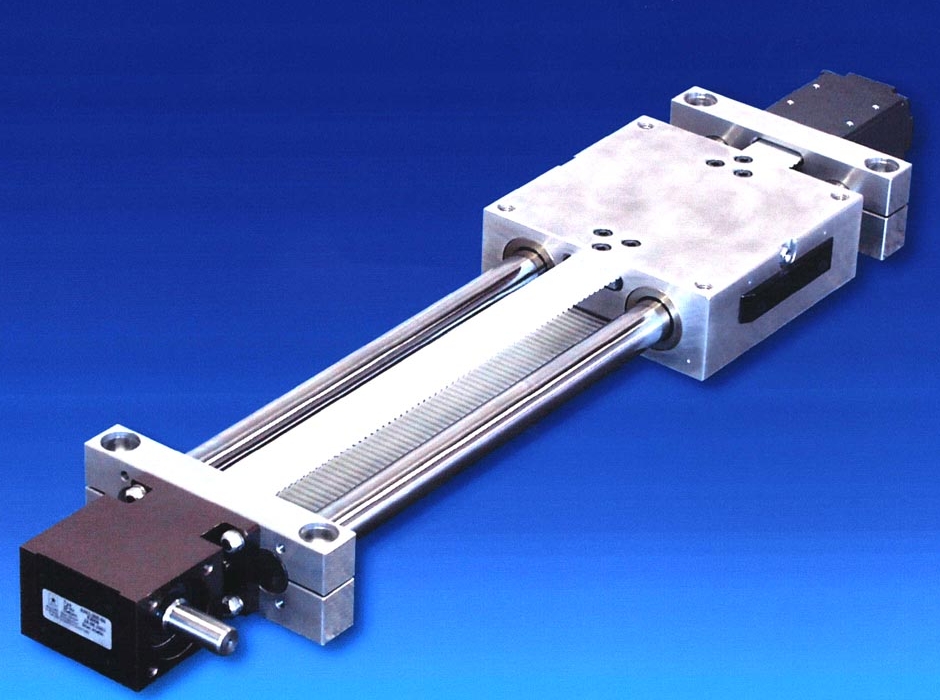
via STAR
There are a few more specifications to consider, but I get
the feeling that you really, really want to go over to GlobalSpec's site to check them out. They can offer a better and more in-depth description than what
I ever could.
That's not to minimize all the work I've done here. I think
I deserve some recognition, actually.
"Everybody clap your hands. Clap clap clap clap your hands.
Clap clap clap clap your hands."
| 


 Re: Linear Slides and You: A Tutorial


