|
Many are already mourning the slow death of the incandescent
bulb by its more efficient cousin, the compact fluorescent light (CFL). But
most say LEDs (light emitting diodes) are the lighting of the future as soon as
they can cut down the cost of production.

[LED vs. Incandescent vs. CFL - Source: relumination]
A startup company, Soraa, claims that it can make a new type
of LED which is brighter and cheaper than current technologies.
The Process
The diodes are made of layers of semiconductor material, one
has an excess of electrons and the next has a deficit. Impurities in the
material are used to create the electron densities required for the electrons
to move and generate light. Different colors are generated by using different
semiconductor materials.
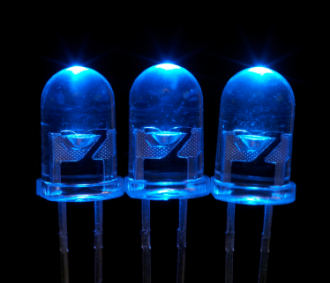
Blue and white LEDs (like those seen right - Source: keepandshare.com) are typically
made by growing a thin layer of gallium nitride on a substrate (sapphire, silicon
carbide, or silicon). The expense of gallium nitride has made using a thin
layer the cheapest method, but results in reduced performance of the LED with
increases in current density due to the mismatched crystal structure.
Soraa's process uses gallium nitride as the substrate. This
reduces the mismatches ("dislocations") by a factor of 1,000. Those at the
startup company say this reduction allows them to push 10x the current through
the active layer material, resulting in brighter LEDs.
Overcoming Cost
Barriers
Soraa claims the additional brightness allows the system to
be designed cheaply enough to make up for added material costs. This is because
Soraa's LEDs are the equivalent brightness of multiple traditional LEDs,
requiring only one chip/diode. In addition, Soraa argues that the energy
savings will make up the cost differential in under a year of use.
Gallium nitride is much more expensive than sapphire or silicon-based materials, which is
the reason traditional designs used much less of it in the construction of the
LED. Colin Humphrey, director of research at the University of Cambridge's
Department of Materials Science and Metallurgy, says gallium nitride production
can be long and difficult. He says it costs about $30 for a six-inch-diameter
silicon wafer or two-inch-diameter sapphire wafer, and about $500 for a
one-inch-diameter gallium nitride wafer.

On The Bright Side
Whether Soraa's claims will actually be cost effective will
depend on how it does on the production line. With the ever-dropping cost of
silicon, it may be hard for gallium-nitride based LEDs to compete.
[<-- Source: geek.com]
But regardless of whether the products are successful, the new methods are
evidence that solid state lighting technology is pushing forward. LEDs boast a
number of advantages over other lighting sources, including significantly
longer lifespan and surpassing efficiency. I think it's only a matter of time
before they become the world's primary consumer lighting option.
Sources:
Madehow.com
- LED
Technology
Review - LEDs that Burn 10 Times Brighter
| 

 3
3


 Re: LEDs Made Brighter and Cheaper


Good Answers:
"Almost" Good Answers: