|

Microbes, or microorganisms, are tiny "bugs" that have
significance in a number of biological processes, including some very familiar ones like human digestion. In
the energy realm, microbes are used in the production of methane, ethanol, and various
other liquid fuels. They also are used to generate electricity through the
processing of nuclear wastes, sludge, and wastewater.
But scientists have recently found usefulness in a
particular species of bacteria - Bacillus
stratosphericus. This microbe, as its name might suggest, is found in high
concentrations in the earth's stratosphere. This sky bug has been a major player in creating a
new artificial biofilm that doubles the output of a microbial fuel cell.
(<-- Credit: Tripleman)
Microbial Fuel Cells
Microbial fuel cells (MFCs) are biological fuel cells that
convert chemical energy to electrical energy using microbes as the catalysts.
They operate by taking advantage of the natural processes that bacteria undergo
when they digest fuel or waste (animal manure, biomass, etc.) to gain energy.
Specifically, fuel cells capture the electrons transferred from an electron
donor (e.g. glucose, acetate) to an electron acceptor (oxygen) and use them to
generate electricity.

(Microbial fuel cell diagram. Credit: Greeniacs)
MFCs are inexpensive to design compared to other types of
fuel cells, and provide convenient generation of energy from waste which might
otherwise be sent to a landfill or disposed through other means. The conversion
process is also direct to electricity, which means much higher energy yield
rates than by first converting the organic matter into a biofuel and then
combusting it (no waste heat). Specifically, MFCs have operating efficiencies
up to 80% with theoretical yields of 3 kWh electricity for every kg of organic
matter (dry weight). This is compared to yields of 1 kWh electricity and 2 kWh
heat per kg for hydrogen and biogas production - achieving overall efficiencies around 30%.

(Microbial Fuel Cell - Credit: National Science Foundation -->)
But while the electrochemical bottlenecks have decreased
considerably from the growing success of catalytic fuel cells, other factors
have made the MFC more of a dream than a reality. Losses from overpotential,
turbulence, activation, membrane resistance, and upscaling are all problems.
Additionally, power production only averages 0.5 Volts per cell, meaning an
extremely large footprint is required to create sufficient amounts of power
Superbugs to the
Rescue
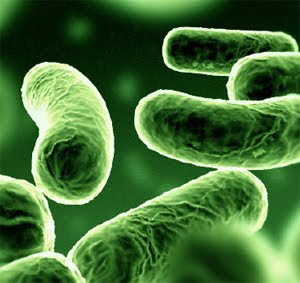
Biofilms are surfaces
which contain and aggregate microorganisms. They are the source of the bacteria
(microbes) used in microbial fuel cells and are what catalyze and drive the
reaction. Biofilms usually contain a mix of different types of bacteria rather
than just a single kind.
(<--Credit: Open Energy Info)
B. Stratosphericus, the bug from the sky, is a particular microbe
with good power-generation abilities. It was one of 75 different types of
bacteria tested for its abilities. The scientists selected and mixed the best
of these species to create an artificial biofilm with the most advanced
properties. The result was a biofilm that nearly doubles the output of the MFC
- from 105 Watts per cubic meter to 200 Watts per cubic meter.
What It Means
This breakthrough is not going to
immediately solve all the problems of the MFC. Each individual cell still only
produces enough juice to power a light or two, making it only truly effective
for remote parts of the world without electricity.
However, the principle behind manipulating
the types and concentrations of bacteria on a biofilm will open the doors to
possibly even more efficient cells. After all, "there are billions of microbes
out there with the potential to generate power" says Grant Burgess, Professor
of Marine Biotechnology at Newcastle University.
Billions… and they only looked at
75. I guess that means there will always have more to test.
Sources:
Microbialfuelcell.org
- Microbial fuel cells: performances and perspectives (pdf)
Greeniacs - Microbial Fuel Cell
Science Daily -Stratospheric Superbugs Offer New Source of Power
The
Engineer - Artificial biofilm helps double output of microbial fuel cell
| 


 Re: Superbugs from the Sky


