|
For over twenty years it has been known that fine atmospheric particles, most of which are secondary air pollutants, are the most lethal of dispersed air pollutants in the U.S. They have links to both heart and lung disease, and are blamed for the deaths of around 50,000 Americans each year.
If that's not enough of a downer, new research shows that a particular subset known as secondary organic aerosols (SOAs) have a greater total mass than previously estimated, making them even more dangerous.
The Scoop on SOAs
All air pollutants are classified as either primary or secondary. Primary pollutants are those directly released into the atmosphere, such as nitrogen oxides (NOx) sulfuric oxides (SOx) and hydrocarbons which come from different combustion reactions. Primary pollutants can then form into secondary pollutants via interactions in the atmosphere. Examples include the formation of smog from hydrocarbons and other constituents and the generation of acid rain from NOx and SOx.
Secondary organic aerosols are a subset of secondary air pollutants formed from multi-step interactions between volatile organic compounds (VOCs) and other pollutants and chemicals (both natural and manmade). Here's a glimpse of the formation process in diagram form (Image Credit: Dep. Of Atmospheric Science - CSU):
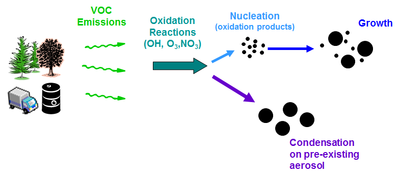
To be clear, while an aerosol is rightly defined as a mixture of gases and particulate matter (PM), most pollutants referred to as aerosols (including SOAs) are just particles.
Just how big are SOAs? Well, aerosol particle diameters can be anywhere from 0.01-100 micrometers (µm) but many SOAs derived from anthropogenic (manmade) pollutants average between 0.1-10 µm.

The size of these particles is what makes them so harmful. In addition to being harder to capture, smaller particles cause more health problems. Tiny particles can travel deep into the lungs, and some can even get into the bloodstream. Smaller particles also cause more reduced visibility, called haze, in parts of the U.S.
(<-- The Great Smoky Mountains seem extra 'smoky' when clouded with haze - Image Credit: Vanderbuilt University)
The New Findings
Secondary pollutants can be more troubling than primary pollutants because they cannot be directly measured. Instead, they must be estimated based on levels of primary emissions and predictions of the interactions that take place in their formation. This also makes it harder to produce sufficient standards to regulate their control.
But a new study by scientists at the University of California and the Pacific Northwest National Laboratory has sorted out some of this confusion on SOAs. Apparently, past studies and models of the atmosphere have underrepresented the abundance of these particles. Actual atmospheric densities could overstep previous predictions by as much as a factor of 10.
Specifically, the new study reevaluates assumptions about the gaseous byproducts from internal-combustion engine pollution. Instead of forming airborne drops which dissipate quickly, these byproducts attach themselves more tightly to airborne organic particles, creating "tiny tar balls" which persist for much longer.

(Perhaps a more legitimate concern for ICE pollution… Credit: The Telegraph -->)
These findings will likely lead to a reassessment of current air pollution control initiatives. Current standards show a lack of emphasis on regulating or controlling VOCs and other organic emissions. This is particularly disconcerting, considering they have a more direct and noticeable effect on the health of people and the environment than the infamous greenhouse gases.
Sources:
NYT - Scientists Find New Dangers in Tiny but Pervasive Particles in Air Pollution
| 

 2
2


 Re: Secondary Organic Aerosols Sold Short


Good Answers:
"Almost" Good Answers: