|
Your QA manager can put you to sleep explaining the difference between
these two terms- but you really need to know the difference.
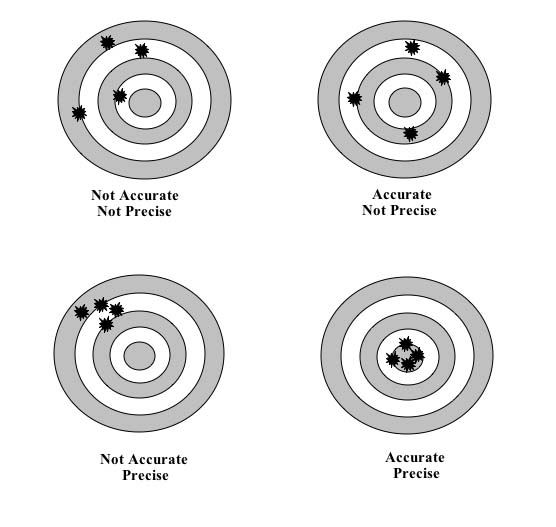
Accuracy describes
'close to true value'; Precision describes 'repeatability'.
Accuracy in measurement describes how closely the
measurement from your system matches the actual or true measurement of the
thing being measured. It is the difference between the observed average of
measurements and the true average.
Think of accuracy
as the "trustworthiness" of a measurement system.
Precision in measurement describes how well a
measurement system will return the same measure; that is its Repeatability.
As the targets
above show, it is important to be both Accurate and Precise if you are to get
useable information from your measurement system.
But the
repeatability has two components- that of the measurement system (gage)
itself and that of the operator(s). Differences resulting from different
operators using the same measurement device- this is called Reproducibility.
In our shops, we
cannot tell if our measurement system has repeatability or reproducibility
issues without doing a Long Form Gage R&R study.
Gage
repeatability and reproducibility studies (GR&R) use statistical
techniques to identify and discern the sources of variation in our
measurement system: is it the gage, or is it the operator?
Gage error
determined by the GR&R is expressed as a percentage of the tolerance that
you are trying to hold.
Typically, 10% or
less Gage Error is considered acceptable. Over 30% is unacceptable; between 10
and 30% gage error may be acceptable depending on the application.
Regardless- any
level of gage error is an opportunity for continuous improvement.
Target Graphic
| 


 Re: The Difference Between Accuracy And Precision Measurement In Your Machine Shop


"Almost" Good Answers: