|
Anyone who is excited about the premier of the long-anticipated Avengers movie will likely recall the premiere of Thor nearly a year ago. While not my favorite Marvel superhero, it's hard not to like a guy who uses a massive, lightning empowered hammer as his weapon.

(Credit: heyuguys.co.uk)
This hero is basically a carbon copy of Norse mythology's Thor, the god of thunder. This god is also where the element thorium got its namesake. Coincidentally, the potential applications of this substance as a nuclear fuel are as thunderous as its name.
A Brief Summary of Thorium
Thorium: a radioactive element, atomic number 90, symbol 'Th' on the periodic table. There ya go.
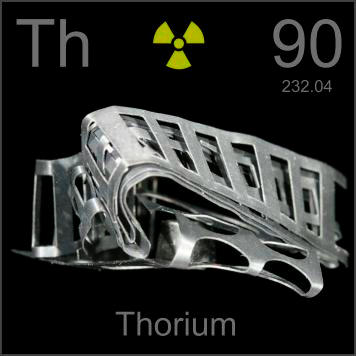
Not enough? Ah well, I tried… (Credit: Periodictable)
Thorium exists naturally as thorium-232 and decays with a half-life of 14.05 billion years. There is nearly four times as much thorium as there is uranium in the Earth's crust, and the primary source of it comes from a mineral known as monazite.
Around the 1950s, when the nuclear industry was just kicking off, scientists were considering thorium as the fuel on which to design their reactors. Unfortunately, thorium reactors didn't create the plutonium by-product used for nuclear weapons that its brother uranium did, so it got pushed aside.
Was it a bad choice? Did evil win that day? I can't say; what's past is past. But whether we should choose to push for thorium fuel in the future is a much different question. Let's examine some of the pros and cons.
Why We Should
As mentioned above, thorium is much more abundant than uranium, so the cost and supply of the fuel is less of a concern. Currently, the U.S. has a stockpile of 32 metric tons of thorium, and much more within the country that still can be harvested. And like Thor, thorium packs some serious power. One ton of thorium can generate as much energy as 200 tons of uranium, making it much more efficient.
Thorium-based liquid fuel reactors also generate less nuclear waste than uranium-fueled reactors, and this waste loses its radioactivity in a much shorter time span (hundreds of years as compared to thousands).
In addition, the best use of thorium is in molten salt reactors (MSRs), which have some distinct advantages over pressurized water reactors (PWRs). Thorium MSRs, called Liquid Fluoride Thorium Reactors (LFTRs), don't use water as the coolant, so they don't require extremely high pressure containment vessels to keep the coolant liquid at high temperatures. Lower pressures make for less expensive and more compact facilities. It also means the facilities do not need to be located next to large bodies of water to satisfy the needs of cooling towers.
The issue of safety that pervades the nuclear industry is also addressed by thorium. In addition to producing little to no weapons-grade waste, molten salt thorium reactors have a much lower likelihood of meltdown. If power to the facility is lost, the reactor is designed to shut itself down automatically, unlike traditional PWRs which require power to keep coolant flowing and prevent a meltdown. The chain reactions that have led to nuclear meltdowns in the past cannot happen in thorium reactors, proponents say.
For a summary of the benefits of thorium, check out this TEDxTalks presentation by Kirk Sorenson, a major advocate for thorium reactors.
Why We Shouldn't
Thorium sounds great, but if it was that super, wouldn't it be saving the world by now? What was Mr. Sorenson not telling us about these reactors?
Unfortunately, the downsides to thorium reactor technology are still largely uncertain, because modern designs have not been completed and tested (though China is in the process, and is looking to have a full-scale commercial one running by 2020).
One of the main concerns about MSRs is the corrosion problems resulting from the molten salts. The salts could degrade the reactor surfaces, adding high maintenance costs and safety concerns. In addition, impurities to the fuel are also likely to be a problem, causing undesirable reaction/fission which slowly eats away at vessel walls.
(Credit: Kickstarter -->)
Perhaps the biggest nail in the thorium coffin right now is the seemingly insurmountable economic and political wall. Because the world has embraced uranium fueled reactors, the conversion of current plants to thorium would be both wasteful and extremely costly. The economic incentives for developing brand new thorium plants have not yet been fully realized. This is due in part to the lack of standards and regulations regarding thorium nuke plant construction. The Nuclear Regulatory Commisson (NRC) is being pushed to start developing these standards, but needs funding in order to train qualified staff on this new type of reactor technology.
The Verdict
In the battle for Earth, it's obvious who will win in the end.
"Art thou mad? 'Tis Thor, the warrior-prince of Asgard and avenger of earth, who confronts thee... and offers thee an opportunity to surrender with honor!" - Thor, before facing Juggernaut
Of course, when comparing different approaches in science and technology, the solution is never that simple… There are no godlike technologies - each one has flaws and weaknesses. But it will be interesting to watch the development of liquid fuel thorium reactors to see what impact they have in the future.
| 


 Re: THORium to the Rescue?


