|
What would you do if a new piece of cutting-edge technology
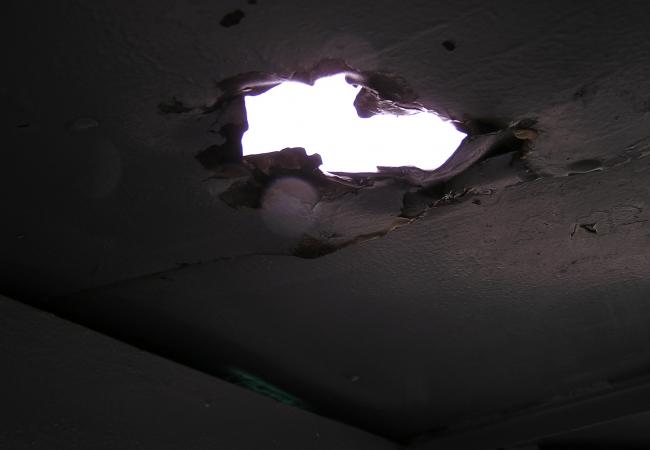
came falling out of the sky onto your workbench? Well, after you fix the hole
in your shop roof, it'd probably be nice to get the part precisely measured
onto a computer so you could mass produce it (and subsequently make millions of
course). That's when you'd use a coordinate measuring machine (CMM).
(Credit:
Mickeyholman.blogspot.com -->)

CMMs are nifty devices that take measurements of parts for applications such as
reverse engineering your competition's products, testing, design,
assessment, profiling, and so on and so forth. Traditional CMMs consist of
three components: the machine, the probe, and the control or computing system.
The machine controls a probe which measures and records the location/coordinates
of different points on a part; these points are uploaded to a computer which
can use them to map part dimensions.
(<-- Credit: Leader
Metrology)
When sourcing a CMM, it's most important to size the
equipment to the size of the parts being measured. The arms of a CMM probe may be flexible, but
they do have a limited range of motion. Machines are specified based on the
measuring length of each axis of motion. Other specifications include the
resolution (how precise it can measure), the measuring speed of the device
(hopefully not agonizingly slow), and the weight capacity (how much the part
being measured can weigh).
Traditional CMMs are bench mount point probe devices, which
physically touch the part to detect its position (as demonstrated in this video). But not all
parts can be measured this way. More advanced measuring technologies use
cameras and/or lasers to record coordinates, and some are even handheld to
provide portability and flexibility.
For a one-time measurement, it may be best to use a CMM
service to do the measuring for you. But if your company finds itself profiling
parts often, it may be necessary to source out a new coordinate measuring machine to
make precise part-dimensioning possible. When you do, take a look at
GlobalSpec's Coordinate
Measuring Machine Selection Guide for a more thorough explanation of the
selection process.
| 


 Re: Sourcing a CMM


