|
A military-class
space shuttle lands on the back of an Earth-approaching asteroid, with the
intention of implanting a nuclear weapon deep within the core. This asteroid
will likely kill 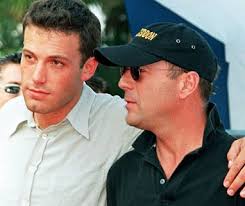 every species on Earth and the fate of humanity rests in the
hands of Bruce Willis and Ben Affleck. every species on Earth and the fate of humanity rests in the
hands of Bruce Willis and Ben Affleck.
Okay, so I may have just described the plot of Michael Bay's Armageddon,
a stinker of a movie in 1998 and a film that was roundly criticized for its
scientific credibility. In fact, NASA
shows the film in training programs, asking participants for detail
inaccuracies. So far, 168 have been confirmed, and that's not including Billy
Bob Thornton as intelligent.
So, while Bruce and Ben aren't going to be saving us from an
asteroid, there is indeed a real possibility an asteroid is on a collision
course with our green and blue home. This has prompted speculation on a plan
for if/when that day comes.
Scientists better get steppin' on it. In
2028, half-mile-sized asteroid 1997 XF11 will pass Earth at a distance of
930,000 miles. As the closest encounter with an asteroid yet, it will be
observable with the naked eye.
The four most promising--and plausible--asteroid deterrents are listed below.
- The Nuclear Option: The
detonation of a nuclear-grade weapon at, near, or beneath the surface of an
asteroid isn't movie fiction. As a type of nuclear pulse propulsion, this could
severely alter the course
of the projectile. It should be noted that destroying the asteroid could
have a more catastrophic effect-particles blown off the asteroid could be
radiated and enter the Earth's atmosphere anyhow. Discovering
the asteroid early enough would mean even a small nuclear explosion would be enough
to change the asteroid's trajectory.
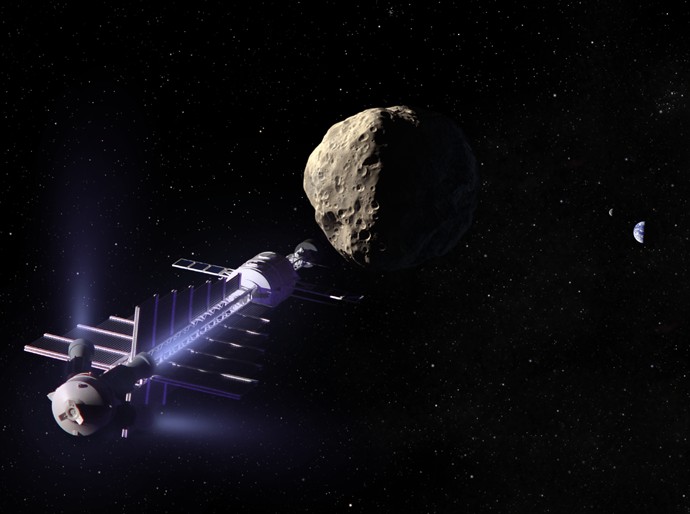 Gravity:
Positioning a large-mass object near, but not on the asteroid, would draw the
asteroid towards it over time, such as in the representation to the right. This object would need to have a source of
thrust to keep the objects from touching, and would also need at least a few
years to be effective. Gravity:
Positioning a large-mass object near, but not on the asteroid, would draw the
asteroid towards it over time, such as in the representation to the right. This object would need to have a source of
thrust to keep the objects from touching, and would also need at least a few
years to be effective.-
Kinetic energy: Collision with another large-mass object
would change the course of the asteroid considerably. For completely accurate
and scientific representation, Dr. Farnsworth solves the
asteroid problem with a giant ball of garbage launched at an asteroid.
 Ion
beam: The force from a slow, constant thrust from a ion beam thruster directed at the asteroid alters the trajectory
of the asteroid in a similar fashion as the gravity from a nearby mass. Ion
beam: The force from a slow, constant thrust from a ion beam thruster directed at the asteroid alters the trajectory
of the asteroid in a similar fashion as the gravity from a nearby mass.
There
are some methods which require articulation on
the asteroid's surface. Physically attaching rocket engines to the asteroid has
been proposed, as has been building a mass driver on the asteroid. The
Yarkovsky Effect has been thoroughly discussed as a possibility. By releasing
thermal photons, the rotating asteroid would gain enough anisotropic direction
to alter its course. While it is scientifically feasible, enormous amounts of
international engineering and cooperation would be required. The asteroid would
need to be painted first, or a gigantic solar lens would need to be positioned
-in space-to focus the solar rays. Again, while scientifically feasible-it
would take years to organize, perhaps too long to destroy the asteroid. The
Yarkovsky Effect has been thoroughly discussed as a possibility. By releasing
thermal photons, the rotating asteroid would gain enough anisotropic direction
to alter its course. While it is scientifically feasible, enormous amounts of
international engineering and cooperation would be required. The asteroid would
need to be painted first, or a gigantic solar lens would need to be positioned
-in space-to focus the solar rays. Again, while scientifically feasible-it
would take years to organize, perhaps too long to destroy the asteroid.
And what happens when we fail to protect ourselves from
cosmic destruction?
Enter the Tunguska Event.
Shortly after 7 a.m. on June 30, 1908, an exceptionally
bright light streaked across the Russian sky in remote part of Siberia. Its intersection with Earth knocked individuals down and broke windows hundreds of
miles away.
 While its origin is widely debated, there is little scientific doubt that
the resulting non-crater is a result of an impact with a cosmic body: most likely an asteroid that exploded several
miles above the Earth's surface from atmospheric pressure. The blast was equivalent to 1,000 Little Boys, and had the capability to wipe out a
major metropolis. Notably, the asteroid was relatively small, measuring just 100 meters in diameter. The explosion decimated an area of 830 sq. miles. While no
major-impact crater has ever been found, hundreds of smaller-scale lakes and craters
have materialized from the asteroid's fragments. While its origin is widely debated, there is little scientific doubt that
the resulting non-crater is a result of an impact with a cosmic body: most likely an asteroid that exploded several
miles above the Earth's surface from atmospheric pressure. The blast was equivalent to 1,000 Little Boys, and had the capability to wipe out a
major metropolis. Notably, the asteroid was relatively small, measuring just 100 meters in diameter. The explosion decimated an area of 830 sq. miles. While no
major-impact crater has ever been found, hundreds of smaller-scale lakes and craters
have materialized from the asteroid's fragments.
 No amount of fall-out shelter reinforcement is going save
you from an asteroid. It's likely a large-scale impact would be another
extinction event. No amount of fall-out shelter reinforcement is going save
you from an asteroid. It's likely a large-scale impact would be another
extinction event.
So
which defense should we go with? The best coverage would be a proverbial net
that defends the planet on multiple levels. In a sense, the moon has already
saved the Earth several times according to evidence
presented by the NASA Lunar Science Institute.
Yet, the moon won't always have our backs. Eventually, an
asteroid is going to run a blitz and the Earth is going to get sacked.
And just like Monday Night Football, I'll sit there with a beer and watch the travesty. What else can you do?
Image credits, in order: Will Sound; NASA; Wikimedia; Astroprof's Page; Wired; Chzscience
Resources
Wikipedia - Tunguska event; Yarkovsky effect;
Space.com: Asteroid Defense...; Asteroids Smacked Moon...;
| 

 2
2


 Re: Asteroid Self-Defense


Good Answers:
"Almost" Good Answers: