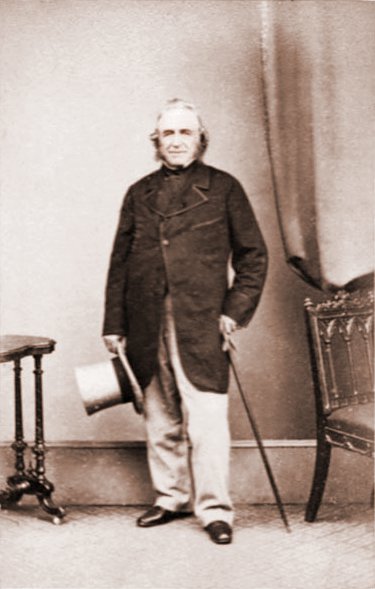
Sir Joseph Paxton was a 19th century gardener,
architect, and Member
of Parliament. He is best known for designing the Crystal
Palace, a pre-fabricated glass and iron structure used at the Great Exhibition
of 1851.
Early Days
as a Gardener
Paxton was born on August 3, 1803, the seventh son of an English
farmer. His year of birth was
accidentally recorded as 1801 and so at age 15 he became a garden boy for Sir
Gregory Osborne Page-Turner at Battlesden Park, near Woburn.
While working as a gardener for the Horticultural Society's Chiswick Gardens, Paxton met
William Cavendish, 6th Duke of Devonshire. The Duke offered Paxton a job as head
gardener at Chatsworth. There Paxton was
responsible for creating and moving gardens including the relocation of mature
trees weighing up to 8 tons.
Greenhouse Design
During his time at
Chatsworth Paxton became interested in greenhouses. He began to incorporate design elements that
would be precursors to modern greenhouses:
- Ridge and furrow roof at right angles to
morning and evening sun
- Rigidity provided by the radiating ribs connecting with flexible
cross-ribs
- Hollow pillars to double as drain pipes
- Special rafters that also acted as an internal
and external gutter
- Pre-fabricated, modular components that could
be produced in large numbers and assembled into various designs
Paxton built the Victoria Regia House for a giant lily and the
Great Conservatory using similar techniques.
The Great Conservatory was the largest glass building of its time with columns
and beams made of cast-iron and arched elements of laminated wood. In those days the largest sheet of glass
available was 3 feet long; 4 foot sheets were procured. The conservatory was heated by eight boilers
using seven miles of iron pipe and cost over £30,000.

The Crystal Palace was Paxton's most well-known
accomplishment. After 245 other plans
for the main exhibition hall were rejected, Paxton took a few days to modify
and enlarge the design for the Victoria Regia House. The design was a revolutionary, modular, pre-fabricated
design that incorporated glass. Paxton
was knighted after the completion of the construction.
- 1,848 feet long, 408 feet wide, and 108 feet high
- Required 4,500 tons of iron, 60,000 cubic feet
of timber, and over 293,000 panes of glass
- 2,000 men took just eight months to build it
at a cost of £79,800.
Later Life
and Parliament
Paxton published horticultural periodicals and co-founded The Gardeners' Chronicle in 1841. He worked
at Chatsworth and designed public parks and country houses.
Paxton was a Liberal Member of Parliament for Coventry until his
death on June 8, 1865. In Parliament he
presented an idea called the Great Victorian Way, an arcade in a 10-mile loop
around the center of London.
Resources:
BBC
History
Wikipedia
| 


