|
The United States, no matter the decade, has a keen sense of
the paranormal. I promise that this isn't another blog post about ghosts or extraterrestrials, but the
 latter is exactly what late 19th Century Americans believed were
behind the wave of 'mystery airships' that were reported upon heavily. Airships
were en vogue and their whereabouts highly publicized--so unexplained airships,
the public realized, simply must be from outer space. Witnesses reported
conversations with crews who acted unusual and claimed to be Martian. latter is exactly what late 19th Century Americans believed were
behind the wave of 'mystery airships' that were reported upon heavily. Airships
were en vogue and their whereabouts highly publicized--so unexplained airships,
the public realized, simply must be from outer space. Witnesses reported
conversations with crews who acted unusual and claimed to be Martian.
Yes, clearly this technologically-superior
race of humans flew their blimp to Earth to talk to you numbskulls. It's
interesting that as high-tech aviation, space travel, and atomic power became
commonplace, so did UFOs with this technology, no?
These events garnered a lot of media attention; enough so
that Thomas Edison had to rebuke the notion of his participation. Of course, as
people drank less in the early 1900s (temperance movement) and airplanes became
real (1903, Wright brothers) people stopped reporting mystery airships. Although
they were no longer the leading-edge of the flying craze, the airship had continued
service in many roles. It 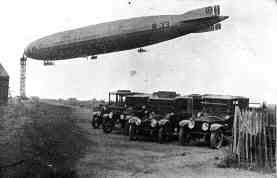 served as a tactical machine (World War I
bomber/scout), exploring vessel (North Pole), and freight/passenger transport
(hello, Hindenburg). After countless airship disasters and the
radical improvement of airplanes in World War II, airships were just about
discarded. served as a tactical machine (World War I
bomber/scout), exploring vessel (North Pole), and freight/passenger transport
(hello, Hindenburg). After countless airship disasters and the
radical improvement of airplanes in World War II, airships were just about
discarded.
Could the airship make a prominent comeback? Could we be on
a new dawn of airship UFO reports? I
surely hope so. Here are few ways airships are reinvigorating a stagnant
air-travel market.
Scientific Research
The low-speed, high-stability, and precision-maneuverability
of an airship is an asset to scientific endeavors. NASA has contracted
zeppelins for its Ames Research Center to conduct experiments measuring the
reflected solar and emitted thermal radiation, as well as to sample aerosols
and gas constituents at various altitudes. NASA also collaborated with marine
biologists to measure harmful algae blooms in Monterrey Bay, Calif. Other
zeppelins have been used by the National Oceanic and Atmospheric Administration
to track the migration of orca whales.
 In similar ecological fashion, airships are being used to
provide researchers study of the diverse rainforest canopy. An airship carries
an oversized raft with scholars into the jungle, carefully places it amongst
the tree tops, and flies off. This allows scientists prime access to areas that
they would otherwise have to trek to and then climb. This effort puts forth some stunning visuals
of a brightly colored balloon hovering above remote, hazy forests. In similar ecological fashion, airships are being used to
provide researchers study of the diverse rainforest canopy. An airship carries
an oversized raft with scholars into the jungle, carefully places it amongst
the tree tops, and flies off. This allows scientists prime access to areas that
they would otherwise have to trek to and then climb. This effort puts forth some stunning visuals
of a brightly colored balloon hovering above remote, hazy forests.
In 2010, the world's worst oil spill occurred in the Gulf of
Mexico, and U.S. Coast Guard officials requested the use of U.S. Navy blimp
MZ-3A to help locate oil slicks and distressed wildlife as well as coordinate
skimming vessels.
Finally, vast geological assessments are capable from the
platform of an airship. Diamond mining company De Beers retained the services
of an airship in South Africa to search for low-density rock formations
associated with diamond formation. This airship was unfortunately damaged while
moored in a storm.
Heavy Hauling
 Newer blimp concepts have been attempting to cross the
invisible 'heavy lifter' threshold. Until 2010, DARPA was investing in airship
hybrid concepts that could transport 500-1,000 tons of cargo up to 14,000 miles.
A hybrid airship derives some of its flight from mechanical means, such as a
propeller. While the development funding for this project was eventually cut,
some companies had developed such robust designs that they continue to research
and market airships. Newer blimp concepts have been attempting to cross the
invisible 'heavy lifter' threshold. Until 2010, DARPA was investing in airship
hybrid concepts that could transport 500-1,000 tons of cargo up to 14,000 miles.
A hybrid airship derives some of its flight from mechanical means, such as a
propeller. While the development funding for this project was eventually cut,
some companies had developed such robust designs that they continue to research
and market airships.
 Alberta-based Aviation Capital Enterprises has ordered for
the delivery of at least one "SkyTug" which it intends to lease or sell to oil
and gas companies. One of the largest logistical problems for Canadian drilling
companies is the transportation of heavy, cumbersome equipment from
manufacturing centers to remote mining sites in the Arctic. Furthermore, these
sites are sometimes only accessible by seasonal routes over frozen lakes and
rivers. I've got bad news for fans of the show Ice Road Truckers;
flying heavy machinery could take place at any point during the year without
the need for costly road upkeep. Alberta-based Aviation Capital Enterprises has ordered for
the delivery of at least one "SkyTug" which it intends to lease or sell to oil
and gas companies. One of the largest logistical problems for Canadian drilling
companies is the transportation of heavy, cumbersome equipment from
manufacturing centers to remote mining sites in the Arctic. Furthermore, these
sites are sometimes only accessible by seasonal routes over frozen lakes and
rivers. I've got bad news for fans of the show Ice Road Truckers;
flying heavy machinery could take place at any point during the year without
the need for costly road upkeep.
This form of 'roadless trucking' can provide quite of bit of
support to locales with poor infrastructure. It can also serve as a better form
of a tower crane; there is no need transport large crane components to a job
site. This is expected to be an area of rapid development in the next few
decades as the need for heavy cargo transport with a low procurement cost
becomes global. Unfortunately, designs
for carrying loads over 50 tons have not been realized; demand and funding
have yet to reach beyond this benchmark.
Security
The
Germans, who relied on the zeppelin for four years during World War I, were the
foremost developers of airship capabilities in military theatre. They relied on these vehicles to provide
intelligence and to bomb cities, but difficulties while navigating and
 targeting proved too adverse. While zeppelins are typically invulnerable to
regular bullets, the invention of incendiary rounds made the hydrogen-filled
zeppelins exactly the opposite:
absolutely helpless. Military use of helium-filled airships virtually
ceased after World War II, where the United States used them to defend ships
and convoys from submarines with remarkable success. targeting proved too adverse. While zeppelins are typically invulnerable to
regular bullets, the invention of incendiary rounds made the hydrogen-filled
zeppelins exactly the opposite:
absolutely helpless. Military use of helium-filled airships virtually
ceased after World War II, where the United States used them to defend ships
and convoys from submarines with remarkable success.
As the focus on military operations shift toward unmanned,
advance reconnaissance, airships are making a steady comeback. In 2004, Spain
purchased an unmanned airship that's purpose remains classified. Its small size
and rigorous flight schedule lead experts to believe it is used as an encrypted
communications relay.
The U.S. Army has invested over $150 million for
three airships that will commence operational testing in Afghanistan in
2013. These are intended to provide a variety of logistical support, including target
and convoy tracking, communications relay, and equipment hauling of supplies up
to  seven tons. While planes and helicopters capable of these functions would
cost up to $20,000 per hour, the airship can accomplish this much more
economically while also being autonomously deployed for up to three weeks.
Specifically, the HAV 304 has the ability to use solar radiation to power many
of its electronics. seven tons. While planes and helicopters capable of these functions would
cost up to $20,000 per hour, the airship can accomplish this much more
economically while also being autonomously deployed for up to three weeks.
Specifically, the HAV 304 has the ability to use solar radiation to power many
of its electronics.
Why It Won't Work
 I remember as a kid seeing the Goodyear blimp around sports
arenas and being mesmerized; I'm not sure why--perhaps it was just the enormity
of the darn thing. So the little kid inside of me really wants to travel the
world by dirigible. The Aeroscraft is currently under assembly to provide large-scale
freight handling, as well as the
luxury of an ocean liner. I remember as a kid seeing the Goodyear blimp around sports
arenas and being mesmerized; I'm not sure why--perhaps it was just the enormity
of the darn thing. So the little kid inside of me really wants to travel the
world by dirigible. The Aeroscraft is currently under assembly to provide large-scale
freight handling, as well as the
luxury of an ocean liner.
As with everything though, it comes down to dollars and
cents, and it's not looking too good.
Theodore von Kármán published What Price
Speed? in 1950 and it continues to be the seminal work in determining
transportation efficiency. By taking a
vehicle's power and  dividing it by [payload] weight and speed you get a comparable value.
Simply put, airships aren't much faster than road transport and are very much
slower than a plane. Simple zeppelins and blimps are somewhat more fuel
efficient than planes, but airship hybrids do not have a significant fuel
advantage. dividing it by [payload] weight and speed you get a comparable value.
Simply put, airships aren't much faster than road transport and are very much
slower than a plane. Simple zeppelins and blimps are somewhat more fuel
efficient than planes, but airship hybrids do not have a significant fuel
advantage.
So, it seems that airships may forever be destined as
nothing more than a camera platform for the Super Bowl. Ho-hum.
Resources
Image credits: Wikipedia; History on the Net; Hot Air Ships; Dynalifter; Aviation Week; WW2 in Color; Top War; Pop Sci; Promotion 1
Cleyet-Marrel - Dirigibles
Wikipedia - Airships; LEMV; Walrus HULA; Hybrid airship; SkyCat; American Blimp MZ-3; Mystery airship;
Pop Sci: The Flying Luxury Hotel
Jane's IHS - All the World's Aircraft: Development & Production
NASA - NASA Conducts Airborne Science Aboard Airship
| 


 Re: What's 'Up' with Airships?


