|
In the first
Impossible Objects installment, we investigated the cyclical
cross-pollination of mathematics and art as Penrose and Escher inspired and
re-inspired each other. In this post we'll delve into another, more
eccentric trio: Salvador Dali, Thomas Banchoff, and the fourth dimension.

Conceptualizing dimensions higher than the third is not a
new concept. Mathematicians began kicking ideas around in the early 19th
century, with the relatively "big names" of Möbius, Riemann, and Hinton taking
stabs at fourth-dimensional geometric figures and arithmetic. The 1884 novella Flatland (a fantastic little read, in my
opinion) explores and compares higher dimensions from the perspective of its
narrator, a two-dimensional square. Flatland
is a prime example of using dimensional analogy, or the study of how a
dimension n relates to its
neighboring dimensions, (n-1) and (n+1). (So, in the case of n=3 [the third dimension], the
comparison of the third dimension to the second and fourth.)
To the outside observer, Salvador Dali - the guy who did the
limp
watches, sliced
the eyeball, and was never spotted without his waxed
mustache, billowing cape, and pet ocelot - was always in search of novel
methods of stretching the physical world. In 1954, Dali painted Corpus Hypercubus, a quintessentially
Dali-esque amalgam of religion, mathematics, and physics. While this painting
may appear to be a representation of Jesus hanging from a geometrically-altered
cross, it's actually an example of dimensional analogy: the "cross" is an
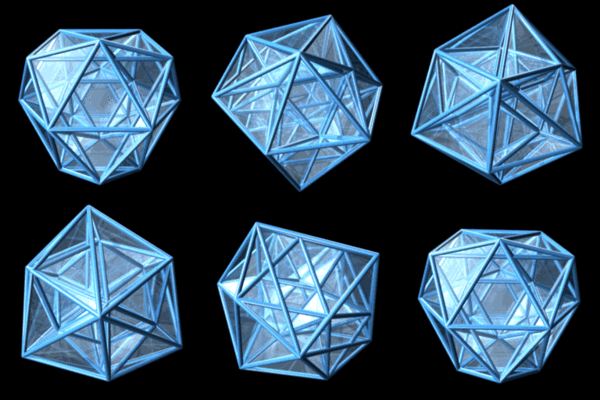
"unfolded" tesseract, a fourth dimensional analog of a cube. (Schlegel's model of a tesseract is shown below.) Just as it's
possible to unfold a three-dimensional cube into six
squares, it's also feasible to morph a tesseract (using the n-1 dimensional analogy; fourth to
third) into eight cubes.

Dali, as well as Captain
Marvel comics, inspired a young student named Thomas Banchoff - now a
professor of mathematics at Brown University - to devote his life to the study
of the fourth dimension. Using Corpus
Hypercubus as a model, Banchoff constructed a paper
model of an unfolded tesseract and was photographed with both the model and
Dali's painting by the Washington Post
in 1975. A few weeks later, Dali - who resided in New York at the time -
dropped Banchoff a note requesting to meet with him. Nervously assuming the
request was either a hoax or a follow up on the illegal use of Dali's work in
the Post, Banchoff was surprised to discover
that Dali was interested in meeting with him to pick his brain about representing
higher dimensions. The two met several times, became fast friends, and
corresponded often for the rest of Dali's life.
Dali was known for his respect for and friendships with
mathematicians and scientists, going so far as to say that, "Scientists give me
everything, even the immortality of the soul." We've all had that one weird,
out-there friend, but Dali? I'd say he takes the cake.
(Image credits: Wikipedia | The peacock's tail)
| 

 3
3


 Re: Dali and the Fourth Dimension: "Impossible" Objects, Part II




Good Answers:
"Almost" Good Answers: