|
 It was almost nine feet tall and weighed close to half a
ton. Long fur draped around its face, and ear-piercing howls emitted from its
giant mouth. No, we're not describing Chewie, Harry, or your mother-in-law…it's
Gigantopithecus, a
relatively-recently extinct giant ape. Paleontologists know little about "Gigantos"
and have been hesitant to make concrete statements based on minimal fossil
evidence, but cryptologists - who seem eager to venture where scientists fear
to tread - posit that the possibility of a relict population of these beasts provides
the most scientifically plausible case for the existence of Bigfoot. It was almost nine feet tall and weighed close to half a
ton. Long fur draped around its face, and ear-piercing howls emitted from its
giant mouth. No, we're not describing Chewie, Harry, or your mother-in-law…it's
Gigantopithecus, a
relatively-recently extinct giant ape. Paleontologists know little about "Gigantos"
and have been hesitant to make concrete statements based on minimal fossil
evidence, but cryptologists - who seem eager to venture where scientists fear
to tread - posit that the possibility of a relict population of these beasts provides
the most scientifically plausible case for the existence of Bigfoot.
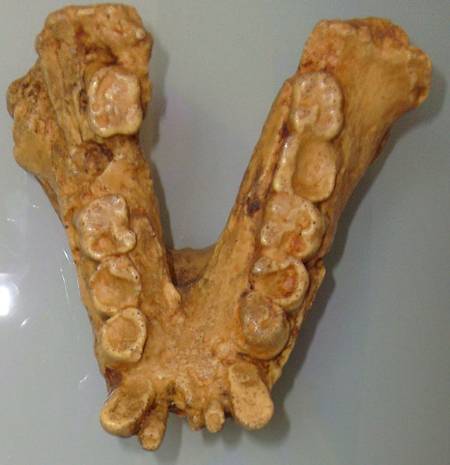 Gigantopithecus was
named in the 1930s by Ralph von Koenigswald, a German anthropologist who
discovered the ape's fossilized teeth being sold as divination bones in a
Chinese medicine shop. Since this time, the only known relevant fossils are
thousands more teeth and a few mandibles recovered from China, Vietnam, and
India. Paleontologists have classified the finds as belonging to three species
of Gigantopithecus: G. blacki, G. bilaspurensis, and G.
giganteus. Because the teeth and mandibles are the only extant fossils of
Gigantos, their constructed appearance is based largely on speculation and
comparison to the bones of the most similar living species of orangutans. In
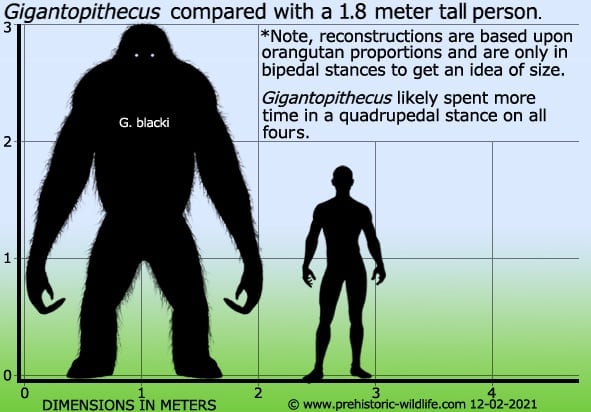
any case, scientists believe that G.
blacki, the largest of the three species, was upwards of 2.5 meters tall
when standing and went extinct about 100,000 years ago. After doing a bit of
math, we find that G. blacki lived
concurrently with Homo sapiens for
approximately 80,000 years, and with Homo
erectus for over one million. Their powerful teeth were probably used to
process the plentiful bamboo in their South Asian habitat. Gigantopithecus was
named in the 1930s by Ralph von Koenigswald, a German anthropologist who
discovered the ape's fossilized teeth being sold as divination bones in a
Chinese medicine shop. Since this time, the only known relevant fossils are
thousands more teeth and a few mandibles recovered from China, Vietnam, and
India. Paleontologists have classified the finds as belonging to three species
of Gigantopithecus: G. blacki, G. bilaspurensis, and G.
giganteus. Because the teeth and mandibles are the only extant fossils of
Gigantos, their constructed appearance is based largely on speculation and
comparison to the bones of the most similar living species of orangutans. In
any case, scientists believe that G.
blacki, the largest of the three species, was upwards of 2.5 meters tall
when standing and went extinct about 100,000 years ago. After doing a bit of
math, we find that G. blacki lived
concurrently with Homo sapiens for
approximately 80,000 years, and with Homo
erectus for over one million. Their powerful teeth were probably used to
process the plentiful bamboo in their South Asian habitat.
According to such groups as the Bigfoot
Field Researchers Organization (BFRO), bigfoots (apparently they purport
that there's more than one in existence) are most likely leftover Gigantopithecus; they have aptly named
this as the "Bigfoot-Giganto theory." Bigfoot researchers, though, have still
had to make major assumptions about Gigantos to construct a plausible "theory."
The widest leap involves the assumption that Gigantopithecus walked upright (as do bigfoots, they say), which is
highly unlikely due to the enormous strain of the beast's weight on its legs
and ankles, as well as the fact that most extant great apes are quadrupeds. Another
assumption with little merit is that, because most Bigfoot sightings have
occurred in North America's Pacific Northwest region, Gigantos would have
needed to cross the Bering land bridge to migrate to what is now North America.
(Coincidentally this migration would've been dependent on bipedal locomotion;
the established extinction date for Gigantopithecus
also falls tens of thousands of years before the feasibility of Beringia migration.)
As to why there have been no fossil discoveries outside of South Asia, the BFRO
responds with something like "because no one has looked yet."
 The question of Gigantopithecus'
extinction dogs both the scientific and pseudoscientific communities. Climate
change, inadequate diets, and competition with other ape species seem to be the
most plausible explanations. Some scientists believe that predation by
crocodiles, bears, sabre-tooth cats and early humans may have done them in.
Bigfoot researchers have spun this theory their own way, claiming that predation
by Homo sapiens could not have
possibly wiped out the entire species; more importantly, they purport that
living Gigantos are left with a morbid fear of humans, which explains why we've
never seen one in person. The question of Gigantopithecus'
extinction dogs both the scientific and pseudoscientific communities. Climate
change, inadequate diets, and competition with other ape species seem to be the
most plausible explanations. Some scientists believe that predation by
crocodiles, bears, sabre-tooth cats and early humans may have done them in.
Bigfoot researchers have spun this theory their own way, claiming that predation
by Homo sapiens could not have
possibly wiped out the entire species; more importantly, they purport that
living Gigantos are left with a morbid fear of humans, which explains why we've
never seen one in person.
The case of Gigantopithecus
remains interesting because both groups - scientists and Bigfoot researchers -
are continuously attempting to make sense of a creature about which we know
very little for certain. With little fossil evidence to draw upon, we may even
have another Mantell/Owen
Iguanodon on our hands. Despite
some relatively irrefutable facts which fly in the face of their theories, cryptid
hunters will continue to speculate, hypothesize, theorize, and proselytize. We
know one thing for sure: if [a] bigfoot shows up, don't mess with him.
(Image credits: podgallery.org | MacroEvolution | Prehistoric Wildlife)
| 


 Re: Bigfoot Research Brushes With Science


"Almost" Good Answers: