|
The nature of genetic engineering makes it an explosive topic for discussion. Last June, when I posted a blog that quasi-supported GMO foods, a dozen viewpoints were expressed by CR4 readers. It's clearly an issue that evokes political, religious and ethical responses. What's more is that GMO crops are hardly the zenith of genetic modification, and just as with GMO foods, the contrast in opinions isn't black-and-white.
Perhaps the person who can best help me elaborate is Ethan Hawke (swoon!). Or more accurately, Ethan Hawke's character from the sci-fi flick Gattaca. The film is set in the not-too-distant-future, and Hawke's character, named Vincent, has dreamed of being an astronaut since he was a child. However, he lives in an age where job opportunities and social class are determined by the DNA of the person, and any genetic imperfection or health concern is a cause for disqualification and ostracism. Vincent's parents opted for a natural conception, rather than one where doctors probe, take gamete samples and impregnate the female with the zygote that has the best genetic profile. As a result, Vincent is born with a heart defect, shortsightedness, and a high probability of developing mental disorders; his life expectancy is 30 years. Vincent's brother Anton was conceived using genetic discrimination, and throughout their childhoods Anton regularly excels past Vincent in athletics and academics despite being a few years younger. Vincent creates an elaborate ruse in whichhe purchases the identity of a former competitive swimmer, gains employment in the space industry, and then must hide his genetics as his rocket launch date approaches. The rest you'll have to watch yourself.
Gattaca was released in 1997 and its depiction of a near-future is beyond the realities of 2013, but each year we come closer and closer to "liberal eugenics," or the right of individuals to elect to participate in genetic screening; this is opposed to "authoritarian eugenics," where people are coerced or forced to participate in eugenic policies. Currently, pre-implantation genetic diagnosis (PGD) is a common method for couples to screen embryos for hereditary diseases before in vitro fertilization, and many aspects of this practice, and liberal eugenics in general, are protected by the U.N.'s Universal Declaration of Human Rights. However, many countries closely restrict the implementation of PGD despite having an atrocious history with eugenics.
It may be that based on the world's most recent experiences with authoritarian eugenics, the argument against the topic is self-made. Many of the atrocities committed by Adolf Hitler and the Third Reich were in the name of racial hygiene. His policies forcibly sterilized or killed over 675,000 German people solely to remove their DNA from their gene pool. Eventually 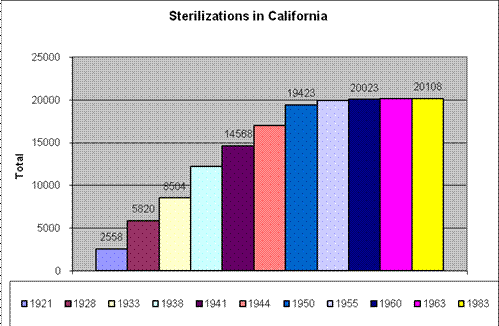 these policies were overturned after an outpouring of public dissent, so the Nazis initiated the Holocaust instead. I should note that the Nazi eugenic program was influenced by that of California's. In the early half of the 20th century, both the U.S. and Canada had eugenics programs which sterilized those with criminal records, mental illness or hereditary diseases. Since the close of both programs, government apologies and settlements continue to this day. South Africa, Russia and Uzbekistan continue to enact forced sterilization policies. Heck, Project Prevention pays crack addicts to get sterilized. these policies were overturned after an outpouring of public dissent, so the Nazis initiated the Holocaust instead. I should note that the Nazi eugenic program was influenced by that of California's. In the early half of the 20th century, both the U.S. and Canada had eugenics programs which sterilized those with criminal records, mental illness or hereditary diseases. Since the close of both programs, government apologies and settlements continue to this day. South Africa, Russia and Uzbekistan continue to enact forced sterilization policies. Heck, Project Prevention pays crack addicts to get sterilized.
Based on the social needs of our modern world and the renewed need for understanding and tolerance across the globe, there isn't even a need for a discussion about eugenics today. However, it's easy to picture a future where eugenics returns, this time as an individual liberty. In fact, advancements in reproductive health have already provided the basis for a more broad eugenics movement.
Such a future is actually the prediction of eugenicist Frank Osborn. In the post-war era, Osborn was considered the last respectable face of eugenics, but as early as 1930 Osborn argued that one day a capitalist economy and the nuclear family would develop to the point where liberal eugenics would be sold as a commodity. There wouldn't be any backlash or criticism; no one is forced to participate and no one is killed or sterilized. This 'positive eugenics' movement would foster the heredity of positive traits, rather than discourage the spread of negative traits. In theory, more successful people would be able to afford access to better healthcare and parenting resources, making them likely to have more children than less successful families.
Such a future seems inevitable in light of these economic and social expectations, but the legal structure needs to be in place to support the positive eugenics movement. I don't think I'll see a rally for liberal eugenics in my lifetime, but my grandkids might, so why not start the dialogue now?
Resources
Wikipedia - Frederick Osborn; Compulsory Sterilization;
Eugenics
| 

 2
2


 Re: The Eugenic Future



Good Answers:
"Almost" Good Answers: