|
Like many warm blooded American males, there are a few things that draw my attention like no others. Sports. Women. Delicious, greasy food. And of course, anything that goes fast. It is with some regret that I'll never drive a drag racer. I'll never be able to steer a hydroplane. I don't think anyone is going to insure me for anything that goes more than 200 miles per hour, actually. I think it's somewhat-late to get my aviation career started.
So it is kind of amazing then that just ten years ago, with some extra cash and the patience to wade through airport security, I could have zoomed through the skies at more than 1,300 miles per hour.
Of course, I'm talking about the Concorde, a marvel of 20th century aviation engineering if there ever was one. From the date of the Orville and Wilbur's first powered flights in 1903 North Carolina-at a top speed of 6 miles an hour-to the dawn of supersonic passenger transportation, it was just 66 years. Even so, there is a consensus that the Concorde was, and remains, an engineering spectacle.
The development of the Concorde was spearheaded by a partnership between the British Aeroplane Company and the French Sud Corporation. Originally both companies (with substantial government subsidies) intended to build their own supersonic transport (SST), but with different applications in mind. BAC wanted to create a transatlantic plane, possibly capable of a cruising speed of Mach 3, to reinvigorate a stagnant British jet industry. Sud envisioned a small, regional jet which could transport passengers anywhere in Europe within the hour and would replace an aging fleet. Both companies agreed that developing such a plane would cost an enormous sum. In 1962, government and business leaders from both sides agreed that merging the projects would aid in cost reduction and speed development. The only thing the French and British couldn't agree upon was the spelling of the plane's name (the French preferred 'Concord'). The word, in both languages, means 'harmony'.
Notable innovations had to be implemented to make the Concorde a reality. The air which entered the turbofan engines had to be slowed to be effective, but if slowed too much, shockwaves would rip apart the engine blades. The entire structure of the aircraft would be warm to the touch from air friction and the Concorde had to be made of hiduminium to account for the 261° F external structure temperature. The aircraft fuselage would grow by 12 inches during supersonic flight. The fuel tank was also revolutionary. Not only did it utilize the fuel as a heat sink to keep the cabin and hydraulics cool, the tank would have to shift the distribution of the fuel within to keep the aircraft stable at high speeds. The Concorde was also equipped with radiometers. Because the Concorde flew at a height at least 10,000 feet higher than conventional aircraft, there was a chance passengers and crew would be exposed to extra-strong UV radiation. The cabin of the Concorde was pressurized in a similar way to other jets, but if the cabin lost pressure the typical oxygen mask wouldn't work at altitudes above 50,000 feet. The Concorde was instructed to carry a reserve of pressurized air if the cabin's atmosphere was breached.
The Concorde's signature feature, the droop nose, was a necessary innovation. The delta wing design of the aircraft required a high angle of attack, and a conventional plane nose would distort the view of the pilots. For runway taxiing and takeoff, the nose would be lowered by 5°. Prior to landing it would be lowered by 12.5° so the pilots could position the aircraft over the runway, before reverting back to 5° before landing to prevent damage to the nose.
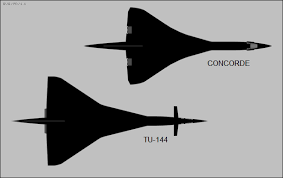 By 1969, two prototypes had been produced and flown around the world for media introductions. However, interest in the aircraft from the date of its announcement until it reached production dwindled. First, a Soviet knock-off SST known as the Tupolev Tu-144, which was produced from stolen plans of the Concorde through industrial espionage, crashed at the Paris Air Show in 1973, possibly because the blueprints stolen were incomplete and the Soviets were attempting to beat the Concorde into service. Other conspiracy theories surround the crash. Second, many environmentalists were concerned about the pollution from the Concorde. The sonic boom and thrust from take-off was particularly deafening, and the Concorde was also notorious for its emissions (two tons of fuel was consumed just during runway taxiing). These concerns were enough to defeat the Boeing 2707 in its development stages. Eventually, only 40 Concordes were produced and sold to British and French Companies. Though they were leased by some American companies, they did not prove profitable in the U.S. and state legislation frequently restricted how the aircraft could operate (Florida would not allow sonic booms from passenger jets in its airspace). By 1969, two prototypes had been produced and flown around the world for media introductions. However, interest in the aircraft from the date of its announcement until it reached production dwindled. First, a Soviet knock-off SST known as the Tupolev Tu-144, which was produced from stolen plans of the Concorde through industrial espionage, crashed at the Paris Air Show in 1973, possibly because the blueprints stolen were incomplete and the Soviets were attempting to beat the Concorde into service. Other conspiracy theories surround the crash. Second, many environmentalists were concerned about the pollution from the Concorde. The sonic boom and thrust from take-off was particularly deafening, and the Concorde was also notorious for its emissions (two tons of fuel was consumed just during runway taxiing). These concerns were enough to defeat the Boeing 2707 in its development stages. Eventually, only 40 Concordes were produced and sold to British and French Companies. Though they were leased by some American companies, they did not prove profitable in the U.S. and state legislation frequently restricted how the aircraft could operate (Florida would not allow sonic booms from passenger jets in its airspace).
A few things spelled out the end for the Concorde. Rising energy and maintenance costs, the manufacturer announcing they no longer intended to service the Concorde, no more government subsidies, a fatal Concorde crash in 2000, and an overall decline in aircraft travel following September 11 are prime reasons. Though Richard Branson offered to buy at least a dozen of the planes at $5 million apiece, British Airways refused to sell its Concorde stable.
Is there a future for SST? Probably not. Currently, only one passenger plane is being developed for supersonic travel, the Quiet SST. Lockheed Martin hopes for its first flight in 2018, but many obstacles remain. Other SSTs are 25 years or more away from their first flights. Rather, hypersonic transport aircraft seems to be the new spiritual incarnation of the Concorde. The A2 will be capable of more than 3,800 miles per hour and a route from London to Tokyo will take just 4 hours. Advancements in fuel efficiency and material design will provide the plane greater flexibility than the Concorde. Unfortunately, the A2 also won't be ready until there is a demand for it. And by that time, my need for speed will be proved by a Hoveround.
Resources
PopSci - What It Was Like To Fly In The Concorde
Wikipedia - Concorde; Reaction Engines A2
| 


 Re: Will There be a Successor to the Concorde?




"Almost" Good Answers: