|
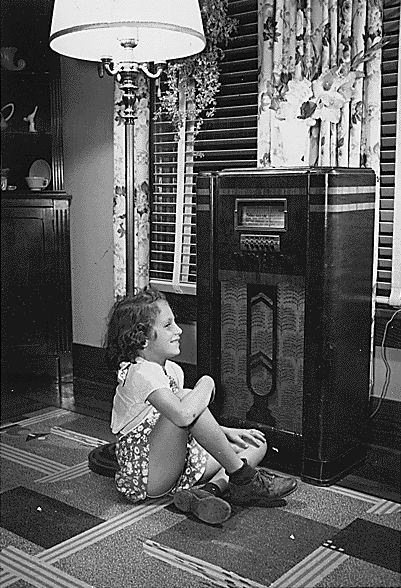 Picture this: you're an 8 year old on a Friday night in 1933,
cross-legged on the floor next to your hulking, overheating Zenith console,
impatiently waiting for Buck Rogers
to come on the air. Fast forward to 1947, when as a young man the highlight of
your week is tuning in to "watch" Jack Benny on your dial. A decade later,
you're at your homebrew HF set in the basement of your suburban American home,
anxiously trying to make contact with Philippine hams and dreaming about
receiving that QSL card in the mail. Picture this: you're an 8 year old on a Friday night in 1933,
cross-legged on the floor next to your hulking, overheating Zenith console,
impatiently waiting for Buck Rogers
to come on the air. Fast forward to 1947, when as a young man the highlight of
your week is tuning in to "watch" Jack Benny on your dial. A decade later,
you're at your homebrew HF set in the basement of your suburban American home,
anxiously trying to make contact with Philippine hams and dreaming about
receiving that QSL card in the mail.
These very-20th-century moments depict the glory
days of radio broadcasting, which has steadily declined since the advent of
television, computers, and the World Wide Web. What's worse, analog enthusiasts
are experiencing unbearable interference from these modern devices, making many
AM or shortwave stations unlistenable. In the late-20th and early-21st
centuries, however, digital broadcasting seems to have infused some life into
this dying medium. In particular, Digital Radio Mondiale (DRM), a developing
set of digital broadcasting technologies, has shown major promise and has been
speedily adopted as a new standard since its inception.
Digital Radio Mondiale (mondiale
is French/Italian for "worldwide") is also the name of the consortium which
designed and is implementing the platform. Members include major international
radio organizations such as Radio France Internationale, BBC World Service,
Deutsche Welle, Voice of America, and Transradio (formerly Telefunken). The
group's aim is to use digital audio broadcasting to efficiently improve AM
transmissions without requiring a massive changeover of equipment and increased
expenditures.
DRM's efforts appear to have been successful. The consortium
realized that computer processing power is much cheaper and more freely
available than bandwidth, so that the DRM system relies on using processing
power to compress signals in order to make more efficient use of bandwidth. DRM
standards give broadcasters the limited choice of three MPEG-4 codecs to encode
source material for a maximum bit rate of almost 35 kbit/s on a 10 kHz channel.
(For comparison, American HD Radio is capable of 20 kbit/s on the same channel
width.) This results in a long-distance signal with audio quality comparable to
local FM stations.
It's worth noting here that while AM broadcasting may seem
hopelessly outmoded in many Western nations, it still occupies a significant
hold on local and international media in less-developed countries. AM remains a
go-to choice for reaching widely-dispersed populations due to the increased
reach of longwave, medium wave, and shortwave transmissions. International
broadcasting uses these same frequencies to export tourist information,
propaganda, and patriotic rigmarole to foreign lands. Compared to modern
telecommunications, shortwave requires minimal infrastructure: a couple
transceivers, an antenna, a power source, and favorable atmospheric conditions
are all you need to reach someone on the other side of the world. Some sources
(albeit shortwave broadcasting stations) estimate that the number of active
shortwave receivers tops 1.5 billion worldwide.
DRM's techniques are nothing new: Digital Audio Broadcasting
(DAB) technology has been using compressed broadcasting in local European broadcasting
for years, albeit with lower audio quality and little interoperability. Boons
of DRM include the fact that the standard has been designed to make use of
older equipment in existing stations; for example, no specialized antenna is
needed to transmit the compressed signal. In addition to audio, DRM can
simulcast multiple signals, including audio metadata, analog signals, and other
data. Simulcasting digital and audio signals, which is impossible on most other
digital broadcasting methods, is especially useful to conserve bandwidth
because digital as well as analog receivers are able to pick up the same
program on the same bandwidth without wasted space.
 While DRM is
pretty good about touting the benefits of their new technology, there have
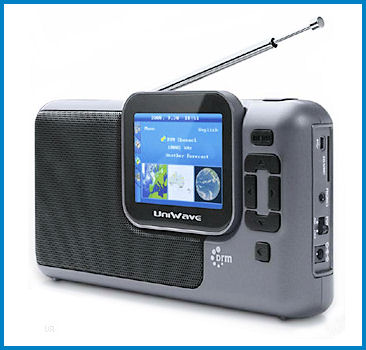
been drawbacks. Early DRM-compatible receivers (like the one at left) all required computers to
operate, and while many European companies are now manufacturing dedicated DRM
receivers, they remain relatively expensive (200 € and up). Very recently,
there have been a string of commercially manufactured radios which provide
DRM-compatible output ports. Considering the availability of open-source DRM
software, this looks to be a much cheaper option. While DRM is
pretty good about touting the benefits of their new technology, there have
been drawbacks. Early DRM-compatible receivers (like the one at left) all required computers to
operate, and while many European companies are now manufacturing dedicated DRM
receivers, they remain relatively expensive (200 € and up). Very recently,
there have been a string of commercially manufactured radios which provide
DRM-compatible output ports. Considering the availability of open-source DRM
software, this looks to be a much cheaper option.
The original DRM standard has been enthusiastically adopted
by several international and regional standards bodies, including the IEC and
ITU, and the U.S. Federal Communications Commission adopted it as a digitally
modulated emissions standard in late 2013. DRM's development continues to march
on, and the group is busy testing DRM+, which applies similar principles to
local FM broadcasting. Community Media Forum Europe recently advised the EC to
adopt DRM+ as a replacement for Digital Audio Broadcasting (DAB) standards for
local broadcasting in Europe.
This writer hopes that DRM-compatible equipment continues to
drop in price as a prerequisite for more widespread adoption. While the
Internet continues to shrink the scale of global communications, I still think
it might be cool to switch on the radio and hear FM-quality underground Chinese
broadcasts or soft rock from India.
Image credits: Neatorama | National Association of Broadcasters
| 


 Re: AM Broadcasting: A Rebirth?


