|
 NASA is ready to take the next step in space exploration.
Yesterday--Earth Day--they
announced plans to send a human to an asteroid by 2025, followed shortly by
Mars in 2030. Nevermind that they don't have a manned space vehicle at the
moment. And nevermind they relinquished their partnership with Roscosmos after
Russia's recent international transgressions. And let's ignore the fact that
the $2 billion in underwriting needed just to redirect the aforementioned
asteroid will
probably never be approved. NASA is ready to take the next step in space exploration.
Yesterday--Earth Day--they
announced plans to send a human to an asteroid by 2025, followed shortly by
Mars in 2030. Nevermind that they don't have a manned space vehicle at the
moment. And nevermind they relinquished their partnership with Roscosmos after
Russia's recent international transgressions. And let's ignore the fact that
the $2 billion in underwriting needed just to redirect the aforementioned
asteroid will
probably never be approved.
It seems NASA is ready to send people to Mars strapped to
bottle rockets if need be.
I applaud NASA's ambition because they'll never get close to
any of their cosmological goals if they don't publicize their efforts. NASA
does this by leveraging the imagination of the individual taxpayer, hoping that
by appealing to everyone's inner astronaut, they can gain enough political
traction to financially renew the space race.
The space race and NASA inspired over a
thousand planetariums to be built in U.S. high schools in the 20th
century. And in fact it was NASA and
Apollo 8 which first inspired Earth Day. Astronauts would comment on how
fragile and small Earth looks from space, and photos of our planet enveloped by
nothingness truly illustrated how isolated humanity is.
 Eventually, we'll get to Mars, so one has to assume the
next-next step, the one after humans
land on Mars, would be an established space colony, right? Why else would NASA
hold an annual space colony
design competition? And in the past, they've publicly
released some their most imaginative designs. Since there hasn't been a
manned mission to the moon since 1972, (because we're so over the moon) this colony would
also probably end up on Mars. Eventually, we'll get to Mars, so one has to assume the
next-next step, the one after humans
land on Mars, would be an established space colony, right? Why else would NASA
hold an annual space colony
design competition? And in the past, they've publicly
released some their most imaginative designs. Since there hasn't been a
manned mission to the moon since 1972, (because we're so over the moon) this colony would
also probably end up on Mars.
This concept is what has inspired four Mars Analog Research
Stations (MARS) around the globe. In these stations, scientists and engineers
simulate the experience of living on Mars to test tools and procedures which
will eventually become useful to astronauts who are conducting Martian
operations. The MARS are located in the Canadian
Artic and the Utah desert, with two others in planning stages, where certain
environmental parameters (wind, dust, temperatures, etc.) match what could be
expected of a real Mars-based colony.
 The Mars Society
defines the MARS goals as identifying which tools and machines are best suited
for permanent deployment on Mars, and how this deployment and the living
quarters affects human psychology. While
MARS may provide all the cramped sleeping and work quarters a handful of
scientists need, it's not the self-sustaining closed ecological system that
would be needed to set up a permanent residence for true Martians. The Mars Society
defines the MARS goals as identifying which tools and machines are best suited
for permanent deployment on Mars, and how this deployment and the living
quarters affects human psychology. While
MARS may provide all the cramped sleeping and work quarters a handful of
scientists need, it's not the self-sustaining closed ecological system that
would be needed to set up a permanent residence for true Martians.
Instead, NASA would need to return to the now-dormant idea
of a biosphere, where a mix of ecological zones balances the resource
consumption and waste of human inhabitants.
Pauly Shore made light of such an experiment with 1996's
awful satire Bio-Dome. His stoner
character mistakes a biosphere for a mall and accidentally gets locked in for
the experiment's duration of 1 year, or
385 days. Of course, he wrecks the experiment with nonsense and
misbehavior, which isn't that far off from the real Bio-Dome.
Biosphere
2 is a structure in Arizona which was home to two attempts of scientists
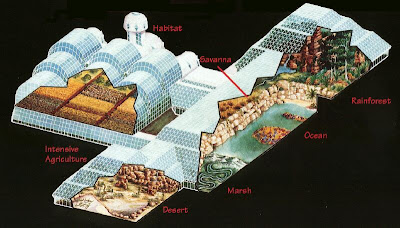
living in a sealed structure to maintain homeostasis. BS2 contained a
rainforest, an ocean with a reef and tides, mangrove wetlands, grassland, a
desert, farming tracts, and a human habitat. The first mission enclosed eight
scientists for two years, but was ultimately a failure. Oxygen levels
eventually dropped to the point where crew suffered from fatigue and sleep
apnea. Conversely, exposed concrete had begun to absorb carbon dioxide, and
plant life also suffered. Eventually gas injections had to be made. Ants from
the Arizona wilderness had also found their way inside BS2, meaning it was
never really a closed system. The scientists completed their duration, however.
 If the first mission was a failure, then the second was
equivalent to a tire fire. It was intended to last ten months, but only lasted
six. Not only did BS2's management run into financial problems and infighting,
but scientists from the first mission smashed through airlocks and emergency
exits, exchanging more than 10% of the biosphere's atmosphere and ruining
further studies. Since this attempt, no other human-sized closed ecologies have
been attempted. If the first mission was a failure, then the second was
equivalent to a tire fire. It was intended to last ten months, but only lasted
six. Not only did BS2's management run into financial problems and infighting,
but scientists from the first mission smashed through airlocks and emergency
exits, exchanging more than 10% of the biosphere's atmosphere and ruining
further studies. Since this attempt, no other human-sized closed ecologies have
been attempted.
While NASA is just now announcing their intent to travel to
Mars, we know they've been planning for it pretty much since, "One small step
for man…"
In order to be ready for the giant leap headed their way,
NASA must be considering biosphere designs in the present, even if they aren't
ready to recognize it. It's like the proposed mission to an asteroid: they're
planning for it even if it never happens.
| 


 Re: NASA's Need for Closed Ecology


"Almost" Good Answers: