|
 "Air rights"
isn't a term that's likely well-known beyond those who use it: primarily
property owners, real estate brokers and civil engineers in congested cities.
It specifically refers to the empty airspace above a building and how the
building owner can administer his or her authority over it. In the example at
right, located in Manhattan, the building owner has sold some or all of his air
rights to the apartment complex next door. "Air rights"
isn't a term that's likely well-known beyond those who use it: primarily
property owners, real estate brokers and civil engineers in congested cities.
It specifically refers to the empty airspace above a building and how the
building owner can administer his or her authority over it. In the example at
right, located in Manhattan, the building owner has sold some or all of his air
rights to the apartment complex next door.
The
overcrowded nature of New York City has evoked some of the more creative applications
for air rights. And in a recent incarnation, a 99 year lease of the air rights
over the MTA's West Side Yard-where Long Island Railroad trains sit between
rush hours-has spurred the construction of the largest private development
project in U.S.
history.
 The West
Side Yard was converted from a freight terminal to a rail yard in 1987, and
during construction space was intentionally left between tracks to accommodate
columns for potential overbuilds of the yard air rights were negotiated. At one
point or another, Madison Square Garden, Yankee Stadium and a new stadium for
the New York Jets (blech!) were all considered for the spot. After a stadium never materialized,
the space was rezoned and many developers expressed interest in the air rights,
which were ultimately awarded to the joint venture Hudson Yards. The West
Side Yard was converted from a freight terminal to a rail yard in 1987, and
during construction space was intentionally left between tracks to accommodate
columns for potential overbuilds of the yard air rights were negotiated. At one
point or another, Madison Square Garden, Yankee Stadium and a new stadium for
the New York Jets (blech!) were all considered for the spot. After a stadium never materialized,
the space was rezoned and many developers expressed interest in the air rights,
which were ultimately awarded to the joint venture Hudson Yards.
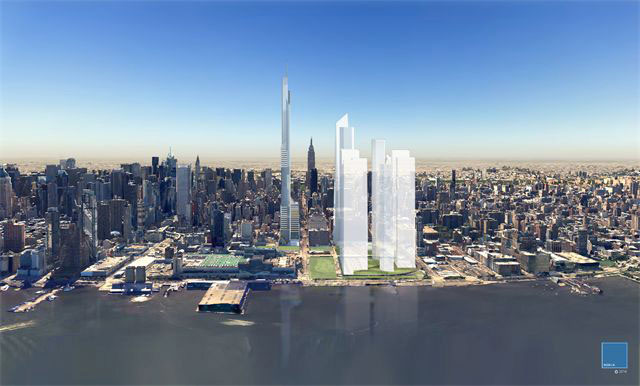 By the end
of this year, Hudson Yards will erect an enormous, $680 million platform
over the rail yard that consists of 16 different bridges and will serve as an
artificial foundation. Three hundred concrete-sleeved caissons will be inserted
40-80 feet into the bedrock between West Side Yard tracks, and construction
will halt during transit times so trains can continue unobstructed. On top of
this platform will sit six skyscrapers ranging between 780 and 1,255 feet-high,
consisting of offices, hotels, retail and
affordable residential units (though the definition of
"affordable" is absurdly different in New York City). This entire structure
will only utilize 38% of the rail yard surface area for support. By the end
of this year, Hudson Yards will erect an enormous, $680 million platform
over the rail yard that consists of 16 different bridges and will serve as an
artificial foundation. Three hundred concrete-sleeved caissons will be inserted
40-80 feet into the bedrock between West Side Yard tracks, and construction
will halt during transit times so trains can continue unobstructed. On top of
this platform will sit six skyscrapers ranging between 780 and 1,255 feet-high,
consisting of offices, hotels, retail and
affordable residential units (though the definition of
"affordable" is absurdly different in New York City). This entire structure
will only utilize 38% of the rail yard surface area for support.
Hudson Yards
also will be one of the most sustainable developments in history once completed.
Buildings will be monitored via heat mapping to track crowd sizes and energy
usage. Mobile apps will  connect users to building data systems. New York University has installed sensors and a monitoring network to
carefully manage all building resources and pollutants. At the same time,
engineers have installed energy redundancy so if a Superstorm Sandy Part 11
happens, Hudson Yards can still be turned on. Then there is the pneumatic garbage chute. Waste from each building is removed
by vertical trash chutes that feed into a pneumatically-powered network that
will accumulate trash at an off-site dispensary. Lastly, Hudson Yards is also incorporating
green space into its design by becoming the terminus of one end of the High Line, the famous defunct subway line that has been transformed
into a modern park and trail. connect users to building data systems. New York University has installed sensors and a monitoring network to
carefully manage all building resources and pollutants. At the same time,
engineers have installed energy redundancy so if a Superstorm Sandy Part 11
happens, Hudson Yards can still be turned on. Then there is the pneumatic garbage chute. Waste from each building is removed
by vertical trash chutes that feed into a pneumatically-powered network that
will accumulate trash at an off-site dispensary. Lastly, Hudson Yards is also incorporating
green space into its design by becoming the terminus of one end of the High Line, the famous defunct subway line that has been transformed
into a modern park and trail.
There you have it. Hudson Yards is transforming
the New York skyline, innovating the overbuild construction game, and becoming
a world-leader in sustainability despite building over a grimy rail yard. Let's
hope MTA decides to renew the lease in 2108.
| 


