|
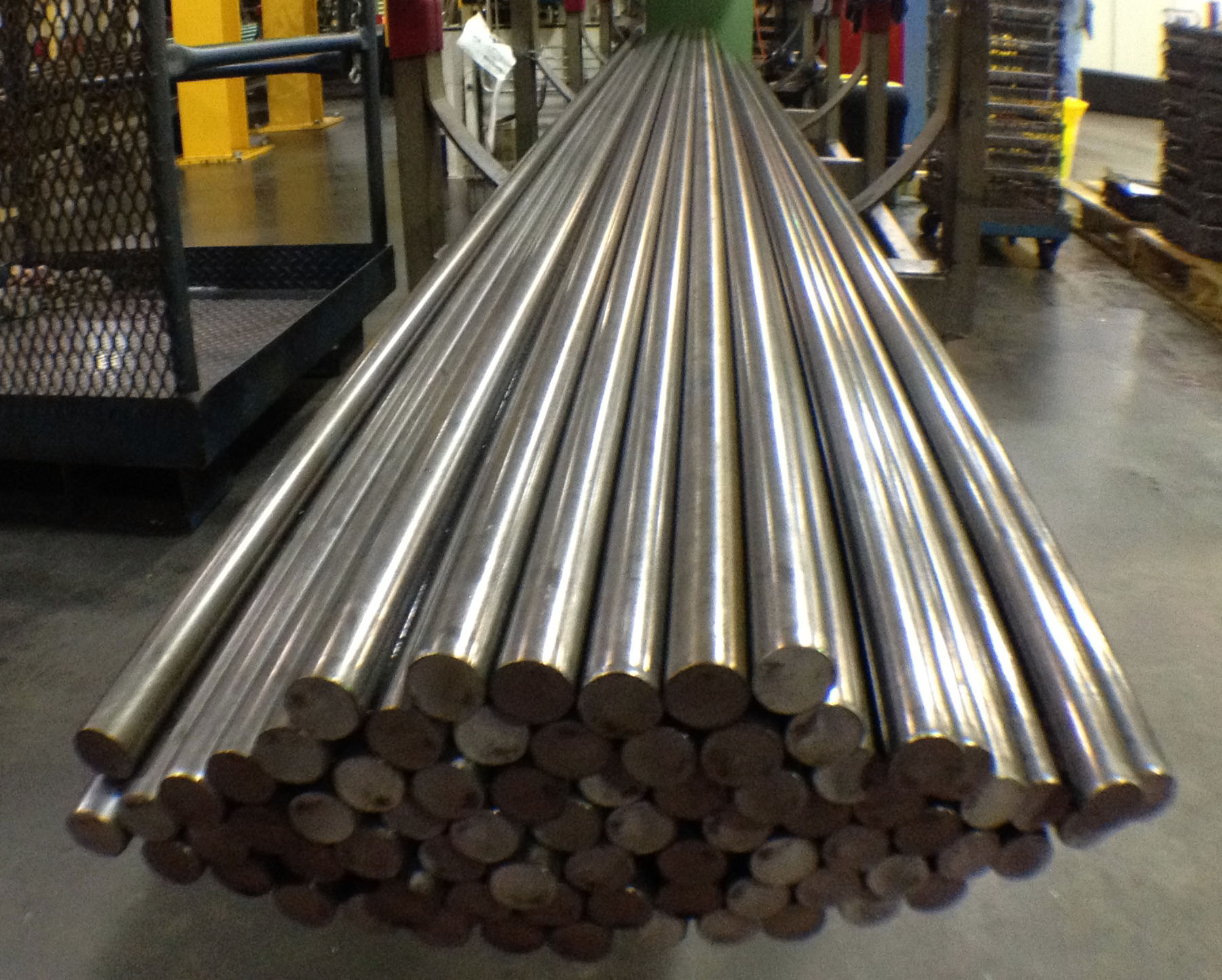
Leaded steel bars historically have been a mainstay
raw material in the screw machining industry. As more applications and
newer technology move away to non leaded steel applications, we thought
that a brief refresher about Lead and its role in our shops might be
timely.
 The 0.15- 0.35 weight percent of lead contained in these bars helps them machine 25% faster with less power required. The 0.15- 0.35 weight percent of lead contained in these bars helps them machine 25% faster with less power required.
- Leaded steel bars are standard steels and widely available.
In the U.S. 12L14 is the predominant grade. 11SMnPb30, 11SMnPb28,
9SMnpb28, and 9SMnPb36are German designations nominally equivalent to
12L14.The Chinese version of 12L14 is Y15Pb; Japanese nominal
equivalents include SUM22L, SUM23L, andSUM24L.
- Leaded steels are selected for use for the savings achieved in producing parts by machining.
- Leaded steels are not appropriate for all parts- and parts with low amounts of stock removal may not create any noticeable savings.
- Today's Leaded steels are more consistent, more uniform, than they were when produced by the ingot process.
- The decision to use Leaded Steels for a specific part must be based on the economics for that part-
volume, stock removal, part complexity, tolerances required, surface
finish needed are all factors that contribute to that economic
calculation.
- There is no sacrifice in mechanical properties when adding lead to steel. neither longitudinal nor transvers mechanical properties are affected by the addition of lead to steel.
- Leaded steels are currently permitted under European Union Regulations covering End of Life Vehicles, RoHS.
- The reduction in energy required and time needed (about 25%!) to machine a part make leaded steels environmentally friendly by reducing Carbon Dioxide emissions to create parts compared to using unleaded materials.
- In order to be dangerous to humans, lead must be in a soluble form.
The lead in steel bars is a separate solid phase. IARC lists lead under
its Group 2B category - "possibly carcinogenic to humans".
- Lead, as well as Chromium, Copper, Manganese, Nickel, and Phosphorous is required to be reported under Sara 313 (40 CFR 372.65) when above thresholds.
Editor's Note: CR4 would like to thank Milo for sharing this blog entry, which you can also read here.
| 




 Re: Top 10 Facts About Leaded Steel Bars


