|
Technological advancements have allowed temperature sensor integrated
circuits (ICs) to be used for precision applications such as human body
temperature measurement found in wearable health bands and medical
devices. TI's temperature sensing team has received many questions
regarding these types of applications with the recent release of the
accurate, small-form-factor LMT70
analog temperature sensor for human body temperature measurement. As I
have answered some of these questions in the past with other sensors, I
thought I would cover a few in this post.
Q: When monitoring a sensor with an analog-to-digital
converter (ADC), how can you achieve better quantization error with a
12-bit ADC, such as the one found in MSP430™ ultra-low-power microcontrollers (MCUs)?
A: Using rolling averages in the software can improve the
resolution of the ADC - you can actually change the number of averages
and see that the noise level as well as the resolution increase or
decrease. Rolling averaging works if the noise amplitude of the signal
applied to the ADC input is greater than the ADC's least significant bit
(LSB). For example, using a rolling average of 16 samples extends
12-bit ADC resolution to 14 bits using Equation 1:

The LMT70 evaluation module
uses the MSP430 MCU's 12-bit ADC. The typical performance of this
evaluation module has shown to be ±0.07°C due to this technique.
Q: How does the transfer function affect the overall accuracy of the analog temperature sensor?
A: There are accuracy curves in many datasheets that show how different equations affect accuracy. Regarding the LMT70,
with second- or third-order curves, the accuracy is about the same as
the lookup table (LUT) for the limited temperature range of human body
temperature measurement, so the device will meet the same
specifications. Of course, as the curves show in Figures 1 and 2, the
third-order equation given in the data sheet for 10°C to 110°C is best
to use. Even a second-order curve that is best fit for 20°C to 45°C may
give acceptable results.
How do you generate this equation? Use Excel or MATLAB curve fitting.
And how do you generate the accuracy curves? Simply plug in the minimum
and maximum voltage limits found in the data sheet's electrical
characteristic (EC) table into your equation.

Figure 1: Using a third-order transfer-function best fit, 10oC to +110oC

Figure 2: Using a second-order transfer function best fit, 10oC to +110oC
Q: Can a battery that varies from 1.8V to 3V directly power an analog sensor, and what is the impact on accuracy?
A: Analog sensor datasheet specifications include power-supply
sensitivity as well as curves so that you can determine the impact on
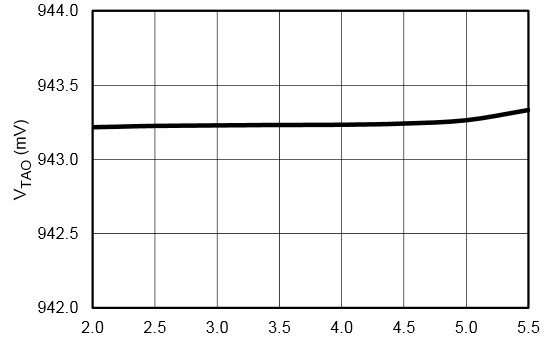
accuracy. Let's look at the LMT70 as an example. Figure 3 (from page 9 of the LMT70 datasheet) shows a typical curve found in analog temperature sensor datasheets.

Figure 3: LMT70 line regulation
As you can see, accuracy down to 2V is very good for a typical LMT70
sensor. Each division in this curve is 0.5mV, so that is 0.1°C. The
power-supply sensitivity limit is +/-9m°C/V. Thus for a range of 2V to
3V, you get a variation of no more than 0.009°C. For a target of
0.1°C-0.2°C, the impact on error is negligible.
All ICs have a voltage level where they start to malfunction or turn off. For the LMT70, this occurs below 2V, as listed on the EC table. If you try a few LMT70
sensors on the bench, you may find that some work below 2V, but TI does
not specify the IC for that voltage. IC manufacturers do extensive
characterization on devices to ensure that datasheet specifications
cover future production variations.
Q: Electrostatic discharge ESD - Do I need to be worried about it?
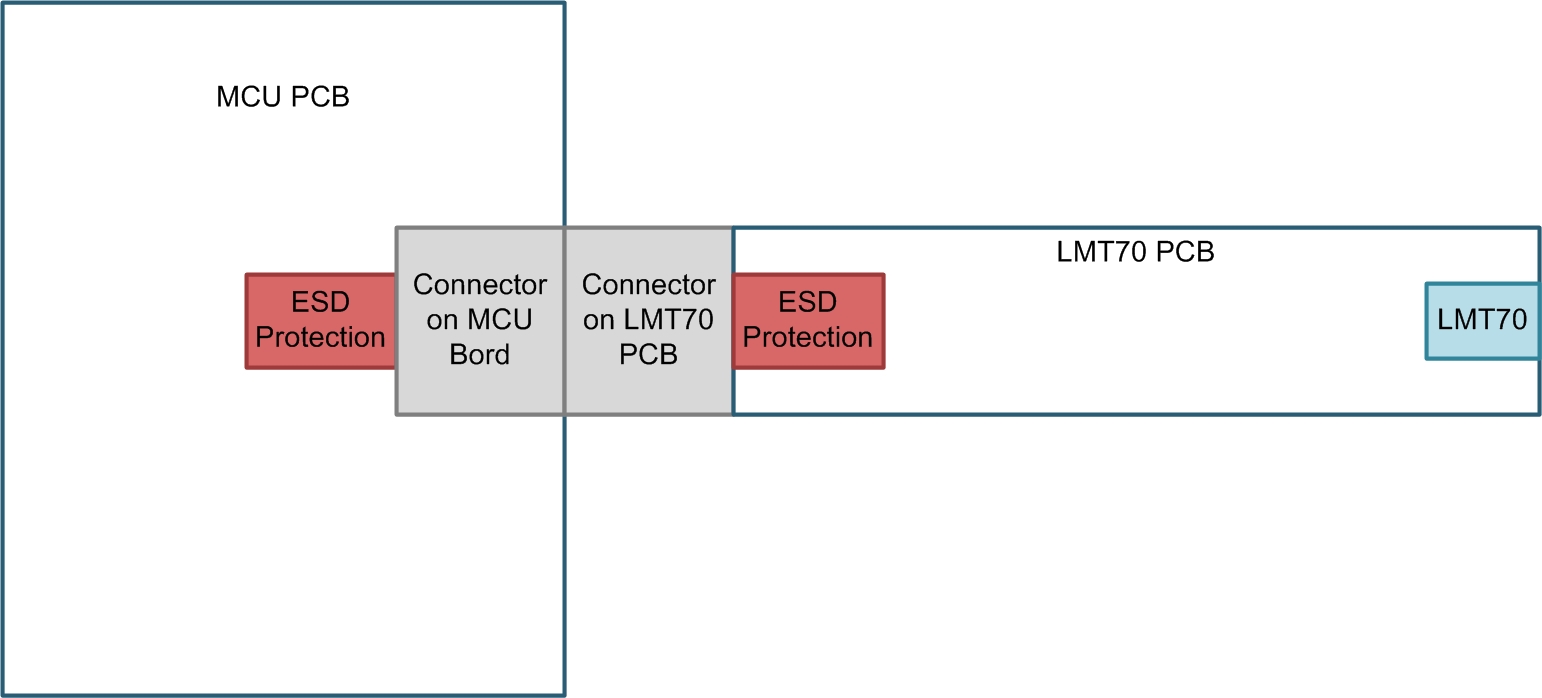
A: If you are worried about the ESD at connectors and those
connectors will be user-accessible, you need to protect both the MCU
board and the IC sensor, as shown in Figure 4 in red. You could also add
notes in the user's guide warning about using ESD safe practices when
handling the boards/assemblies.

Figure 4: Sensor placed off board
If users won't be able to access the connector, the analog
temperature sensor should be handled in an ESD-safe environment. For the
LMT70 specifically, no additional ESD protection is necessary, as this sensor has built-in ESD protection for manufacturing purposes.
Please leave us a note below and let us know what else you would like
to know about IC temperature sensors-perhaps we'll answer them in a
future blog post!
Additional resources
| 






 Re: Tips and Tricks for Human Body Temperature Measurement with Analog Temperature Sensor ICs


